
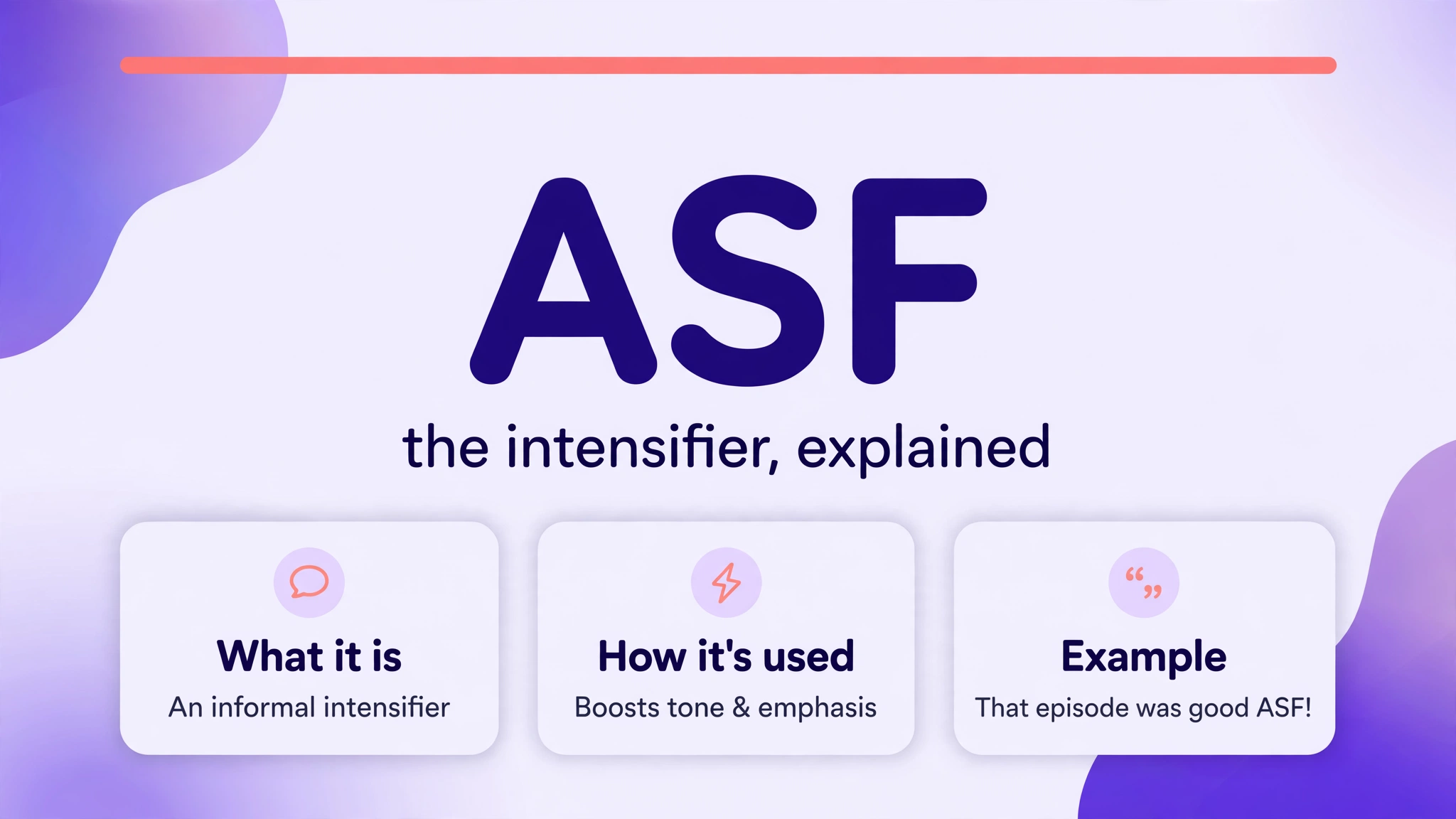
Three letters that work like a volume knob. “I’m tired” is a statement; “I’m tired ASF” is a performance of exhaustion — the same sentence with the intensity cranked all the way up. ASF is one of texting’s most efficient tools: a tiny intensifier that makes any description hit harder. It’s also one of the easiest to misuse, because the force it adds comes from a word most people wouldn’t say out loud in polite company.
ASF is short for “as f***” — a slang intensifier meaning “very,” “extremely,” or “incredibly.” This guide covers why it hits harder than “very,” where it sits in a sentence, why its target changes its social risk, how it differs from AF, and when to leave it in the drafts.
The Short Answer
| What it does | Intensifies the word before it — “very” or “extremely,” with attitude |
| Where it sits | After an adjective or short description (“tired ASF,” never “ASF tired”) |
| Register | Informal; carries implied profanity |
| Same as AF? | Functionally identical — interchangeable in almost every sentence |
| Tone | Casual, emphatic, often exaggerated for humor |
| Formal alternative | “Extremely,” “incredibly,” or a vivid single word (“exhausted,” “hilarious”) |
Why “Very” Doesn’t Hit Like ASF
Here’s the honest mechanics of it: ASF borrows its force from taboo. The unspoken word at the end is doing the heavy lifting — it signals that the speaker isn’t filtering, which reads as raw honesty and extra emphasis at the same time. That’s why no polite intensifier is a perfect substitute. “I’m extremely tired” informs you; “I’m tired ASF” performs the exhaustion. Same fact, different broadcast: one is a measurement, the other is a mood.
There’s a second thing working here: ASF is almost always exaggeration, and everyone knows it. “Hungry ASF” doesn’t describe a medical condition — it means the hunger is currently the most dramatic thing happening. “Broke ASF” doesn’t mean the bank account is literally empty. Readers don’t fact-check the intensity; they read it as emotional truth. That’s the contract: you get to be dramatic, they agree not to take you literally.
This is also why ASF thrives in meme and hype culture. Exaggeration is engagement fuel — the same loop that powers FOMO content, where big feelings travel fast. A caption that says “this episode was good” gets scrolled past; “this episode was good ASF” gets a reaction.
The Grammar of ASF
ASF has strict placement rules for something so casual:
- After the adjective, always. “Cold ASF” sounds natural; “ASF cold” sounds wrong to anyone who uses the term. It modifies what comes immediately before it.
- After emotional states: “I’m nervous ASF” — the feeling gets amplified.
- After evaluations: “that idea is smart ASF” — strong approval.
- After manner descriptions: “she finished fast ASF” — extremely quickly, very informal.
- Never standalone. Nobody opens with “asf?” — it needs a description to attach to. It’s a modifier, not a sentence.
Capitalization doesn’t change the meaning: lowercase “asf” is the fast-typed default, uppercase adds emphasis.
Then there’s the odd one: “me ASF.” You’ll see it under relatable memes and videos — “me ASF” means “this is so me” or “I relate to this completely.” It’s meme grammar, not standard English: “me” stands in for the whole idea of identification. Variants like “mood ASF” work the same way. If you see it and the sentence seems broken, that’s why — it’s comment-section dialect.
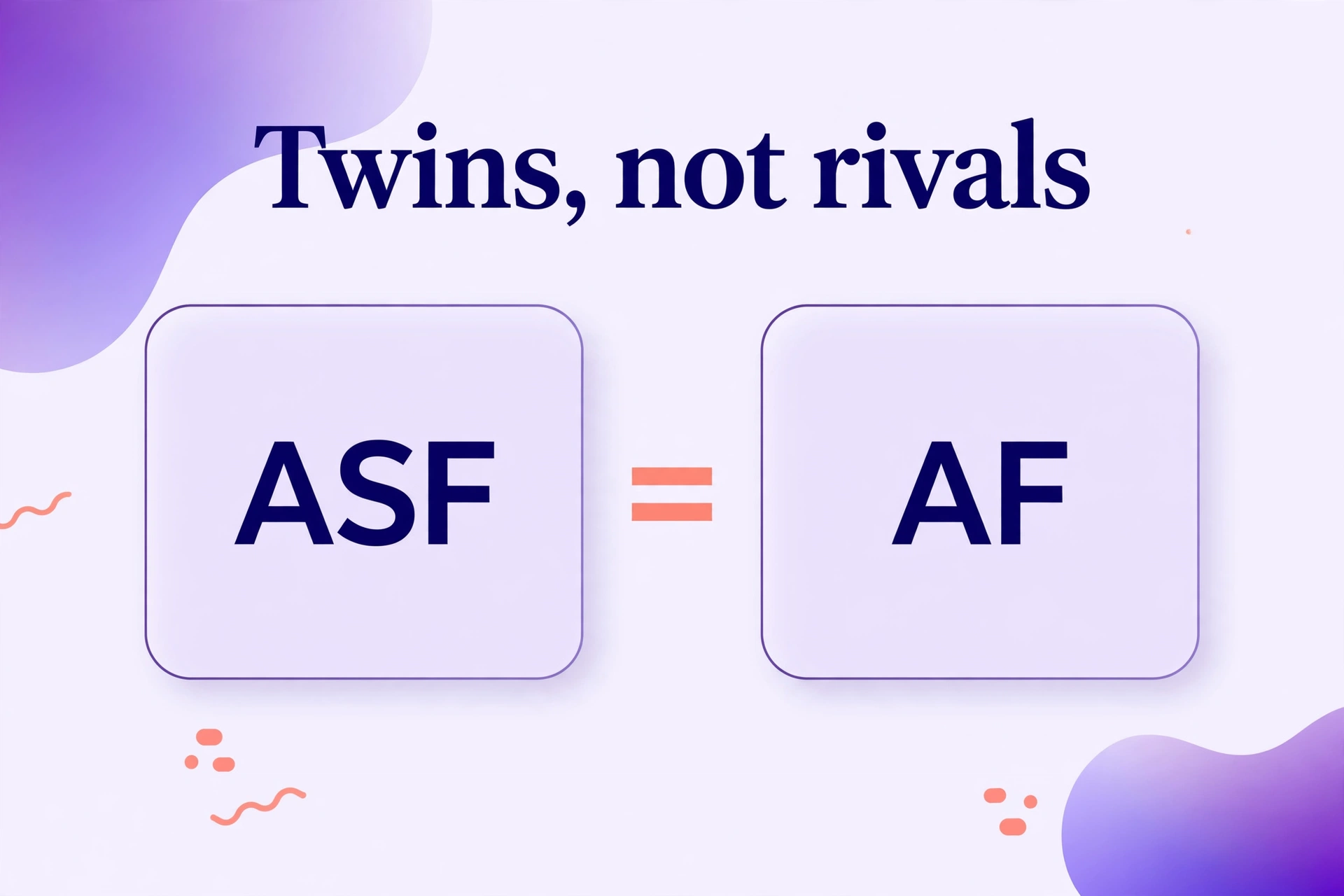
ASF vs. AF: The Twin Question
The most common question about ASF is whether it’s just AF with an extra letter. Functionally, yes. “I’m tired AF” and “I’m tired ASF” mean the same thing, work in the same sentences, and carry the same register. They’re interchangeable.
The differences are stylistic, not semantic:
- AF is the shorter, older, more universal form — the one even your cool aunt might recognize.
- ASF visually preserves the word “as,” which some users feel reads more naturally — you can see the phrase inside the abbreviation.
- Community habit decides. Some friend groups and corners of the internet default to one; neither is more “correct.”
One rule: don’t stack them. “Tired AF ASF” isn’t extra emphasis — it’s redundancy.
A few neighboring intensifiers, honestly placed:
- ASL (“as hell”) — the same job with different profanity and an older internet vintage.
- FR (“for real”) — different job. FR stresses truth and agreement (“that was hard FR” = I agree, truly); ASF stresses intensity (“that was hard ASF” = extremely hard). They often appear together because they do complementary work.
- RS — also about truth and realness, not intensity. Same distinction as FR.
Who It’s Aimed At Changes Everything
This is the part most guides skip, and it’s the most socially useful thing to know about ASF. The intensifier amplifies whatever it touches — including the target.
Aimed at yourself: low risk.
“I’m tired ASF,” “my wifi is slow ASF,” “I’m broke ASF” — the joke lands on you or an object. This is the vast majority of ASF usage, and it’s why the term feels harmless most of the time. Self-directed exaggeration reads as humor and honesty.
Aimed at someone else: the risk doubles.
“You’re annoying ASF” isn’t just “you’re annoying” said louder — the profanity removes the plausible deniability of “just kidding.” What would have been mild teasing becomes a genuine jab. “He’s weird ASF” behind someone’s back is gossip with the volume up. Before aiming ASF at a person, ask whether you’d say the unabbreviated version to their face — because they can hear it.
Aimed at someone in writing:
remember screenshots exist. “The boss is mad ASF” in a group chat is funny until it isn’t.
The rule of thumb: ASF is a megaphone. Point it at yourself all you want; point it at others carefully.
Where It Lives
One honest section instead of four repetitive ones: ASF means the same thing in texts, group chats, DMs, captions, comments, and gaming lobbies. Anyone telling you it means something different on TikTok versus Snapchat is inventing distinctions — it’s the intensifier everywhere.
What does vary is density. You’ll see it most in:
- Texts and group chats — the home turf: reactions, complaints, and exaggerations between friends.
- Captions and comments — “this view is beautiful ASF,” “me ASF” under relatable posts.
- Gaming and Discord — “that boss is hard ASF,” “this map is confusing ASF.”
Lowercase “asf” dominates in fast typing, and it’s notably a reaction word — more common in responses and captions than in planned statements.
Reading the Tone
ASF takes its color from the sentence around it:
- Flirty: “you look good ASF,” “cute ASF” — stronger and more explicit than “you look nice.” The intensifier makes the compliment feel bolder, which is the point — but also the risk. Make sure the boldness is welcome before sending it.
- Angry: “this is annoying ASF” — complaints get bigger with ASF attached. In a disagreement, it escalates; “you’re wrong ASF” lands very differently from “I disagree.”
- Humorous and self-deprecating: “I’m a mess ASF” — the most common register. Shared exaggeration builds rapport because everyone recognizes the performance.
- Hype: “that drop was insane ASF” — the laugh-out-loud-adjacent energy of group chats reacting to something together.
When to Keep It in the Drafts
The abbreviation hides the spelling, not the meaning — every reader hears the implied word. Keep ASF out of:
- Work emails, Slack, and client messages
- School assignments and academic writing
- Messages to kids, teachers, or elders
- Formal or public posts under your real name
- Religious or family settings where profanity is unwelcome
- First messages to strangers
When you need the intensity without the profanity, don’t just swap in “very” — that’s a downgrade. Use a vivid single word instead:
| ASF version | Cleaner upgrade |
|---|---|
| “tired ASF” | “exhausted” |
| “funny ASF” | “hilarious” |
| “good ASF” | “excellent” |
| “cold ASF” | “freezing” |
| “annoying ASF” | “maddening” |
| “fast ASF” | “blazing” |
| “beautiful ASF” | “stunning” |
| “hungry ASF” | “starving” |
Specific beats censored, every time.
How to Reply
ASF doesn’t need a special slang response — reply to the description, not the intensifier:
- “I’m tired ASF” → “long day? rest up — lmk if you need anything.”
- “This boss is hard ASF” → “FR, that level is brutal.” (matching the energy)
- “Bored ASF” → “wtd this weekend?” (answering the feeling behind it)
- “You look good ASF” → “thank you!” — or, if the boldness wasn’t welcome: “thanks — let’s keep it respectful.”
- “That was funny ASF” → “I knew you’d laugh.” (the compliment inside the exaggeration)
Don’t treat “I’m [negative] ASF” as a crisis — it’s usually a performance, not a report. Match the register with a little humor back, unless you have real reason to worry.
Other Meanings of ASF
In a text message, ASF is the intensifier essentially every time. Elsewhere it can mean African swine fever (veterinary and agriculture news) or the Apache Software Foundation (open-source software) — context makes the right reading obvious.
Quick Answers
Q: What does ASF mean in text?
A: “As f***” — an informal intensifier meaning “very,” “extremely,” or “incredibly.” It goes after the word it amplifies: “tired ASF” = extremely tired.
Q: Is ASF the same as AF?
A: Yes. They’re functionally identical and interchangeable — “tired AF” and “tired ASF” mean the same thing. AF is shorter and more universal; ASF visually preserves the word “as.”
Q: What does “me ASF” mean?
A: “This is so me” — it’s meme comment-section dialect for strong relatability, usually under funny or painfully accurate posts.
Q: Is ASF a bad word?
A: It contains implied profanity. Friends use it casually without a second thought, but it’s inappropriate in formal, professional, or profanity-free settings.
Q: Is ASF flirty?
A: It can be — “cute ASF” and “fine ASF” are bold compliments. But most ASF usage is purely emphatic, so read the relationship, not the letters.
Q: Does ASF mean the same thing on every platform?
A: Yes. Texts, TikTok, Snapchat, Discord, gaming chats — the meaning is identical everywhere. Only the spelling (lowercase vs. caps) varies.
Q: What’s a cleaner way to say it?
A: Skip “very” and use a vivid single word: “exhausted” for “tired ASF,” “hilarious” for “funny ASF,” “freezing” for “cold ASF.”
Q: What else can ASF stand for?
A: Outside texting: African swine fever (animal health) and the Apache Software Foundation (software). In a chat, it’s always the intensifier.
The Short Version
ASF is a volume knob for descriptions — “very” with the filter off. It goes after the adjective, hits hardest when aimed at yourself, and doubles the social risk when aimed at someone else. It means the same thing on every platform, it’s interchangeable with AF, and “me ASF” is just meme-speak for “so relatable.” Use it where your audience already talks like you; everywhere else, a vivid plain word does the job better.