
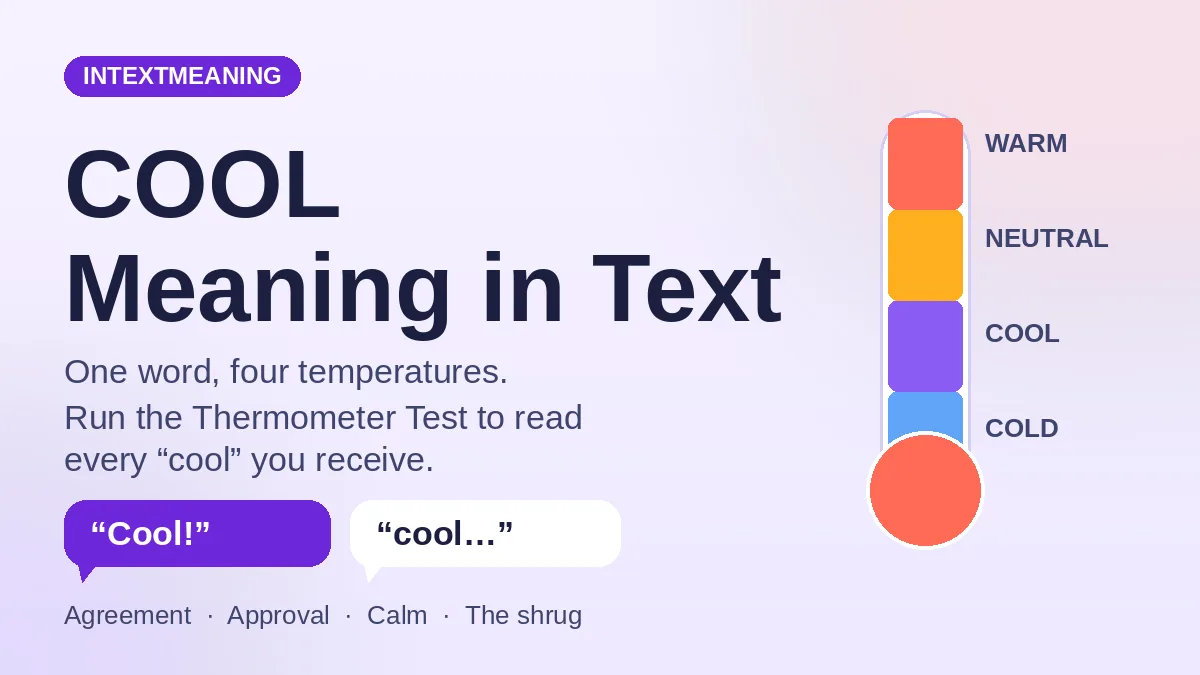
You send the news you have been waiting all week to share — the internship, the tickets, the photo you are proud of — and the reply comes back in four letters: "cool." Is that good? Is it a shrug? Is it a polite way of ending the conversation? The word is so small that it carries almost no information on its own, and that is exactly why it confuses people. That is why the cool meaning in text needs a proper reading: the same four letters can be warm approval, a simple yes, a compliment, or a cold front.
Here is the short version. In text, "cool" does four jobs. As an adjective it means impressive or stylish ("That bike is cool"). As a standalone reply it means agreement ("Let’s meet at 6." — "Cool."). As a description of a person it means calm, confident, and easy to be around ("She’s really cool"). And as a bare reply to something that deserved more, it can mean distance — the digital shrug. The word itself never tells you which job it is doing — the thread does.
This update also corrects the old version of this page in plain sight. The old article called COOL "one of the most common words in texting" and "very popular," and it printed a fixed tone code — "Cool!" means excited, "cool" means neutral, "cool…" means less interest — as if punctuation were a cipher. Both are withdrawn here.
What COOL Actually Means — One Word, Four Jobs
COOL is not slang in the way most words on this site are. It is an ordinary English word with a long history: the approval sense comes from 1940s Black American jazz culture, where saxophonist Lester Young is widely credited with popularising "I’m cool" as a state of mind — calm, keeping it together, unruffled. It crossed into mainstream print by 1948 and teen slang by the early 1950s.
Job one is the adjective: impressive, stylish, worth admiring. "That jacket is cool." This is the most strongly supported reading in the article — every dictionary consulted lists it as informal approval, and every slang guide agrees.
Job two is the reply: agreement or acceptance. "We leave at six?" — "Cool." It is the job that causes most of the confusion, because a reply carries no object — nothing after it tells you how much the sender meant it.
Job three is the person: calm, confident, easygoing. "He’s cool." "She stayed cool under pressure." This is the oldest sense of all — the jazz sense — and it is a compliment about temperament, not taste. A cool person is not necessarily fashionable; they are unbothered. People want to be cool, so they keep saying it.
Job four is the shrug: the bare "cool" that lands where a real response was owed. "I got into the programme I wanted." — "cool." Nothing wrong with the letters; everything wrong with the size of the reply next to the size of the news. This is not a separate dictionary meaning. It is job two delivered with so little energy that it stops sounding like agreement.
Run the Thermometer Test
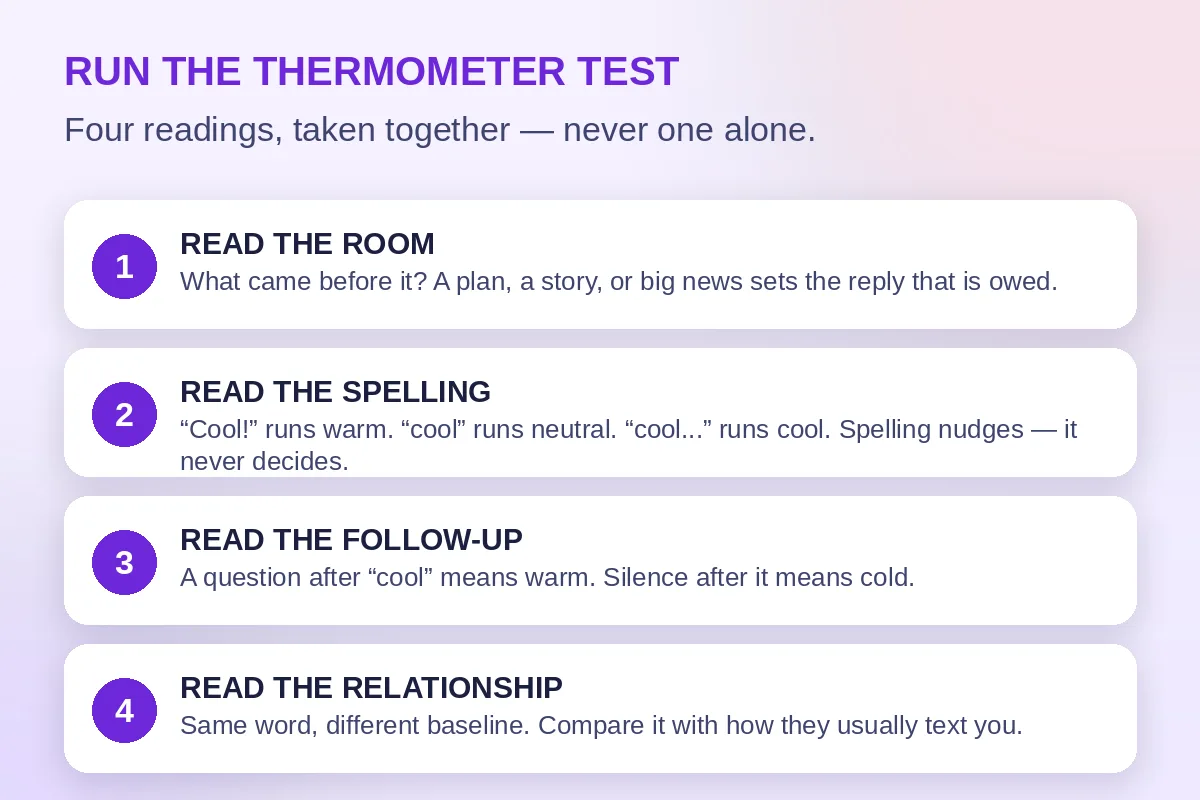
Because COOL is literally a temperature word, the test is a thermometer: every "cool" you receive has a temperature, set by four readings taken together.
Check one is READ THE ROOM. What was the message before it? A plan, a story, a photo, or a confession sets the size of the reply that is owed. A "cool" after a plan ("Meet at six?") is agreement, and a short reply is exactly right. A "cool" after big news is a shrug, because the news deserved a sentence and got a word.
Check two is READ THE SPELLING. Spelling and punctuation nudge the temperature, and the nudges are real even though they are not a code. "Cool!" runs warm: the exclamation mark is effort, and effort is warmth. "cool" in lowercase runs neutral: the default, the word at rest. "cool…" runs cool: the sentence trails off instead of landing. "coool" runs playful. "COOL" runs loud: excitement or sarcasm, and only the room decides which.
Check three is READ THE FOLLOW-UP. This is the check the old article never mentioned, and the most decisive one. A "cool" followed by a question or a detail — "Cool! What time?" — is warm whatever its spelling, because the sender kept talking. A "cool" followed by silence is the coldest version of all, because the sender stopped.
Check four is READ THE RELATIONSHIP. The same bare "cool" means different things from different people, because every relationship has a baseline. From a busy friend who texts in single words all day, a bare "cool" is normal and warm enough. From a crush who usually writes paragraphs, the same bare "cool" after your long message is a cold front.
Try it on a real thread. You text your best friend: "I got the internship!!" She replies: "cool". Read the room: big news, owed a sentence, got a word. Read the spelling: lowercase, no punctuation, neutral at best. Read the follow-up: nothing follows. Read the relationship: she usually sends paragraphs. Four readings, all pointing the same way — this "cool" is cold. Ask: "You okay? You’d usually be screaming with me."
The Four Temperatures of a "Cool" Reply
Warm is the easiest temperature to recognise, because warm replies carry extra material. "Cool! I love that for you." "Cool, let’s do it — what time?"
Neutral is the default, and it is where most "cool" replies actually live. "Meet at six?" — "Cool." "Tickets are booked." — "Cool, thanks." The reply matches the size of the message before it, adds nothing, and takes nothing away. Neutral "cool" is honest work: it confirms, it acknowledges, and it moves the conversation forward without fuss. Neutral is not a failure: most of the logistics in a friendship run on neutral "cool."
Cool — the temperature, not the word — is where the trouble starts. A "cool" slightly too short for its thread: the story that got one word, the photo that got a lowercase reply. The sender probably does not mean to be cold. They are busy, distracted, or unsure what to say, and "cool" is the smallest reply that is still polite. Give them something easy to answer, like a question: "Cool — are you free Saturday or should we do Sunday?"
Cold is a "cool" that ends something. The long message answered with one word and then silence. The apology answered with "cool." Cold "cool" is not a meaning of the word; it is a relationship signal wearing the word as a costume.
COOL on TikTok, Instagram, Snapchat, and Text Messages

On TikTok and Instagram, COOL is mostly public, and public COOL runs warm. A "cool!" in a comment is a small public like: it says "I saw this, I approve, I am on your side" in front of other people, and the exclamation mark and the emoji usually come along for the ride.
On Snapchat, COOL goes lighter and faster. Snaps disappear, chats feel low-stakes, and a "cool" there is usually a tap of acknowledgment between two people mid-conversation — closer to a nod than a verdict.
In plain text messages, COOL carries the heaviest ambiguity, because texting is where the word does its most serious work and has the least help. There is no photo, no story, and no audience to soften it — just the word, the thread, and the relationship. That is why the Thermometer Test matters most in texting.
Who Sent It: Friend, Crush, Partner, Group Chat, or Stranger
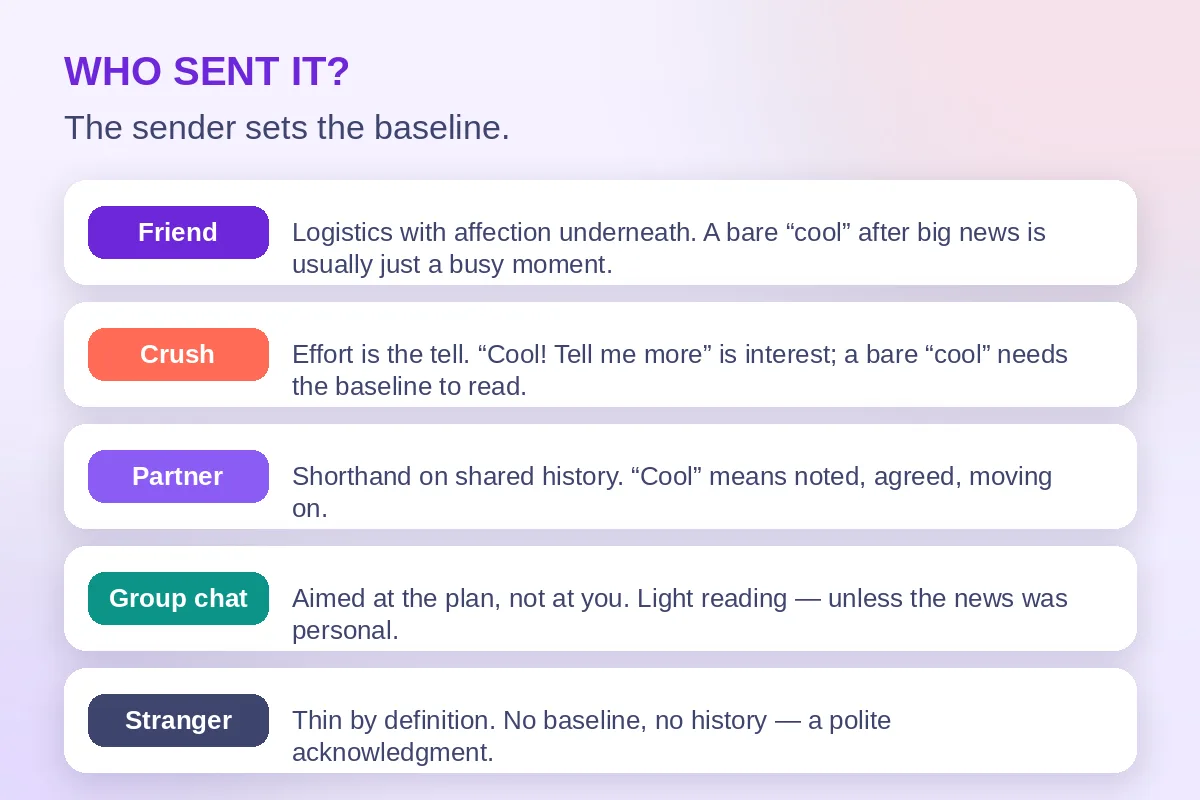
From a close friend, a "cool" is usually logistics with affection underneath. Friends trade "cool" the way they trade nods: it confirms the plan, acknowledges the news, and keeps the day moving. The only version that stings is the cold one — the bare "cool" after news that mattered — and even then, the likeliest explanation is a busy moment, not a cold heart.
From a crush, a "cool" does quiet extra work, and the tell is the effort around it. A crush who replies "Cool! Tell me more" is interested and showing it. A crush who replies with a bare "cool" to a message you poured effort into is either nervous, busy, or cooling off — and you cannot tell which from the word alone.
From a partner, "cool" is usually shorthand built on shared history, and the safest version of the word. A "cool" between partners means "noted, agreed, love you, moving on." From a group chat, "cool" is at its most literal: one person confirming or reacting while the group talks around them. It is rarely aimed at you personally — it is aimed at the plan, the photo, or the joke — so it deserves a light reading. From a stranger, "cool" is thin by definition: no baseline, no history, just a polite acknowledgment.
How to Answer "Cool" — and How to Reply Better Than "Cool"
Answering a "cool" depends on which temperature you received. A warm "cool" needs momentum: answer the question it asked, or match its energy with a detail of your own. A neutral "cool" needs a next step if there is one — the plan, the time, the link — and nothing at all if there is not. A cool or cold "cool" needs a question, because a question is the easiest thing in the world to answer, and it gives the other person a way back in without admitting they drifted.
Replying with "cool" yourself is a skill worth learning. The rule is simple: match the size of your reply to the size of the message you received. A plan gets a "cool" plus a confirmation — "Cool, see you at six." A photo gets a "cool" plus a reaction — "Cool! I love the colours in this one." News gets a "cool" plus a feeling — "That’s so cool, I’m really happy for you." If you want to keep a conversation open without deciding anything yet, a light "lmk what you decide, I’m probably in" hands the other person the next move without pressure, and the guide to lmk meaning in text shows how that handoff works.
Two small habits make a large difference. First, if you are about to send a bare "cool" to a message that clearly mattered to the sender, add one more beat — a question, a detail, an emoji that means something — before you send it. Second, if you need to step away, say so rather than letting a "cool" be your last word; a pause word beats a trailing reply, and the guide to brb meaning in text shows how that pause works. When the conversation is done for the night, the guide to ttyl meaning in text covers the clean exit, which is kinder than a "cool" that fades into silence.
Reply Upgrades: Five Cold "Cools" Rewritten Warm
This is the upgrade this batch adds over the previous one: instead of only teaching you to read a "cool," it shows you how to write a better one. Each thread below is real in shape — the cold version first, then the same reply warmed up. The word "cool" stays in every rewrite; only the sentence around it changes.
One: the plan. They say, "Let’s meet at six, I found a place near the station." Cold: "cool". Upgrade: "Cool, six works — send me the pin and I’ll be there."
Two: the news. They say, "I got the internship!!" Cold: "cool". Upgrade: "That’s so cool!! I’m really happy for you — when do you start?"
Three: the photo. They send a picture of their new bike. Cold: "cool". Upgrade: "Cool! The colour is amazing — where did you find it?"
Four: the idea. They say, "What if we do a road trip next month?" Cold: "cool". Upgrade: "Cool, I’m in — are we thinking coast or mountains?"
Five: the apology. They say, "Sorry I was short with you yesterday, rough day." Cold: "cool". Upgrade: "Cool, don’t worry about it — rough days happen. We’re good." This one matters most, because a bare "cool" after an apology can read as "I accept your apology and I am still annoyed."
COOL vs Similar Words: OK, Nice, Great, Awesome, LOL
COOL overlaps with a family of short positive words, and the overlaps are where people choose the wrong one. OK is the neutral sibling: it agrees and confirms, but it carries no warmth and no admiration. "Meet at six?" — "OK" is a clean confirmation; "Cool" is the same confirmation with a friendlier edge. The old article said COOL "feels more friendly and positive" than OK and left it there; the sharper version is that OK answers the question while COOL answers the question and likes it.
Nice and great are the warmer cousins. "Nice!" and "Great!" carry more enthusiasm than "cool": "Nice photo!" is warmer than "Cool photo." Awesome is the loud cousin: stronger, more excited, and harder to use often without sounding like you are performing enthusiasm.
The guide to lol meaning in text covers a different kind of reaction word — one that laughs where COOL nods. LOL reacts to something funny, COOL reacts to something good, and sending one where the other belongs is a small, common misfire. Honesty words sit next to COOL rather than under it: the guide to tbh meaning in text shows how "to be honest" frames a reaction, and the guide to ngl meaning in text shows how "not gonna lie" does the same job with a different edge. And when the plan needs a small aside, the guide to btw meaning in text shows how a by-the-way note fits without derailing the thread.
"Cool Story, Bro" and the Sarcastic Edge
There is one phrase where COOL means the opposite of what it says, and it has a documented history. "Cool story, bro" is a sarcastic dismissal of a boring, overlong, or pointless story — a way of saying "that was not, in fact, cool." The phrase circulated in online forums in the late 1990s and early 2000s, a similar line appeared in the 2001 film Zoolander, and it took off as a meme on 4chan’s video-game board in July 2008, later attached to a panel from Marvel’s The Incredible Hercules #122.
The important point is that the sarcasm lives in the whole phrase, not in the word "cool." A bare "cool" is not sarcastic by default, and treating it as sarcasm is one of the most common misreads in texting. "Cool story, bro" is sarcastic because of the "story, bro" — the mock-praise of a story that did not deserve praise — and because of the context, usually a long post in a public thread. The guide to wtm meaning in text shows why a plan question deserves a plan in reply, not a nod.
Readings This Article Refuses to Count
A good slang article grades its readings instead of listing them, so here are the ones investigated and declined. First, the fixed punctuation code. A 2015 humour piece listed fifteen meanings of "cool" based on capitalisation and punctuation — "Cool." means annoyed, "cool" means uninterested, "COOL" means sarcasm — and that piece is still quoted by guides today. It is a joke, and its own text admits the same form "varies intensely." Punctuation and case are hints, read with the thread. Not a code. Not counted.
Second, "cool" as a greeting or a sign-off. No guide supports it, and no real exchange uses it that way: "cool" opens nothing and closes nothing on its own. A "cool" that happens to be the last message in a chat is a reply that landed last, not a goodbye.
Third, the popularity claims. The old article called COOL "one of the most common words in texting," "very common," and "very popular," on the basis of nothing. No count, survey, or frequency study was cited, and none was found in research. Those claims are withdrawn here in full. Fourth, the old article’s comparison table, which called COOL "more balanced" than OK, NICE, AWESOME, and GREAT without explaining what "balanced" meant. That comparison is replaced above with a job-by-job account of what each word does that the others do not.
Finally, the old article’s own shape: twenty-four headings, a FAQ section in plain paragraph text, and three images with empty alt text.
Quick Answers
What does COOL mean in text?
In text, "cool" usually means agreement ("that works"), approval ("that’s impressive"), or a compliment about someone being calm and easygoing. As a bare reply it can also read as distance — only the thread decides.
Is a bare "cool" reply rude?
Not by itself. A bare "cool" after a plan or a small update is normal and polite. It reads as cold when it answers big news, a personal story, or an apology with a single word and no follow-up.
Does "Cool!" mean something different from "cool"?
It nudges the temperature, it does not change the meaning. "Cool!" runs warmer because the exclamation mark is effort; lowercase "cool" runs neutral; "cool…" runs cooler because the sentence trails off.
What does "cool story, bro" mean?
It is a sarcastic dismissal of a boring or overlong story — a way of saying the story was not cool at all. The sarcasm lives in the whole phrase, not in the word "cool" on its own.
Is COOL formal or informal?
COOL is informal. It belongs in casual chats, comments, and relaxed work messages, not in formal emails or official writing. In a formal message, write the reply out in full: "That works for me" or "That sounds great."
What is the best reply to "cool"?
Match the temperature. A warm "cool" needs momentum — answer its question or add a detail. A neutral "cool" needs a next step if there is one. A cold "cool" needs a question: "Cool — does Saturday still work for you?"
Final Thoughts
COOL is the smallest word that causes the most confusion, and the reason is simple: it is a reply word pretending to be a complete message. This update solves it the other way: fewer meanings, honestly graded, and a better tool. One word, four jobs, four temperatures, and the Thermometer Test. When a "cool" still feels cold, ask. The question costs nothing, and it is the one reply that can never be misread.