
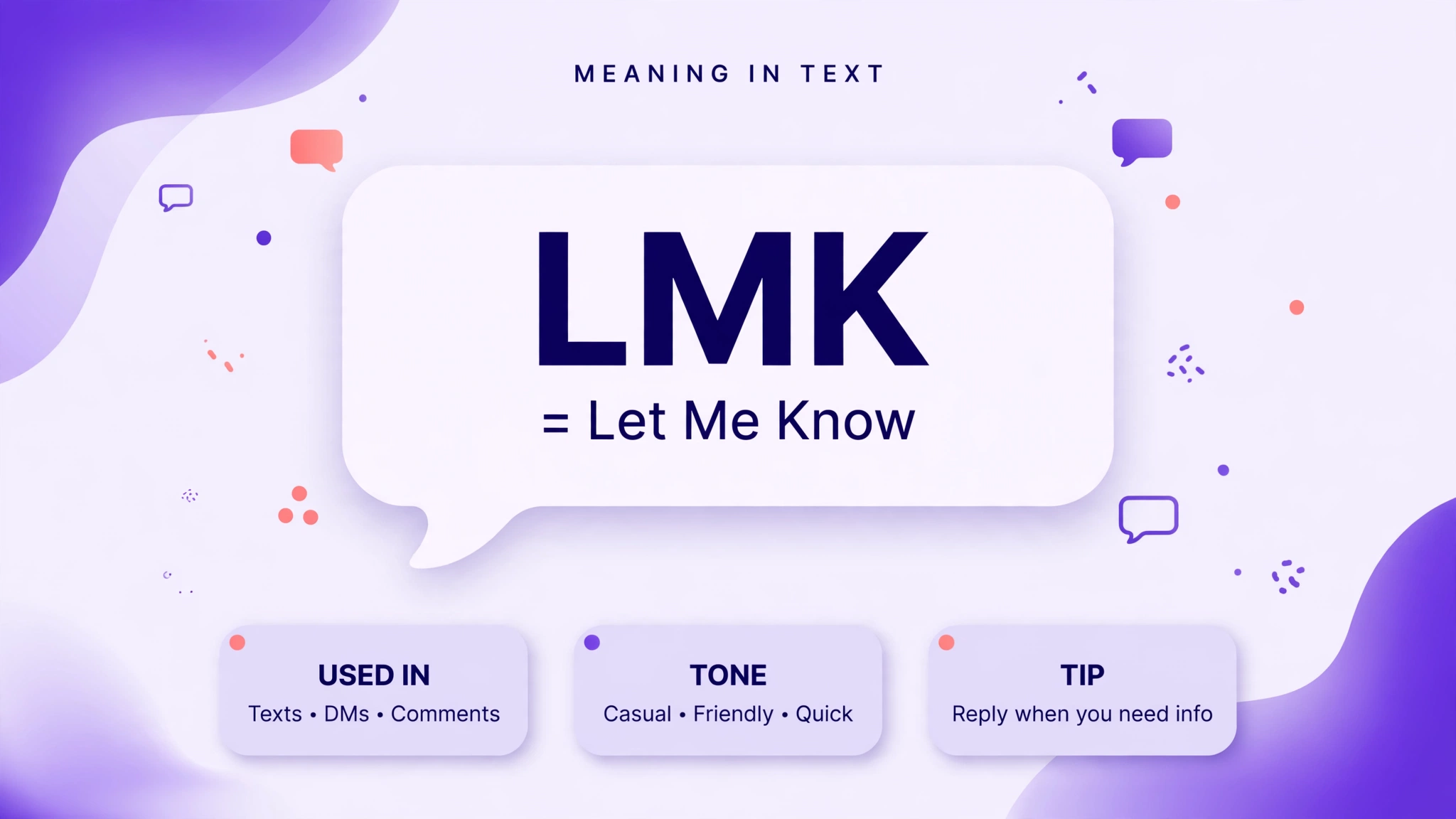
Three little letters that hand someone a small assignment: “lmk.” You’ve seen it at the end of texts, in group chats, in work Slacks, under Instagram posts. It looks almost too short to matter — but LMK does quiet, useful work in conversations, and the tone around it matters more than most people realize.
LMK stands for “let me know”: a request for information that hasn’t arrived yet — an answer, a decision, an update, a confirmation. This guide covers what LMK really does in a conversation, how tiny changes in punctuation change its tone, how to reply (especially when you don’t know the answer yet), and when to spell it out instead.
LMK Meaning at a Glance
| Full form | Let Me Know |
| Main job | Asking for information, an update, a decision, or a confirmation — now or later |
| Tone | Casual, usually friendly; softens requests |
| Common in | Texts, WhatsApp, group chats, DMs, comments, Slack/Teams, casual emails |
| Example | “LMK when you get home.” |
| Capitalization | LMK and lmk mean the same thing; case changes the energy, not the meaning |
| Formal alternative | “Please let me know” or “Please keep me updated” |
| Natural reply | Answer it — or “I’ll LYK” (let you know) |
What LMK Actually Does in a Conversation
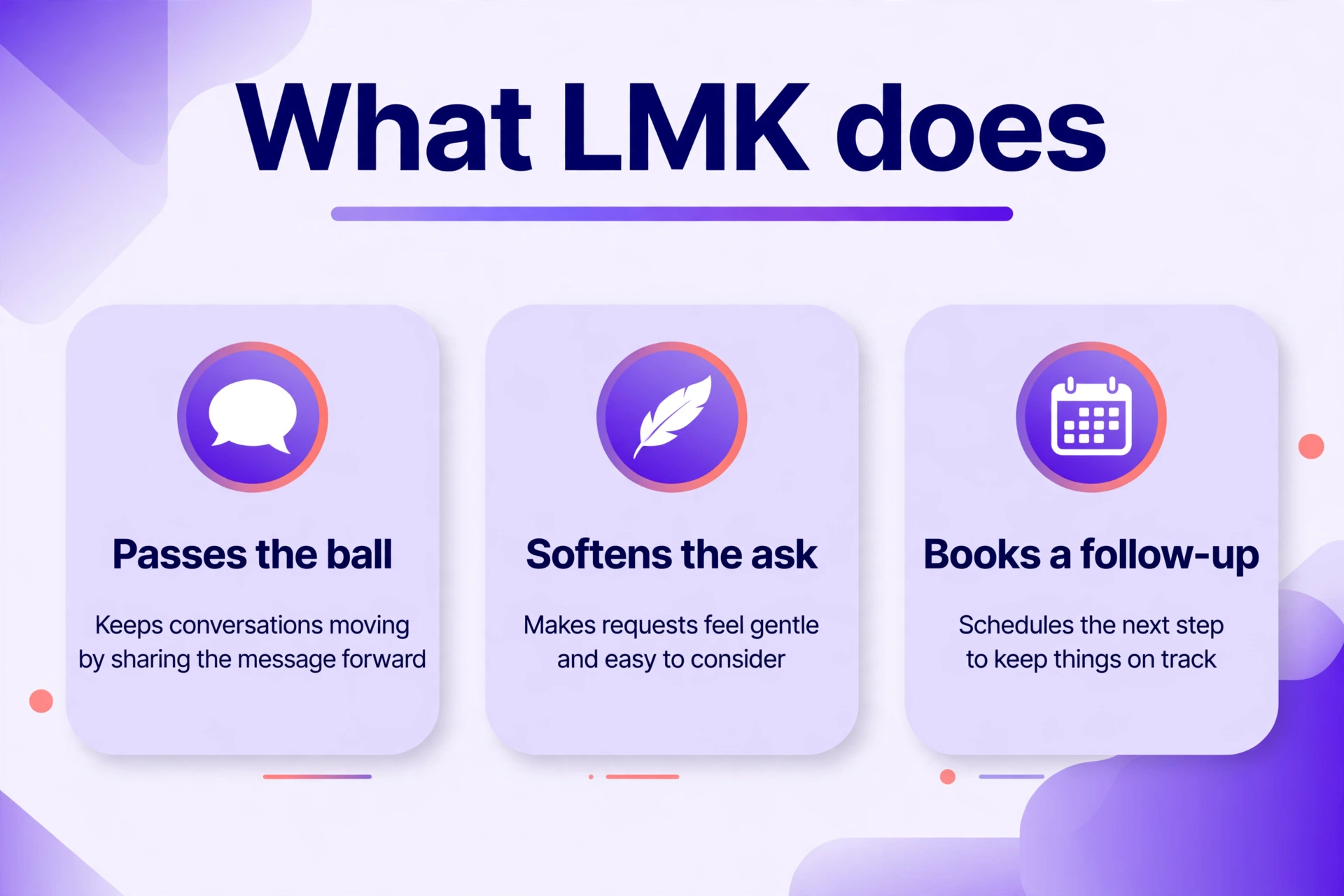
On the surface LMK is a simple request. Underneath, it’s doing three conversational jobs at once.
It passes the ball.
Every “lmk” hands the next move to the other person. “LMK which restaurant you prefer” means: I’ve said my part, the decision is yours now, and the conversation pauses until you answer. That’s why LMK shows up wherever plans are forming — it’s the official way of saying “your turn.”
It softens the ask.
A bare question can feel like pressure: “Which restaurant do you prefer?” Frame it as “LMK which restaurant you prefer” and the same question feels lighter, less confrontational. It signals no rush — answer when ready. That softening is a big part of why LMK survived while other abbreviations faded: it’s genuinely polite technology.
It promises a future conversation.
An LMK usually means the chat is paused, not over. “Good luck, and lmk how it goes!” books a follow-up for later. The sender is saying: this matters enough that I want the sequel.
There’s also a quieter fourth job: the social offer. “LMK if you need anything” usually isn’t a real request — nobody expects a project plan back. It’s a politeness formula, a way of saying “I’m here for you” in three letters. Read it as warmth, not homework.
For raw, unfiltered examples of how people actually use it, see the Urban Dictionary entry for LMK.
The Tone of Three Letters
LMK is toneless on its own, so the wrapping does all the emotional work. Small changes, big difference:
- “lmk” — the default. Casual, neutral, friendly enough.
- “LMK” — adds weight. Not shouting, just emphasis: this one matters a bit more.
- “lmk.” — the period is doing something. A bare “lmk.” can read cold, clipped, even passive-aggressive — like the sender’s patience ran out.
- “lmk!” — warm and upbeat. The exclamation mark turns it into enthusiasm.
- “LMK ASAP” — deadline energy. Fine with a real deadline; tense without one.
- “just lmk” — the softener. “Just” takes the pressure off: no big deal either way.
- “lmk when you can” / “no rush, lmk” — explicitly removes urgency. Use when you mean it.
If your LMK could read as demanding, add a softener. “LMK” alone is a coin flip in a tense conversation; “lmk when you get a sec :)” almost never is.
LMK in Real Conversations
The exchanges below are illustrative examples, not real messages.
Making plans
- Ava: “We’re thinking about dinner at seven.”
- Mia: “Sounds good. LMK where you decide to go.”
Mia wants an update after the group chooses. The ball is officially in Ava’s court.
The check-in
- Noah: “Are you coming to the game tomorrow?”
- Ethan: “I need to check my schedule.”
- Noah: “No problem, LMK tonight.”
Noah expects a definite answer later — and gave a soft deadline without making it sound like one.
The social offer
- Ella: “Ugh, this week has been a lot.”
- Grace: “I’m sorry. LMK if you need anything.”
Grace isn’t requesting information. This is the politeness formula — pure warmth, no homework expected. A simple “thanks” is the complete reply.
The low-pressure invite
- Liam: “I’m free this weekend, lmk if you wanna hang out.”
This is LMK doing romantic or friendly work: expressing interest while leaving the other person a graceful out. The casualness is the point — it keeps things light either way.
The decision dodge
- Sophie: “We can watch a movie or go out.”
- Chloe: “I’m fine with either. LMK.”
Chloe hands the final choice to Sophie. But note the trap: if neither person wants to decide, two LMKs just bounce the ball forever. For the genuinely stuck, WTD (what to do) is the right abbreviation.
Where You’ll See It
- One-to-one texts: the home turf — plans, favors, check-ins, decisions.
- Group chats: “lmk who’s in” when the plan needs a headcount.
- DMs and comments: “lmk what you think” — an engagement invitation, same mechanics as texting.
- Slack, Teams, and email: LMK is unusually workplace-acceptable. “LMK once the report is ready” reads fine in a team chat; in a client email, spell it out.
- Not in formal writing: job applications, official documents, strangers — write “please let me know.”
The meaning doesn’t change across platforms. Anyone telling you LMK means something different on Snapchat versus WhatsApp is inventing distinctions — it’s “let me know” everywhere.
How to Reply to LMK
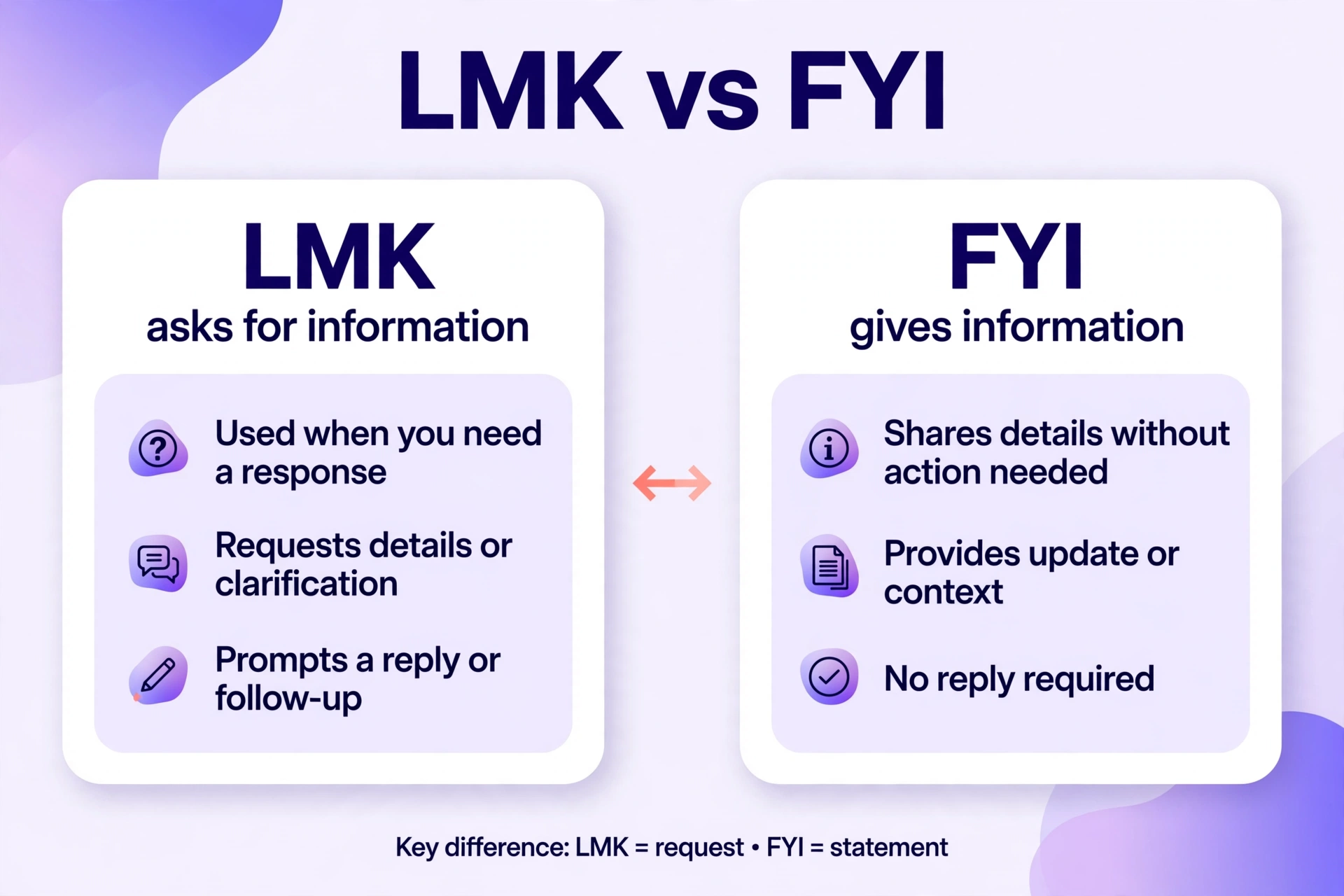
The golden rule: an LMK is a request with your name on it. The worst reply is silence.
- If you know the answer: just answer it. “Friday works!” beats “ok will lmk” every time.
- If you don’t know yet: acknowledge and give a timeline. “Not sure yet — I’ll lyk by tonight” is the perfect LMK reply: it confirms you got the ball and says when you’ll throw it back.
- If it’s a task: “on it” or “will do” confirms receipt; follow up when it’s done.
- If it’s the social offer (“lmk if you need anything”): “thanks, I appreciate it” is complete. No update required.
- The mirror reply: “I’ll LYK” — LYK means “let you know,” the standard response to LMK. “LMK if you can make it” → “I’ll lyk tomorrow.”
If an LMK had a soft deadline (“lmk tonight”) and you miss it, acknowledge the miss: “Sorry for the late reply — Friday works!” Costs nothing, keeps the goodwill.
LMK vs. Similar Abbreviations
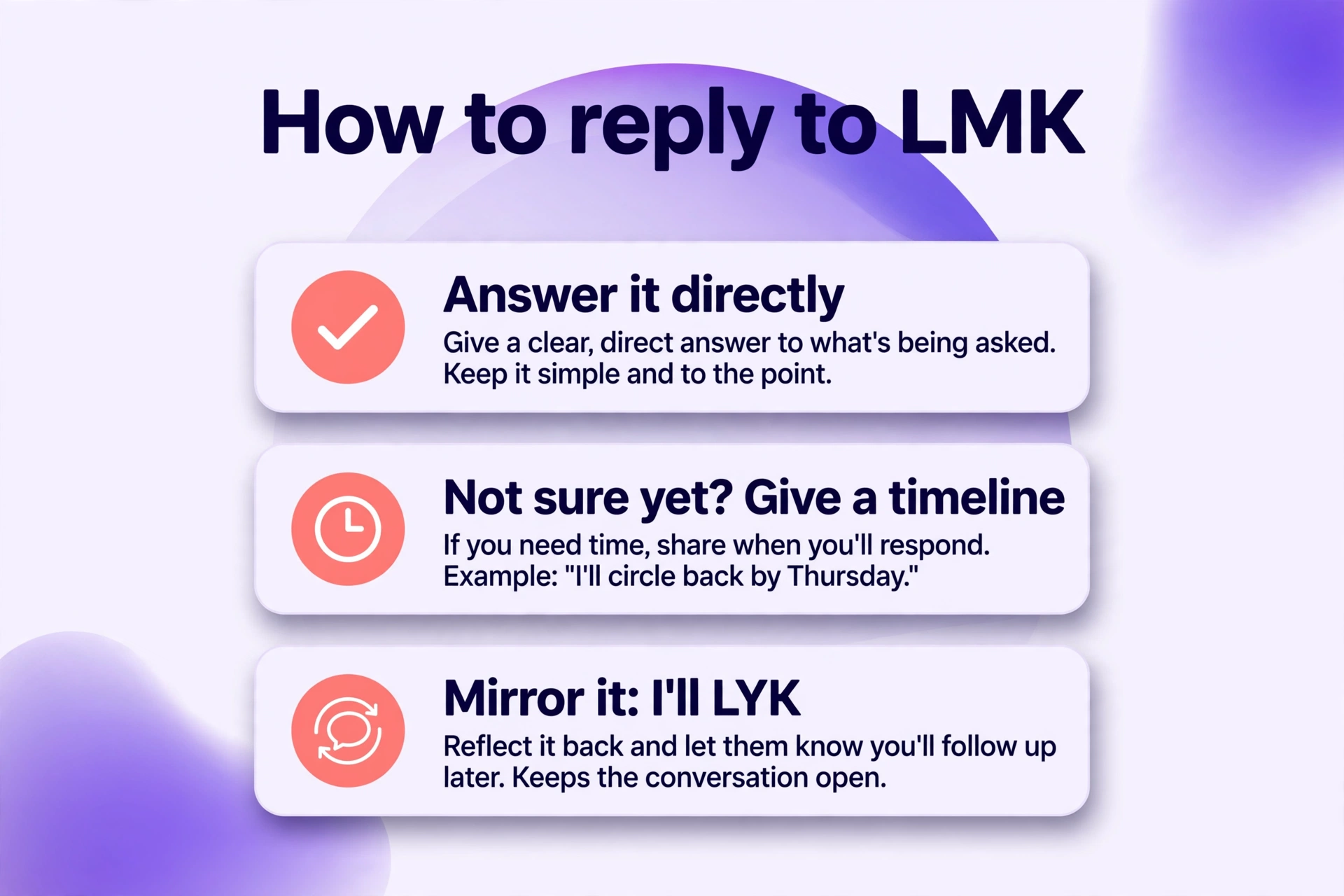
Direction is everything. LMK requests information (“tell me”); FYI (for your information) gives it. “LMK what you think” asks for your opinion; “FYI, the meeting moved” hands you a fact. They’re a matched pair: one asks, the other tells.
LMK vs. “keep me posted.”
Near-synonyms with a shade of difference. “Keep me posted” asks for ongoing updates; LMK usually wants one answer. “Keep me posted on the house hunt” (a saga) versus “lmk what the realtor says” (one update).
LMK vs. HMU.
HMU (“hit me up”) means “contact me” — about anything, whenever. LMK means “answer this specific thing.” “HMU sometime” is an open door; “lmk if you’re free Friday” is a question with a deadline hiding inside it.
LMK vs. IMK — watch the typo.
In some fonts, capital-i “IMK” and lowercase-L “lmk” look nearly identical. They mean opposite things: IMK (“in my knowledge”) shares uncertain information; LMK requests it. If “imk when you land” reads backwards, it’s almost certainly a typo for LMK.
Using LMK Without Sounding Rude
LMK is one of the few abbreviations that works at work — but it has rules.
- Add “please” for anyone you don’t text daily. “Please LMK by Thursday” is professional; a bare “LMK” to your manager can read as curt.
- Give context and a deadline. “LMK what you think of the proposal by Thursday” gets answers; a context-free “lmk” gets forgotten.
- Spell it out the first time with new contacts or clients. Once the rapport exists, LMK is fine.
- Slack/Teams: LMK is standard. Client emails: write it out. Job applications: never.
- Don’t stack it. “LMK ASAP!!!” to a coworker reads as aggressive. One softener (“lmk when you get a chance”) changes the temperature.
LMK’s casualness is a feature with friends and a risk with everyone else. Match the spelling to the relationship.
When Not to Use LMK
- When you need the answer now. LMK implies “whenever” — if it’s urgent, ask directly: “Are you free Friday? I need to book today.”
- When the news is heavy. “LMK how the surgery goes” is fine between close friends; in most other cases, write the full sentence with real warmth.
- When finding the answer is your job. Don’t “lmk” someone about something you should be looking up yourself — it reads as delegating your work.
- When silence would be kinder. After an argument, “lmk when you’re ready to talk” can feel like pressure disguised as patience. Sometimes no message is the message.
Other Meanings of LMK
In ordinary texting, LMK is “let me know” essentially every time. A few niche readings exist: Low Memory Killer (an Android process), Local Master Key (IT security), or someone’s personal coinage (“Love My Kids”) — none standard. Trivia: “LMK” is also a Kelela song (2017). In a text message, assume “let me know.”
FAQs
What does LMK stand for?
“Let Me Know” — L for Let, M for Me, K for Know.
Does LMK require a reply?
Usually, yes. It hands you the next move. If you don’t know the answer yet, reply with a timeline (“I’ll lyk by tonight”) rather than going silent.
What does “I’ll LMK” mean?
Watch the direction: “I’ll lmk” means I’ll let you know — the sender is promising to follow up, not asking you to. It’s the mirror image of a plain “lmk.”
What does LYK mean?
“Let You Know” — the natural reply to LMK. “LMK if you can make it” → “I’ll lyk tomorrow.”
Is “lmk.” with a period rude?
It can read that way — the full stop makes it clipped and cold. Fine between close friends, risky in a tense exchange. Drop the period or add a softener if warmth matters.
Is LMK passive-aggressive?
Not by itself, but it can carry that tone with the wrong punctuation (“lmk.”) or right after a disagreement. The letters are neutral; the context isn’t.
Can I use LMK in an email?
In casual internal emails and team chats, yes. For clients, managers you don’t know well, or anything formal, write “please let me know.”
What’s the difference between LMK and IMK?
Opposite directions. LMK (“let me know”) requests information; IMK (“in my knowledge”) shares uncertain information. They’re confused because capital-I and lowercase-l look alike — “imk when you land” is almost certainly a typo for LMK.
Is LMK flirty?
It can be — “lmk if you wanna hang out” is a classic low-pressure signal of interest. But most LMKs are purely practical, so read the relationship, not the letters.
What does LMK mean from a guy?
Usually just “let me know” — he’s waiting for an answer or an update. In a dating context (“lmk if you’re free this weekend”), it can signal casual interest. Context decides.
The Short Version
LMK is “let me know” — three letters that hand someone the next move in a conversation. It softens requests, books a future follow-up, and works almost everywhere from group chats to work Slacks. Watch the punctuation (“lmk.” hits different from “lmk!”), answer with a timeline when you don’t know yet, and spell it out for clients and formal settings. Small abbreviation, real conversational skill.
