
You post the photo you spent twenty minutes getting right, and at the end of the caption you add four letters: "LMSS." A friend likes it. Another shares it. A third asks what the letters mean. That is LMSS in one scene: not a word you say to someone, but a small shout aimed at a crowd, asking it to do things for your post. That is why the lmss meaning in text confuses people who meet it in a private chat — in a one-to-one conversation there is no crowd, and an ask with no crowd to hear it feels out of place.
Here is the short version. LMSS most often means "Like My Status and Share": like my post or status, and share it with other people. On video platforms, where a subscribe button exists, it can stretch to "Like My Status, Share, and Subscribe." In exchange games it can mean "Like My Status Seriously," as in "LMSS for a rating," where the like is the price of a reply. The letters never change. The platform, the audience, and the payoff decide which version you are looking at.
This update also corrects the old version of this page in plain sight. The old article gave "Like My Status, Share, and Subscribe" as the only meaning, and its Quick Answer table listed two more expansions — "Like, Message, Share, Subscribe" and "Like My Story, Share, Subscribe" — that no guide, dictionary, or slang source supports. Both are withdrawn here. The old article also called LMSS "commonly used," "widely used," and "popular," and claimed platforms reward likes with extra reach. No count, survey, or frequency study supports the popularity claims, and no source supports the algorithm claim.
What LMSS Actually Means — Like My Status and Share
LMSS is built from four plain words, and the first three never move. L is Like. M is My. S is Status. The fourth letter, the second S, is the moving part, and that is where all the confusion lives. In the main reading it stands for Share: like my status and share it — the version two guides give first, and the one the old article buried under the longer Subscribe form.
The Subscribe version is real, but it is a variant, not the default. "Like My Status, Share, and Subscribe" appears when the person is promoting a video channel — YouTube, or any platform with a subscribe button — because there, subscribing is a real action a reader can take. On WhatsApp Status there is no subscribe button at all, so the last S cannot mean Subscribe there. The platform decides whether the third action exists.
The third version, "Like My Status Seriously," is the emphatic one. It is attested in online slang dictionaries and repeated by two guides, and it shows up in one specific place: the exchange game. "LMSS for a rating" does not mean "like my status and subscribe." It means "like my status — seriously, actually do it — and I will rate you back."
One more thing the letters never are: a conversation. LMSS does not ask a question, answer one, or keep a chat going. It is a call to action attached to a piece of content — a caption, a status, a story — and it only makes sense where content is shown to people. A megaphone in a living room is the wrong tool; in a crowd it is exactly right.
Run the Megaphone Test
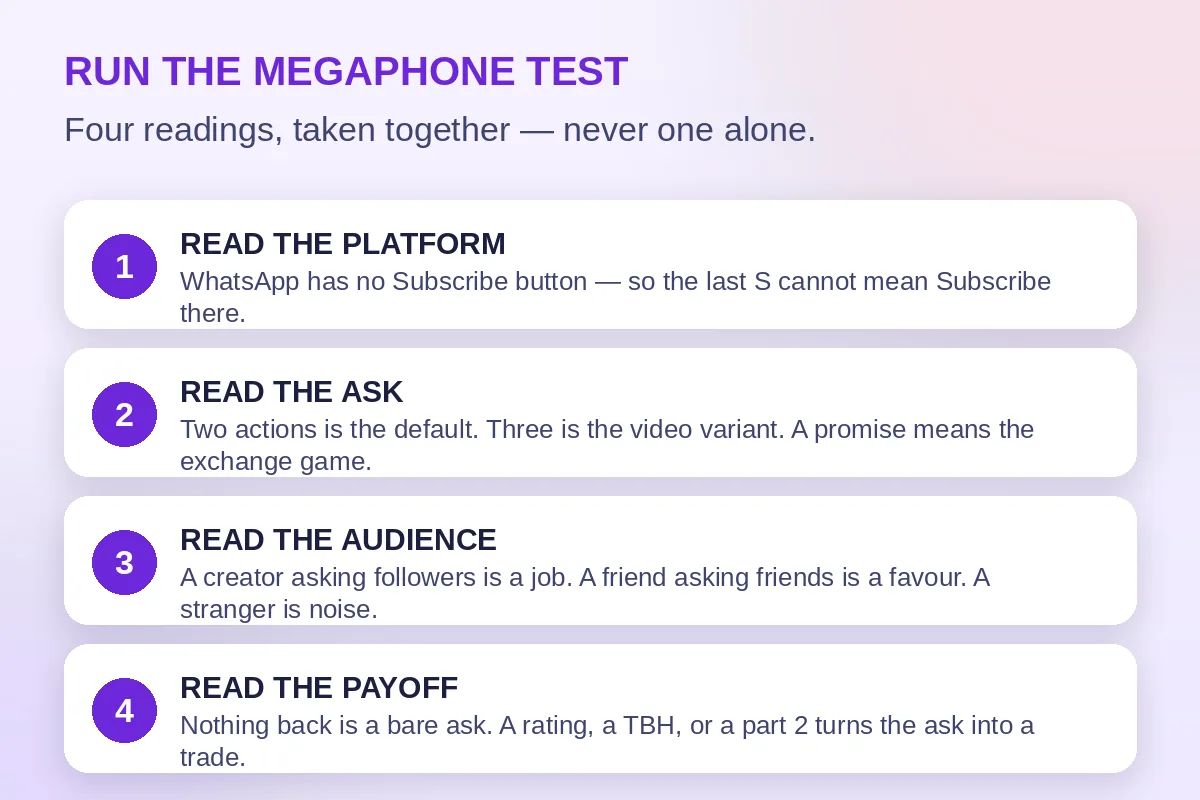
Because LMSS is a shout into a crowd, the test is a megaphone. Every LMSS is an ask with four parts — read all four before you answer it.
Check one is READ THE PLATFORM. What can people even do here? WhatsApp Status lets people like and share, but it has no subscribe button — so the last S cannot mean Subscribe there. YouTube has a subscribe button, so there it can. If the platform cannot do the action, the letter does not mean that action.
Check two is READ THE ASK. How many actions are packed into the four letters? Two actions — like and share — is the default. Three actions — like, share, and subscribe — is the video variant, and it usually arrives with a video attached. One action with a promise attached — "LMSS for a rating," "LMSS for a TBH" — is the exchange game, and the promise is the real message.
Check three is READ THE AUDIENCE. Who is being asked? A creator asking followers is doing a job: promotion, stated plainly. A friend asking friends is asking a favour, and the favour is small. A stranger asking a group chat is making noise, and the group is allowed to ignore it.
Check four is READ THE PAYOFF. What does the liker get? Nothing — a bare "LMSS please" — is a bare ask, and you should like the post only if you like the post. A rating, an honest opinion, or a part two is an exchange: the like is the price of admission, and the exchange-game section below explains the deal. Try it: "New song out now, LMSS for a rating" on WhatsApp means no Subscribe, a like-plus-share ask, friends as the audience, and a rating as the payoff. Four readings, one answer: the exchange game.
The Four Letters, Decoded
The letter-by-letter map is the new element this batch adds: one map you can check in seconds, because the final S is the only letter that ever moves.
L is Like, and it is the one action every version agrees on. The sender wants a tap on the heart, a thumbs-up — the smallest public signal that someone saw the post and approved. M is My, and it is the word that makes LMSS personal. The sender is not asking you to like good content in general. They are asking you to like their content, their post. That is why LMSS feels pushy from a stranger and warm from a friend: "my" means something different depending on whose it is.
The first S is Status, and it is the word that dates the abbreviation. LMSS was born in the era of the Facebook status and the WhatsApp Status — the short update that vanishes after a day. On WhatsApp the word is literal: a Status is a feature with a name. On Instagram and TikTok the "status" is the post, the story, or the video — whatever the person just put up.
The second S is the moving part, and it has three honest jobs. On most platforms it means Share: pass the post on to your own people. On video platforms it can mean Subscribe: follow the channel so the next video finds you. In exchange games it means Seriously: actually do it, I mean it, this one counts. The platform tells you which: Share where sharing exists, Subscribe where subscribing exists, Seriously where a promise is attached. The one thing the second S never means is Message, and it never means Story: those two expansions appeared only in the old article's table, and no source anywhere supports them.
LMSS on TikTok, Instagram, Snapchat, WhatsApp, and Text Messages
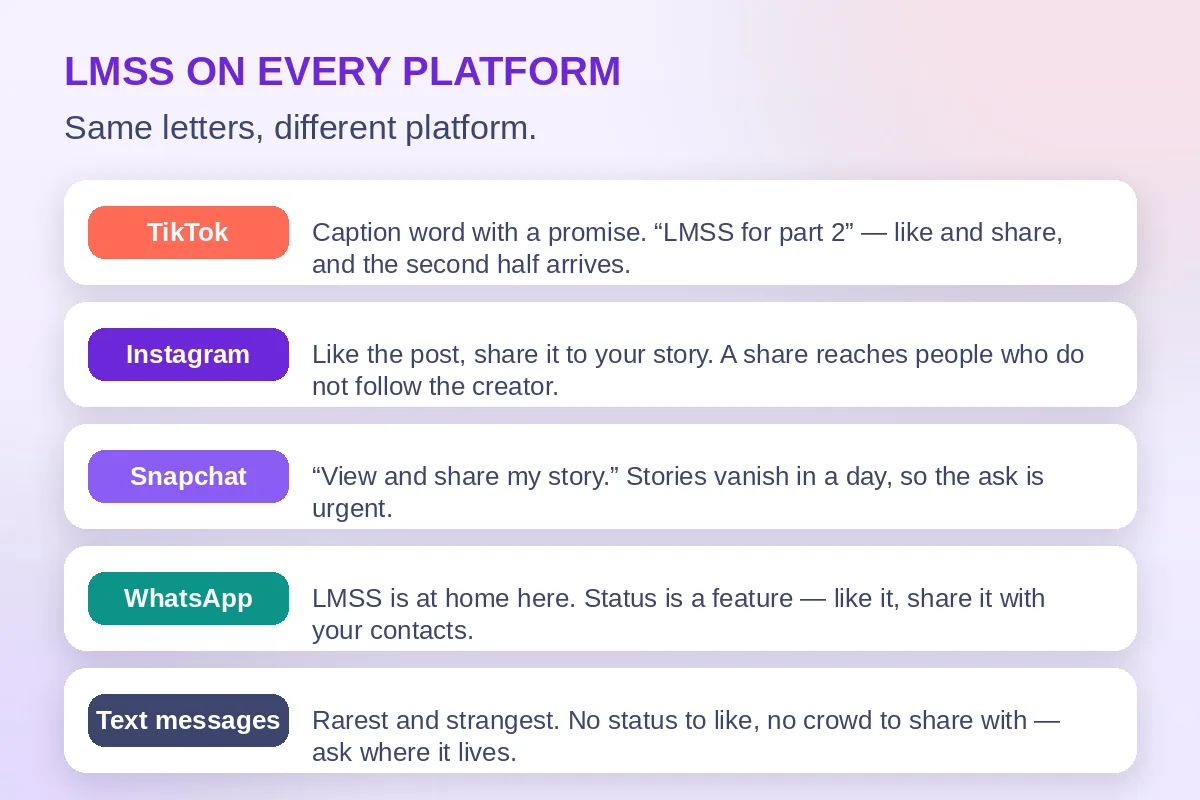
On TikTok, LMSS is a caption word, and it usually arrives with a promise. "LMSS for part 2" is the commonest shape: like the video and share it, and the creator will post the second half. The promise is the engine — without it, a bare LMSS in a TikTok caption is easy to scroll past. The guide to fyp meaning in text explains the feed LMSS is trying to reach: the For You page, where a like and a share are the two signals that matter most.
On Instagram, LMSS works the same way with a different stage. It sits at the end of a caption or on a story, asking followers to like the post and share it to their own stories. A story share is worth more than a like here, because a share puts the post in front of people who do not follow the creator at all.
On Snapchat, LMSS means "view and share my story." Snapchat stories disappear in a day, so the ask is urgent in a way it is not elsewhere: like it now, share it now, or it is gone. The exchange game lives here too: "LMSS for a rating" is one of the abbreviation's oldest shapes.
On WhatsApp, LMSS is at home. WhatsApp has a feature literally called Status, and LMSS was built for it: like my status, share it with your contacts. People use it on status updates, event announcements, and small-business posts.
In plain text messages, LMSS is the rarest and the strangest. A text message has no status to like and no crowd to share with, so a bare "LMSS" in a one-to-one chat usually means the sender copied a caption into the wrong place — or that they are asking you, personally, to go and find their post. The right answer is a question, not a like: "LMSS where — your status or your video?"
Who Sent It: Creator, Friend, Crush, Group Chat, or Stranger
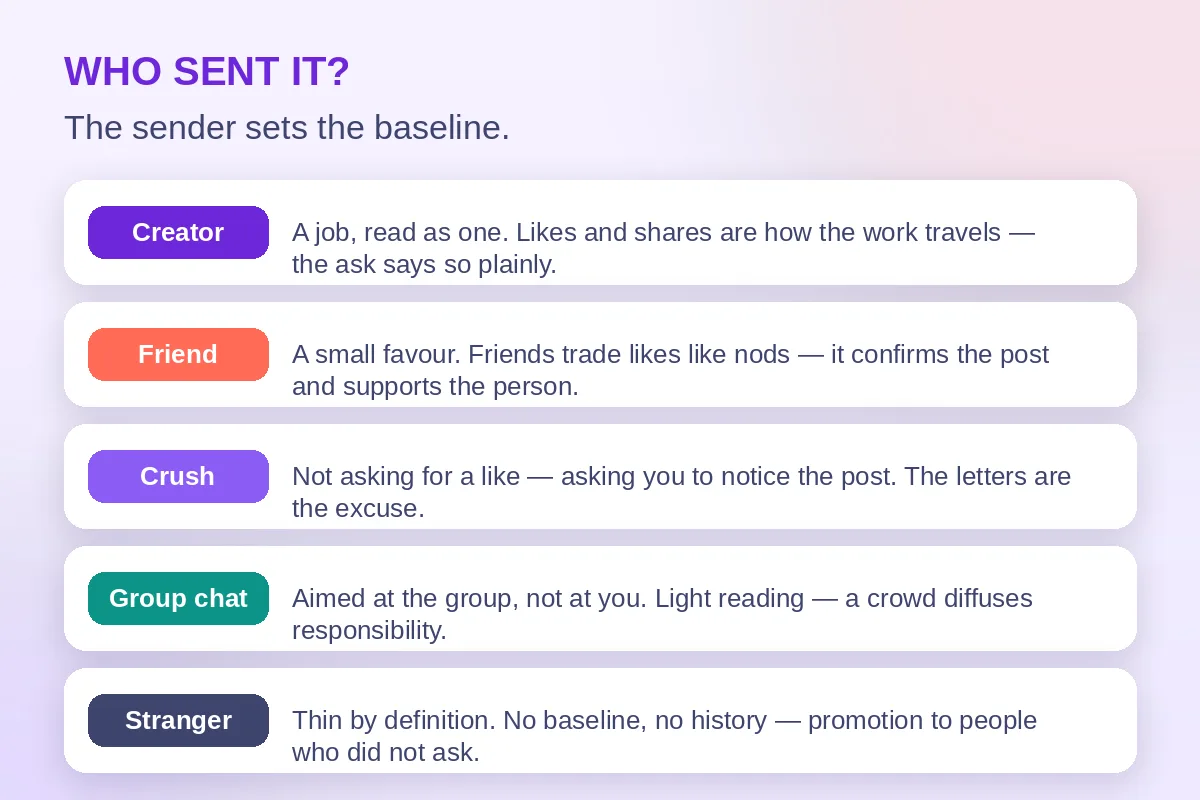
From a creator, LMSS is a job, and it should be read as one. Creators ask for likes and shares because that is how their work travels, and the ask is honest about it: four letters instead of a paragraph. The question is whether the post is worth the like, and only the post can answer that.
From a friend, LMSS is a favour, and it is usually a small one. Friends trade likes the way they trade nods: it confirms the post and supports the person. The only version that stings is the exchange-game version from a friend who never returns the favour — the rating that never comes, the TBH that never arrives.
From a crush, LMSS does quiet extra work, and the tell is the same as ever: the effort around it. A crush who posts "LMSS" is usually not asking you for a like. They are asking you to notice the post — the photo, the song, the status — and the four letters are the excuse to put it in front of you.
From a group chat, LMSS is aimed at the group, not at you, and it deserves a light reading. Someone drops a link to their new video with "LMSS" underneath, and the ask is spread across twenty people at once. Nobody in particular owes them a like, and the group-chat version is the version most likely to be ignored completely, because a crowd diffuses responsibility.
From a stranger, LMSS is thin by definition. There is no baseline, no history, and no reason to care about their status. A stranger's "LMSS" in a public comment or a random message is promotion to people who did not ask for it. You owe it nothing. Scroll on, and spend the like on a post you actually enjoyed.
LMSS for a Rating, a TBH, and Part 2 — The Exchange Game
This is the one place LMSS has a genuine social function beyond a bare ask — the first exchange game the project has decoded in full. The deal is simple: like my status, and I will do something for you in return — usually a rating, an honest opinion, or a second part.
"LMSS for a rating" is the oldest shape. You like the person's status, and they rate yours — photo, outfit, profile — usually one to ten, sometimes with a comment. The rating is the payoff, and the like is the ticket. The guide to tbh meaning in text covers the sibling deal: "LMS for a TBH" is the same game with a different prize, an honest opinion instead of a number.
"LMSS for a TBH" works the same way. Like the status, and the person tells you honestly what they think — a compliment, a joke, a verdict. The honesty is the point: a TBH is worth more than a rating because it takes thought, and the like is a small price for a real opinion. The guide to ngl meaning in text shows how that honesty is usually framed — "not gonna lie" is the softener that makes a blunt TBH survivable.
"LMSS for part 2" is the creator's version of the same deal, and it is the one that travels furthest. Like and share this video, and the creator will post the second half. The payoff is content, not a compliment — but the shape is identical: do this for me, and I will do that for you. The deal only works if the creator keeps it. A part 2 that never arrives is the fastest way to turn an audience against a creator.
There is a warning that belongs here, because the exchange game has a cost the old article never mentioned. Ratings and TBHs are public and permanent in screenshots, and a low rating or a blunt TBH can sting in a way a bare like never will. The game is voluntary on both sides: nobody has to like, and nobody has to ask. If the deal feels like pressure — a friend who keeps score, or a stranger demanding a like before they will speak to you — step out of the game, not into it.
How to Answer LMSS — and How to Ask Better Than LMSS
Answering an LMSS is easy once you have read it with the Megaphone Test. A bare ask from a friend deserves a like if you liked the post — and nothing at all if you did not. An exchange offer deserves the deal or a pass: like it and claim the rating, or scroll on. A bare ask from a stranger deserves nothing; your like is not a public service. If you are the one asking, write the ask out: "New song is out — a like and a share would mean a lot" beats "LMSS" every time. When the conversation is done for the night, the guide to ttyl meaning in text covers the clean exit, and if you need to step away mid-chat, the guide to brb meaning in text shows how that pause works. If you want someone to tell you something later, the guide to lmk meaning in text shows how that handoff works, and the guide to wtm meaning in text shows why a plan question deserves a plan in reply.
Caption Rewrites: Five LMSS Asks Rewritten Warm
This is the upgrade this batch adds over the previous one: instead of only teaching you to read an LMSS, it shows you how to write a better one. The letters stay out of every rewrite.
One: the new song. Cold: "New song out now LMSS." Warm: "New song is out — if you like it, a share would mean the world."
Two: the new photo. Cold: "New pic LMSS." Warm: "New photo from the trip — likes and shares appreciated."
Three: the new video. Cold: "New video LMSS for part 2." Warm: "Part 1 is live — like and share it and part 2 goes up tomorrow."
Four: the event invite. Cold: "Event on Saturday LMSS." Warm: "We are playing Saturday — share this with anyone who might want to come."
Five: the small-business post. Cold: "Sale ends today LMSS." Warm: "Sale ends tonight — a share helps a small shop more than you know."
LMSS vs LMS, LSS, SFS, and F4F
LMS is the root: "Like My Status," one ask, no second action. LMSS adds the second S — Share, Subscribe, or Seriously — and asks for two things at once. LSS is a different abbreviation, not a shorter LMSS: "Like, Share, Subscribe" is a creator's checklist with no "my" in it, and it belongs on videos, not statuses. SFS is a trade, not an ask: "shoutout for shoutout" means I promote you and you promote me, and the guide to sfs meaning in text explains that deal. F4F is the same shape for followers: "follow for follow."
Readings This Article Refuses to Count
Here are the readings investigated and declined. First, "Like, Message, Share, Subscribe" and "Like My Story, Share, Subscribe" — the old article's own inventions, found in no guide or dictionary anywhere. Both are withdrawn. Second, "Let Me See Something" — that is LMS in a private chat, not LMSS, and the one source that lists it for LMSS contradicts itself on the same page. Third, "Laughing My Socks Off" — one AI-written blog, no attestation anywhere else, not counted. Fourth, the popularity claims — "commonly used," "widely used," "popular" — made on the basis of nothing. Withdrawn in full. Fifth, the algorithm claim: no source supports the idea that platforms reward LMSS likes with extra reach, so it is withdrawn too.
Quick Answers
What does LMSS mean in text?
Most often "Like My Status and Share." On video platforms, "Like My Status, Share, and Subscribe"; in exchange games, "Like My Status Seriously."
Is LMSS rude?
No — a direct, usually friendly request for likes and shares. Pushy only from a stranger, or under every post.
What does "LMSS for a rating" mean?
Like my status and I will rate yours, usually one to ten. The like is the price of the rating.
Does LMSS mean the same thing on every platform?
No — Share on WhatsApp and Instagram, Subscribe on YouTube, Seriously in exchange games. The platform decides.
Can I use LMSS in a private text message?
You can, but it fits badly: a private chat has no status to like and no crowd to share with. Ask directly instead.
What is the best reply to LMSS?
Like the post if you like it. If a rating or part 2 was promised, claim it. A stranger's ask deserves nothing.
Final Thoughts
LMSS is four letters doing the work of a sentence: like this, share this, and maybe subscribe, or maybe rate me back. Read the platform, the ask, the audience, and the payoff, and the letters stop being a puzzle. And when it is your turn to ask, write the sentence. A real ask, in real words, is worth more than any abbreviation.