
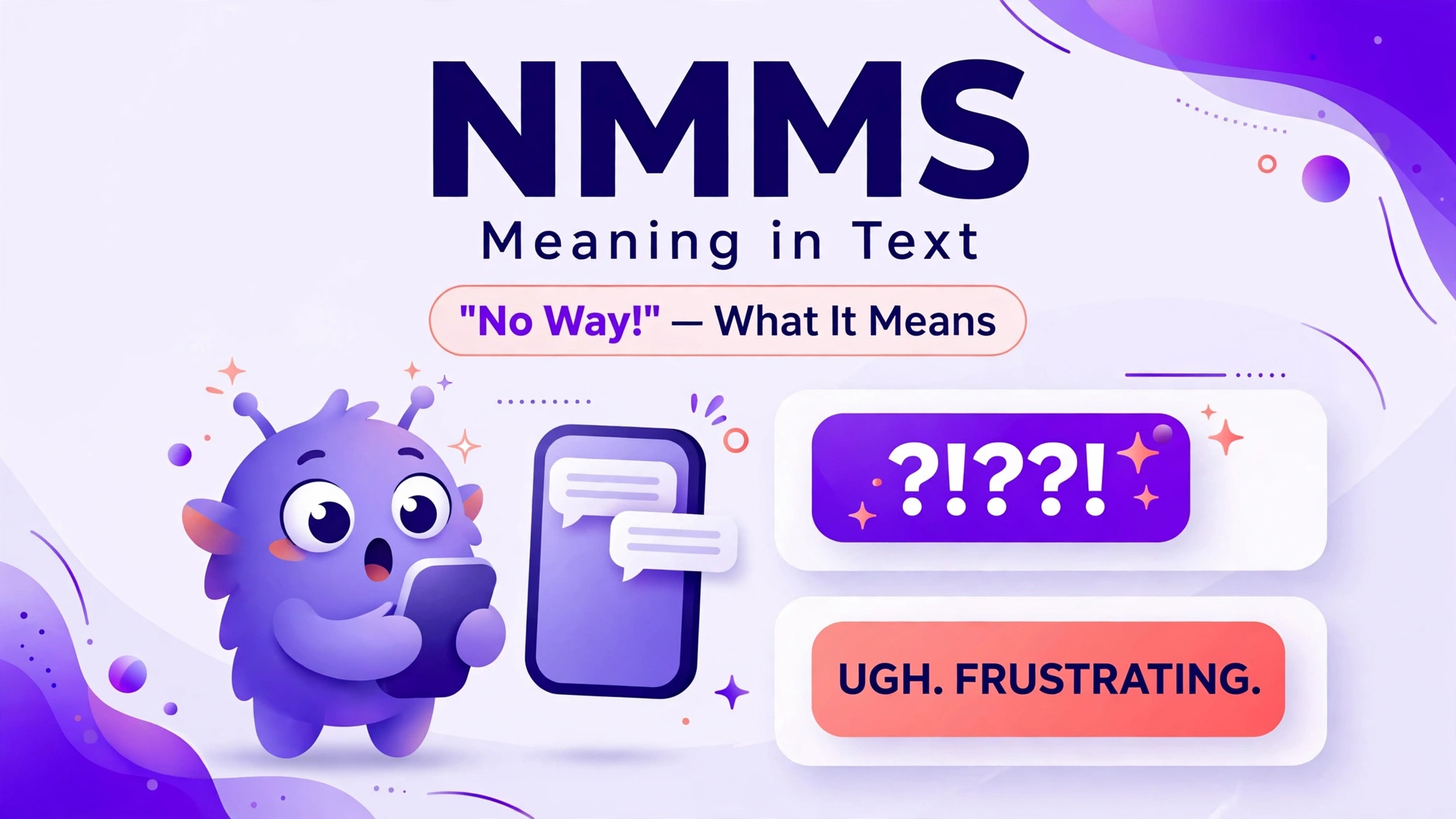
If a friend just sent you “nmms” and you cannot tell whether to laugh or apologize, this page will help. The nmms meaning in text is a reaction, not a statement. In some bilingual and Mexican Spanish online conversations, NMMS is used as a consonant-style shortening of “no mames.” The full phrase is crude Mexican Spanish slang. In plain English it is closest to “No way!”, “You’re kidding me!” or “Are you serious?”
NMMS is niche and context-dependent. Many Spanish speakers know the full phrase, but the shortening is not universally understood, even by fluent speakers. Read it with the messages around it, and do not use it in formal or workplace messages.
Why Those Four Letters Look Confusing at First
NMMS looks like an English initialism, the kind of thing that should stand for four English words. It does not. It keeps the consonant skeleton of a Spanish phrase, N, M, M, S, in the way English texting drops vowels in words like “pls” or “tmrw.”
Where the letters come from
Dictionaries treat the full phrase, not the shortening, as the main entry. Dictionary.com describes “no mames” as Mexican Spanish slang used to express disbelief or excitement, with equivalents such as “no way” and “you’re kidding me.” The Collins Spanish–English Dictionary gives it the same very informal, distinctly Mexican register. Wiktionary lists “nmms” as an alternative form of the phrase, labelled for Internet slang and text messaging. That is how the shortening turns up in chats, even though it has no dictionary entry of its own.
One brief note on the literal side. The phrase is built on a vulgar verb, which is why references label it crude. There is no polite word-for-word translation, and you do not need one. What matters is the reaction it expresses.
How to say the full phrase
If you hear it spoken, the full phrase sounds roughly like “noh MAH-mehs,” with the stress on the first syllable of the second word. People say the full phrase out loud. The shortening mostly lives in writing.
How to Understand NMMS From the Messages Around It
NMMS carries feeling more than information, so its exact tone depends on the conversation. The clues below can help you read it, but they cannot guarantee what the sender meant. If the meaning is still unclear after checking them, ask the sender what they meant.
Start with the message right before it
The sender is reacting to whatever came just before. Good news can pull NMMS toward amazement. A delay, a price or a piece of bad luck can pull it toward frustration. A claim that sounds hard to believe can pull it toward “I don’t believe you.” Reread the line above the four letters before you decide.
Punctuation adds emphasis
An exclamation mark makes the reaction feel sharper and louder, as in “NMMS!” The same letters inside a sentence, as in “nmms, the store was already closed,” can feel softer and more throwaway. Repeated letters or repeated messages can raise the intensity. A full stop may make a message feel more abrupt or annoyed, depending on the conversation. Punctuation is a supporting clue. It does not create a new meaning on its own.
Emojis add feeling
One emoji can change how a message feels. A shocked face or raised hands can point toward amazement. A laughing emoji can make it sound like teasing disbelief. An eye-roll emoji or an angry face can point toward frustration. Emojis are supporting clues, not definitive proof. Read them together with the message before it.
Consider your relationship with the sender
NMMS can sound playful between close friends who already trade this kind of slang. Relationship alone does not establish tone, though. From someone you barely know, the same reaction can feel confrontational, because there is no shared joke to soften it. If you are unsure, a short, friendly check is better than guessing.
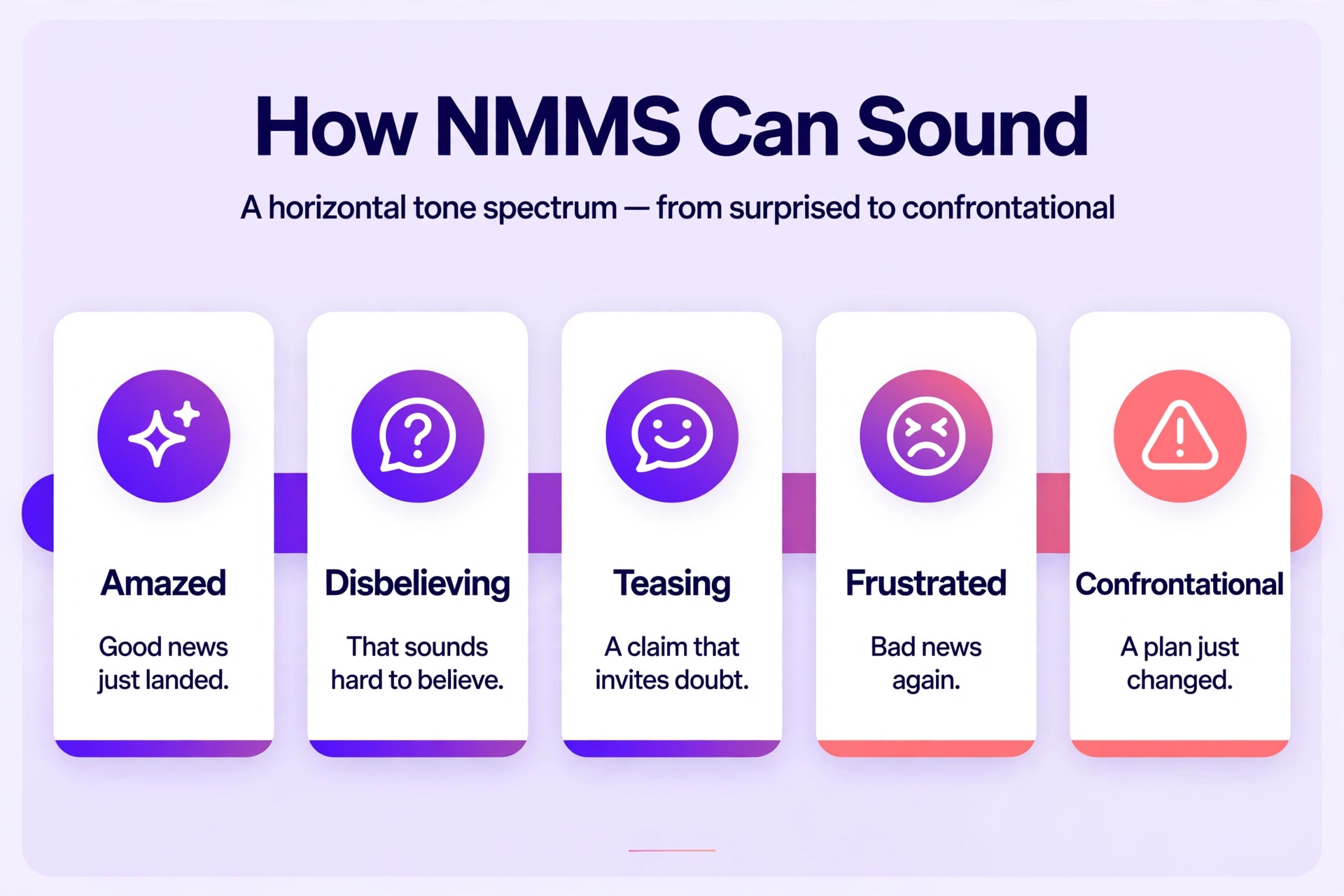
Five Ways the Same Four Letters Can Sound
The short exchanges below are invented examples. They are not real quotations. They show how the same letters can sound different in different conversations.
Amazed, when the news is good.
Example: “I passed my driving test on the first try!!”
Example reply: “NMMS! Finally. Dinner is on me.”
The congratulations after the reaction point to celebration, not disbelief aimed at you.
Disbelieving, when the news sounds hard to believe.
Example: “Tickets sold out in two minutes, I swear.”
Example reply: “nmms. Did you actually get any?”
The follow-up question suggests the sender wants the rest of the story, not that they are calling anyone a liar.
Teasing, when a claim invites doubt.
Example: “I ate thirty tacos in one sitting.”
Example reply: “nmms lol. Pics or it didn’t happen.”
The “lol” keeps the example friendly. This reading is closer to “stop messing around,” aimed at the claim rather than the person.
Frustrated, when the news is bad.
Example: “The bus got cancelled again.”
Example reply: “NMMS. Third time this week.”
A full stop and a complaint straight after can point to frustration with the situation.
Surprised complaint, when a plan changes.
Example: “Coach moved practice to 6 a.m. on Saturday.”
Example reply: “NMMS?? You’re joking.”
The double question mark adds surprise. In this example, the sender seems to hope the news is not real.
What to Send Back
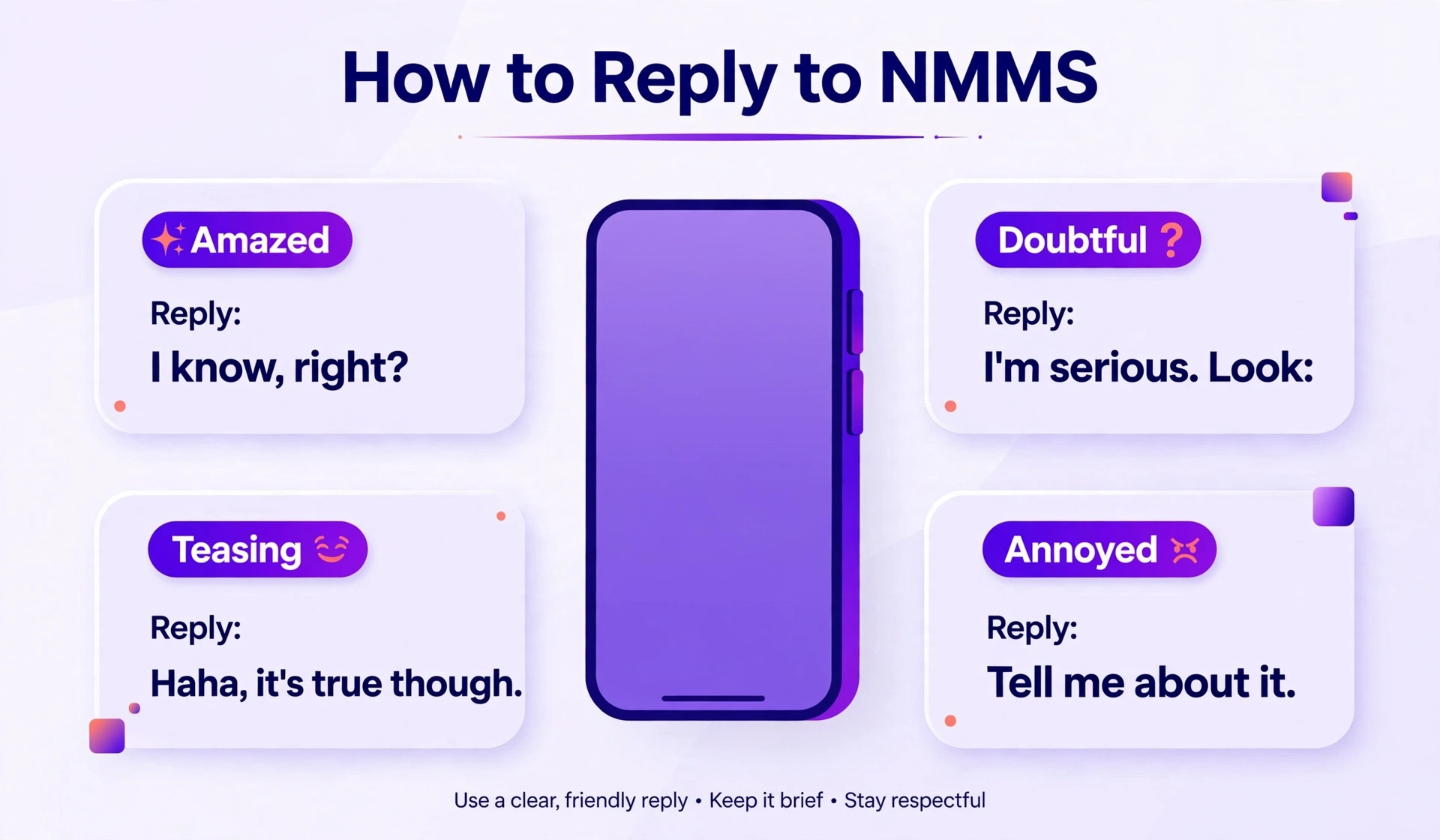
You rarely need Spanish to answer. Match the sender’s energy where you can, and reply in the language the chat is already using.
If the news was yours
- “I know, right? I couldn’t believe it either.”
- “Right?? It still doesn’t feel real.”
A short, happy confirmation is usually enough for an amazed reaction.
If they do not believe you
Treat it as a request for more detail, not as an insult.
- “I’m serious. Look:” followed by the photo, link or screenshot.
- “Haha, I knew you’d say that. It’s true though.”
If the tone feels annoyed
Agree with the frustration instead of arguing with it.
- “Tell me about it. Third time this week.”
- “I know. Want to sort it out together?”
If you would like to answer in Spanish, the milder option in the next section is safer to borrow.
A Milder Way to Say the Same Thing: No Manches
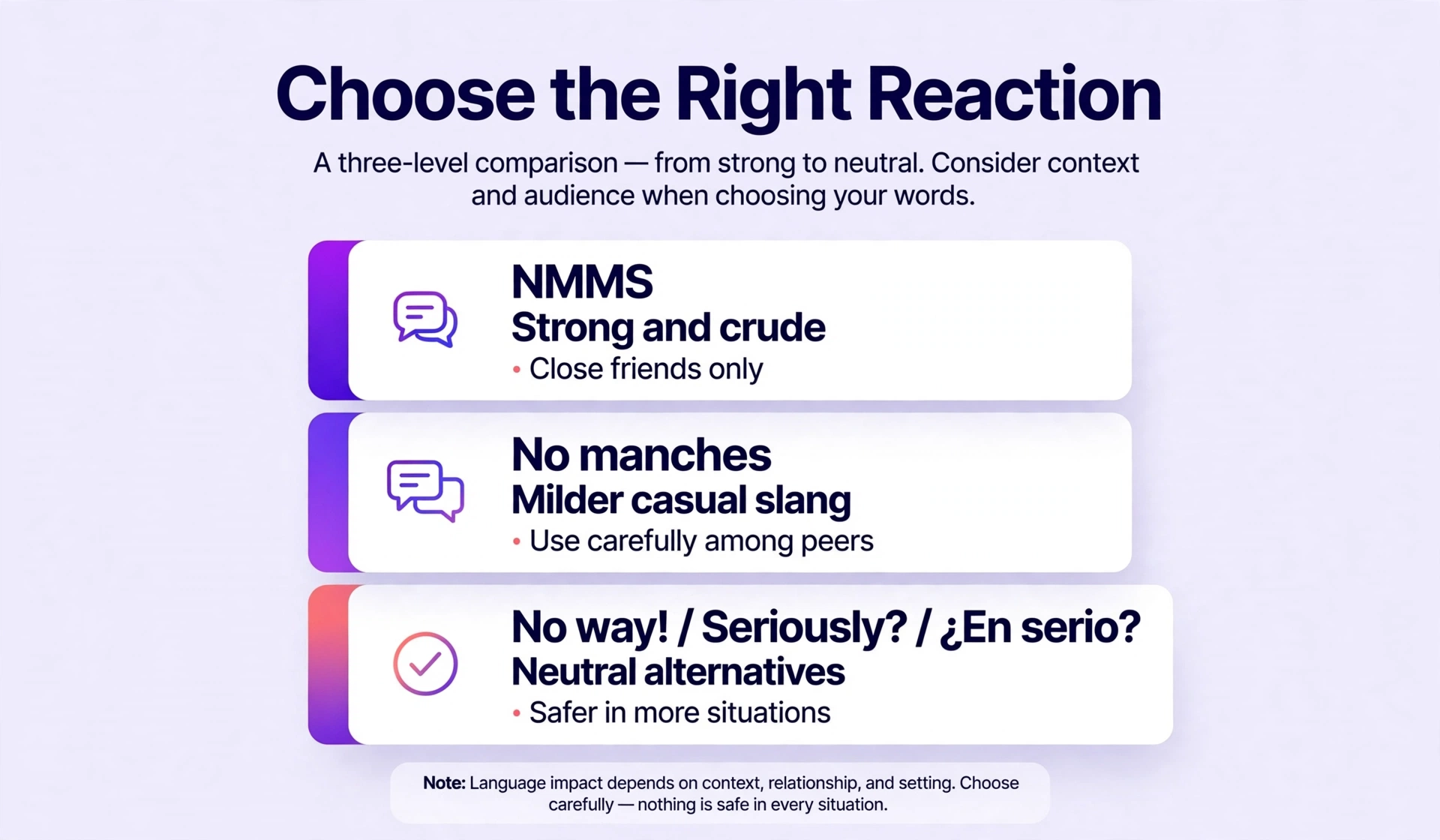
Spanish has a softer version of the same reaction: “no manches.” It can express “no way” or “you’re kidding” without the vulgar verb underneath the stronger phrase.
Think of three levels. At the top is NMMS and its full phrase, the strongest and crudest option. In the middle is “no manches,” still casual slang, but milder. At the bottom are neutral options that fit more situations: “No way!”, “Seriously?” or, in Spanish, “¿En serio?” Neutral wording is generally safer, but no reply is appropriate in every situation. If you are borrowing slang you did not grow up with, start one level lower than the person you are talking to.
When NMMS Does Not Belong
NMMS does not belong in formal or workplace communication. Avoid it in an email to a manager, a message to a teacher, a client thread, a job application chat, or a group chat run by your employer. The same caution applies with older relatives you do not know well and with strangers.
There is also a practical risk. A reader who does not know the shortening may not decode it as Spanish at all. One short message can then leave you misunderstood and sounding unprofessional at the same time.
The Other NMMS in Search Results
In India, the same letters point to education. The formal scheme is the National Means-cum-Merit Scholarship Scheme, abbreviated NMMSS in Ministry of Education material. In everyday use, schools and exam pages often shorten the related selection exam and scholarship to NMMS. Selection is at Class 8, with support through Classes 9 to 12. That use has nothing to do with texting.
Three Mix-Ups That Change the Meaning
NM is not a shorter NMMS. NM usually means “not much” or “nothing much,” as a calm answer to “what’s up?,” or it can mean “never mind.” It is a reply, not a strong reaction.
OMG, WTF and SMH are not translations. OMG is a neutral shock reaction. WTF is stronger and also vulgar, and it can add anger or disgust. SMH signals disapproval, like shaking your head at someone. NMMS can do a job similar to OMG, but with a cruder edge.
NMMS is not automatically an insult. A strong reaction can look personal, but it is often aimed at the news, not at you. Check the message before it and any emoji beside it before taking offence.
Frequently Asked Questions
What does NMMS mean in a text message?
In some bilingual and Mexican Spanish chats, NMMS is a consonant-style shortening of a crude slang phrase that expresses disbelief or surprise. In English, it is close to “No way!” or “You’re kidding me!”
Is NMMS a bad word?
In effect, yes. The full phrase is crude, vulgar Mexican Spanish slang, and the shortening carries the same register. Treat it as swearing, even between friends.
Can I use NMMS at work or with a teacher?
No. Use “No way!” or “Seriously?” instead. They carry the surprise without the vulgarity.
What is the difference between NMMS and no manches?
They express a similar reaction. NMMS shortens the stronger, vulgar phrase. “No manches” is the milder version, and it is safer to copy if you want to reply in Spanish.
How do you pronounce the full phrase?
Roughly “noh MAH-mehs,” with the stress on “MAH.” The full phrase is what people say out loud. The shortening is mainly written.
Does NMMS in capital letters mean something different from nmms in lowercase?
No, not on its own. Capital letters are the standard way to cite an abbreviation, and lowercase is how it often appears in a chat. Capitalisation alone does not determine meaning.
What should I reply when someone sends me NMMS?
Match the energy if you can. For good news, try “I know, right?” If they doubt you, share the proof. If they sound annoyed, agree first, for example “Tell me about it.” If you are still unsure what they meant, ask them.
Does NMMS also mean a scholarship?
Yes, in a different context. In India, the letters NMMS are used for the scholarship and exam linked to the National Means-cum-Merit Scholarship Scheme. That meaning belongs on education pages, not in chat.
The Short Version to Remember
NMMS is a written, consonant-only shortening of a crude Mexican Spanish reaction, close to “no way” said with feeling. It belongs only in casual chats with people who already talk that way with you. When you are unsure what it meant, reread the message before it, look at the punctuation and any emojis, and ask the sender if it is still unclear. When you are unsure what to send back, a neutral reply is generally the safer choice.
