
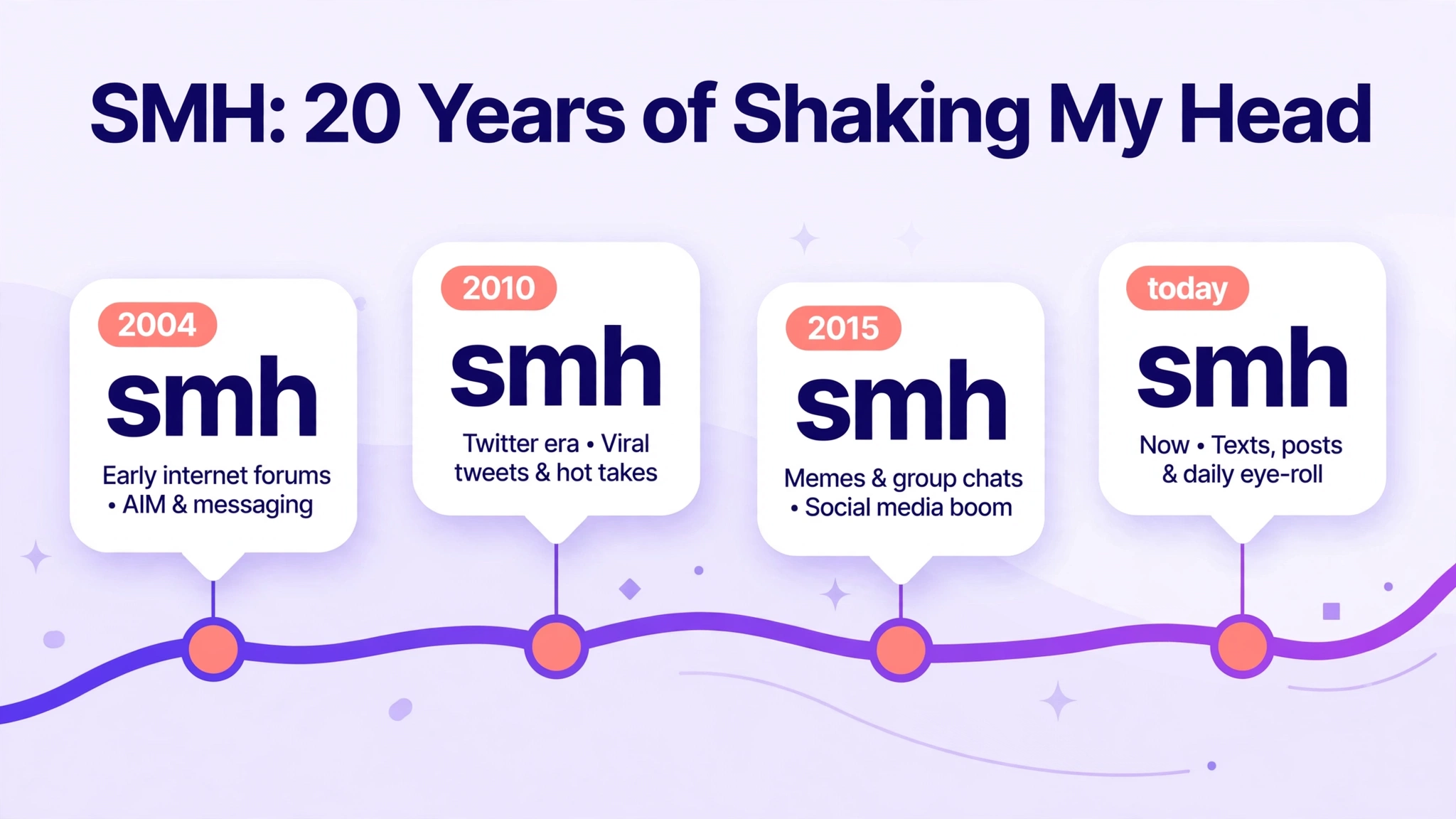
Twenty years old and still the perfect reaction. “SMH” — shaking my head — is the internet’s oldest continuously-used reaction acronym: born in early-2000s forums, defined on Urban Dictionary in February 2004, carried through Twitter, memes, GIFs, and Snapchat into the group chats of today. It has outlived platforms, outlasted trends, and spawned a whole variant family.
If you’re looking up the smh meaning in text, you know the basics: disappointment, disbelief, dismay. This guide goes deeper — the documented 20-year timeline, the SMDH/SMFH variant family (handled with care), the tone forensics, the psychology of why head-shaking “clicks,” and when SMH lands wrong.
The Short Answer
| Question | Answer |
|---|---|
| What it means | “Shaking my head” — disappointment, disbelief, or dismay |
| What it does | Reacts to something foolish, frustrating, or facepalm-worthy — without words |
| Tone | Ranges from playful (“smh 😂”) to weary (“smh…”) to stern (“SMH.”) |
| Where it sits | Usually standalone, as a complete reaction |
| Register | Casual everywhere — texts, comments, Twitter/X, group chats, Slack |
| Formal alternative | “That’s disappointing” or “I can’t believe that” spelled out |
The 20-Year Timeline
Most slang is born and dies in a year. SMH has a documented two-decade history — and the dates are the differentiator:
Early 2000s — the forums. SMH emerges in internet forums and instant messaging (the Yahoo!/AOL era), alongside the first generation of reaction acronyms. No single inventor; it’s folk language.
February 14, 2004 — Urban Dictionary. User “trickologist” posts the defining entry: SMH is for “something so stupid, no words can do it justice.” 20,000+ upvotes over the years. This is the canonical definition, and it’s perfect — SMH was never about the head-shake, it was about the speechlessness.
2009–2012 — the mainstream years. Twitter and Facebook carry it from forums to everyone. The 140-character limit loves it: a whole reaction in three letters.
2010 — the hip-hop co-sign. Jimmy Dade releases the track “SMH.” Slang that gets a song title has officially arrived.
2013 — the thinkpiece. Vice publishes “What Does ‘Shaking My Head’ Even Mean Anymore?” — the moment a slang term gets a Vice explainer is the moment it’s fully mainstream.
2015 — the meme/GIF era. SMH becomes visual: reaction GIFs, image macros, the head-shake as content. /r/BlackPeopleTwitter makes it a staple reaction.
2016+ — the emoji successor. Snapchat adds the shaking-hand emoji; the gesture goes pictographic. But the letters survive — because sometimes “smh” in text hits different from an emoji.
Today — the dictionary. Merriam-Webster lists it. Twenty years from forum slang to the dictionary: that’s longevity no competitor’s “it started in chatrooms” hand-waving can match.
The Variant Family
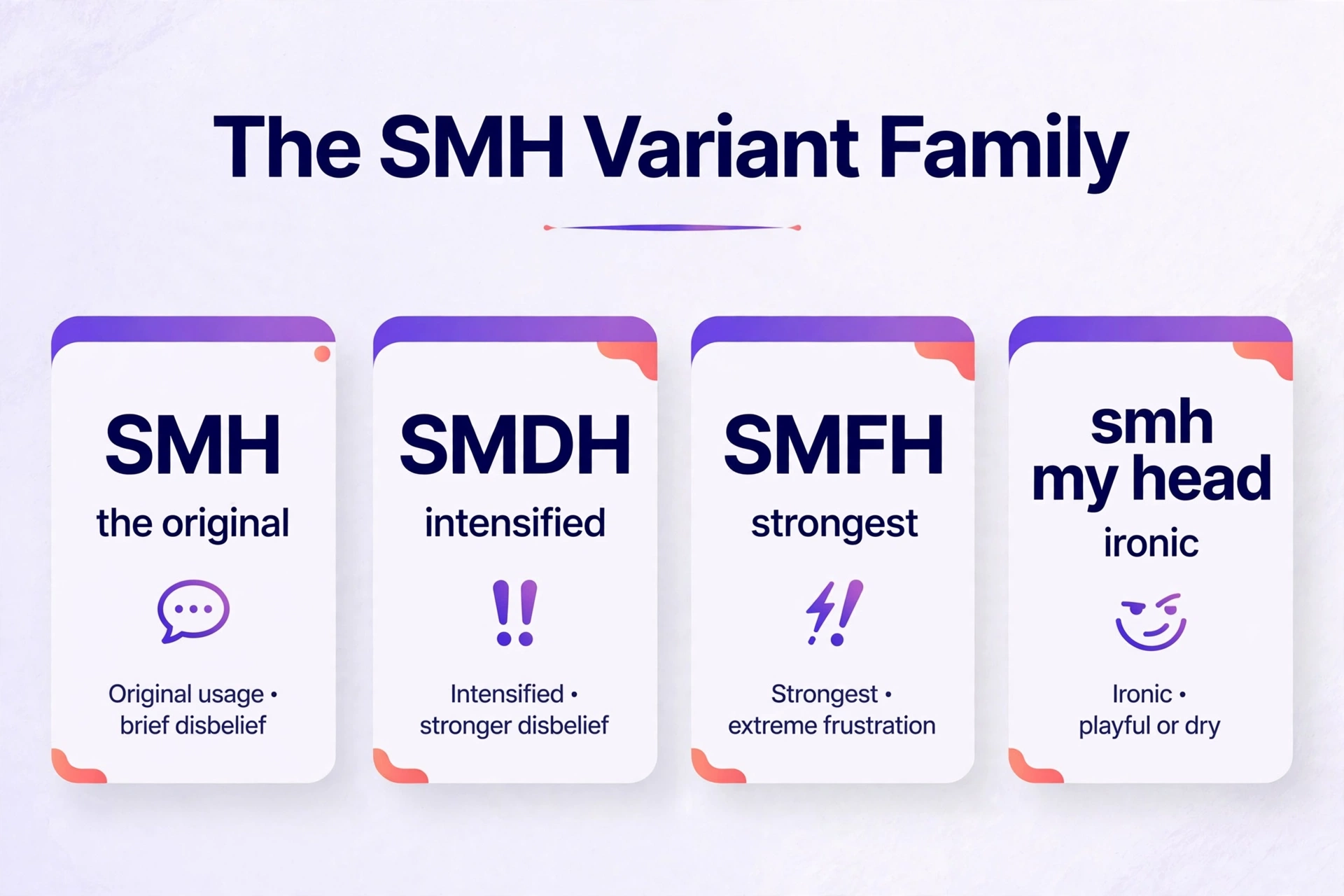
SMH didn’t just survive — it reproduced. The variant family is what makes this article the definitive reference:
SMH — the original. “Shaking my head.” Disappointment, disbelief, dismay. The all-purpose reaction.
SMDH — “shaking my d— head.” The intensifier (Urban Dictionary, June 2007). Same reaction, more emphasis — the profanity is doing volume work, not adding meaning. Masked here per policy; never spelled out in polite contexts.
SMFH — stronger still. The nuclear variant. Rare in friendly contexts; common in venting. Same masking rule.
“smh my head” — the ironic redundant. Literally “shaking my head my head.” Deliberately wrong, funny on purpose — the same joke mechanics as “ATM machine.” If someone types this, they’re in on the joke.
Case matters:
- Lowercase “smh” — casual, conversational. The default in texts.
- Uppercase “SMH” — emphatic, formal-ish. More weight, more judgment.
- “smh” + 😂 — playful. The laughing emoji converts disappointment into comedy.
- “smh…” — weary. The ellipsis is exhaustion: I don’t even have the energy.
- “SMH.” — stern. The period is a gavel: this is genuinely bad.
The variants follow the same vulgar policy as the rest of the site: named as variants in masked form, explained honestly, never spelled out in headings, SEO fields, or image text.
Tone Forensics: Reading the Reaction
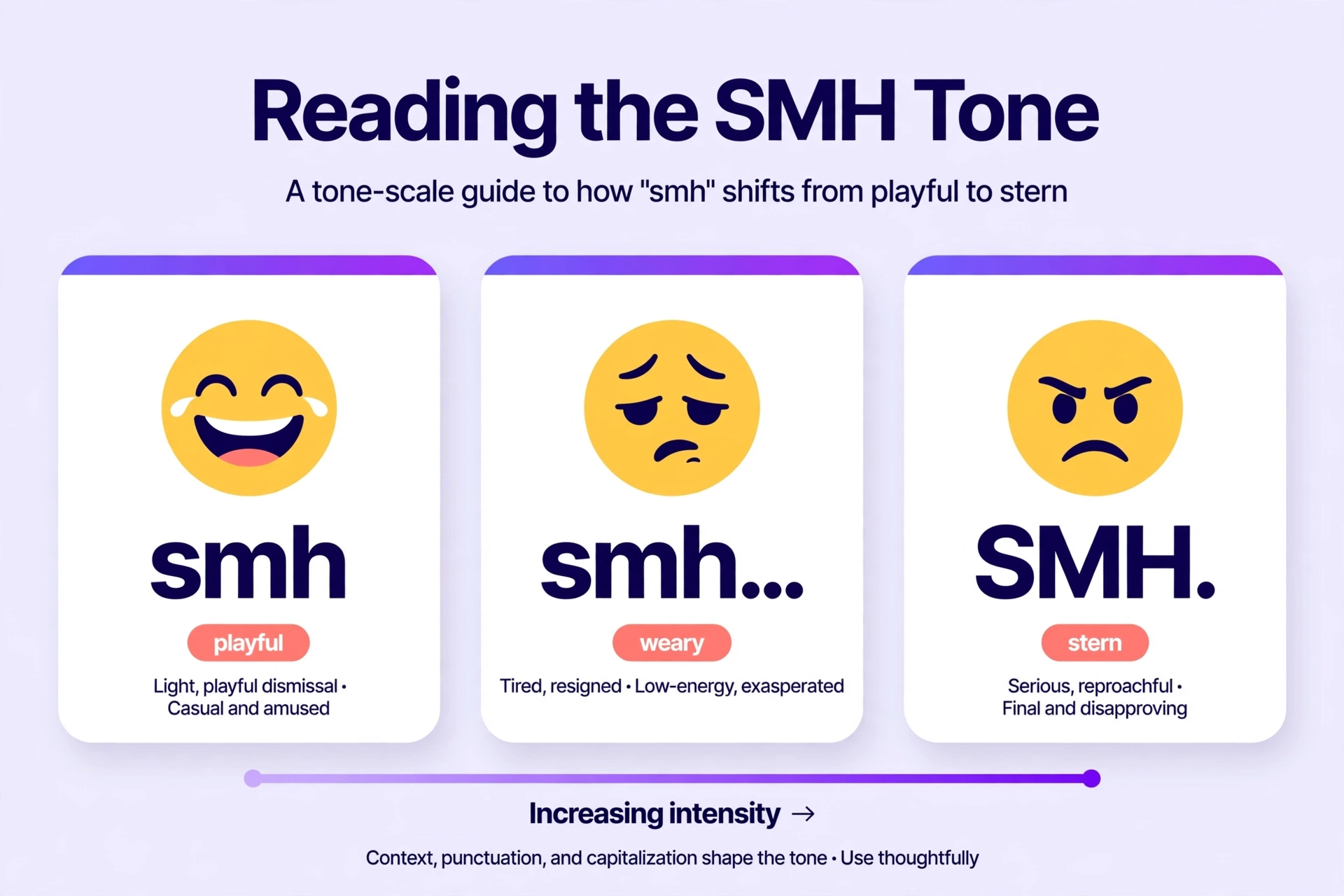
SMH is a reaction, and reactions have temperatures. Here’s the decoder:
“smh 😂” — playful disbelief. This is so dumb it’s funny. The laughing emoji is doing all the tonal work. Safe, friendly, common.
“smh…” — weary resignation. I’ve seen this before and I’m tired. The ellipsis stretches the disappointment into exhaustion.
“smh” (bare, lowercase) — mild disappointment. The default. Not great.
“SMH” (uppercase, bare) — stronger judgment. This is actually bad. The caps add gravity.
“SMH.” (with period) — stern, final. I’m done with this. The coldest common form.
“smh bro” / “smh my guy” — directed disappointment. The addressee makes it personal: you did this.
When it lands wrong: SMH is for mild-to-moderate negative reactions — foolishness, facepalms, everyday disappointments. Aiming it at genuine tragedy reads as callous (one source puts it well: it’s for “mild to moderate negative reactions, not serious tragedies”). Someone’s bad news gets sympathy, not “smh.” Match the reaction to the weight.
The Psychology Hook: Why It Clicks
Here’s the memorable bit, from the research: head-shaking is one of the earliest negation gestures humans learn. Infants shake their heads to refuse food long before they can speak — it’s pre-verbal, cross-cultural, neurological. The gesture means no at a level deeper than language.
That’s why “smh” works as text. It’s not just an abbreviation — it’s a gesture compressed into letters. When you type “smh,” you’re performing a physical reaction your reader’s brain recognizes instantly, the same way “lol” performs laughter. The acronym clicks because the gesture is hardwired.
This is also why the Snapchat shaking-hand emoji didn’t kill it. The emoji shows the gesture; the letters perform it. Different jobs, both alive.
SMH as Reaction Culture
SMH grew up alongside the platforms, and each one uses it slightly differently:
Twitter/X — the hashtag. #SMH as a reaction tag during viral events: a dumb take goes viral, the replies fill with “smh.” It’s communal disappointment, performed publicly.
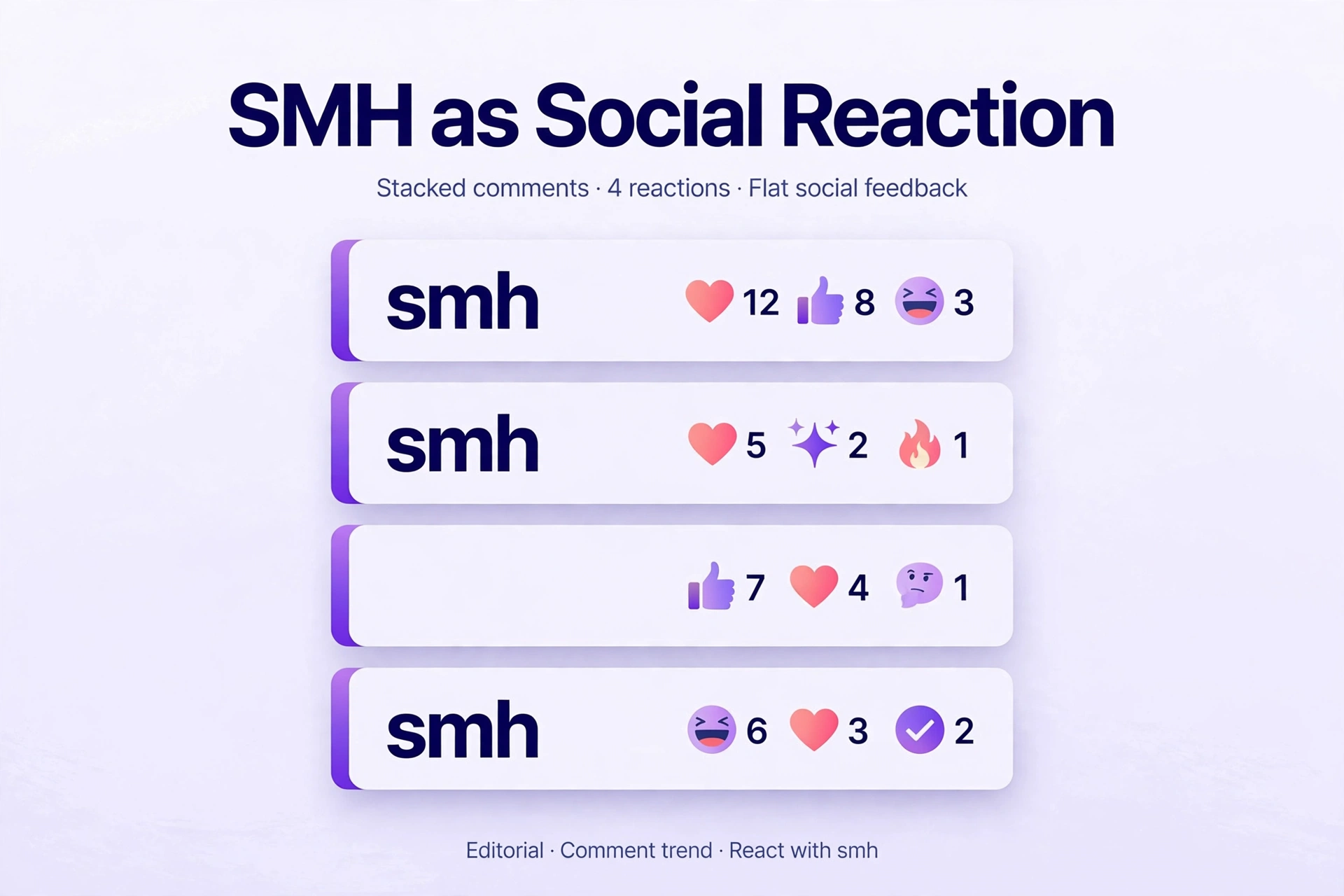
Comment sections — the standalone. A single “smh” under a video is the new facepalm. No explanation needed; the three letters are the whole review. (Same mechanics as the stfu meme reaction — performative, low-stakes, communal.)
Group chats — the directed. “smh” aimed at a friend’s bad decision: I love you, but that was dumb. Usually softened with an emoji or followed by actual advice. (The group-chat cousin is wtw — “what’s the word” — which asks what’s happening where “smh” reacts to it.)
Work Slack — the lighthearted. “smh” at a broken deploy or a silly bug. One source notes its “lighthearted workplace” use — the professional version is always lowercase, often with 😂, and never aimed at a person. (For actual workplace exits, gtg and brb are the safe acronyms — “smh” is a reaction, not a sign-off.)
Journalists and influencers use it too — which is how you know it’s fully mainstream. When the news uses your slang, the slang has won.
SMH in Real Conversations
The exchanges below are illustrative examples, not real messages.
The facepalm
- Alex: “I locked my keys in the car AGAIN”
- Riley: “smh 😂”
Playful. The 😂 converts it from judgment to affection — you’re a mess and I love you.
The viral take
- Post: “hot take: cereal is better dry”
- Comments: “smh” / “smh my head” / “SMH.”
Escalating reactions, the ironic redundant in the middle. Communal disappointment as content.
The weary one
- Sam: “he did it again, didn’t he”
- Jordan: “smh…”
The ellipsis says everything. Not angry, not laughing — just tired. This is SMH at its most human.
The directed
- Casey: “I spent $200 on in-game skins”
- Morgan: “smh bro”
Personal, but friendly. The “bro” softens the judgment into camaraderie — I’m disappointed because I care.
The lmk pivot
- Taylor: “smh, my flight got cancelled”
- Jamie: “ugh, lmk if you need a ride from the airport”
Jamie acknowledges the frustration, then moves to help. The lmk turns a reaction into action — which is the best possible reply to someone’s bad day.
How to Reply to SMH
- It’s playful (“smh 😂”): laugh along. “I know, I’m a mess 😅” — the self-aware reply is always charming.
- It’s weary (“smh…”): acknowledge, don’t joke. “Ugh, that’s rough” lands better than comedy when someone’s genuinely tired.
- It’s directed at you (“smh bro”): take it lightly if it’s friendly. “Fair 😅” defuses it. If it stings, say so — “that actually hurt” is honest.
- It’s a hashtag pile-on: you don’t need to reply. #SMH threads are spectator sport.
- You sent it and regret the tone: “smh 😂” with the emoji is the repair. The laughing face retroactively softens. (Same mechanics as mb — “my bad” — after a typo: the softener converts the edge into warmth.)
- Someone’s having a moment: if the “smh” was about you, a quick oml (“oh my lord, I know 😅”) shows you get it. Self-awareness disarms judgment.
Quick Answers
What does SMH mean in text?
“Shaking my head” — a reaction to something foolish, frustrating, or disappointing. The textual equivalent of the physical head-shake.
What does SMDH mean?
“Shaking my d— head” — the intensified variant (masked here). Same reaction as SMH, more emphasis. The profanity adds volume, not meaning.
What’s the difference between “smh” and “SMH”?
Case changes the weight. Lowercase “smh” is casual; uppercase “SMH” is more emphatic and judgmental.
What does “smh my head” mean?
The ironic redundant — literally “shaking my head my head.” Deliberately wrong, funny on purpose (like “ATM machine”).
When was SMH invented?
Early-2000s forums; the defining Urban Dictionary entry is from February 14, 2004. It’s one of the oldest reaction acronyms still in daily use.
Is SMH rude?
Usually not — it’s mild. But “SMH.” with a period aimed at a person can sting, and it’s the wrong reaction for genuine tragedy. Match the weight.
Can I use SMH at work?
Lighthearted use in team chat is fine (“smh, the deploy broke again 😂”). Never aim it at a colleague’s mistake — that’s judgment, not banter.
Why is head-shaking universal?
It’s one of the earliest human negation gestures — infants do it before they can speak. The acronym works because the gesture is neurological, not just cultural.
The Short Version
SMH is “shaking my head” — the internet’s oldest reaction, defined on Urban Dictionary in February 2004, still going strong twenty years later. It survived because it’s a gesture in letters: the head-shake is pre-verbal, cross-cultural, hardwired. Learn the variant family (SMDH/SMFH masked, “smh my head” ironic), read the tone (😂 = playful, … = weary, . = stern), keep it away from real tragedy, and respect the longevity. Three letters, twenty years, one timeless reaction: I can’t believe this, and I don’t have words.
