
Three letters, one buzz, zero patience for a long reply. You’re halfway out the door, bags in hand, when your phone lights up: “wya?” No greeting, no context — just three letters asking where you are. If you’ve ever stared at that message wondering whether it’s a casual check-in or someone getting impatient, you’re reading it right: it’s usually a bit of both.
WYA stands for “where you at?” — the casual, colloquial cousin of “where are you?” It’s one of the most functional abbreviations in texting: not an emotion, not a joke, just a fast way to ask someone’s location or status. This guide covers what WYA means, what people are really asking when they send it, how to reply, and the lookalikes worth knowing.
The Short Answer
- WYA means “where you at?” — a quick way to ask someone’s location or current status in a text.
- It’s a check-in, not an interrogation. Most of the time it means “are you on your way?” or “are you here yet?”
- The tone depends on context: from a friend before a hangout it’s casual; after you’ve been silent for twenty minutes it carries some impatience.
- It’s informal. Don’t use it with a boss, a teacher, or anyone you’re trying to impress.
- Reply with your location, your ETA, or an honest update — three options cover almost every WYA you’ll ever get.
What “Where You At” Actually Asks
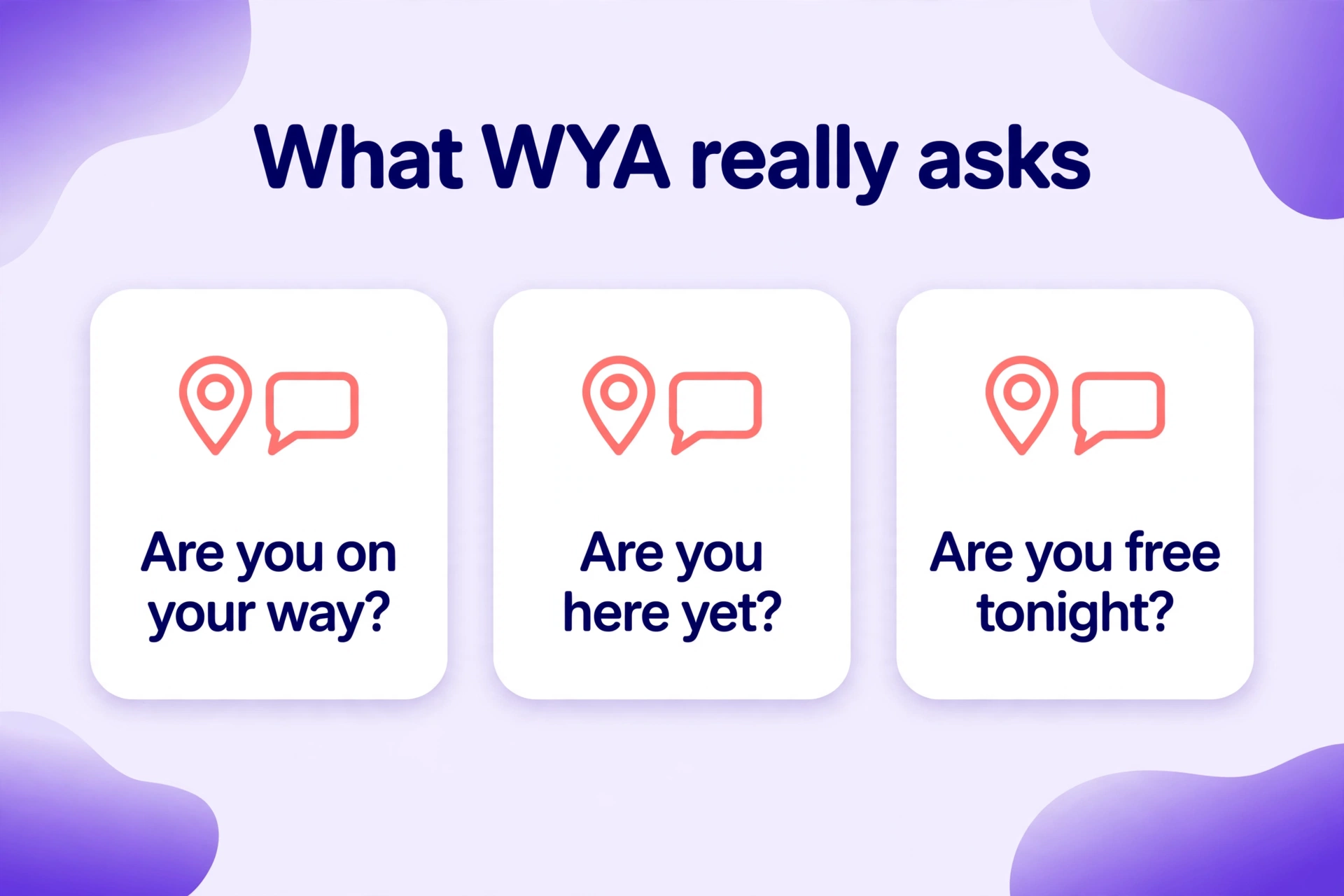
On the surface, WYA is a location question. Underneath, it’s almost always a plans question. When someone texts “wya?”, what they usually mean is one of these:
- “Are you on your way?” — the plan is in motion and you’re part of it.
- “Are you here yet?” — they’re at the spot and scanning the crowd for you.
- “Are you coming?” — softer, checking whether the plan is still on.
- “Are you free?” — the late-night variant, where location matters less than availability.
The literal reading — “tell me your exact coordinates” — is the least common one. WYA is social logistics: someone trying to coordinate real life in real time, and three letters is the fastest way to do it.
The phrasing itself comes from casual spoken English. “Where you at?” drops the “are” the way people actually talk, with roots in African American Vernacular English (AAVE) speech patterns that mainstream texting absorbed years ago. For more raw usage evidence, see how people define it on Urban Dictionary.
Punctuation does quiet work here too. A plain “wya” reads relaxed, almost lazy. “Wya?” is neutral. “WYA??” with capitals and double question marks has an edge — someone has been waiting. And “wya rn” (right now) is the urgent version: answer this one first.
WYA in Realistic Conversations
The exchanges below are illustrative examples, not real messages.
The running-late check
- A: “wya?? we’re at the entrance”
- B: “parking now, 2 min”
A is getting impatient — note the double question mark. B answers with location plus time, which is the perfect WYA reply: short, specific, done.
The casual link-up
- A: “wya tonight?”
- B: “probably staying in, you?”
Here it’s not about right now at all — it’s “are you free later?” B answers the real question instead of the literal one, which is exactly right.
The crowd search
- A: “i don’t see you, wya”
- B: “by the merch stand, black jacket”
Specific landmark plus identifier. In a crowd, vague answers don’t help anyone.
The soft nudge
- A: “hey wya, haven’t heard from you in a bit”
- B: “sorry, crazy week. i’m around this weekend though”
Not about location at all — it’s a friendship check-in wearing a location question’s clothes. B reads it correctly and responds to the feeling, not the letters.
Where You’ll See It
- One-to-one texts: the home turf — coordinating meetups, rides, and hangouts.
- Group chats: “wya everyone?” when the plan needs a headcount.
- DMs before plans: the “are we still on?” message, usually sent about an hour before.
- Late-night messages: the availability check. “Wya?” at midnight means something different from “wya?” at noon — read the hour.
- Not for formal settings: work chats, emails, messages to people you don’t know well. Outside casual circles it reads as blunt or demanding.
What to Send Back
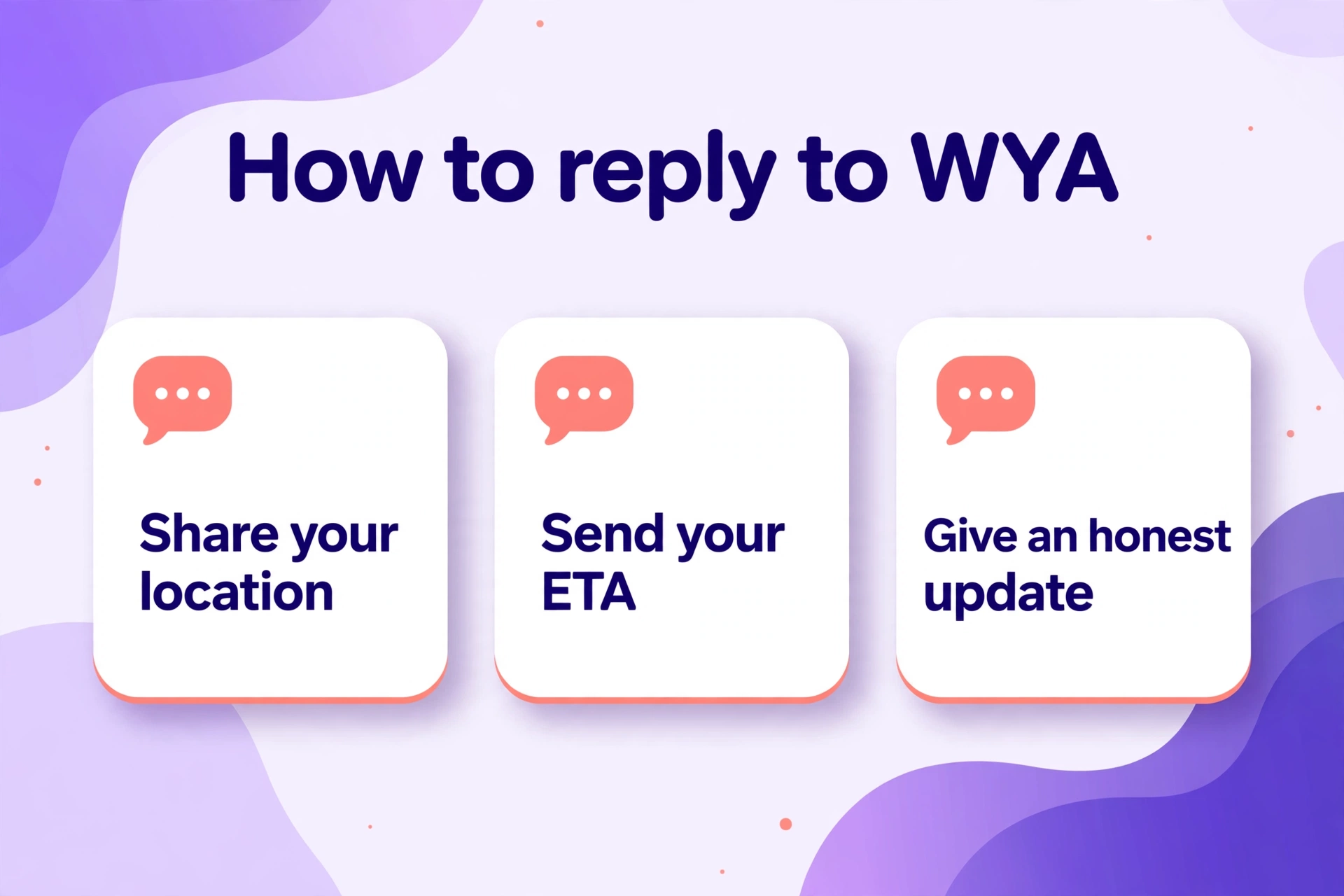
A WYA wants information, so give it — briefly. Three replies cover nearly everything:
- Your location: “at the mall, food court”
- Your ETA: “10 min away”
- An honest update: “running late, start without me”
If plans are shifting, a let me know keeps everyone coordinated: “running 15 behind — lmk if you guys go in without me.” If you’re heading out the door as you reply, GTG (got to go) is the honest sign-off. And when the check-in is done and the chat has served its purpose, TTYL closes it cleanly.
Don’t want to share your location? That’s fine — answer the social question instead of the literal one. “Just chilling, what’s up?” keeps things friendly without pinning you down. You owe a WYA an answer, not your coordinates.
WYA vs. Similar Slang
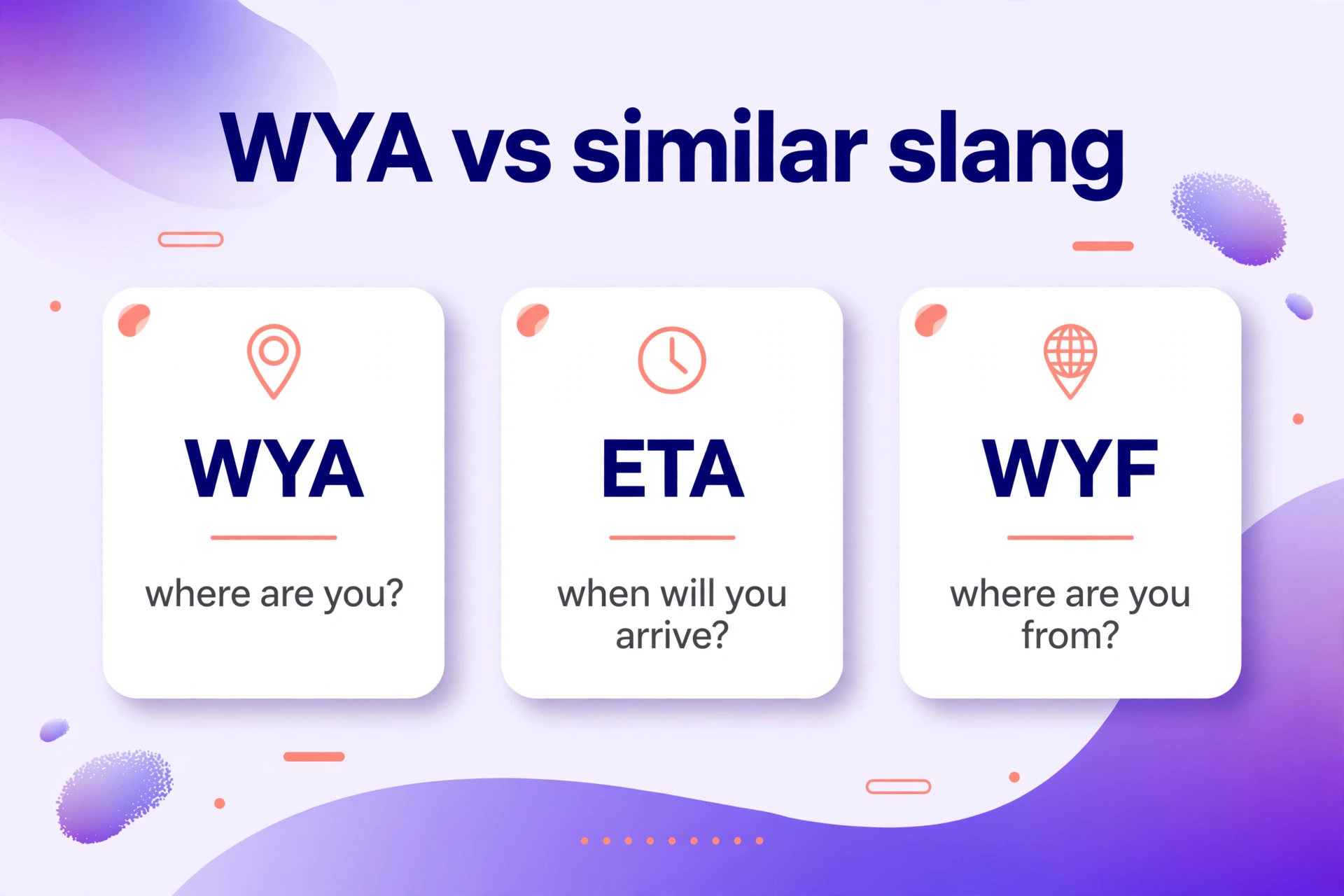
Short check-in slang clusters together, and a few of these get mixed up.
WYA vs. ETA.
These are question and answer. WYA asks “where are you?”; ETA (estimated time of arrival) answers “when will you be here?” The perfect exchange is “wya?” followed by “eta 10 min.” One asks, the other tells — learn both and you’ll never fumble a meetup text again.
WYA vs. WYF (where you from).
Easy to confuse at a glance — one letter apart, both location-flavored. But they ask completely different things: WYA is “where are you right now?”; WYF (where you from) is “where are you from originally?” Answering “wya?” with your hometown will confuse everyone in the chat.
WYA vs. BRB.
Both deal with presence, from opposite sides. WYA asks where someone is; BRB (be right back) announces a short absence. If you get a WYA while stepping away, “brb, 5 min” is a complete answer — it tells them where you aren’t and when you’ll be back.
The through-line: WYA is the only one of these that’s a pure question about someone else’s current position. The others answer it, announce absence, or ask about origins.
What WYA Is Not
It’s not always about location.
The late-night “wya?” and the “haven’t heard from you” variant are about availability and connection, not geography. Read the relationship and the hour before answering literally.
It’s not formal.
“Where you at?” is casual speech, and the abbreviation is even more so. In anything professional — or with anyone you don’t know well — write “where are you?” or “are you on your way?” instead.
It’s not the World Youth Alliance.
In formal or organizational contexts, WYA can stand for the World Youth Alliance, a nonprofit working on youth issues. In a text message, nobody means the nonprofit. Context makes this one obvious.
It’s not “what you at.”
You’ll occasionally see WYA glossed as “what you at,” as in “what are you up to?” — but that’s a rarer variant reading. The location check-in is the standard meaning. Assume it unless the conversation clearly points elsewhere.
Frequently Asked Questions
Q: What does WYA mean in a text?
A: “Where you at?” — a quick way to ask someone’s location or current status, usually when coordinating plans.
Q: What does “wya?” with a question mark mean versus “wya” without one?
A: Same meaning, different temperature. The question mark is neutral; multiple question marks (“wya??”) usually signal impatience, and capitals (“WYA”) add emphasis.
Q: How do you respond to WYA?
A: With your location, your ETA, or an honest update: “at the mall,” “10 min away,” or “running late, start without me.”
Q: Is WYA rude?
A: Not by itself, but it can feel blunt — especially with extra question marks, in all caps, or from someone you don’t know well. The relationship and the timing set the tone.
Q: What’s the difference between WYA and “where are you”?
A: Only formality. “Where are you?” works everywhere, including professional settings. “wya” is the casual texting version, for friends and peers.
Q: Does WYA always mean they want my location?
A: No. Late at night, or after a long silence, it often means “are you free?” or “are we still good?” — availability and connection, not geography.
Q: Can I use WYA at work?
A: No. It’s too casual and can read as demanding. In work chats, use “are you on your way?” or “where are you?” instead.
Q: What does WYA mean on Snapchat or Instagram?
A: The same as in texts — a location or availability check-in, usually tied to making plans or meeting up.
The Short Version
WYA is “where you at?” — the fastest way to ask someone’s location or status in a text. It’s social logistics more than geography: “are you coming?”, “are you here yet?”, “are you free?” Answer with your location, your ETA, or an honest update, and save the full “where are you?” for formal settings. Three letters, one question, zero patience required.
