
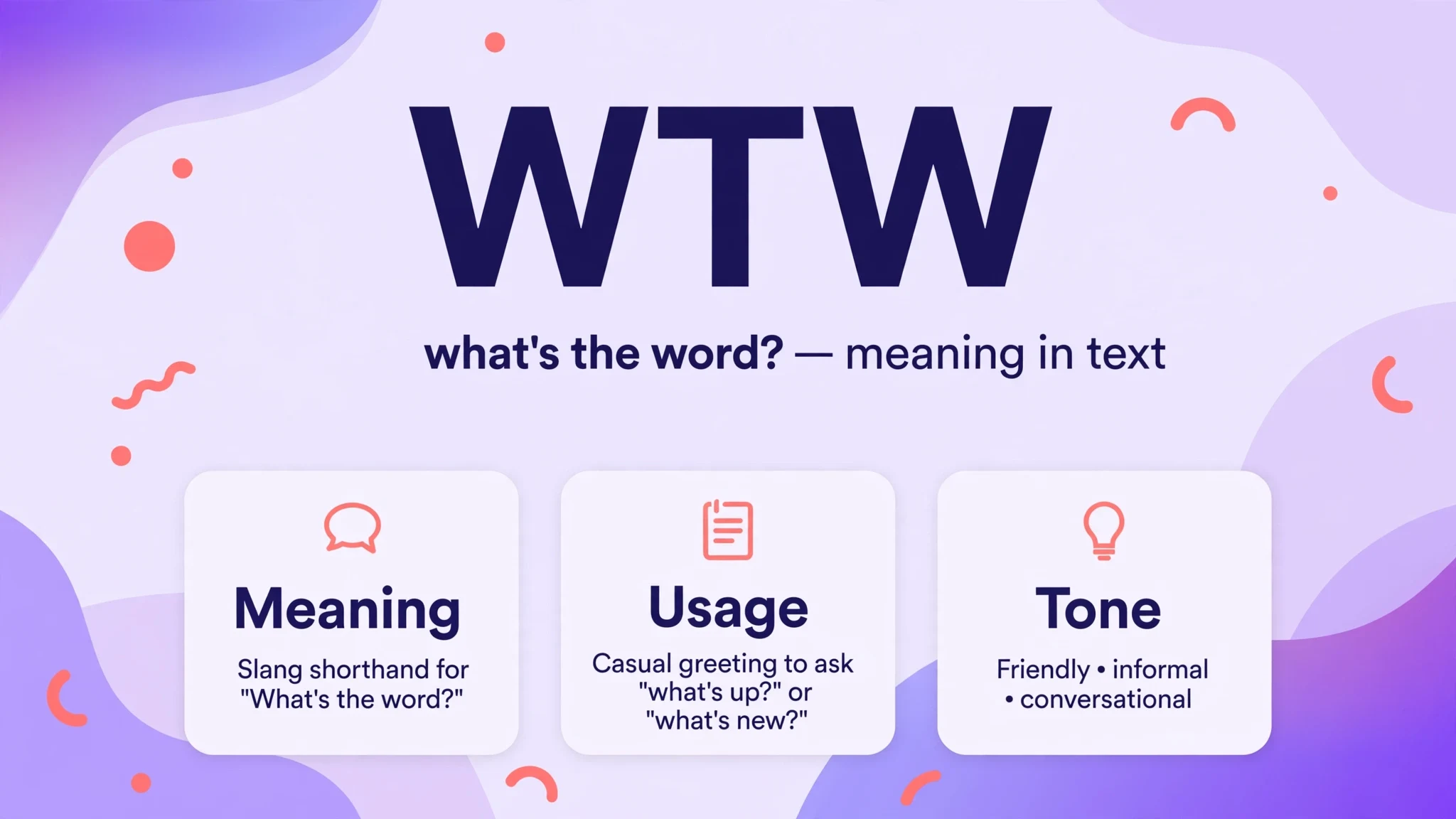
There’s a special kind of message that arrives with no warning and no context: “wtw?” No greeting, no name, just three letters sitting alone in the chat. If it came from a friend, it’s probably friendly. If it landed right after some wild news, it might mean something else entirely.
WTW most often stands for “what’s the word?” — a casual, compact way of asking “what’s up?” or “what’s going on?” It’s a greeting with a question built in: the sender wants to hear what’s happening, what the plan is, or what you’ve been up to. This guide covers what WTW means in texts, the second meaning hiding behind the same three letters, how to tell them apart, and what to send back.
What WTW Stands For
The default reading — the one that covers the vast majority of texts — is “what’s the word?” It’s the texting form of an old spoken greeting. Instead of typing “hey, what’s going on?”, someone types “wtw?” and gets the same conversation started in three keystrokes. On its own, “wtw” means “what’s up, what’s new with you?” With a time attached — “wtw tonight?” — it becomes a plan question: “what are we doing tonight?”
The same three letters have a second life as “what the what?” — a softened, jokey reaction to something shocking or strange. It’s a minced oath: it stands in for a stronger swear the sender decided not to type. Punctuation is the tell. “Wtw tonight?” asks about plans. “Wtw?!” right after surprising news means “wait, WHAT?” — disbelief, not a question about your evening.
There’s also a cousin reading, “what’s the wave?” — same energy as “what’s the word?”, asking about the plan or the move. It shows up in some circles, but the classic “what’s the word?” is the standard meaning. Assume that one unless the conversation points elsewhere.
The phrase “what’s the word?” itself comes from casual spoken English with roots in African American Vernacular English (AAVE), where it worked as a community greeting — asking what news was circulating. Texting compressed the spoken phrase into an abbreviation, the way it compresses everything. For raw, unfiltered examples of how people actually use it, the Urban Dictionary entry for WTW collects real-world definitions from texters themselves.

“WTW” in Real Conversations
The exchanges below are illustrative examples, not real messages.
The plan ask
- A: “wtw tonight? anything happening?”
- B: “thinking pizza and a movie, you in?”
A attached a time, so this is the plan question. B answers with a concrete proposal — the ideal response to a “wtw tonight?”
The casual check-in
- A: “hey wtw, long time”
- B: “nm, just work stuff. wbu?”
No time attached, no news before it — just a friendly opener. B keeps it short and bounces the question back.
The shocked reaction
- A: “they cancelled the trip”
- B: “wtw?! we already booked everything”
The news came first, so this is “what the what?!” — pure disbelief. Nobody here is asking about plans.
The group-chat fishing trip
- A: “wtw everyone”
- B: “nothing much”
- C: “gym then food?”
Dropped into a group chat on a Friday evening, “wtw” is an open invitation: someone wants the night to become a plan, and they’re letting the group fill in the blank.
Which WTW Did You Just Get?
Two readings, one abbreviation — here’s how to tell them apart without asking.
Check what came before it.
If the message before was news — a screenshot, a story, an announcement — “wtw” is the reaction: “what the what?!” If it arrived out of nowhere, especially in the evening or before the weekend, it’s the greeting: “what’s the word?”
Check the punctuation.
A plain “wtw” or “wtw?” is the casual question. Multiple question marks or an exclamation mark — “wtw?!”, “WTW??” — lean toward shock. Capitals add emphasis either way, but combined with bad news they scream disbelief.
Check the clock.
“Wtw tonight?” and “wtw this weekend?” are always plan questions. Nobody asks “what the what tonight?” — the time attachment settles it instantly.
Check the sender.
A friend you make plans with is probably asking about plans. Someone reacting in the moment to something you just told them is probably reacting.
When in doubt, answer the greeting version — it’s the common one, and if they meant the shocked version, your “nm, what’s up with you?” will prompt them to explain anyway.
How to Answer WTW
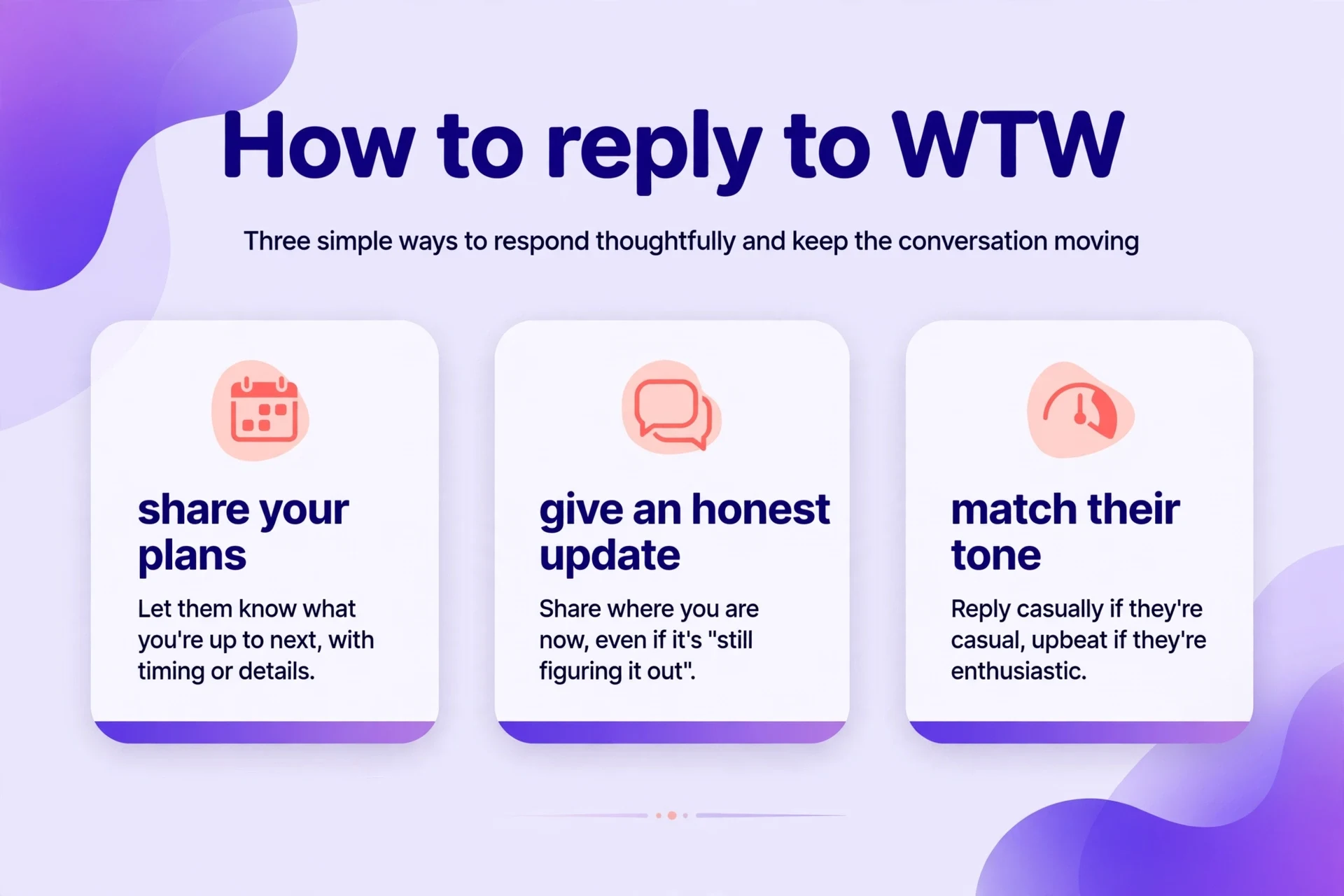
A “what’s the word?” WTW wants one of three things: your news, your plans, or your availability. Give it briefly.
- Your update: “nm, just chilling. you?”
- Your plans: “free tonight, what’s the move?”
- A counter-question: “not much — wtw with you?”
If plans are actually forming, let me know keeps everyone coordinated: “might be free later, lmk what you guys decide.” If you’re heading out as you reply, GTG (got to go) is the honest sign-off: “about to head out — gtg, catch up later?” And when the chat has run its course, TTYL closes it cleanly.
If it was the “what the what?!” version, don’t answer with your plans — match the shock. “I know, right?” or “crazy, tell me everything” keeps you on the same wavelength. The fastest way to kill that conversation is replying “nm, you?” to someone’s disbelief.
WTW vs. the Other Three-Letter Openers
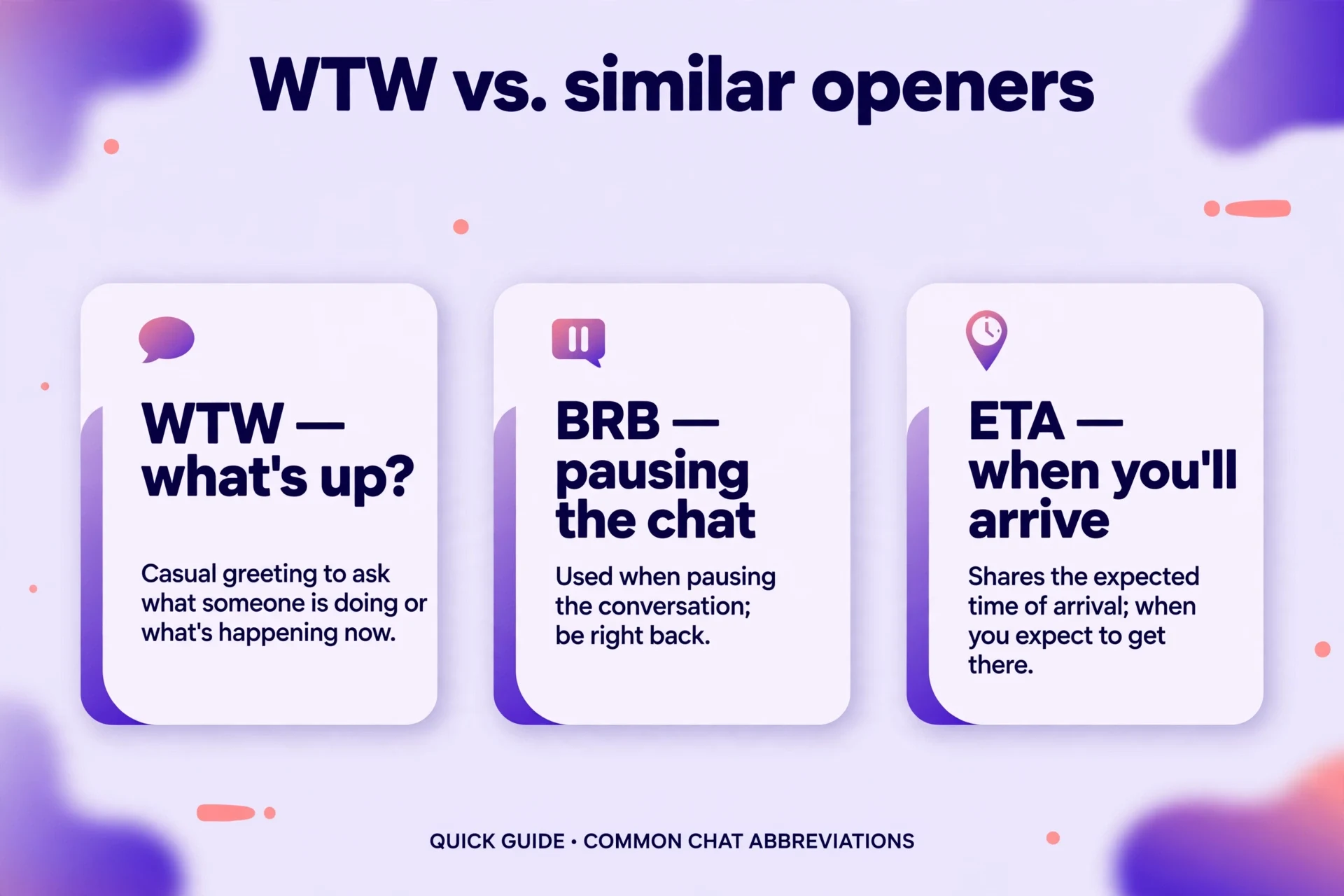
Short openers cluster together, and they don’t all do the same job.
These are opposites. WTW opens a conversation — “what’s up, talk to me.” BRB (be right back) announces a pause: “hold that thought, I’m stepping away.” If someone hits you with “wtw?” right as you need to leave, “brb, 5 min” is a complete answer — it acknowledges the opener and buys you the pause.
“Wtw tonight?” asks what the plan is; ETA (estimated time of arrival) answers when you’ll show up. They pair naturally: “wtw?” followed by “eta 10 min” is the entire coordination of a meetup in six words. One asks, the other tells.
WTW asks a question; FR (“for real”) reacts to an answer. “Wtw?” … “got the job!” … “fr?!” — the opener starts the exchange, and FR carries the disbelief. They’re teammates, not twins.
The through-line: WTW is the only one of these that’s a pure open-ended greeting. The others pause, time, or react.
Where WTW Doesn’t Belong
WTW is informal by design — it was born in casual speech and raised by texting. Don’t use it with a boss, a teacher, a landlord, or anyone you’re trying to impress. “WTW regarding tomorrow’s meeting” reads as careless at best and disrespectful at worst.
It’s also the wrong tool when you need a straight answer fast. “Wtw?” is open-ended on purpose; if you need to know whether the report is done, ask that directly. Save WTW for friends, peers, and group chats where the vibe is relaxed and nobody’s keeping score.
One more: in captions, #WTW is a different animal — it usually tags “what to wear” on outfit posts or “what to watch” on recommendations. Nobody expects a reply to those. That’s hashtag territory, not texting.
Quick Answers
Q: What does WTW mean in a text?
A: “What’s the word?” — a casual way of asking “what’s up?”, “what’s going on?”, or “what’s the plan?”
Q: What does “wtw?!” mean?
A: That’s the second reading: “what the what?!” — a softened, jokey expression of shock or disbelief, standing in for a stronger swear.
Q: How do you reply to WTW?
A: With a short update, your plans, or a counter-question: “nm, just chilling — you?”, “free tonight, what’s the move?”, or “not much, wtw with you?”
Q: Is WTW flirty?
A: It can be — as a low-key opener it works for starting a conversation with someone you’re interested in. But most of the time it’s just friendly. Read the relationship, not the letters.
Q: What’s the difference between WTW and “what’s up?”
A: Almost nothing in meaning. WTW is shorter and feels slightly warmer and more social — it asks about the whole situation (the news, the plan), not just you.
Q: Can I use WTW at work?
A: No. It’s too casual for professional settings. Use a direct question instead.
Q: Does WTW mean anything on Snapchat or Instagram?
A: In DMs it means the same as in texts — a casual check-in or plan question. In captions, #WTW usually means “what to wear” or “what to watch,” which is a different usage entirely.
Q: Is WTW rude?
A: Not on its own. But like any blunt opener, it can feel abrupt from someone you don’t know well, or demanding with aggressive punctuation. Context and relationship set the tone.
The Short Version
WTW is “what’s the word?” — three letters that open a conversation the way “what’s up?” does, with a built-in question about your news or the plan. Watch the punctuation, though: “wtw?!” after surprising news is “what the what?!” — disbelief, not a greeting. Answer the greeting with something short and real, match the shock when it’s shock, and keep it far away from work chats. Three letters, two meanings, one rule: read the room first.
