
TBH means “to be honest.” That part is not in dispute — Cambridge Dictionary defines it as the abbreviation “used, for example on social media and in text messages, when you are giving your opinion about something,” and Oxford’s learner dictionary adds the important part: this is what you really think. TBH is a stamp you put on a sentence to certify it as your real view, not the polite version.
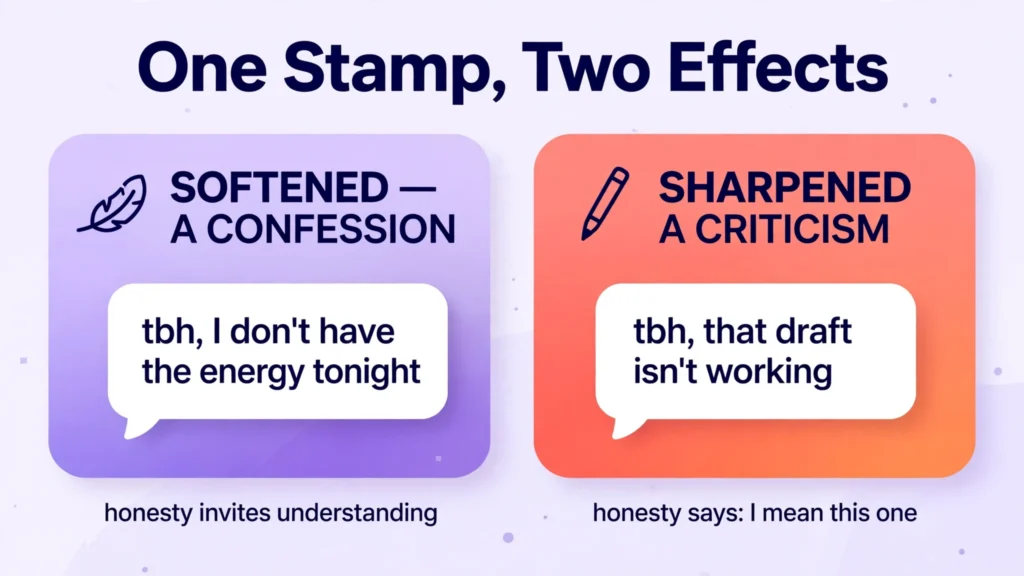
Which is why the tbh meaning in text can’t stop at the expansion. The same stamp that softens a confession — “tbh I don’t have the energy tonight” — sharpens a criticism: “tbh, that draft isn’t working.” One marker, two opposite effects, and the difference is entirely in what follows it. This guide explains the mechanism, where the word sits in a sentence, the strange afterlife of the “tbh post,” how TBH really differs from NGL, and what to reply to each kind.
What TBH Actually Does: The Certification Effect
Think of TBH as a signature rather than a softener. It tells the reader: the line attached to this is the unedited one. Everything about TBH’s behaviour follows from that single job:
- Attached to something vulnerable — an admission, a cancellation, a feeling — the stamp makes it gentler. You’re not attacking anyone; you’re confessing, and the honesty invites understanding.
- Attached to something negative — a judgement about the reader, their work, their plan — the stamp makes it heavier. It announces the criticism is deliberate and considered: I thought about the kind version, and this is the real one.
Most slang guides list “softener” and “blunt amplifier” as if they were two meanings to memorise. They’re one meaning with two surfaces. TBH doesn’t change what your sentence says; it changes how meant it sounds. Once you see that, you can predict exactly how any given tbh will land: ask what the sentence does, and the stamp multiplies it.
A useful consequence: TBH is not armour. Writers sometimes fire off a jab and add “tbh” as if honesty were a permit. Readers experience the opposite — the stamp certifies the jab was meant, too. TBH is the “just being honest” excuse pre-installed, and it fools nobody.
The Softener: TBH Before Something Hard to Say
The kindest TBH is the one guarding a confession:
A: we’re still on for saturday right?
B: tbh I don’t have the energy to go out tonight. rain check?
Without TBH, B’s reply is a flat rejection. With it, the message reframes itself: this is an admission, not a snub. The honesty does the apologising. You’ll find this TBH in front of feelings people are slightly embarrassed by (“tbh I was nervous the whole time”), preferences they expect to be unpopular, and truths that need a small runway.
Two neighbours soften by different mechanics, and confusing them flattens all three:
- JS (“just saying”) shrugs ownership off — it floats an opinion and steps back from it.
- LWK (“lowkey”) understates the strength of a feeling — the emotion is real, the volume is denied.
- TBH does the reverse of both: it owns the opinion completely and certifies it. That’s why it can carry confessions the other two can’t.
The Amplifier: TBH Before Something Hard to Hear
Flip the content and the stamp works against the reader:
“tbh the presentation dragged in the middle.”
“tbh, he’s not right for her.”
Nothing here is an insult, yet both lines land harder than their unmarked versions would — because TBH has testified that the speaker means them in full. Dictionary-wise this is the same “what you really think” from Oxford; emotionally it’s the version YourDictionary describes as appearing “before someone breaks honest news that a listener may not want to hear.”
This is also where TBH criticism gets received: expect the reply to be a reaction, not a rebuttal — often a flat SMH, silence, or a “wow ok” that means the stamp registered. If that isn’t the response you wanted, the fix isn’t removing TBH; it’s not certifying a sentence you only half-mean.
Worth separating cleanly: TBH is not dismissal. IDC announces that the speaker doesn’t care — that’s the genuinely cold neighbour. TBH announces the speaker cares enough to be straight with you. A TBH can sting, but it is almost never the rudest reading in the room.
Position Changes the Weight: Start, Middle, End
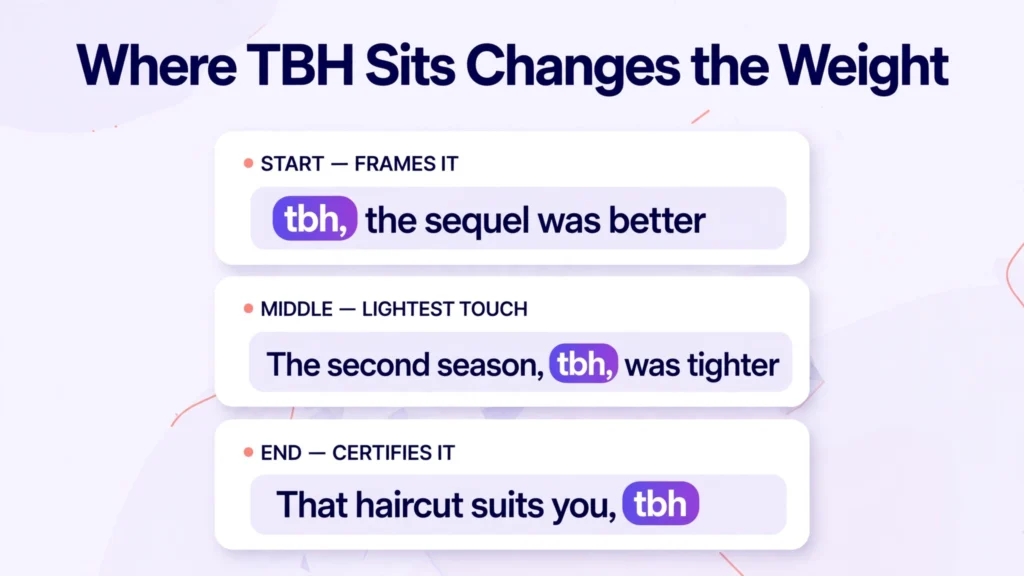
No dictionary legislates where TBH goes, and both Cambridge (“I don’t care tbh”) and Oxford (“I don’t know anything about it, TBH”) print it at the end. Real usage puts it in three places, with tendencies — not rules — worth knowing:
- At the start (“tbh, the sequel was better”) — a preface. It frames everything after it as real talk, and it’s the most common setup position in examples across references.
- In the middle (“The second season, tbh, was tighter”) — a parenthetical aside. The lightest touch; the certification whispers instead of announcing.
- At the end (“That haircut suits you, tbh”) — a stamp applied after the fact, certifying the finished sentence. Some guides claim the end position “hits hardest”; treat that as an impression, not a law — what it reliably adds is emphasis, converting a passing remark into a considered one.
Like ALR, TBH is one of those short forms whose reading is decided by grammar and placement rather than by the letters themselves. And on capitalization: there’s no evidenced rule that “TBH” shouts while “tbh” murmurs. Case is style here, not signal.
TBH in Compliments — and the Strange History of the “TBH Post”
TBH’s happiest modern use is certifying praise. Polite compliments are cheap and everyone knows it, so TBH upgrades one by swearing it in: “You handled that whole mess so well, tbh.” The stamp says this isn’t reflex kindness; it’s an assessment. That mechanism — honesty as a compliment-booster — is the living descendant of a much bigger ritual.
What a “tbh post” was. Around 2011, on Facebook and then Instagram and Tumblr, users posted a prompt: like my status for a tbh (often shortened to “lms for a tbh”). Everyone who liked it received a short, sincere statement about them — usually a compliment they hadn’t heard before — posted publicly. Dictionary.com’s history of the format dates “lms for a tbh” to 2011 and the extended version, tbh, rate, and date (honest statement, plus a 1–10 rating, plus a date verdict), to a Google Trends peak in late 2014 to early 2016. The format was big enough that in 2017 Facebook bought a positive-feedback app literally named tbh, built on the same trade.
In that ritual, “a tbh” became a noun — a unit of honest regard you could request, give, and trade — and readers still occasionally meet it (“send me a tbh”).
Is it still a thing? Mostly, it’s history. How-To Geek noted back in 2021 that the teenage tbh-post sense was already “on the way out,” displaced by Story stickers and Q&A features. The safe statement: the ritual is dated, the noun survives at the margins, and the initialism itself never left everyday chat.
One claim to file under folklore: a major explainer once floated “to be heard” as a second expansion of TBH, apparently inspired by the ritual’s public-opinion format. No dictionary supports it — Cambridge, Oxford, Dictionary.com and Wiktionary all give only “to be honest.” The ritual is real; the expansion is not.
TBH vs. NGL (and the Other Honesty Markers)
NGL (“not gonna lie”) is TBH’s closest relative, and the internet’s guides contradict each other about which one is “softer” — a sign the tone ladder doesn’t exist. The defensible difference is shape, not severity:
- TBH frames an opinion: it expands a standard English idiom, works at the start, middle, or end of a sentence, and can double as the ritual noun.
- NGL volunteers a confession: its contracted, speech-like form leans toward admissions (“ngl I forgot your birthday was today”) and reads more conversational for it.
In practice, readers judge by the sentence that follows, not the marker that introduces it. Pick either; spend your care on the content.
The rest of the honesty family, placed by what each certifies:
- FR (“for real”) certifies that something really is so — it vouches for the fact, where TBH vouches for your candour.
- ICL (“I can’t lie”) is the admission-first cousin: where TBH frames an opinion, ICL leads with the confession itself.
- IMO / IMHO mark a statement as subjective — a disclaimer, not a certification.
- TBF (“to be fair”) and FWIW (“for what it’s worth”) soften by conceding ground or discounting the speaker — honesty with the volume turned down.
How to Reply to a TBH
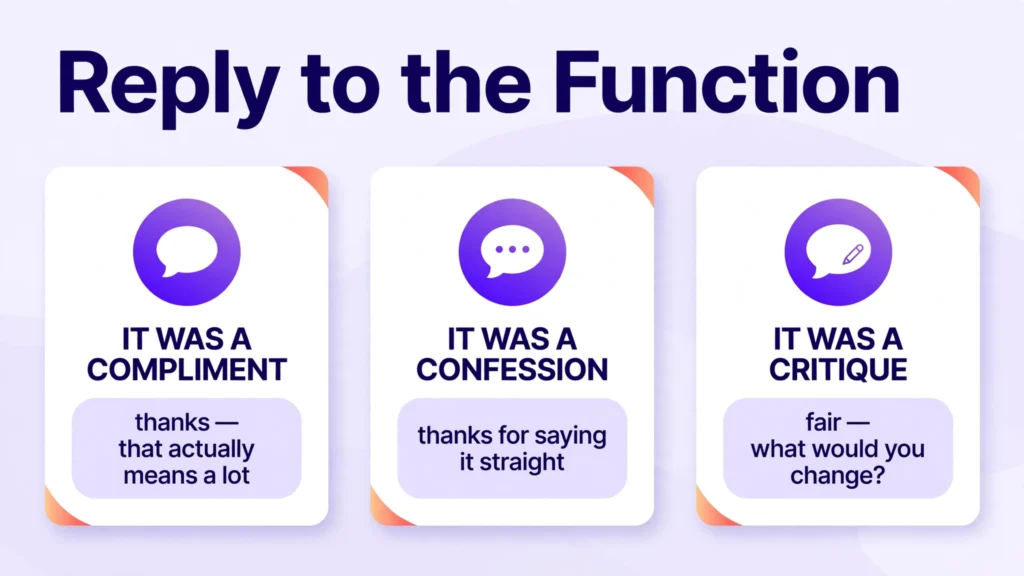
Reply to the function, not the letters — which means first deciding which TBH you received:
It was a compliment. Thank them like the certification was real, because it was: “thanks — that actually means a lot,” or return the honesty in kind. A flat “lol thanks” undersells a stamped compliment.
It was a confession. Acknowledge the honesty before the content: “thanks for saying it straight,” then deal with the news itself. The sender spent something to send that sentence; receipt it.
It was a blunt critique. Don’t mirror the heat. The useful replies either ask for the constructive version — “fair. what would you change?” — or park it: “ok, let me sit with that.” Arguing with the stamp itself (“you didn’t have to say tbh”) argues with the one part of the message that was honest.
Where TBH Doesn’t Belong
Oxford labels TBH “(informal),” and the label is the whole rule. It’s at home in texts, DMs, comments, and casual group chats. It’s out of place anywhere the reader is formal, senior, or a stranger with a screenshot button: work email, applications, reports, messages to clients or teachers. In an already-casual team chat it’s understood and low-risk; in a message that could be forwarded, it isn’t. (The workplace has its own framing initialism that is welcome there — FYI — which shows the register line is real, not anti-abbreviation snobbery.)
When the candour matters and the setting is formal, write the phrase out — “To be honest, the timeline concerns me” — or skip the marker and let a plain, considered statement do the work. And in genuinely sensitive threads (bad news, grief, conflict), empathy first: a sincerity stamp on a hard sentence reads as bracing, and bracing is rarely what’s needed.
Quick Answers
What does TBH mean in text?
“To be honest” — an initialism used to frame a statement as the writer’s real opinion or admission, per Cambridge and Oxford.
What does TBH mean from a girl or a guy?
The same thing. No reference supports a gender-specific sense; what changes the reading is the sentence attached and your relationship with the sender.
Is TBH rude?
Not inherently. TBH certifies; it doesn’t insult. Attached to a confession it’s gentle, attached to a judgement it stings more than the unmarked sentence would. It is never as cold as IDC, which announces not caring at all.
TBH or NGL — which should I use?
Either. TBH frames an opinion and fits anywhere in a sentence; NGL leans confessional and conversational. Claims that one is strictly “softer” contradict each other across guides — readers weigh what follows, not the marker.
What is a “tbh post”?
A largely dated social ritual (c. 2011 onward): post “like for a tbh,” and each liker gets a sincere public statement about them. Dictionary.com dates the format to 2011; its spin-off “tbh, rate, and date” peaked around 2014–2016.
Does TBH also mean “to be heard”?
No. That expansion appears in one popular explainer without a source; every dictionary checked lists only “to be honest.”
Can TBH be sarcastic?
Yes — because it claims sincerity, an obviously insincere use reads as irony among friends (“tbh, thrilled about the overtime”). With anyone who doesn’t share the context, skip it; in plain text there’s no tone of voice to rescue the joke.
The Real Line Is the Next One
TBH itself is the smallest part of any message it appears in — three letters certifying that the sentence beside them is meant. Read the sentence and you’ll read the TBH correctly every time: confession, certified kind; criticism, certified sharp; compliment, certified real. The stamp never lies about which one it is. What follows it does all the talking.
