
“Just sent the notes — you are a lifesaver 🙏” and back comes: “tysm!!” Small message, warm feeling. If you’ve ever wondered exactly what sits inside those four letters — and when they land perfectly versus fall a little flat — you’re in the right place. Let’s decode the tysm meaning in text, because this one carries more nuance than its size suggests.
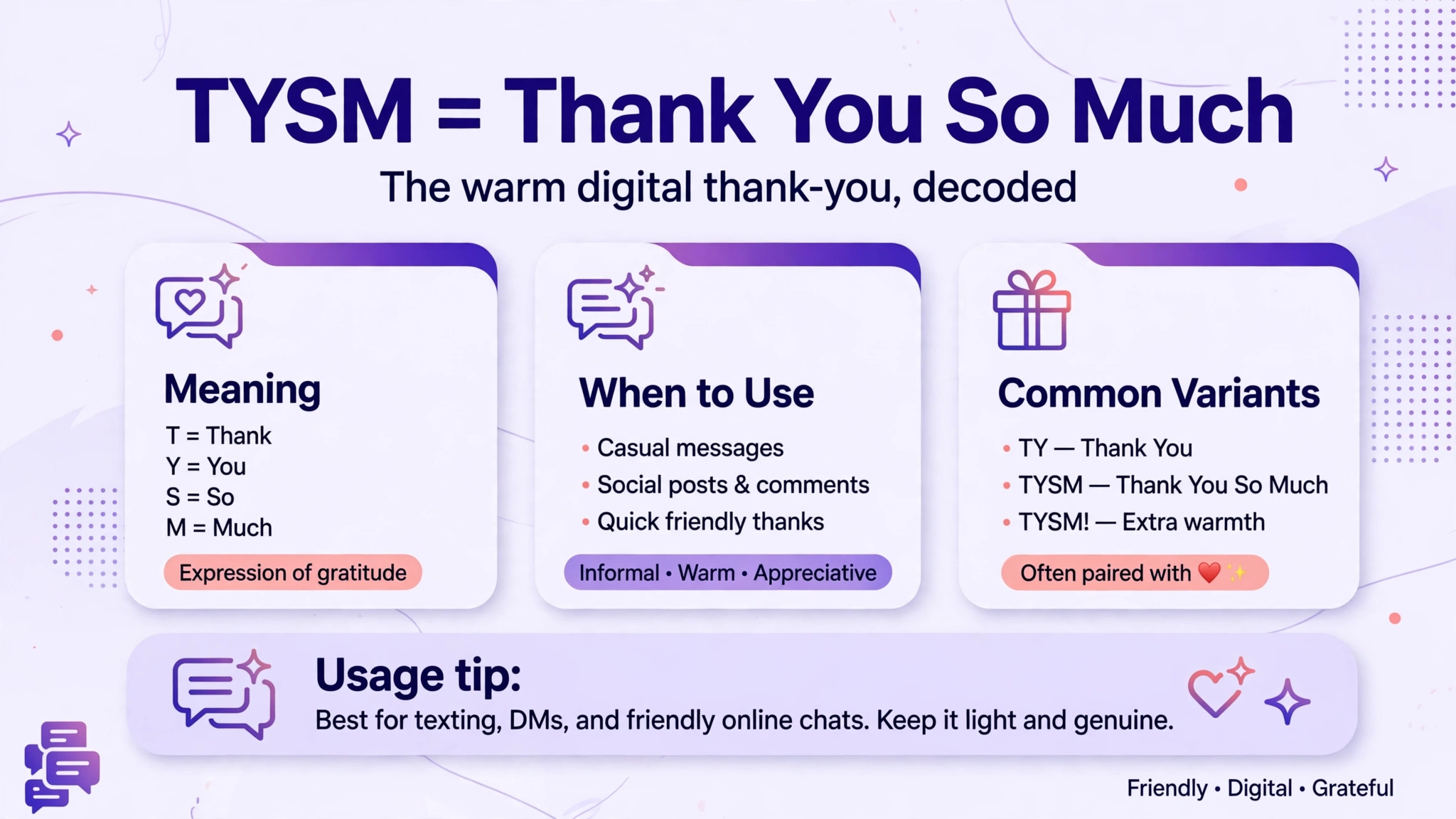
TYSM stands for “thank you so much.” It’s the internet’s way of turning up the gratitude dial past a plain “thanks” — a little warmer, a little more heartfelt, and still casual enough for a Tuesday-night group chat.
What Does TYSM Mean in Text?
TYSM means “thank you so much,” full stop. In texting, that’s the only meaning it carries — every dictionary source that covers it agrees. Wiktionary lists it as an Internet-slang initialism of “thank you so much,” complete with a real-world 2024 citation from Cosmopolitan (“So… I fully want what Barry and Sabrina have, tysm”).
So when someone drops a tysm on you, they’re not being fancy or ironic (usually — more on that in the tone section). They’re saying thanks, and saying it emphatically. The “so much” is doing real work: it’s the difference between acknowledging a favor and actually appreciating it.
Here’s the thing most explainers miss, though: TYSM isn’t a single flat note. It sits on a ladder, and where your thanks lands on that ladder matters. That’s what the next section is for.
The Thanks-Ladder Test
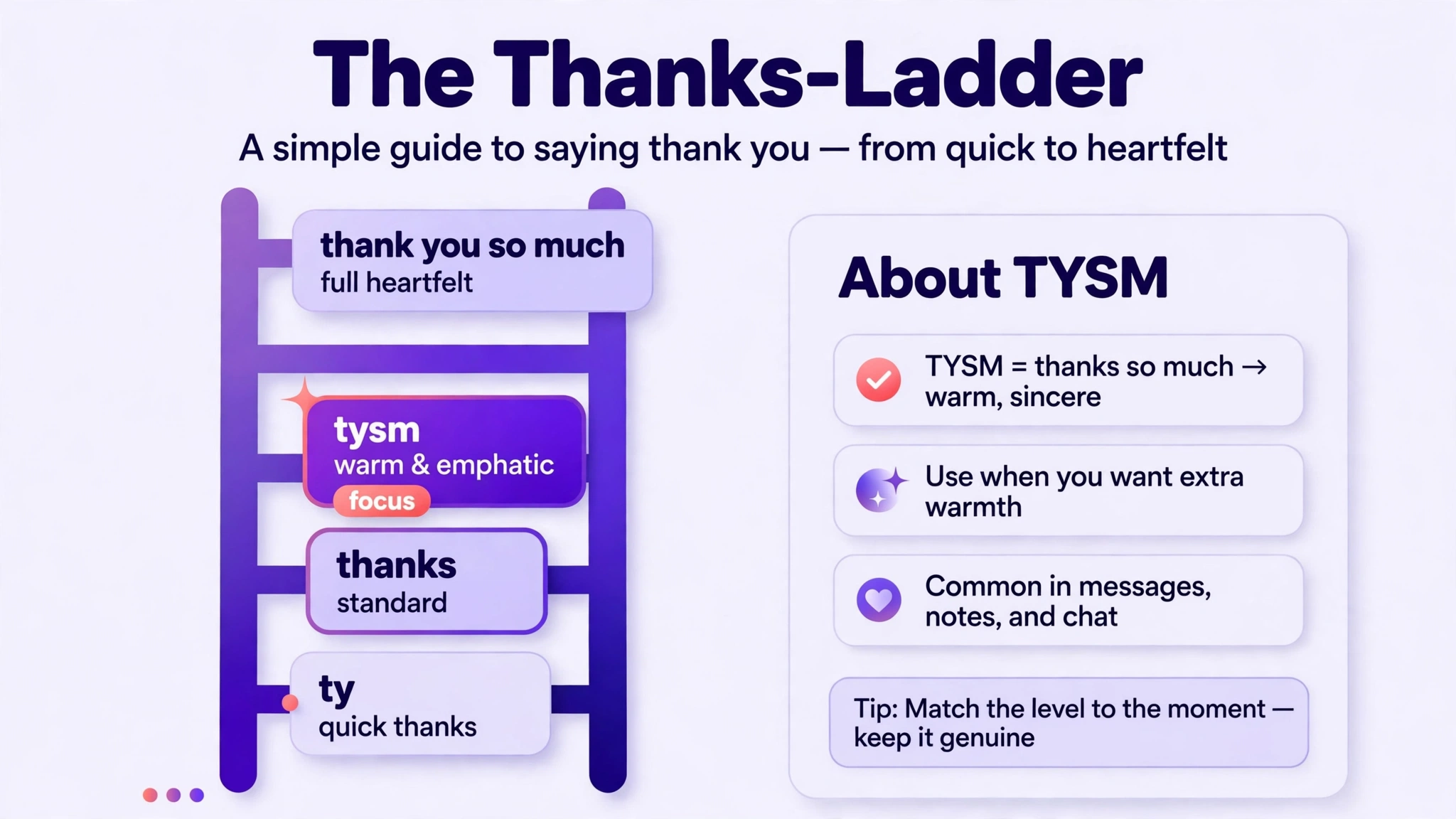
Here’s the named trick for reading — and sending — any TYSM. It’s called the Thanks-Ladder Test, and it takes about three seconds.
Picture a ladder with four rungs:
- Bottom rung: “ty.” The drive-by thanks. Quick, transactional, barely a tap on the brake. (“ty for the link”)
- Second rung: “thanks.” The standard issue. Fine for small favors, expected in most replies.
- Third rung: “tysm.” The one we’re here for. Warmer than “thanks,” heartfelt without being heavy. This is the rung for favors that actually cost someone time or thought.
- Top rung: “thank you so much” spelled out. The full sentence. Reserved for real generosity — the friend who drove across town, the stranger who answered your 2 a.m. question, the coworker who saved your presentation.
How to run the test: when you receive a thank-you, ask which rung the favor deserved. If someone sends “ty” for a huge favor, they’re being casual to a fault. If they send “tysm” for a two-second favor, they’re being warm — take the compliment. And when you’re sending thanks, climb deliberately: pick the rung that matches the effort, and your gratitude will always feel sincere instead of automatic.
The ladder also explains why TYSM sits where it does: it’s the sweet spot of digital gratitude — emphatic enough to feel real, short enough to feel natural. One rung up from routine, one rung down from ceremonial.
The Warmth Dial: Stretch, Caps, and Punctuation
TYSM has no fixed volume. The same four letters can whisper or shout depending on three tiny choices — and texting culture reads all of them fluently:
Lowercase “tysm.” The default. Warm, easy, no fuss. The period-less version is the friendliest of all; a lowercase “tysm” in a chat reads like a smile.
ALL-CAPS “TYSM.” The same words, louder. Caps can mean genuine excitement (“TYSM that made my day!!”) or performative emphasis — the difference lives in the rest of the message. One data point, not the whole verdict.
Stretching: “tysmmmm.” Extra m’s are pure affection. “Aww tysmmmm” is basically a digital hug. Nobody stretches a thanks they don’t mean.
Punctuation: “tysm!!” vs “tysm.” vs “tysm…” Double exclamation marks are warmth turned up. A trailing period can flatten it slightly (“tysm.” sometimes reads dutiful). An ellipsis after thanks is genuinely ambiguous — it can mean emotional overload or mild sarcasm, and only the surrounding conversation settles it.
A TBH-style honesty check helps here: these are tendencies, not rules. The person who always types in caps isn’t always shouting. Read the pattern, not the single message.
Reading TYSM’s Tone: Warm, Flat, or Sarcastic?
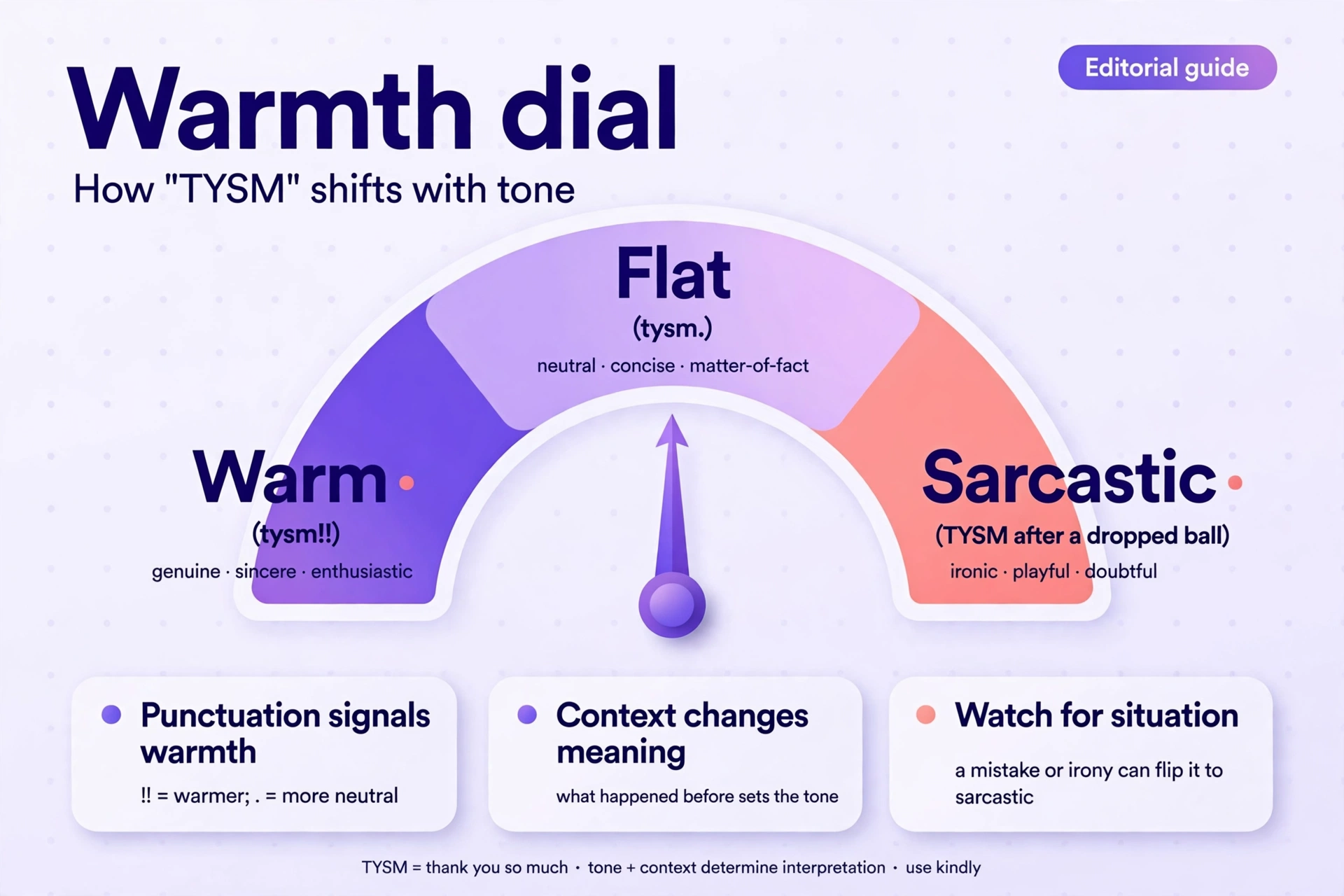
Nine times out of ten, TYSM is exactly what it says: a warm thank-you. But the tenth time deserves a closer look, because texting has invented two alternate readings — and both are documented:
The flat “tysm.” This is the conversational equivalent of a nod. It happens in long favor-chains (the fifth small task in a row), in work-adjacent chats where warmth isn’t the point, or from people whose texting style runs dry. The letters are still thanks; the music is just turned down. Don’t overread it — but if everything about a friendship feels flat lately, a flat tysm is data, not a diagnosis.
The sarcastic “TYSM.” Yes, this is real, and it’s documented in usage guides. The classic setup: someone does the opposite of what you wanted, and you reply “Wow, you really finished that task for me at the last minute, TYSM!” The sarcasm lives entirely in the mismatch between the words and the situation — same mechanism as a sarcastic IDC, where “I don’t care” means “I very much care.” How do you tell? If the thanks follows something unhelpful, it’s not thanks. Nobody who just got stood up is genuinely grateful.
The warmth test: when in doubt, match the energy around it. An “aww tysm 🥹” is warm. A standalone “tysm.” after a favor-chain is neutral. A “TYSM!!!” following a dropped ball is sarcasm wearing a smile. Context is the whole game.
Where You’ll See TYSM: TikTok, Snapchat, Instagram, and Texting
TYSM means the same thing on every platform — no app rewrites it. What changes is where the thanks shows up and what it attaches to:
Texting (SMS, WhatsApp, iMessage). TYSM’s home turf. The classic pattern is the favor-reply: you send the homework answers, the restaurant address, the good advice — and “tysm!!” comes back in seconds. It also pairs beautifully with a follow-up LMK: “tysm!! lmk when you’re free and I’ll return the favor.”
TikTok. In comments, tysm is creator currency: “tysm for 100k!!” under a milestone video, or a creator replying “tysm 🥺” to a sweet comment. The letters skew emotional here — stretched, exclaimed, emoji-heavy — because TikTok gratitude is performative by design.
Instagram. Captions and comment replies are tysm country: “tysm for all the birthday love 💕” on a story, or “tysm!!” as a reply to a compliment. It’s the platform where the warmth dial gets turned up highest.
Snapchat. Quick and disposable: “tysm” over a snap of the favor itself (a photo of the borrowed charger, the shared notes). The thanks evaporates with the snap, which is exactly right for small favors.
Group chats. The group-chat tysm is a broadcast thank-you: “tysm everyone for coming 🎉” after a party. One message, many recipients, zero awkwardness about who it was “really” for.
Notice the constant: same four letters, same meaning, everywhere. Only the volume changes.
How to Reply to TYSM
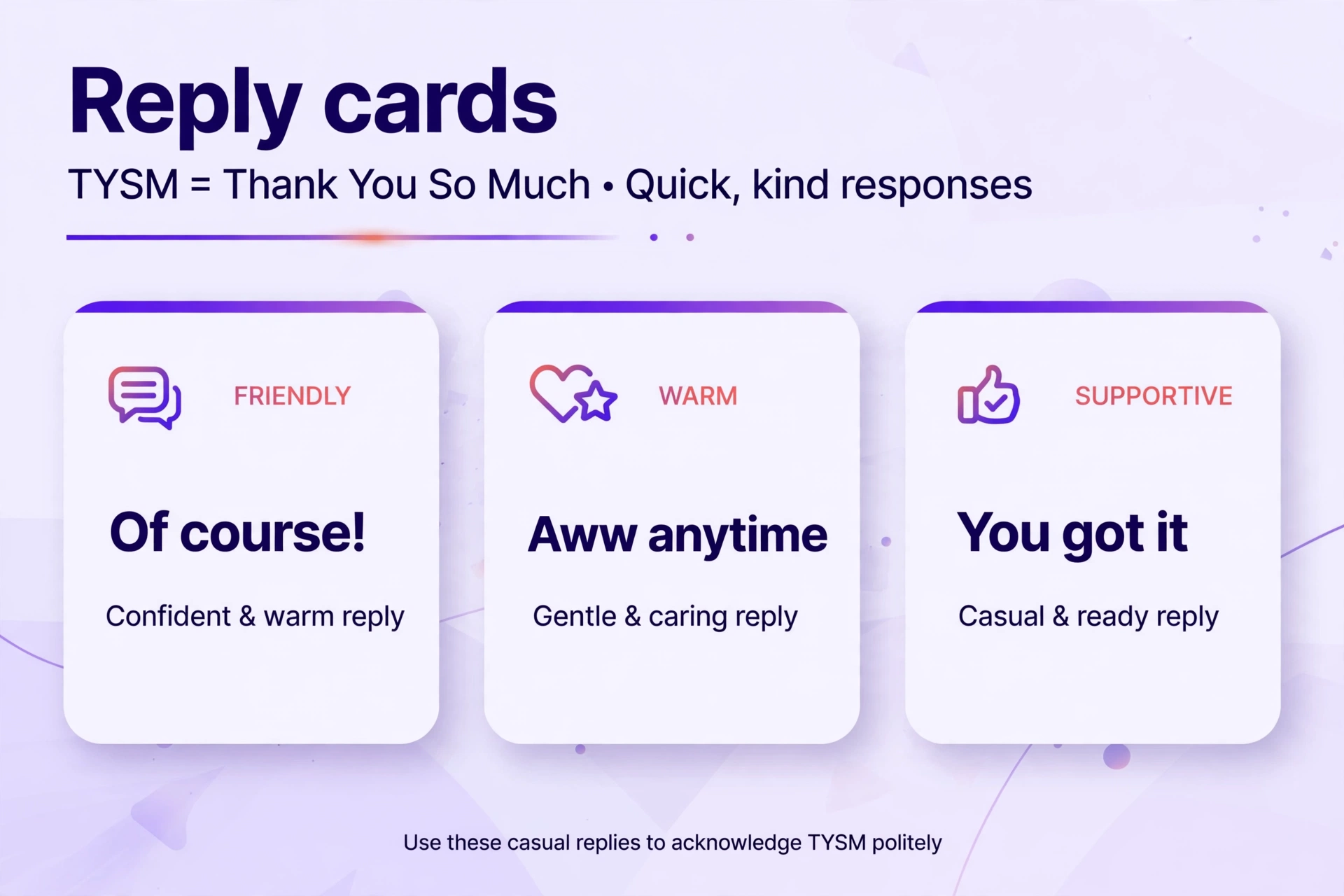
Someone thanked you warmly. What now? A good reply keeps the warmth alive without making it weird. Here are copy-ready moves:
The easy close (most situations). “Of course!” / “Anytime!” / “You got it.” Short, warm, done. This is the 90% answer.
The warmer bounce-back. “Aww anytime 🥰” or “Happy to help!” — for favors you were genuinely glad to do. Match the stretch: if they sent “tysmmmm,” you can afford an emoji.
The deflect (when it wasn’t a big deal). “It was nothing!” or “Barely took a second.” Keeps things light and stops a gratitude spiral.
The redirect (when you want to keep talking). “Anytime! HRU btw?” — turns the closing note into a conversation. The thanks was the period; this makes it a comma.
The FR move (when they really helped you back). “fr tysm, I owe you one” — the lowercase fr plus tysm is the modern friendship contract: gratitude now, favor later.
The sarcastic-TYSM reply. If someone sarcastically “thanks” you for the thing you didn’t do — don’t match the sarcasm with sarcasm. “Ha, fair — let me actually fix it” defuses and moves on. The internet has enough comment-section wars.
TYSM vs Similar Slang: Don’t Mix These Up
TYSM belongs to the gratitude family, and the relatives are close. Here’s the honest map:
| Term | Meaning | The difference |
|---|---|---|
| TYSM | Thank you so much | Warm and emphatic; the sweet spot of digital thanks |
| TYVM | Thank you very much | The slightly more formal sibling; “very much” reads a touch more proper than “so much” |
| TY | Thank you | The quick drive-by; one rung down on the ladder |
| THX | Thanks | The casual cousin; same register, slightly cooler |
| FYI | For your information | A heads-up, not gratitude; the opposite direction of a message |
| TIA | Thanks in advance | Thanks before the favor — presumptuous if the favor isn’t done yet |
| TYSM | Thank you so much | (In texting: always this. No alternate texting meaning exists.) |
The useful contrast is TYSM vs “thanks.” They’re not interchangeable — they’re different rungs. Using tysm for everything flattens it (more on overuse in the FAQ). Using “thanks” for a real favor can read cold. The ladder is the whole skill.
Debunked: What TYSM Does NOT Mean
Four letters, zero mystery — but junk meanings still accumulate. Let’s clear them honestly:
- “Take your sweet moment” — wrong. This one floats around thin content sites, and at least one competitor flags it explicitly as a misreading. There is no dictionary support for it anywhere. If someone corrects your tysm with this expansion, they’re inventing a rule that doesn’t exist.
- A dirty or hidden meaning — no. Usage guides address this search directly: in texting, TYSM is “thank you so much” every single time. There is no secret second reading.
- A formal sign-off — no. TYSM is firmly informal. It belongs in chats and comments, not cover letters. (See “When Not to Use TYSM” below.)
- Exactly the same as “thanks” — no. See the Thanks-Ladder Test. Same family, different rung.
When Not to Use TYSM
TYSM is wonderful in its habitat and awkward outside it. Skip it when:
- The email is formal. Job applications, academic writing, serious professional correspondence — spell out “thank you very much” or write the full sentence. TYSM in a cover letter reads like a typo wearing confidence.
- The thanks is a debt, not a tap. If someone did something genuinely big — the 2 a.m. airport run, the job referral, the crisis help — four letters can feel small. Climb to the top rung: spell it out, add a sentence about what it meant.
- You’ve used it five times today. Overuse is the fastest way to make tysm read insincere. Usage guides flag this honestly: if every message gets a tysm, none of them does. Vary your thanks — rotate in “appreciate it,” “you’re the best,” or just the full words.
- The favor hasn’t happened yet. “TYSM in advance!!” is the TIA move and it presumes. Thank people after, not before.
- You’re being sarcastic and it’s not obvious. Sarcastic tysm works with people who know you. With strangers or in writing-only contexts, the sarcasm may not land — and genuine-looking thanks for a bad situation just confuses everyone.
Quick Answers
What does TYSM mean in text?
TYSM means “thank you so much.” It’s a warm, casual way of expressing emphatic gratitude in texts, chats, and comments — one rung warmer than a plain “thanks.”
Is TYSM the same as “thanks”?
Not quite. “Thanks” is the standard, everyday version; TYSM is warmer and more emphatic. Think of them as different rungs on the same ladder — pick the one that matches the favor.
Can TYSM be sarcastic?
Yes, occasionally. When “TYSM” follows something unhelpful — “Wow, you really did that at the last minute, TYSM!” — the mismatch between the words and the situation is the tell. Genuine tysm follows something helpful; sarcastic tysm follows something that wasn’t.
What’s the difference between TYSM and TYVM?
Both are emphatic thank-yous. TYSM (“thank you so much”) reads warmer and more casual; TYVM (“thank you very much”) reads a touch more proper. In texting, TYSM is the more common choice.
Is it okay to use TYSM in a work email?
In casual internal chats, yes. In formal emails, cover letters, or anything going to someone who decides your future — no. Spell it out: “thank you very much.”
Does TYSM mean anything else?
In texting, no — it’s “thank you so much” every time. There is no dirty, hidden, or alternate texting meaning, despite what thin content sites might imply.
TYSM is four letters doing the work of a whole grateful paragraph. Run the Thanks-Ladder Test before you send your next one, turn the warmth dial deliberately, and your gratitude will land exactly the way you meant it — warm, human, and never automatic.
