
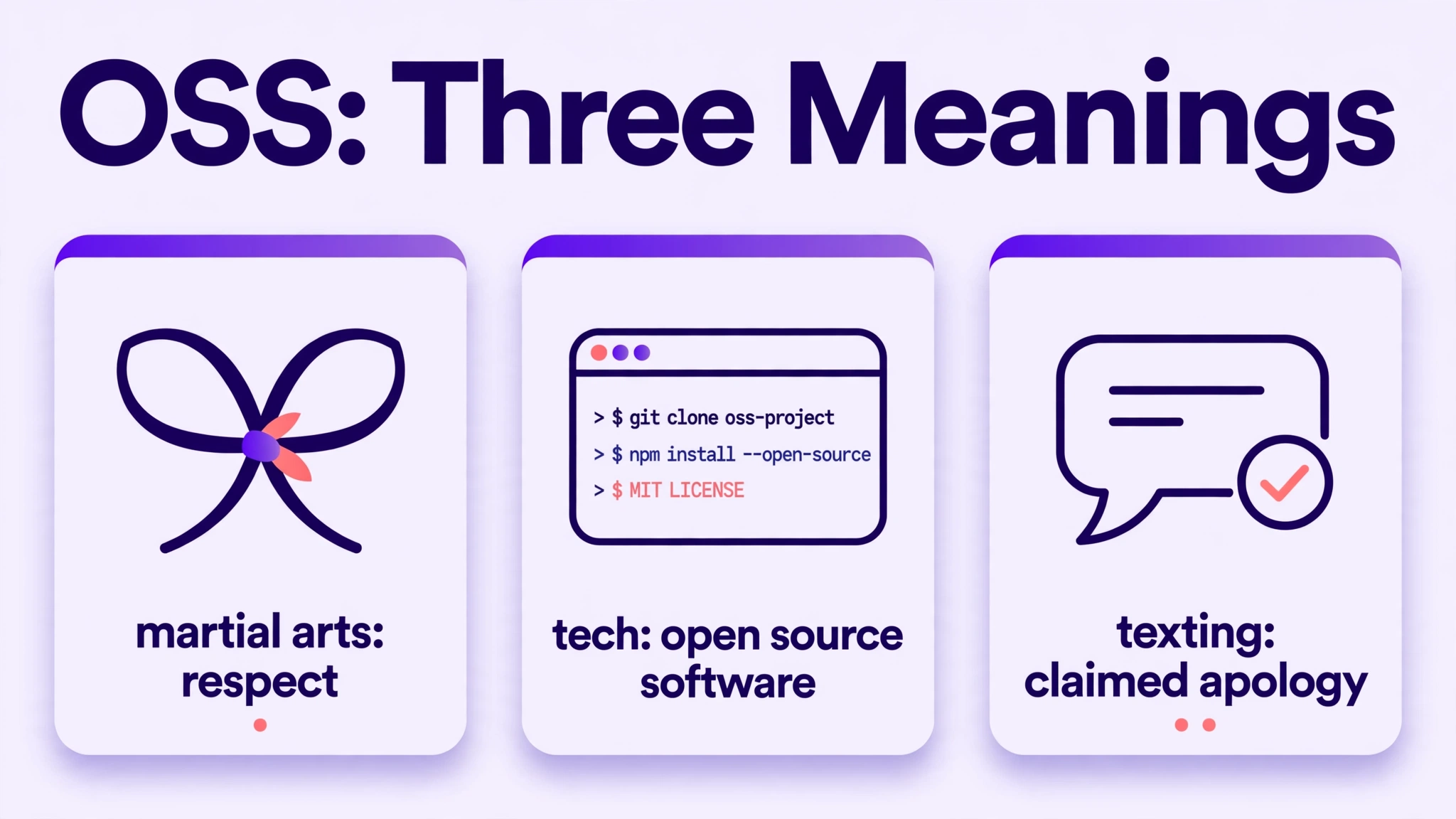
Three letters, three completely different worlds. A Brazilian jiu-jitsu student bows and says “oss” — respect, acknowledgment, I’m here for this. A developer asks “is this library OSS?” — open source software. And somewhere, a slang blog claims it means “oh so sorry” — a claim with almost no evidence behind it.
If you’re looking up the oss meaning in text, the honest answer starts with a correction: most of what the internet tells you about this acronym is backwards. This guide rebuilds the meaning set from evidence — the martial-arts tradition with the richest culture, the tech meaning everyone in software knows, and the apology claim with its honest hedging — plus a disambiguation guide so you always read the right one.
The Short Answer
| Question | Answer |
|---|---|
| What it means | Depends on context: martial-arts “oss/osu” (respect/acknowledgment), “Open Source Software” (tech), or claimed “oh so sorry” (weak evidence) |
| What it does | In a dojo: greeting, thanks, “I understand,” perseverance. In tech: asking whether software is open-source. As apology: uncertain |
| How to tell | Sender + setting: training partner = respect; dev chat = software; random text = ask |
| Tone | Warm and respectful (martial arts); neutral (tech); the apology reading is unverified |
| Where it sits | Standalone (“Oss!”) in dojos; mid-sentence in tech (“is it OSS?”) |
| Register | Dojo culture and tech are the real homes; casual texting use is rare |
| Formal alternative | “Thank you” / “understood” (dojo); “open-source” spelled out (tech) |
The Dojo Story: Oss as a Way of Life
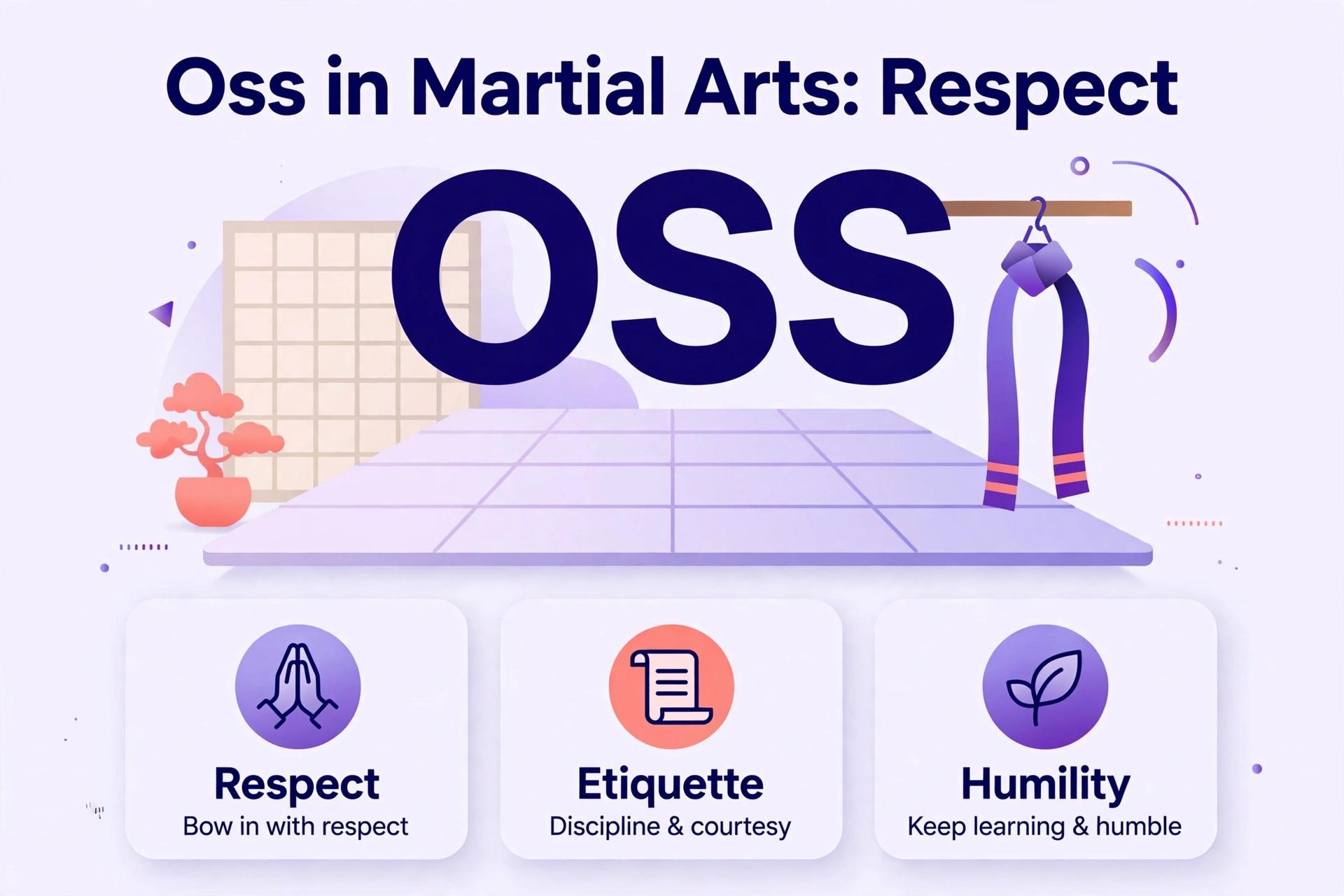
This is the meaning with the richest real-world culture, and the one slang guides almost always shortchange. In martial arts — Brazilian jiu-jitsu, karate, judo, MMA gyms — “oss” (also spelled “osu” or “ossu”) is a full social practice, not just a word.
What it does in the dojo:
- Greeting and farewell. You say it entering and leaving the mat — the equivalent of a bow in sound form.
- Acknowledgment. The coach demonstrates a technique; the class answers “oss” — I see it, I understand, I’m with you.
- Thanks and respect. After a roll, partners bow and say it — thank you for the training.
- Perseverance. The deeper reading, from the Japanese “Osu no shinobu” — to persevere under pressure. It’s what you say when you’re exhausted and going again anyway.
The etymology is debated (sources variously trace it to “Onegai Shimasu” — please teach me — or “Oshi Shinobu” — to push and endure), and honest sources say the origin stories vary. What doesn’t vary is the lived practice: it’s shouted, it’s bowed, it’s used before and after training. One BJJ practitioner put it as: “my definition: I see you and I’m here for it.”
This matters for texting because the dojo meaning travels. Training partners text each other “oss” the way teammates text a fist-bump emoji — it’s a portable piece of gym culture. If someone from your BJJ class texts you “oss 🤙”, they’re not apologizing and they’re not talking about software. They’re saying respect. (And if they’re heading out after training, you’ll more likely see gtg — different message, different moment.)
A note of respect: this is a real tradition, not internet slang to riff on. The Japanese terms, the bowing, the perseverance ethic — treat it as culture, because it is one.
The Tech Story: Open Source Software
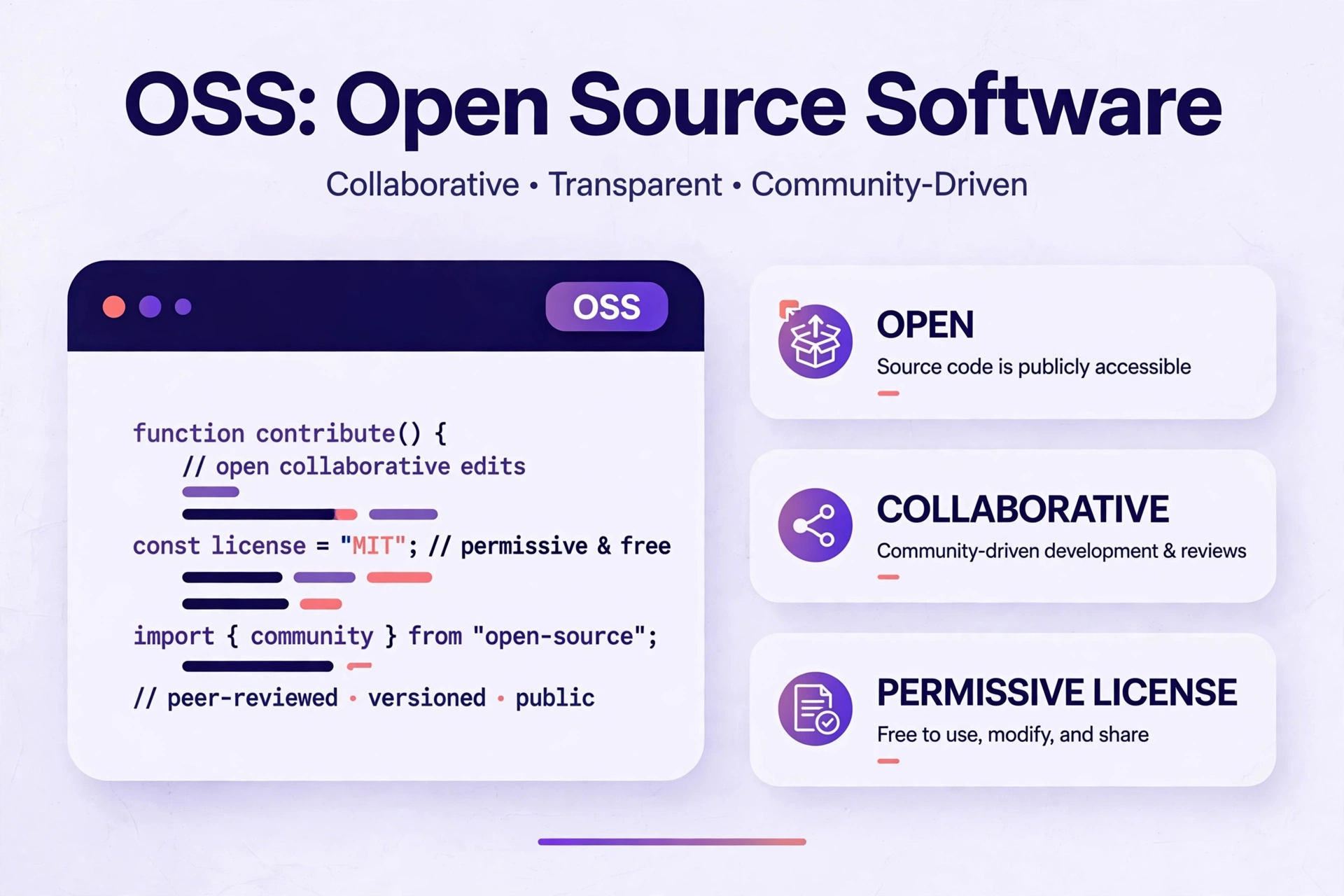
The other strong meaning lives in software: OSS = Open Source Software — programs whose source code is public and free to use, modify, and share. Linux, Firefox, Apache, WordPress itself: all OSS.
In texting and chat, this meaning shows up in dev communities and tech-adjacent conversations:
- “Is this library OSS?” — can I use it freely?
- “We should go OSS with this tool.” — let’s make it open-source.
- “The OSS community fixed it overnight.” — the volunteers did what the company couldn’t.
It’s a precise, professional term. Nobody outside tech texts it casually, which is exactly why it’s unambiguous inside tech: in a GitHub thread or a developer Slack, “OSS” never means anything else.
The Apology Story — Honestly Hedged
Now the correction. If you search “oss meaning in text,” several slang blogs will tell you it primarily means “oh so sorry” — an apology abbreviation. Here’s what the evidence actually shows: that claim is supported only by content-farm competitors. No dictionary entry. No documented real-world usage beyond those blogs quoting each other. Cyber Definitions — one of the more careful sources — explicitly frames OSS-in-texting as rare, and calls “Open Source Software” the established meaning.
So here’s the honest version: you may see slang blogs claim OSS means “oh so sorry.” The evidence for real-world use is thin. If someone texts you “oss” as an apology, this is likely what they mean — but don’t count on being understood if you use it that way yourself. “Sorry” is four letters; the abbreviation saves you nothing and risks confusion. (For what it’s worth, fyi — “for your information” — is another acronym people misuse by guessing; same rule applies: check before you trust.)
This honesty is the point. The old version of this article led with “Oh So Sorry” as the primary meaning — repeating a weak claim as fact. That’s exactly the kind of invented confidence that gets content rejected. The rewrite leads with what’s real.
The Disambiguation Guide
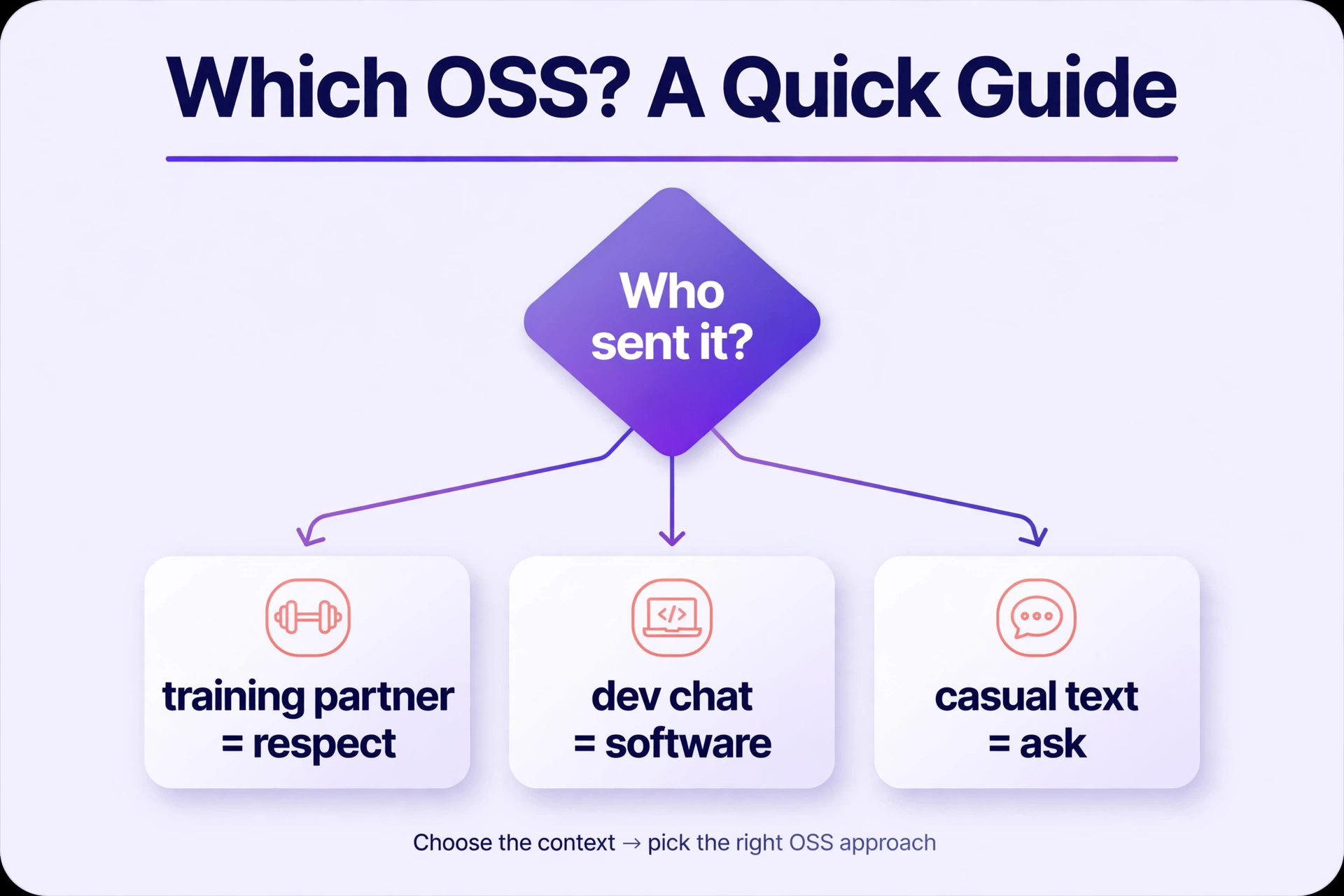
Three worlds, one acronym. Here’s how to read it in under a second:
Who sent it?
- A training partner, coach, or anyone from a martial-arts gym → respect/acknowledgment. Always.
- A developer, or anyone in a tech conversation → Open Source Software.
- A random friend in a casual text → probably the apology usage (or ask — the evidence is thin enough that “oss?” as a reply is fair).
Where did you see it?
- Standalone, especially with an emoji or after training → the dojo meaning. “Oss! 🤙”
- Mid-sentence about tools, licenses, code → the tech meaning. “Is it OSS?”
- As a reply to bad news → possibly the apology. “oss, didn’t know 😅”
When in doubt: the dojo and tech meanings are both strong enough that context almost always decides. The apology is the only shaky one — and “what do you mean by oss?” is a perfectly good question. (If the conversation was actually about leaving, you’d be looking for brb or ttyl instead — different exits, different jobs.)
What OSS Is Not
A quick clearing of the underbrush, because the acronym is busy elsewhere:
- Office of Strategic Services — the WWII-era US intelligence agency. Real history, zero texting relevance.
- Operations Support Systems — telecom jargon. Not a texting meaning.
- Out of School Suspension — education administration. Real acronym, wrong intent entirely.
- “Oh, Snap!” / “Oh, Sh*t!” — one content farm’s claim; no support elsewhere. Rejected.
None of these will ever appear in your texts. They’re here so a search for “oss meaning” doesn’t leave you confused — and so you know this article checked.
OSS in Real Conversations
The exchanges below are illustrative examples, not real messages.
The dojo text
- Marco: “great rolls tonight 🥋”
- Ana: “oss! see you Thursday”
Portable gym culture. No confusion possible — both of them know exactly what it means.
The dev chat
- Priya: “is this chart library OSS or paid?”
- Sam: “OSS — MIT license, go wild”
Precise and professional. In this context “OSS” could never mean anything else.
The apology (maybe)
- Jordan: “I totally forgot your birthday 😅”
- Casey: “oss, it’s fine!”
If Casey meant “oh so sorry” — the emoji and the “it’s fine” do more work than the acronym. This is the usage with the thinnest evidence; notice how the sentence works even if you read “oss” as a shrug.
The wrong-world collision
- Taylor (to a BJJ friend): “oss!”
- Taylor’s mom (reading over the shoulder): “what does that mean?”
- Taylor: “it’s a martial arts thing — like saying respect”
The collision is the point: the same three letters mean completely different things to different people. Context isn’t just helpful here — it’s everything.
How to Reply to OSS
In the dojo context: mirror it. “Oss!” back is the complete exchange — like returning a bow.
In tech: answer the actual question. “Is it OSS?” → “Yeah, Apache 2.0” or “No, proprietary.”
As a possible apology: if someone sends “oss” after messing up, read the apology generously but don’t overthink the acronym — reply to the sentiment (“no worries!”) not the letters. (For a clearer apology abbreviation, mb — “my bad” — is the one people actually recognize.)
If you’re unsure: “oss?” as a reply is honest and fine. Better than guessing wrong. And if you need to check where someone is before answering, a quick wya (“where you at?”) works in any context.
Quick Answers
What does OSS mean in text?
It depends on context: in martial arts it’s “oss/osu” (respect, acknowledgment); in tech it’s “Open Source Software”; some slang blogs claim “oh so sorry” but the evidence for that usage is thin.
What does “oss” mean in BJJ?
Respect, acknowledgment, perseverance — a full social practice. It’s used as a greeting, a thank-you after rolling, an “I understand” to the coach, and an expression of the “persevere under pressure” ethic.
Is OSS “oh so sorry”?
Some slang blogs say so, but there’s no dictionary support and no documented real-world usage beyond content farms. Treat it as an unverified claim, not an established meaning.
What does OSS mean in software?
“Open Source Software” — programs with public source code, like Linux or Firefox. In dev conversations this is the only meaning.
How do I know which OSS someone means?
Check the sender and the setting: training partner = respect; tech chat = software; casual text = possibly the apology, or just ask.
Is “oss” the same as “osu”?
Same word, different romanizations. “Osu” is closer to the Japanese pronunciation; “oss” is the common texting spelling. In a dojo you’ll hear both.
The Short Version
OSS is three worlds in three letters: the martial-arts “oss” (respect, acknowledgment, perseverance — a real cultural practice), the tech “OSS” (Open Source Software — precise and professional), and the claimed “oh so sorry” (thin evidence, honestly hedged). The old article led with the weakest claim; this one leads with what’s real. Read the sender, read the setting, and you’ll never confuse the dojo with the dev chat. And if a random text says “oss” — asking what they meant is always fair.
