
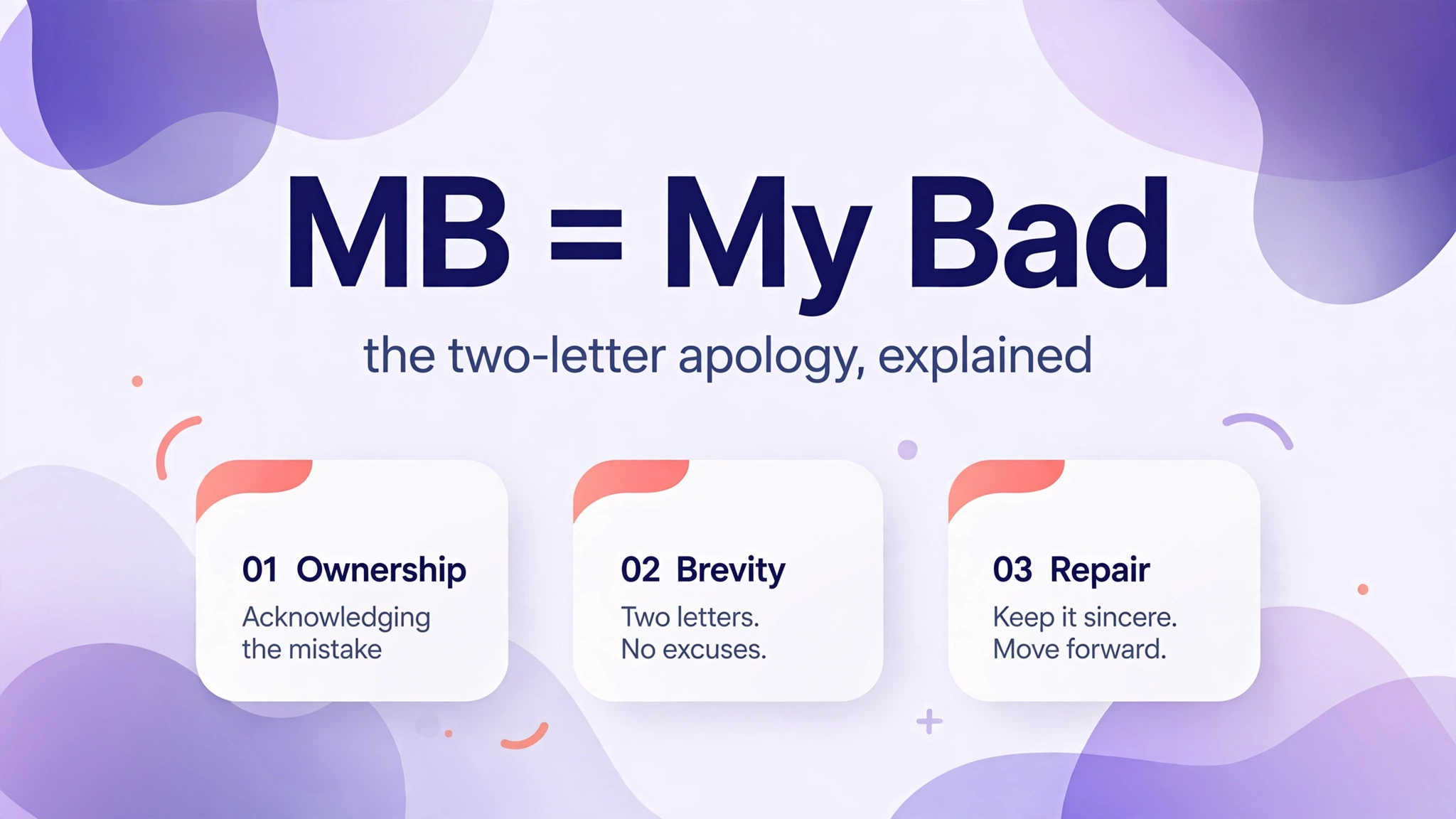
Two letters that carry an apology without ceremony: “mb.” You’ve seen it after a wrong link, a late reply, a message sent to the wrong chat. If you’re looking up the mb meaning in text, the short version is simple — but the social mechanics underneath matter.
MB stands for “my bad” — a quick, informal way to admit a small mistake. It’s the texting equivalent of a shrug and a grin: I messed up, I know it, let’s move on. This guide covers what MB actually does in a conversation, why it sometimes sounds dismissive, how it compares to a real apology, and when to reach for stronger words instead.
The Short Answer
| Question | Answer |
|---|---|
| What it means | “My bad” — a casual admission of a small mistake |
| What it does | Acknowledges fault quickly without making it a big deal |
| Tone | Informal and light; can read as dismissive if the mistake was serious |
| Where it sits | Usually opens the message or stands alone (“mb, sending now”) |
| Register | Casual only — friends, group chats, gaming, quick DMs |
| Formal alternative | “My apologies,” “Sorry about that,” or a full explanation |
What “My Bad” Actually Does in a Conversation
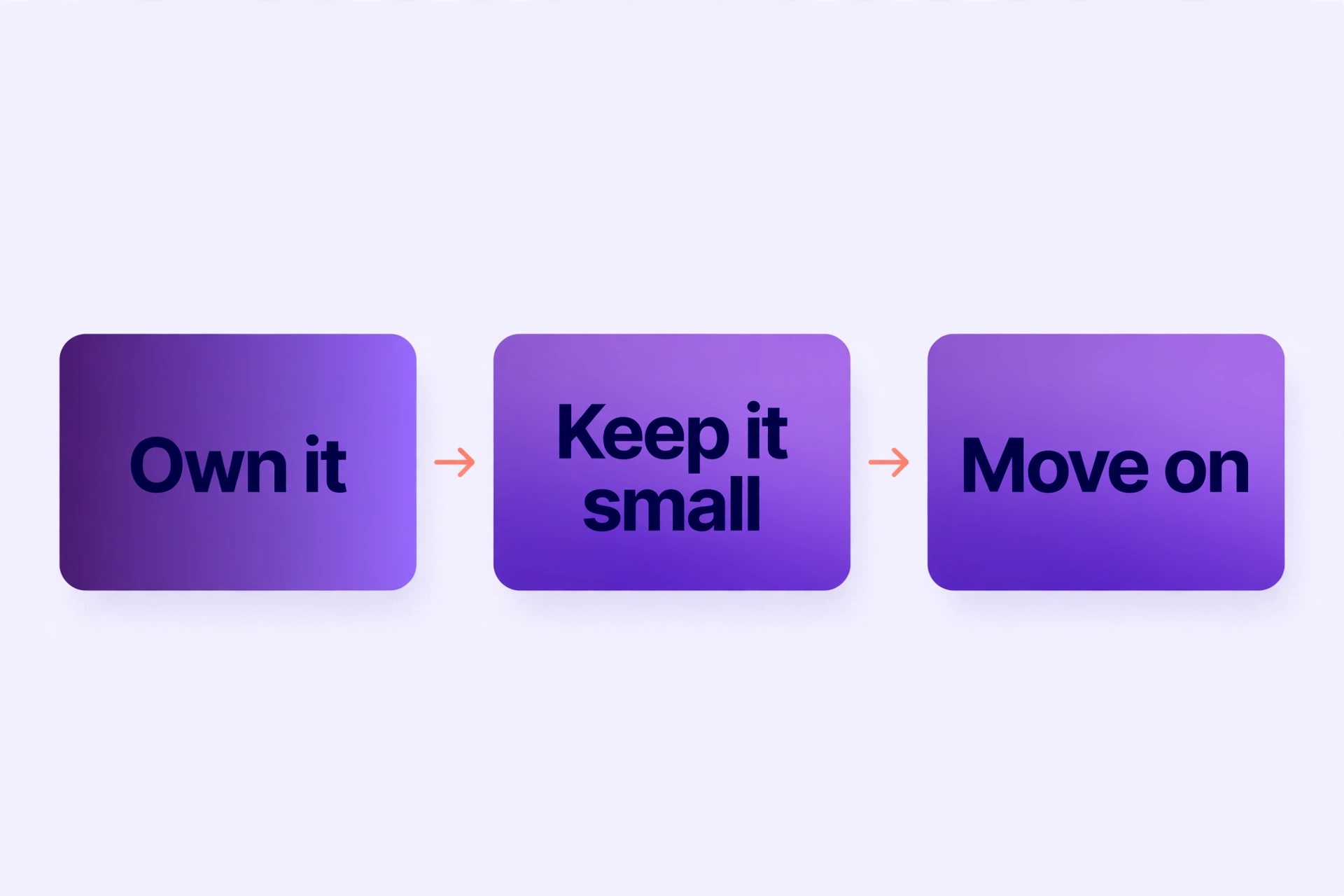
Underneath the shortcut, MB is doing three social jobs at once.
It claims the mistake before anyone else can. “Mb, wrong chat” lands differently than silence followed by a correction. The sender is saying: I see what I did, you don’t need to point it out. That pre-emptive ownership is most of MB’s charm.
It sets the stakes as low. Choosing “mb” over “I’m so sorry” signals scale — this was a small thing, treated as a small thing. That works for typos and late replies, and it’s exactly why MB misfires on real mistakes, where low-stakes framing reads as not caring.
It keeps the conversation moving. A full apology demands a response — “no, it’s fine,” a whole ritual. MB asks for nothing back. “Mb, sending the right file now” skips the forgiveness ceremony.
The phrase has real history: “my bad” comes from 1970s–80s American basketball culture, where players called it out after a bad pass. It went mainstream in the 1990s — the film Clueless gave it a famous push — and was compressed to “mb” once texting made every keystroke count.
MB in Real Conversations
The exchanges below are illustrative examples, not real messages.
The wrong chat
- Alex: “can’t wait for tonight!!” (sent to the wrong group)
- Alex: “mb, wrong chat”
The instant correction — owned before anyone could react. The classic MB use case.
The late arrival
- Sam: “where are you?? we started already”
- Jordan: “mb, eta 10 min — parking now”
Jordan pairs the apology with useful information. “Mb” alone would have been thin; with the ETA attached, it’s complete.
The missed text
- Casey: “did you see my message from yesterday?”
- Riley: “mb, totally missed it — wtw?”
Riley acknowledges the miss and re-engages. The MB clears the air; the WTW restarts the conversation.
The gaming fumble
- Player 1: “why did you push alone??”
- Player 2: “mb, thought you were behind me”
Two taps, no drama, back to the game. In gaming lobbies MB is social lubricant — a longer apology would stall the match.
The Tone Problem: Why MB Sometimes Sounds Dismissive
The same low-effort quality that makes MB charming also makes it risky. An apology’s weight should match the mistake’s weight, and MB is permanently lightweight.
“Mb” after a real letdown stings. Forgot a birthday, missed something important — and replied “mb”? The two letters say “small thing” while the other person feels a big thing. That mismatch reads as dismissive.
A bare “mb” with no follow-up feels empty. “Mb” plus the fix (“sending now,” “on my way”) is a complete apology. “Mb” alone, after something that mattered, reads as: I noticed, and I couldn’t be bothered to type more. The fix is the apology; “mb” is just the wrapper.
Punctuation does quiet work. “mb!” reads warm and sheepish. “mb.” with the period can read clipped. And “mb lol” — the laugh-out-loud softener — works between close friends but can look like laughing at your own mistake in front of anyone else.
The self-directed upgrade. “Smh at myself, mb” — pairing it with SMH — strengthens the apology. It shows you’re annoyed at yourself too.
The rule: MB is for mistakes you’d forgive in someone else within ten seconds. Anything bigger needs real words.
MB vs. “Sorry”: The Apology Spectrum
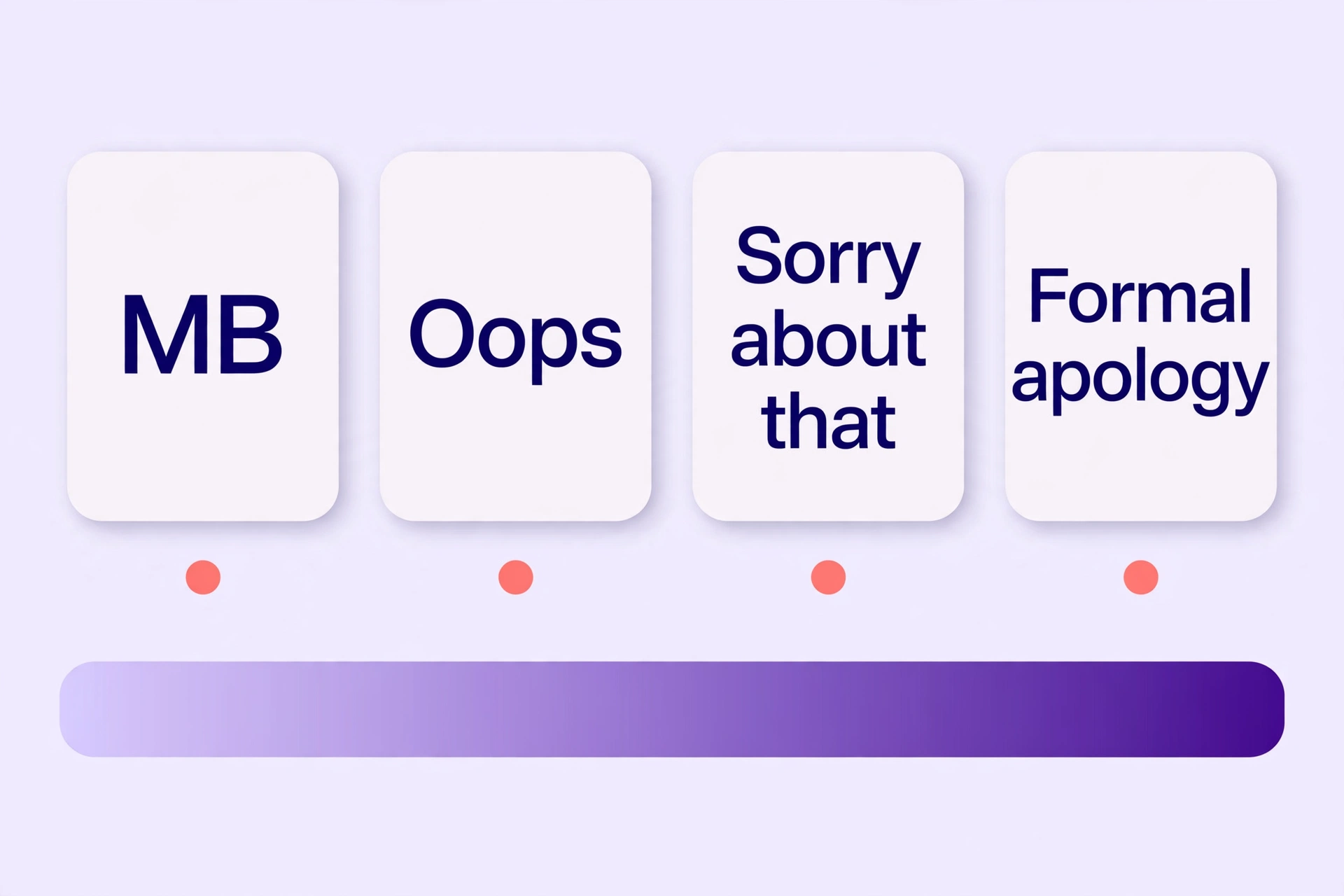
- “Mb” — the lightest touch. Typos, wrong chats, five minutes late. Implies: minor, already handled.
- “Oops” / “my mistake” — a half-step up. Slightly more ownership without going formal.
- “Sorry about that” — the middle ground. Real apology energy, still casual. The safe default when you’re unsure how much it mattered.
- “I’m really sorry” + explanation — for actual letdowns. Missed commitments, hurt feelings. This is where MB becomes insulting.
- “My apologies” + making it right — the formal end. Work, clients, strangers. Written out, with specifics.
The practical test: if you’d feel bad receiving just “mb” for this mistake, don’t send just “mb” for it. Match the apology to the impact, not to your typing speed.
The Other Meanings of MB
In a texting conversation, MB is “my bad” essentially every time.
“Maybe.” A secondary, rarer reading — “mb we can reschedule” — where MB hedges instead of apologizing. Context separates them: “mb” after a mistake is an apology; “mb” before a plan is a hedge.
Megabyte. In tech contexts, MB is a unit of data storage. “The file is 4 MB” is never an apology. This creates genuinely funny collisions — “the file is 4mb, mb for the late send” — sorted by context alone.
Message back. Old SMS shorthand (“mb when you’re free”), rare today.
Assume “my bad” unless the conversation is about files, data, or plans — then read the sentence, not the letters.
Where MB Works and Where It Doesn’t
Where it shines: texts with friends, group chats, gaming lobbies, quick DMs, casual Slack with people you know well. Warm relationships, small mistakes.
Where it fails: work emails, client messages, managers, school, customer service, strangers. “Mb” to your boss after missing a deadline isn’t casual — it’s a career-limiting move. Write it out instead.
The gray zone: family chats, older relatives, non-native English speakers. MB is generational shorthand; when in doubt, write “my bad” in full — four extra characters, zero ambiguity.
One more rule: don’t open a serious conversation with “mb.” It frames everything after it as small — then you have to climb out of the hole you dug.
How to Reply to MB
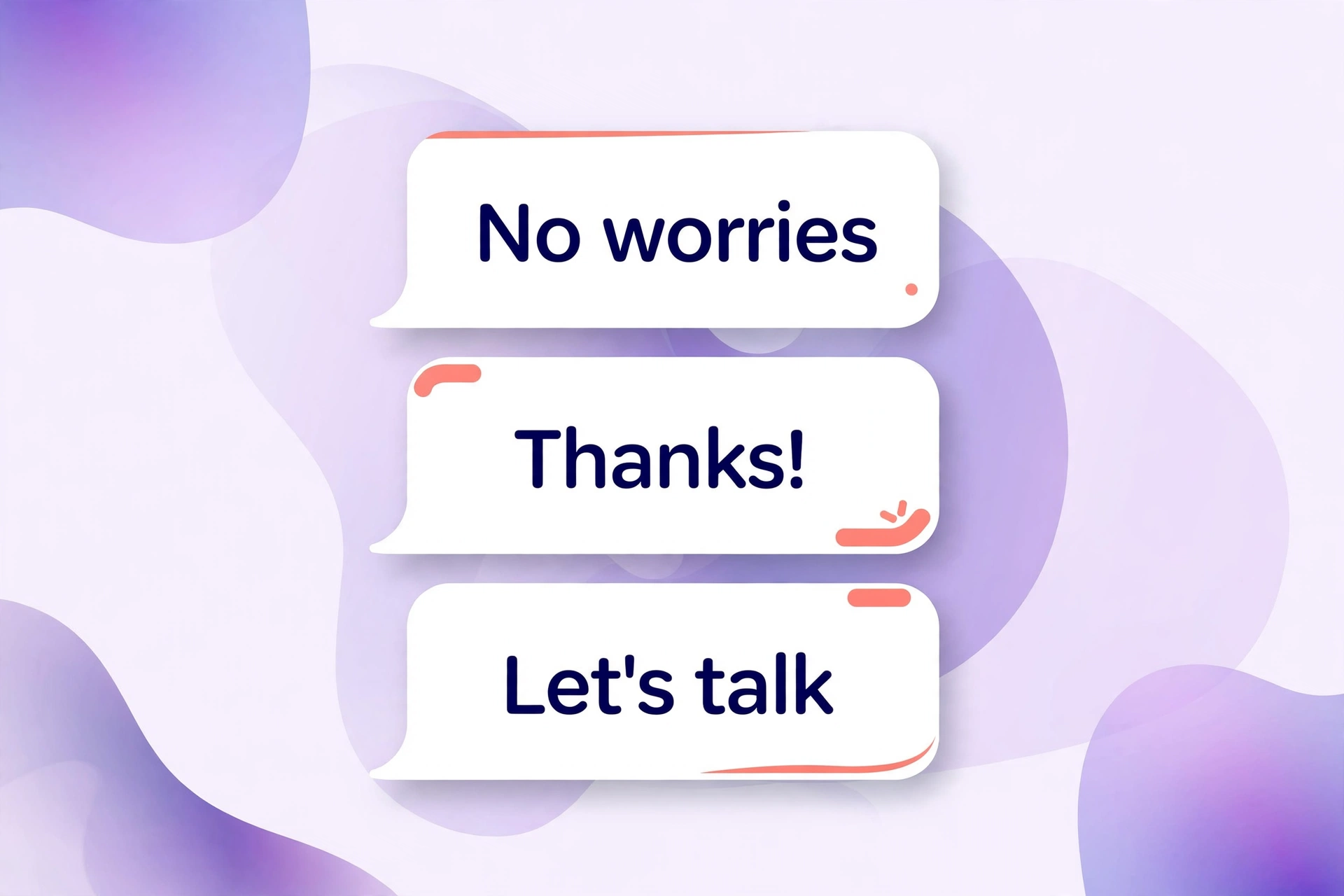
- It was genuinely small: “no worries” or “all good” — the gracious close. Don’t make them grovel for a typo.
- They paired it with a fix: acknowledge the fix. “Thanks!” beats a lecture.
- It felt too light: say so kindly, once. “Hey, that actually mattered to me — can we talk about it?”
- Keep it warm: “lmk if you need anything else” — hands them the next step instead of dwelling.
- It’s a pattern: the third “mb” for the same mistake isn’t an apology anymore. Address the pattern: “this keeps happening — what’s going on?”
- They’re heading out: “mb, gtg!” → “no worries!” A clean apology-exit needs nothing more.
What not to do: don’t punish a good MB. Someone who instantly owns a small mistake with “mb, fixing now” is doing exactly the right thing. Reward it with grace.
Quick Answers
What does MB mean in text?
“My bad” — a quick, informal apology for a small mistake. “Mb, wrong chat” means “oops, my fault — wrong chat.”
Is MB rude?
Not by itself. It turns rude when the mistake was serious and “mb” is all you offer — the lightness that charms for typos reads as dismissive for real letdowns.
What’s the difference between MB and sorry?
Weight. “Mb” is the lightest apology — for typos and tiny slip-ups. “Sorry,” especially with an explanation, is for things that actually mattered.
Can MB mean “maybe”?
Yes, as a secondary and rarer reading — “mb we can reschedule.” Context separates it: after a mistake it’s an apology; before a plan it’s a hedge.
Does MB mean megabyte?
In tech contexts, yes. In a conversation, “the file is 4 MB” is never an apology. Topic decides, not the letters.
Should I use MB at work?
In casual internal chat with close colleagues, occasionally. In emails, client messages, or anything formal — no.
Why lowercase “mb”?
It’s the texting default — faster to type, and it signals the slang meaning. Uppercase “MB” can read as the tech term (megabyte).
Where did “my bad” come from?
American basketball culture in the 1970s–80s. It went mainstream in the 1990s (the film Clueless helped) and was shortened to “mb” as texting took over.
The Short Version
MB is “my bad” — two letters that own a small mistake and keep the conversation moving. It works because it’s pre-emptive, low-stakes, and asks nothing back. But its lightness is also its limit: use it for typos, wrong chats, and five-minutes-late, and reach for real words when the mistake actually mattered.
