
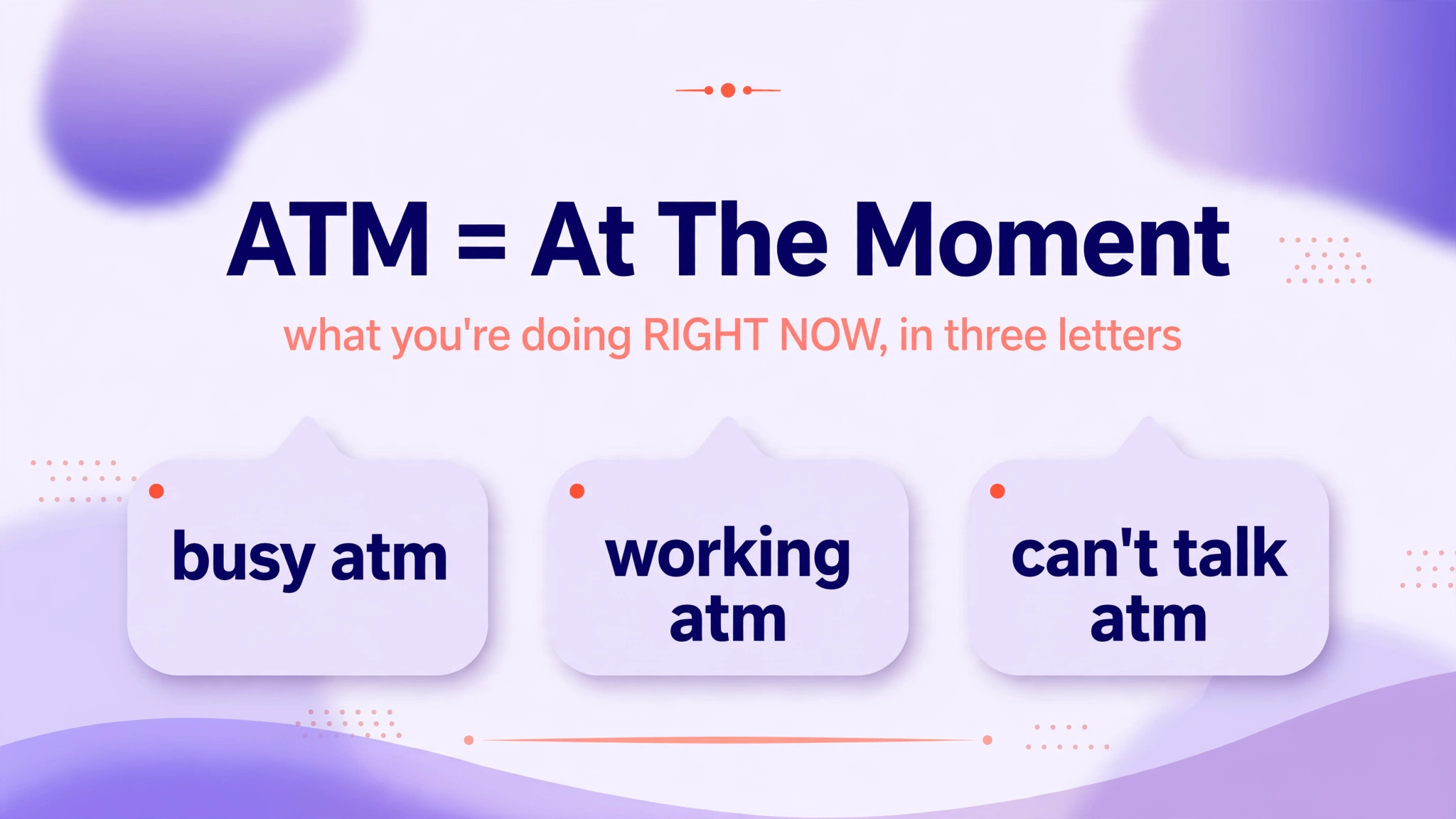
There’s a three-letter abbreviation that causes more double-takes than almost any other in texting: “atm.” You get a message — “can’t talk, busy atm” — and for half a second your brain goes to the cash machine on the corner before it catches up. That moment of confusion is exactly why this one deserves a proper explanation.
In texts, ATM almost always means “at the moment” — a quick way to describe what you’re doing, feeling, or dealing with right now. It’s a status update compressed into three keystrokes. This guide covers how it works, the bank-machine mix-up, the subtle differences between ATM and its time-related cousins, and what to send back when you get one.
The Short Answer
- ATM means “at the moment” in texts — it describes your current situation: what you’re doing or how things stand right now.
- It usually sits at the end of a sentence, modifying whatever came before it: “I’m studying ATM” = I’m studying right now.
- Context decides everything. If the conversation is about money, banks, or cash, ATM probably means the machine. Everywhere else, it’s the time phrase.
- Lowercase “atm” leans casual and slangy; uppercase “ATM” can go either way — don’t rely on capitalization alone.
- It’s informal. Fine for friends and quick chats; skip it in anything professional.
How “At the Moment” Actually Works in a Sentence
Most texting abbreviations replace a whole idea — LOL replaces laughter, BRB replaces an announcement. ATM is different: it works like a time stamp. It rarely stands alone. Instead, it attaches to a sentence and anchors it to the present.
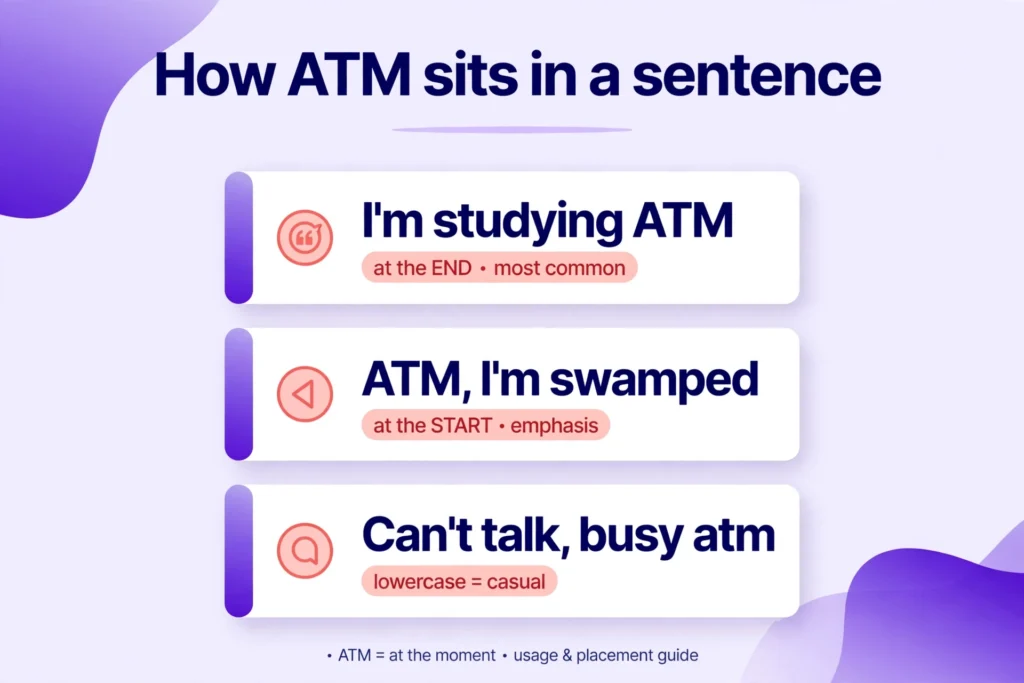
The most common position is the end of the sentence, where it modifies the verb before it:
- “I’m working ATM” — working, right now
- “Can’t talk ATM” — can’t talk, at this moment
- “Everything’s fine atm” — fine, currently
Put it at the start, and it changes the temperature — it becomes emphasis, almost a warning: “ATM, I’m swamped” hits harder than “I’m swamped ATM.” The front position says: pay attention to the timing here.
And then there’s the lowercase version. “atm” in all lowercase is the relaxed, thumb-typed form — the one that shows up mid-conversation when nobody’s thinking about grammar. It signals the same meaning with a softer, more casual feel. You’ll almost never see someone type “ATM” in caps mid-chat unless they’re emphasizing it.
One thing ATM never does: it never starts a conversation. Nobody opens with “atm?” the way they might open with “wya?” It’s a modifier, not a question — it needs a sentence to hang onto.
ATM in Real Conversations
The exchanges below are illustrative examples, not real messages.
The polite dodge
- A: “want to hop on a call?”
- B: “can’t atm, in the middle of something”
- A: “no worries, lmk when you’re free”
B isn’t rejecting the call — just the timing. “ATM” does the softening work here: it’s not “no,” it’s “not right now.”
The status broadcast
- A: “where is everyone?”
- B: “atm just me and sarah, others are otw”
Two abbreviations doing two jobs: “atm” describes the current state, and the headcount is live information. This is ATM at its most functional — a real-time update.
The overwhelmed honest
- A: “you good? you’ve been quiet”
- B: “atm, honestly? barely holding it together lol”
Front-positioned ATM for emphasis, and it works — A immediately understands this is about right now, not life in general.
The group-chat check
- A: “who’s free tonight?”
- B: “busy atm, maybe later”
- C: “same, atm is chaos”
B uses it as a shield; C borrows it as a mood. Same three letters, slightly different jobs — and everyone in the chat reads both correctly without thinking.
The Capitalization Clue: “atm” vs “ATM”
Here’s a rule of thumb you’ll see repeated across slang guides: lowercase “atm” usually means the texting slang, uppercase “ATM” usually means the bank machine. There’s truth in it — but treat it as a hint, not a law.
In practice, plenty of people type “ATM” in caps for the slang meaning, especially for emphasis (“I’m busy ATM, leave me alone”). And the banking meaning shows up in lowercase too (“need to find an atm”). What actually disambiguates them is topic, not typography:
- Money, cash, withdrawals, banks, fees → the machine. “The ATM charged me $3” is never about timing.
- Activities, feelings, availability, current situations → the slang. “Stressed atm” is never about banking.
The genuinely confusing cases are rare, and they resolve in about two seconds of re-reading. If someone writes “stuck at the atm,” the sentence before and after will tell you whether they’re describing a moment or a location. When in doubt, the rest of the conversation is the dictionary.
For a sense of how real people actually deploy both readings — including the jokes — the Urban Dictionary entry for ATM collects unfiltered definitions from texters themselves.
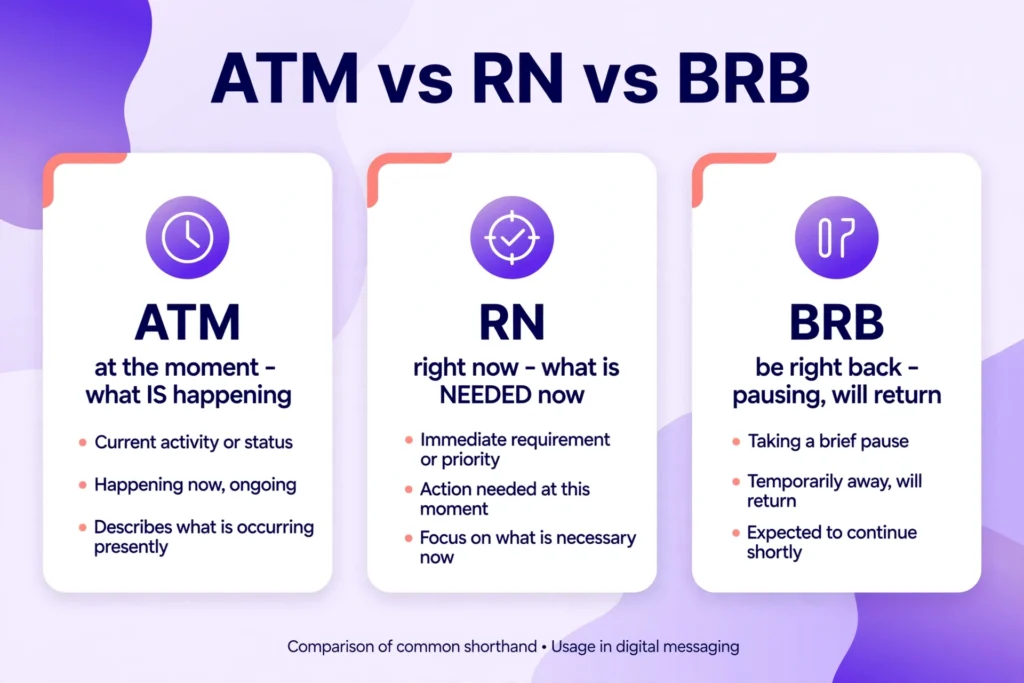
ATM vs. RN vs. BRB — the Time Triplets
Texting has a small cluster of time-related abbreviations, and they get mixed up constantly. They look interchangeable. They’re not.
The closest pair, and the easiest to confuse. The difference is subtle but real: ATM describes an ongoing situation (“I’m working ATM” — this is my current state), while RN (“right now”) emphasizes immediate timing or urgency (“I need food RN” — this can’t wait). ATM is a status; RN is a demand. “Busy atm” is information. “Busy RN” is a wall.
Different jobs entirely. ATM says what’s happening while you stay in the conversation — you’re still here, just occupied. BRB (“be right back”) announces you’re leaving it temporarily. “Studying atm” means messages will be slow. “Brb” means messages will stop. One dims the chat; the other pauses it.
ATM looks backward-or-present (“this is my situation now”); ETA (“estimated time of arrival”) looks forward (“this is when I’ll be there”). They pair well: “busy atm, eta 20 min” tells someone both your current state and when it changes — the complete status update in six words.
The through-line: ATM is the only one of these that’s a pure present-tense descriptor. The others demand, pause, or predict.
When ATM Means the Cash Machine
Let’s give the other reading its due, because the confusion is the whole reason people search this term. ATM as Automated Teller Machine is one of the most universally recognized acronyms in English — the machine that dispenses cash. In any conversation about money, it’s the default meaning, and the slang reading doesn’t even register.
A few practical notes on telling them apart:
- “The” is the tell. People say “the ATM” for the machine (“where’s the ATM?”). The slang almost never takes “the” — nobody says “at the atm” to mean “at the moment.”
- Verbs differ. You go to, find, use, or withdraw from an ATM (machine). You are, feel, or can’t something “atm” (slang).
- In aviation and tech, ATM has other meanings entirely (Air Traffic Management, Asynchronous Transfer Mode) — you’ll never encounter these in a text message, so don’t let them confuse you.
If you ever genuinely can’t tell, just ask. “Do you mean the bank or right now?” takes three seconds and beats guessing wrong.
What to Send Back
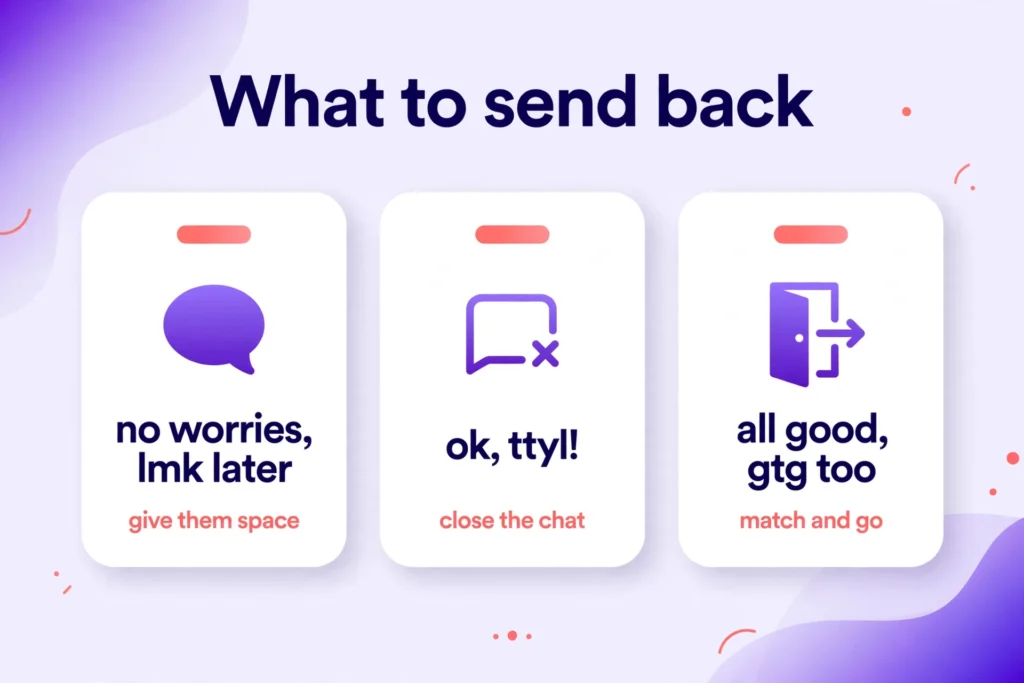
An “atm” message is usually a boundary or a status update, not a question — so your reply depends on what you need from the person.
- Give them space: “no worries, let me know when you’re free” — the gracious response. It respects the boundary and hands them the next move.
- Close the chat: “ok, TTYL!” — when their “atm” clearly means the conversation is over for now.
- Match and go: “all good, GTG too” — when you’re equally occupied and want to end things symmetrically.
- Ask for timing: “how long?” or “eta?” — fair game if you actually need them. An “atm” without a timeframe is an incomplete update, and asking is reasonable.
- Acknowledge and wait: a simple thumbs-up or “got it” — sometimes the best reply to a status update is confirming you received it.
hat not to do: don’t take “busy atm” personally, and don’t keep pushing. The whole point of the abbreviation is to communicate unavailability cheaply — overriding it with three follow-up questions defeats its purpose.
Where ATM Doesn’t Belong
ATM is informal by design, and it has clear boundaries. In work emails, client messages, or anything going to a manager, write it out: “at the moment” or “currently” costs you a few keystrokes and buys you a completely different impression. “I’m busy ATM” to your boss reads as careless; “I’m tied up at the moment” reads as professional.
It’s also the wrong tool when precision matters. “ATM” describes a vague present — it doesn’t say how long the moment lasts. If someone’s waiting on you, give them the actual timeframe instead. And in emergencies or anything safety-related, never abbreviate: clarity beats speed every time.
One more: if there’s any chance your reader is an older relative, a non-native English speaker, or just not a texter, spell it out. The bank-machine confusion is real for people outside texting culture, and “at the moment” is only three more syllables.
Quick Answers
Q: What does ATM mean in a text?
A: “At the moment” — it describes what someone is doing, feeling, or dealing with right now.
Q: Does ATM ever mean the bank machine in texts?
A: Yes, when the conversation is about money, cash, or banks. “Need to stop at the ATM” is always the machine. Topic — not capitalization — is the real clue.
Q: What’s the difference between ATM and RN?
A: ATM describes an ongoing current situation (“working ATM”); RN emphasizes immediate urgency (“need food RN”). ATM is a status, RN is closer to a demand.
Q: Is it “atm” or “ATM”?
A: Both appear. Lowercase “atm” is the casual texting form; uppercase gets used for emphasis. For the bank machine, uppercase is standard.
Q: Can I use ATM at work?
A: In a quick internal team chat, occasionally. In emails, client messages, or anything formal — no. Write “at the moment” or “currently.”
Q: How do you reply to “busy atm”?
A: Respect it: “no worries, lmk when you’re free” or just “got it.” Don’t push with follow-up questions.
Q: Where does the slang come from?
A: It emerged in the early 2000s with SMS and instant messaging, when character limits and tiny keyboards made shortening “at the moment” genuinely useful.
Q: Is ATM rude?
A: Not by itself — but a bare “busy atm” with no follow-up can feel dismissive. Adding a timeframe or a “lmk later” softens it considerably.
The Short Version
ATM is “at the moment” — three letters that timestamp a sentence to right now. It usually hangs off the end of whatever you’re saying: what you’re doing, how you feel, why you can’t talk. Don’t let the bank machine confuse you — topic sorts that out instantly. Use it for quick status updates with people who text like you do, spell it out everywhere else, and when someone hits you with a “busy atm,” do the graceful thing: give them space. Three letters, one moment, zero confusion — once you know what you’re looking at.
