
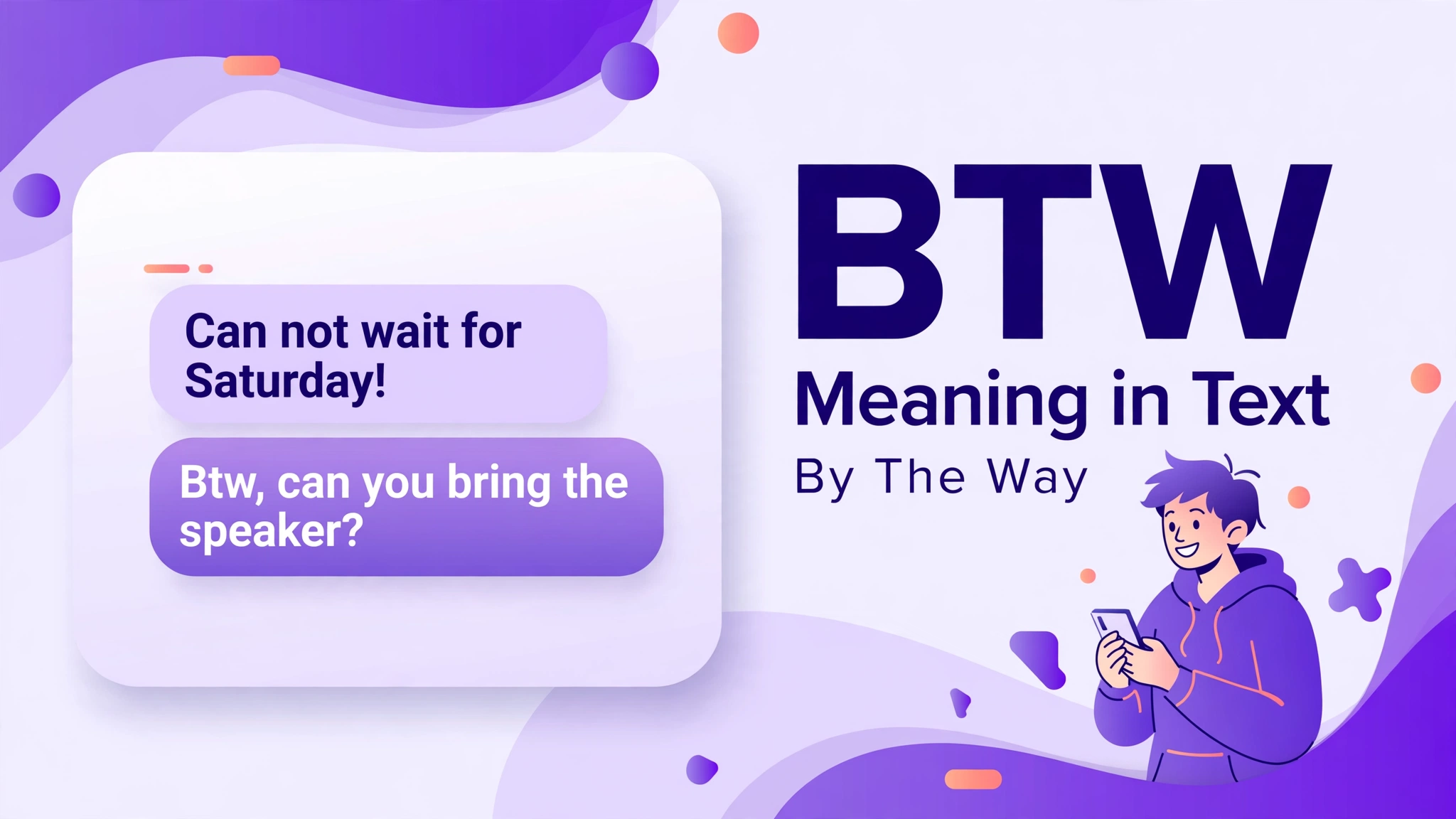
You've seen "btw" tucked into texts a hundred times — "btw, did you see the game?" — and you've probably never stopped to think about it. That's the point. But if you're here, you want the full picture, so here it is: the btw meaning in text is "By The Way."
BTW stands for "By The Way." It's the Swiss-army sentence-starter of digital chat: a tiny phrase that lets you add a side note, change the subject, or drop in something you almost forgot — without derailing the whole conversation.
What Does BTW Mean?
BTW means "By The Way." That's it — no secret second meaning in normal texting, no hidden agenda. The Cambridge Dictionary lists it plainly as the written abbreviation for "by the way," used when you're writing something related to the subject at hand but not the main point of the discussion.
In action:
Alex: Can't wait for Saturday!
Alex: Btw, can you bring the speaker?
Priya: That movie was so good.
Priya: Btw, have you seen the sequel?
See the job it's doing? The first message carries the main point; the "btw" message carries the afterthought. BTW is how you say "oh — one more thing" without typing "oh — one more thing." It's conversational multitasking: the main thread keeps running while a side thread opens beside it.
A quick myth to clear up first, because a few low-quality pages claim otherwise: BTW does not mean "between" in texting. The abbreviation for "between" in writing is "b/w" (or "btwn") — Cambridge, which documents "btw" as "by the way," lists no "between" reading at all. If you ever see "btw" claimed as "between," you're looking at a content farm, not a dictionary.
The Side-Door Test: BTW's One Job
Here's the reader test for this article — the Side-Door Test. BTW is a side door into the conversation: whatever comes after "btw" is never the main topic. To check your understanding, delete the BTW clause from any message. If the main message still stands complete on its own, you've read it right.
- "Can't wait for Saturday! Btw, can you bring the speaker?" → remove the BTW clause → "Can't wait for Saturday!" still complete. ✓
- "Btw, the meeting moved to 3." → the BTW clause is the message here, but notice it still reads as an aside — a bulletin slipped in, not the headline.
That's BTW's entire job: flagging "this is extra." It tells the reader: what follows is a side note — related, but not the point. Once you see it as a label rather than a word, you'll never misread its tone. BTW doesn't emphasize; it de-emphasizes. That's its superpower: it lets important-but-secondary things into the chat without giving them headline status they don't deserve.
The BTW Placement Test: Start, Middle, or End
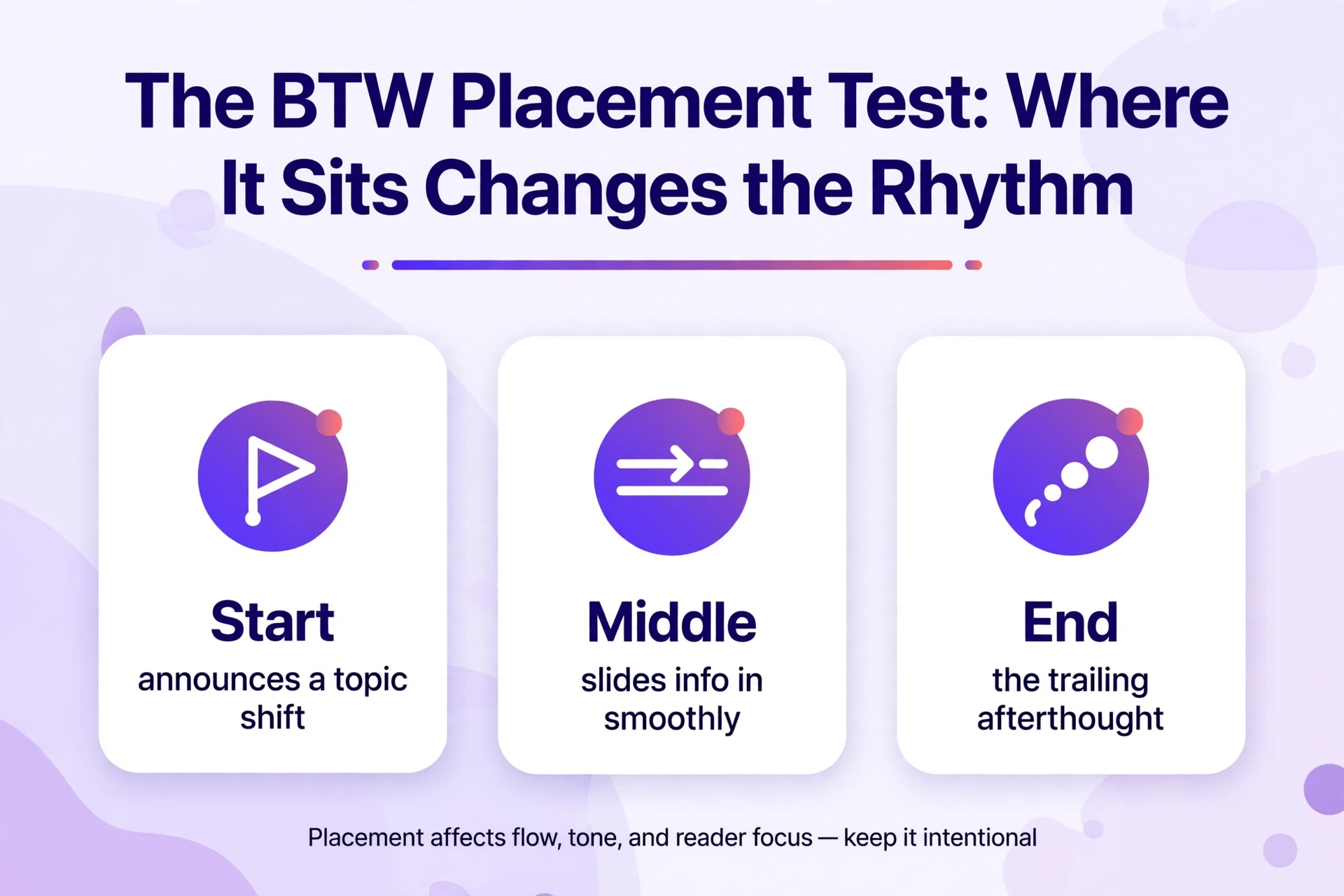
BTW is one of the few slang terms that changes flavor based on where it sits in the sentence. Run the placement test on any BTW you see:
BTW at the start — the classic. Announces a topic shift or an add-on: "Btw, I forgot to tell you — the new episode is out." Starting with BTW is like raising a hand: new item on the agenda. This is the most common placement in texts and chats.
BTW in the middle — the smooth inserter. Slides extra info into a running sentence: "I found that café we talked about, btw, they have the best pastries." Mid-sentence BTW feels the most conversational — it's how people actually talk, remembering details as they go.
BTW at the end — the trailing thought. Tacks something on after the point is made: "Meet at 7? Yep! Bring snacks, btw." End-position BTW reads as an afterthought in the most literal sense — the thing remembered half a second after hitting send.
None of these change the meaning. But they change the rhythm. Start-position BTW is deliberate; end-position BTW is spontaneous. If you're writing BTW yourself, match the placement to how planned the thought feels.
Where You'll See BTW: TikTok, Snapchat, Instagram, Texting — and Email
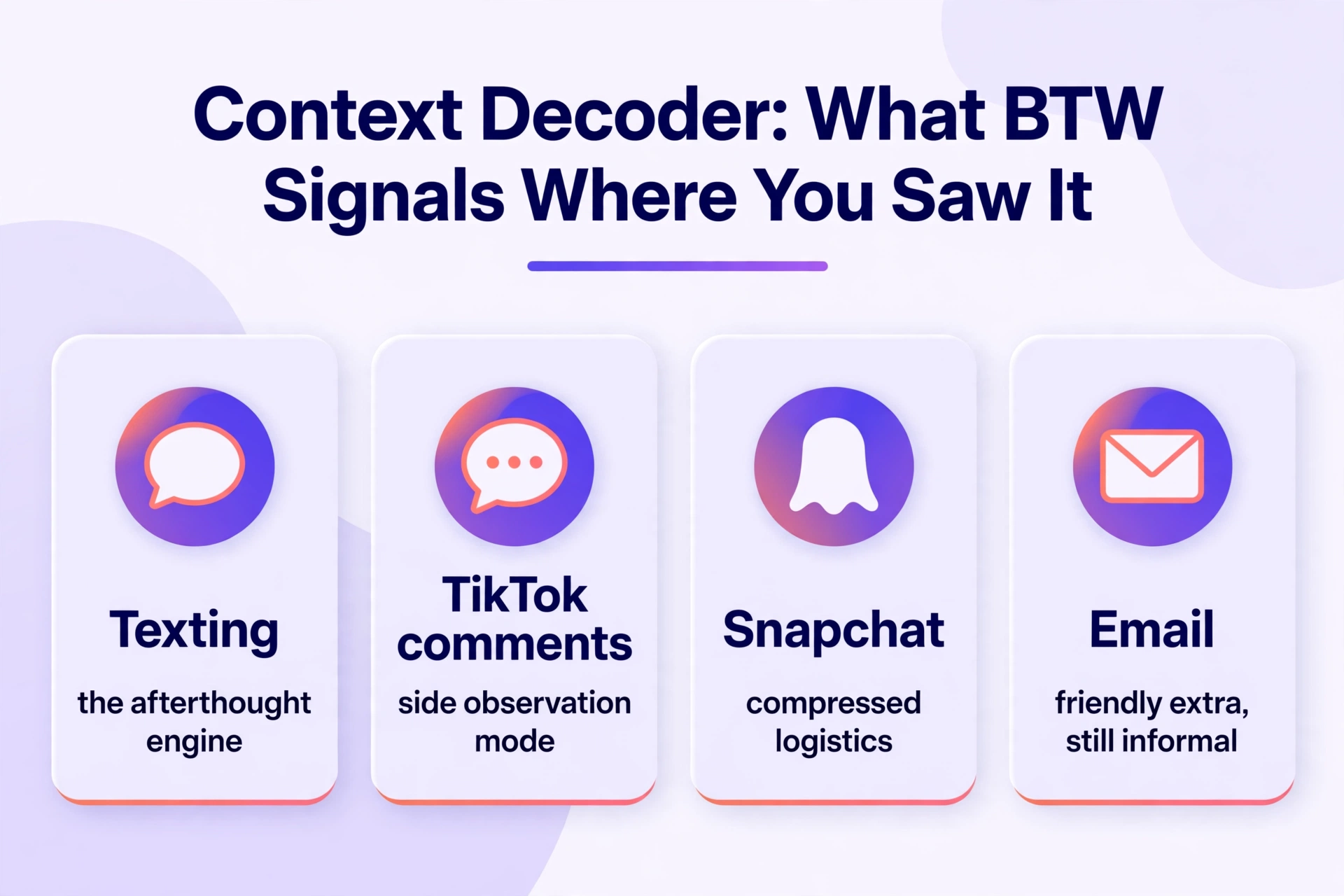
BTW is unusually platform-fluid. Unlike most slang, it survives in semi-formal spaces:
Texting (SMS, WhatsApp, iMessage). BTW's home. The afterthought engine runs constantly here: "Running late, btw did you feed the cat?" Texts are where BTW does its most honest work — remembering things mid-conversation.
TikTok comments. "This video is so good, btw the editing??" Comment-section BTW usually carries a compliment or a side observation. It's the "while I have you here" of the comments.
Snapchat. Quick-fire by nature: "omw, btw bring your charger." On Snap, BTW compresses logistics into the smallest possible package.
Instagram DMs and comments. "Great tips! Btw, I'd love to join the next session." In DMs, BTW softens requests — "btw, could you send me that link?" lands gentler than the bare request, because the BTW frames it as a small extra rather than a demand.
Email (the BTW exception). Here's what makes BTW special: Cambridge explicitly documents it in emails. "I hope you enjoyed your holiday — btw, can you recommend a good hotel?" Most texting slang dies at the inbox door; BTW walks right through. It's still informal — don't put it in a cover letter — but among colleagues and in friendly emails, it's fully established. That email acceptance is a big part of why BTW crossed generations while most slang didn't.
BTW Tone: Casual, But Never Careless
BTW's default tone is light and breezy. It says "no big deal" about whatever follows it. That's usually a feature — but the same de-emphasizing power can backfire:
Friendly BTW adds without demanding: "Btw, you did great today 🙂" The BTW makes the compliment feel spontaneous rather than staged, which makes it land harder.
Neutral BTW is pure logistics: "Btw, the meeting's at 3." No warmth, no coldness — just information wearing casual clothes.
Dismissive BTW is the failure mode. Because BTW labels its content as "extra," using it for something that isn't extra can sting: "Btw, I don't think your idea will work." That reads as slipping criticism in through the side door — which, per the Side-Door Test, is exactly what happened. Rule: never BTW bad news. If it matters, give it the main door.
Playful BTW stacks with other slang for effect: "btw tbh that was hilarious" or "btw, fyi, imo." Multi-acronym combos are common in fast social threads. They read as performatively casual — fun among friends, noise everywhere else.
The emoji rule: a BTW with a 🙂 or 🎉 reads warm; a bare "btw." with a period can read clipped. Same punctuation physics as the rest of texting.
Sender Context: Who's Dropping the BTW
From a friend, BTW is thinking-out-loud: "That concert was unreal, btw are you free Friday?" Answer both threads — the main one and the side door.
From a crush, BTW often smuggles the real message: "Had fun tonight! Btw, we should do it again 👀" The BTW is doing shy work — making the ask feel casual so rejection would sting less. Read the side door as the main door here.
From a coworker, BTW is usually logistics with a friendly face: "Btw, could you send the report by EOD?" It's a softener, not a joke — treat the request as real even though the wrapping is casual.
From family, BTW is the classic parent-text move: "Don't forget your jacket. Btw your aunt says hi." Two messages in one, zero urgency. This is BTW in its purest form.
From a stranger or in comments, BTW is crowd-talk: "Great video, btw what camera do you use?" Low stakes, easy to answer or ignore.
How to Use BTW Without Sounding Dismissive
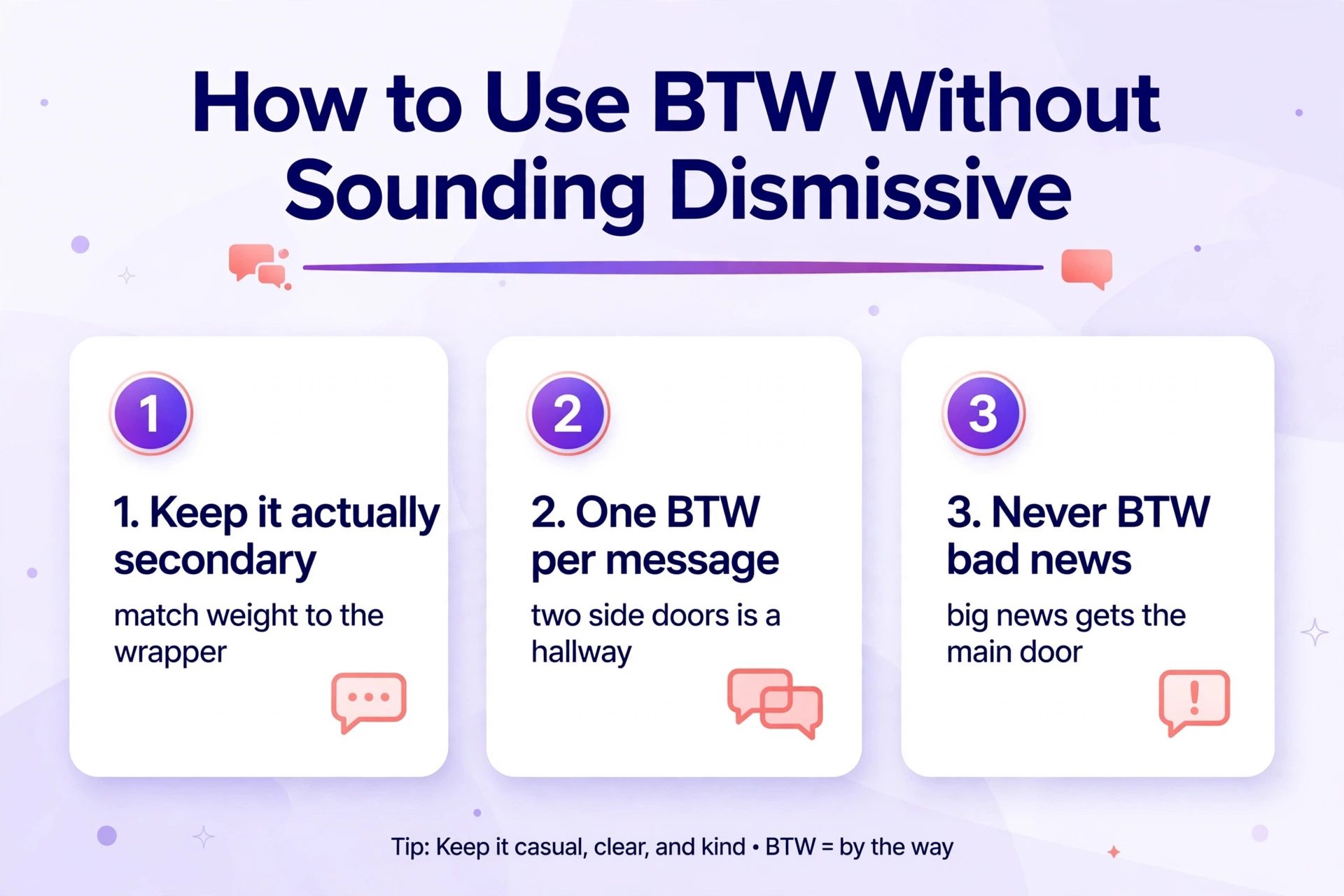
Using BTW well is about respecting what it signals — this is secondary. Three rules:
1. Keep it actually secondary. BTW works when the add-on really is an add-on. "Btw, the sky is blue" after a breakup text isn't casual — it's jarring. Match the weight of the content to the lightness of the wrapper.
2. Don't stack BTWs. One BTW per message is plenty. "Btw this, btw that, btw the other thing" makes you sound like a browser with too many tabs open. If you have three side notes, you have a main note — restructure.
3. Don't use BTW to dodge. "Btw, I can't come" after weeks of planning isn't casual — it's conflict-avoidant. The Side-Door Test cuts both ways: if removing the BTW clause leaves something that deserved the main door, don't side-door it.
And responding to BTW? Easy: answer the side note, not the main thread — or both. "Yep, bringing the speaker! And same, can't wait for Saturday." The BTW clause is usually the part that needs the reply.
BTW vs Similar Slang
| Term | Meaning | How it differs from BTW |
|---|---|---|
| FYI | For your information | FYI delivers a fact you should know; BTW adds a side note. FYI is the memo, BTW is the whisper. |
| TBH | To be honest | TBH signals honesty incoming; BTW signals extra info incoming. They stack well: "btw tbh…" |
| LMK | Let me know | LMK requests a response; BTW just adds info. "Btw, lmk what you think" uses both jobs at once. |
| IDC | I don't care | IDC shuts a topic down; BTW opens a side one. Opposite energies. |
| LOL | Laugh out loud | LOL reacts; BTW redirects. "lol btw…" is the classic combo. |
| BRB | Be right back | BRB pauses the chat; BTW continues it sideways. |
| FR | For real | FR emphasizes sincerity; BTW de-emphasizes importance. Genuine opposites in the emphasis game. |
The most useful pair is BTW vs FYI, because people confuse them. FYI says "you need to know this" — it carries weight. BTW says "while we're here" — it deliberately removes weight. "FYI, the deadline moved" is a headline. "Btw, the deadline moved" is a footnote. Choose based on how much gravity the news deserves.
When Not to Use BTW
- Bad news. Never side-door something that deserves the main door. "Btw, we're breaking up" is a horror story, not a text.
- Formal writing. Resumes, cover letters, academic papers, serious complaints — spell out "by the way" or restructure. BTW's email acceptance has limits.
- Serious conversations. In emotional or high-stakes chats, BTW's breeziness can read as not taking things seriously.
- When everything is "btw." If every sentence starts with BTW, none of them are side notes anymore — you've just written a list with extra steps.
Quick Answers
What does BTW mean in text?
BTW means "By The Way." It's used to add a side note, an afterthought, or a small topic shift without derailing the conversation — for example, "Can't wait for Saturday! Btw, can you bring the speaker?"
Does BTW mean "between"?
No. In texting, BTW only means "by the way." The written abbreviation for "between" is "b/w" (or "btwn"). Pages claiming "btw = between" are content farms — no major dictionary lists that reading.
What's the difference between BTW and FYI?
FYI ("for your information") delivers a fact the recipient should know — it carries weight. BTW ("by the way") adds a side note and deliberately removes weight. "FYI, the deadline moved" is a headline; "btw, the deadline moved" is a footnote.
Is BTW rude?
Not by itself — it's friendly and casual by default. But BTW can sound dismissive if used for bad news or criticism, because it frames its content as "extra." Never BTW something that matters.
Can I use BTW in emails?
Yes — BTW is one of the few texting abbreviations explicitly documented in emails (Cambridge lists email examples). It's fine with colleagues and in friendly emails, but keep it out of formal writing like cover letters.
Where does BTW come from?
BTW emerged in early text-based chat rooms, forums, and BBS systems — Wikipedia's acronym entry dates it to 1989 — as a way to speed up messaging. It survived into the smartphone era because the "one more thing" impulse never went away.
BTW is the side door of digital conversation: small, useful, and easy to misuse. Run the Side-Door Test — if the BTW clause isn't really extra, don't BTW it — and you'll wield three of the most efficient letters in texting like a pro.
