
"Cya tomorrow!" A friendly sign-off. But then, in a work chat: "Make sure you save that thread — CYA." Same letters, very different message. If you've ever paused on those three letters and wondered which one you just got, you're not alone — and the cya meaning in text is genuinely two things wearing one spelling. This article teaches you how to tell them apart every time.
CYA most commonly means "see ya" — a casual goodbye. But it has a second, work-world reading, and knowing both is the whole skill.
What Does CYA Mean in Text?
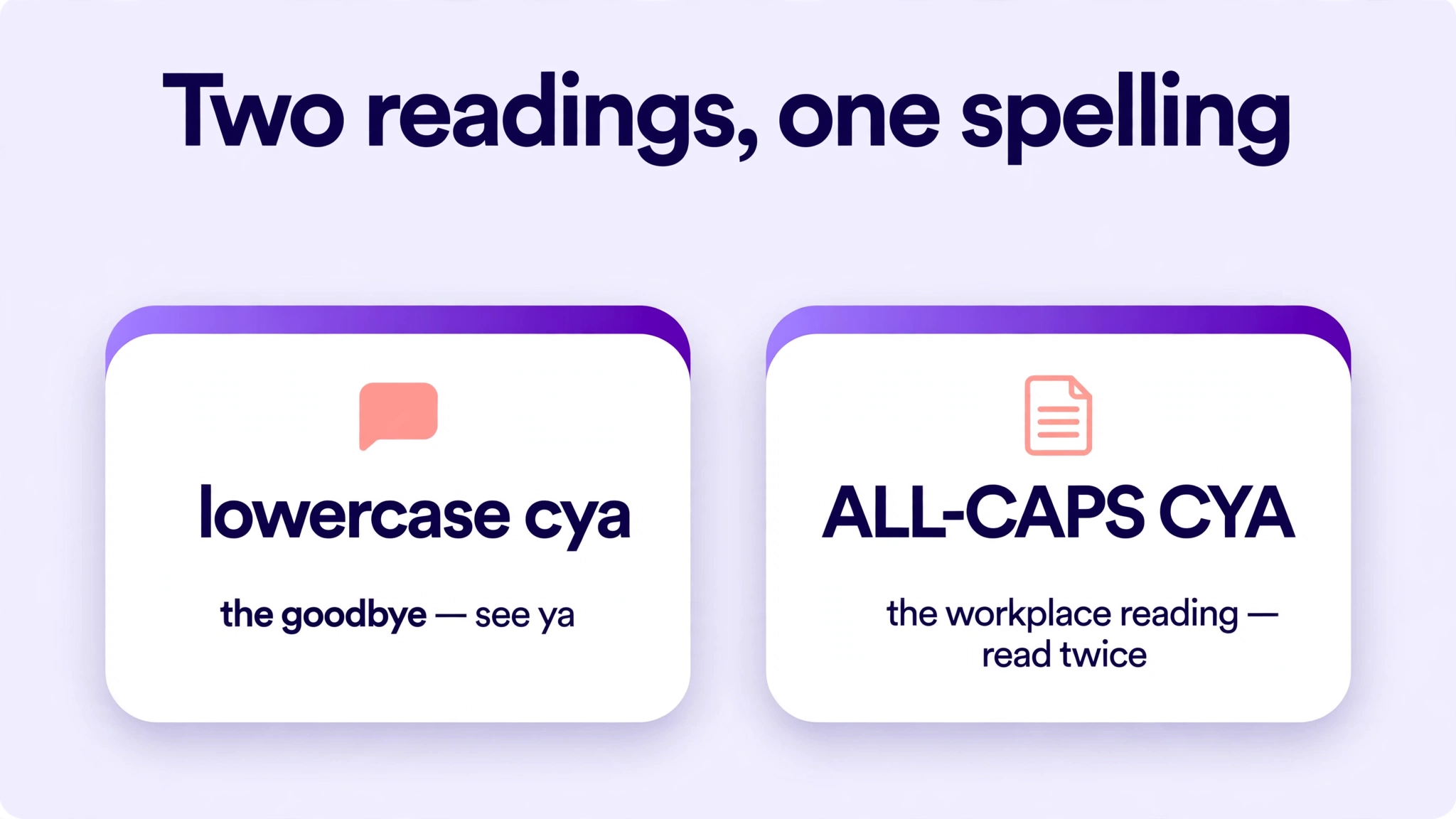
In casual texting, CYA means "see ya" (see you) — a friendly goodbye. Wiktionary's lowercase headword says it plainly: an Internet-slang alternative spelling of "see ya," with real cited usage. Every major explainer agrees: in chats, DMs, and social comments, cya is how you wave goodbye in letters.
"Cya later!" "Cya at 8!" "Alright, cya 👋" — it's the texting equivalent of a half-wave over your shoulder. Quick, warm, and done.
But there's a second reading, and it lives in a different world:
In work contexts, CYA can mean "cover your a**" — protecting yourself by documenting everything. This is the workplace phrase for keeping a paper trail: saving the email where your boss approved the plan, writing down who decided what, making sure blame can't land on you unfairly. Wiktionary carries it as a separate, all-caps headword, and it's genuinely one of the oldest pieces of office slang still in circulation.
Two meanings, one spelling — and here's the part no other explainer will tell you straight: the dictionary itself splits them by case. Lowercase cya gets the "see ya" headword. All-caps CYA gets the "cover your a**" headword. The lexicographers drew the line for us; we just have to follow it.
The Case Test: Reading the Letters
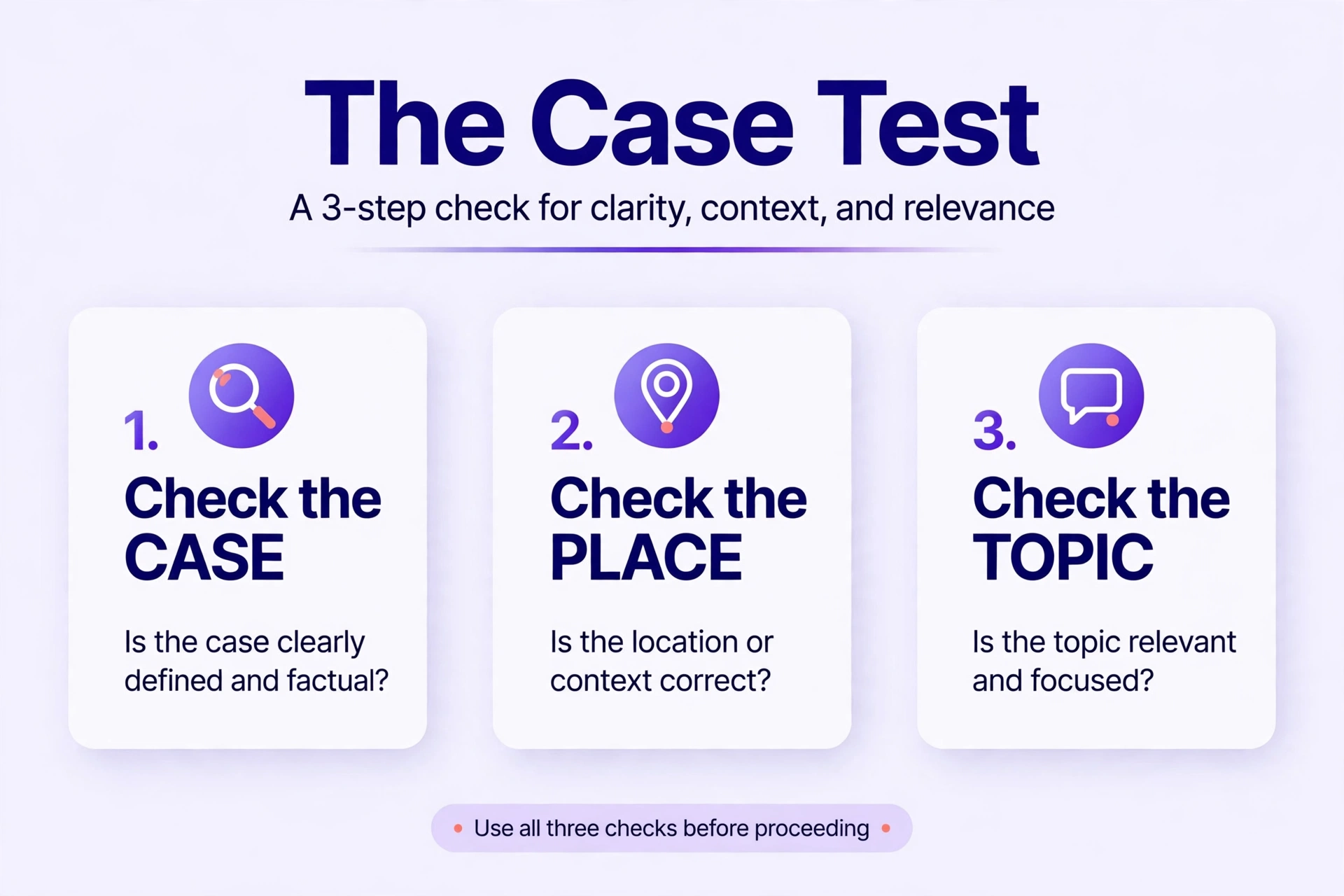
Here's the named method for reading any CYA you receive. It's called the Case Test, and it runs in three steps — case, place, topic.
Step 1: Check the CASE. This is the fastest signal you've got.
- Lowercase "cya" → almost always "see ya." "cya tomorrow!" "ok cya!" The goodbye reading owns the lowercase form.
- ALL-CAPS "CYA" → slow down and check further. Caps lean toward the protective reading — "CYA, save everything" — but caps-lock typists and excited teenagers also shout their goodbyes. Case is a strong hint, not a verdict.
Step 2: Check the PLACE. Where do the letters sit in the message?
- At the very end of a conversation → goodbye. "Great, see you then. Cya!" Nobody signs off a chat with a workplace directive. The position is the tell.
- In the middle of a work discussion → protective. "Before the meeting, CYA and get it in writing." That's not a farewell; that's advice.
Step 3: Check the TOPIC. What were you talking about?
- Plans, hangouts, games, weekends → "see ya." The topic is social; the reading is social.
- Emails, deadlines, decisions, blame, records → protective. The topic is defensive; the reading is defensive.
Run all three and you'll almost never misread it. A WDYM-style confusion ("wait, what did they mean by that?") simply doesn't survive the Case Test — the answer is always in the case, the place, or the topic.
One honest caveat: the case split is a lexicographic fact and a strong tendency, not an iron law. A teenager typing "CYA LATER!!" in all caps is saying goodbye loudly. A colleague writing "cya" in a Slack thread about layoffs might mean the other thing. Steps 2 and 3 exist for exactly those edge cases.
Where You'll See CYA: Texting, Social, Gaming, and Work Chats
CYA means the same two things everywhere — no platform invents a third. What changes is which reading shows up where:
Texting (SMS, WhatsApp, iMessage). Almost always the goodbye. "Cya at mom's!" "Cya tomorrow, don't be late 😄" The lowercase form dominates, and the context is plans. If you're texting a friend, you can safely assume "see ya" every time.
Social media and stream chats. The goodbye again — sign-offs in comment threads, "cya in the next one!" under a video, streamers waving off viewers. Fast-moving chats favor the shortest possible farewell, and cya is it.
Gaming lobbies. Post-match sign-offs: "gg, cya" as players scatter. Same goodbye, gamer flavor. Occasionally a salty "cya" after a rage-quit — still a goodbye, just a frosty one.
Work chats and Slack. Here's where the second reading lives. "CYA — get the approval in an email first" is a colleague doing you a genuine favor: a reminder to protect yourself before a risky decision. In professional channels, read ALL-CAPS CYA as protective until proven otherwise. A quick LMK clarifies fast: "lmk — do you mean save the thread?"
The pattern: social settings own the goodbye; work settings own the warning. The platform doesn't change the meaning — the room you're in does.
Reading the CYA You Got: Tone and Sender Context
The goodbye version of cya is tone-light by default — it's a wave, not a statement. But senders still color it:
The warm goodbye comes with plans attached: "Cya Friday, can't wait!!" The exclamation marks and the plan do the warming; the cya is just the vehicle. From a friend, a crush, or a partner, this is affection in shorthand.
The neutral goodbye is the conversation-ender: "Ok cya." Nothing warm, nothing cold — just someone closing the chat. This is the most common cya in existence, and it needs no decoding.
The frosty goodbye shows up after friction: "cya." following an argument, or "cya then" with a period that feels heavier than punctuation should. The letters didn't change; the temperature did. A TBH-style honest read: if the conversation went cold, the goodbye is cold. The cya isn't the message — the silence around it is.
The protective CYA has its own tone: cautious, experienced, slightly parental. "CYA on this one" from a senior colleague is mentorship disguised as slang — someone who's been burned before, trying to save you the same burn. Take it seriously. It pairs naturally with the FYI-style heads-up: information you didn't ask for but needed.
The generational note (soft, not a rule): younger texters default to the goodbye reading almost exclusively; the protective reading skews toward people who've spent time in offices. If your boss's boss drops a "CYA" in an email thread, read it twice before replying.
How to Reply to CYA (Both Versions)
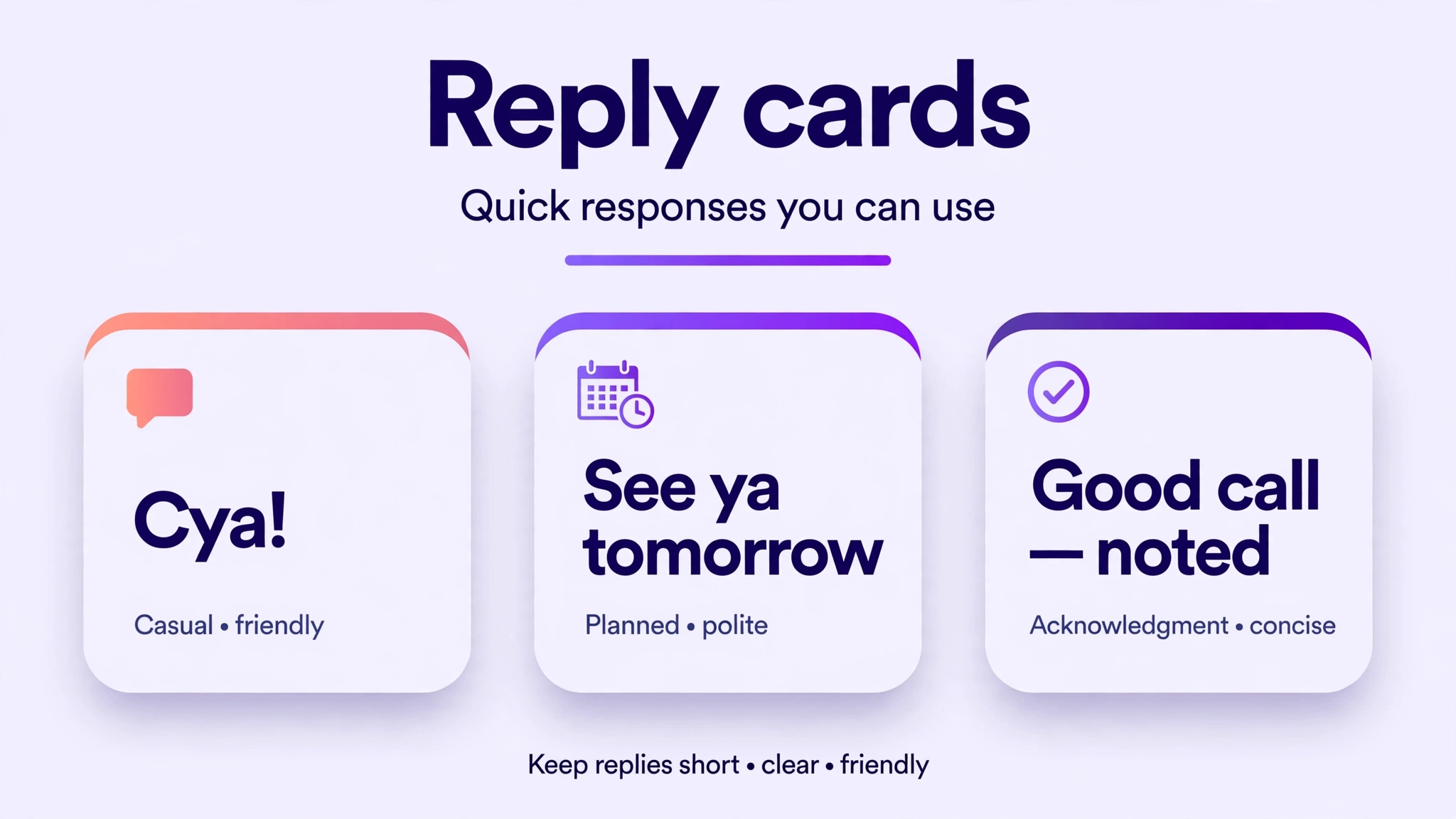
Replying to the goodbye. It's a sign-off — don't overthink it:
- "Cya!" / "See ya!" / "Later!" — the mirror reply, always safe.
- "Cya tomorrow 👋" — confirm the plan while you're at it.
- "Bye! HRU tomorrow?" — if you actually want to keep talking, attach a question. A bare goodbye ends things; a goodbye plus a question restarts them.
- After the frosty "cya." — match the temperature, don't escalate it. "Ok, talk later" leaves the door open without chasing.
Replying to the protective CYA. This one deserves a real response, because someone just gave you advice:
- "Good call — I'll get it in writing." The correct reply. Shows you heard them.
- "Already saved 👍" — if you're ahead of them.
- "Wait, why — what's the risk here?" — if you don't see the danger, ask. The protective CYA is an invitation to learn, and the person who sent it usually knows something you don't.
- Never reply to a protective CYA with a bare "cya!" — you'll look like you missed the point, and in a work context, looking like you missed the point is the thing the CYA was warning you about.
When YOU send it: lowercase for goodbyes, always. Save the all-caps form for work chats where you mean the protective reading — and if there's any chance of confusion, spell it out: "cover yourself on this one" beats a misunderstood "CYA" every time. A FR-style directness rule applies: in professional settings, clarity beats cleverness.
CYA vs Similar Slang: Don't Mix These Up
CYA sits in the farewell corner of texting slang, with one foot in the office. Here's the honest map:
| Term | Meaning | The difference |
|---|---|---|
| CYA | See ya (goodbye) | The casual wave; lowercase is the safe form |
| CYA (caps) | Cover your a** (workplace) | The protective reading; different headword, different world |
| BYE | Goodbye | The full word; slightly more final than cya |
| TTYL | Talk to you later | Promises a future conversation; cya just ends this one |
| G2G / GTG | Got to go | Explains why you're leaving; cya is just the wave |
| IDC | I don't care | A shrug, not a farewell — different emotional planet |
| GN | Good night | Time-specific goodbye; cya works any hour |
The useful contrast is cya vs ttyl. They look interchangeable, but they're not: "ttyl" carries a promise ("we will talk again"), while "cya" is just the wave. Use ttyl when you mean the promise; use cya when you're simply heading out.
Debunked: What CYA Does NOT Mean
Short letters, long rumor mill. Let's clear it honestly:
- "See you around" as the literal expansion — not quite. Some explainers print this as the official form, but Wiktionary's headword says "see ya" — and the dictionary wins this one. "See you around" is a fine paraphrase, not the literal expansion.
- A single meaning — wrong. The laziest explainers cover only the goodbye and never mention the workplace reading. Both are real, both are dictionary-grade, and pretending the second doesn't exist leaves readers misreading their work chats.
- A rude or dismissive goodbye — no. "Cya!" is neutral-to-warm by default. It only reads cold when the conversation was already cold (see the frosty goodbye above). The letters aren't the attitude; the context is.
- Appropriate everywhere — no. The goodbye is casual-chat only; the protective reading is work-chat only. Neither belongs in formal writing. (See "When Not to Use CYA.")
When Not to Use CYA
CYA is two tools, and each has exactly one right room. Skip it when:
- The goodbye needs warmth. "Cya" to someone who's upset, grieving, or having a hard day can read breezy to the point of careless. A real "take care" costs you four more letters and says something the abbreviation can't.
- The setting is formal. Emails to clients, job applications, academic writing — spell out your goodbyes. "Cya" in a cover letter is a decision you'll regret.
- The protective reading might confuse. In a mixed chat (friends + coworkers), an all-caps "CYA" will be read as a loud goodbye by half the room and a warning by the other half. Spell out "get it in writing" instead.
- You're the boss. A manager dropping "CYA" in a team channel reads as either flippant or alarming, depending on the day. Managers should use full sentences for anything involving risk.
- The goodbye is permanent. Ending a friendship, quitting a job, leaving a group for good — "cya" undersells the moment. Some exits deserve actual words.
Quick Answers
What does CYA mean in text?
In casual texting, CYA means "see ya" — a friendly goodbye ("Cya tomorrow!"). In work chats, all-caps CYA can mean "cover your a**" — advice to protect yourself by documenting things in writing.
How do I know which meaning someone meant?
Run the Case Test: (1) check the case — lowercase "cya" is almost always the goodbye; (2) check the place — end of a chat means goodbye, mid-work-discussion means protective; (3) check the topic — plans and hangouts mean goodbye, emails and deadlines mean protective.
Is CYA rude?
No. The goodbye is neutral-to-warm by default — it only reads cold when the conversation was already cold. The workplace reading isn't rude either; it's protective advice, usually meant kindly.
Can I use CYA at work?
The protective reading ("cover your a**") is genuine workplace slang and fine in casual internal chats — but spell it out if there's any chance of confusion. The goodbye "cya" is too casual for formal emails either way.
What's the difference between CYA and TTYL?
"TTYL" (talk to you later) promises a future conversation; "cya" just waves goodbye to this one. Use ttyl when you mean the promise.
Does CYA mean "see you around"?
Not as its literal form — that's a paraphrase some sites print, but the dictionary headword is "see ya." Close enough for everyday use, but "see ya" is the accurate expansion.
CYA is a small masterclass in how case changes everything: lowercase waves you out the door, all-caps tells you to watch your step. Run the Case Test — case, place, topic — and those three letters will never confuse you again.
