
FOMO feels like a word the internet invented — a TikTok-era anxiety with a four-letter name. But here’s the twist: FOMO is older than Instagram. It was coined in 2004 by a stressed-out Harvard Business School student writing for the campus newspaper, years before the first iPhone, years before anyone had ever “scrolled.” The feeling is ancient; the acronym just gave it a name.
If you’re looking up the fomo meaning in text, the short version is “fear of missing out” — that anxious itch that everyone else is having a better time than you. But the word has lived three lives since 2004: a feeling, a marketing weapon, and a meme. This guide covers the real origin story, the FOMO/FOBO/JOMO family, how the word actually works in sentences, and how to use it well in a text without sounding dramatic.
The Short Answer
| Question | Answer |
|---|---|
| What it means | “Fear of missing out” — anxiety that others are having rewarding experiences you’re absent from |
| What it does | Names a feeling; also used playfully to tease or bond (“don’t give me FOMO 😭”) |
| Tone | Vulnerable when sincere (“I have FOMO”); playful when joking; manipulative in marketing |
| Where it sits | Usually a standalone admission (“major FOMO right now”) or a boundary (“stop giving me FOMO”) |
| Register | Casual everywhere — texts, comments, captions, conversation |
| Formal alternative | “I’m worried I’m missing out” or “I feel left out” |
The Origin Story: A Business School Newspaper, 2004
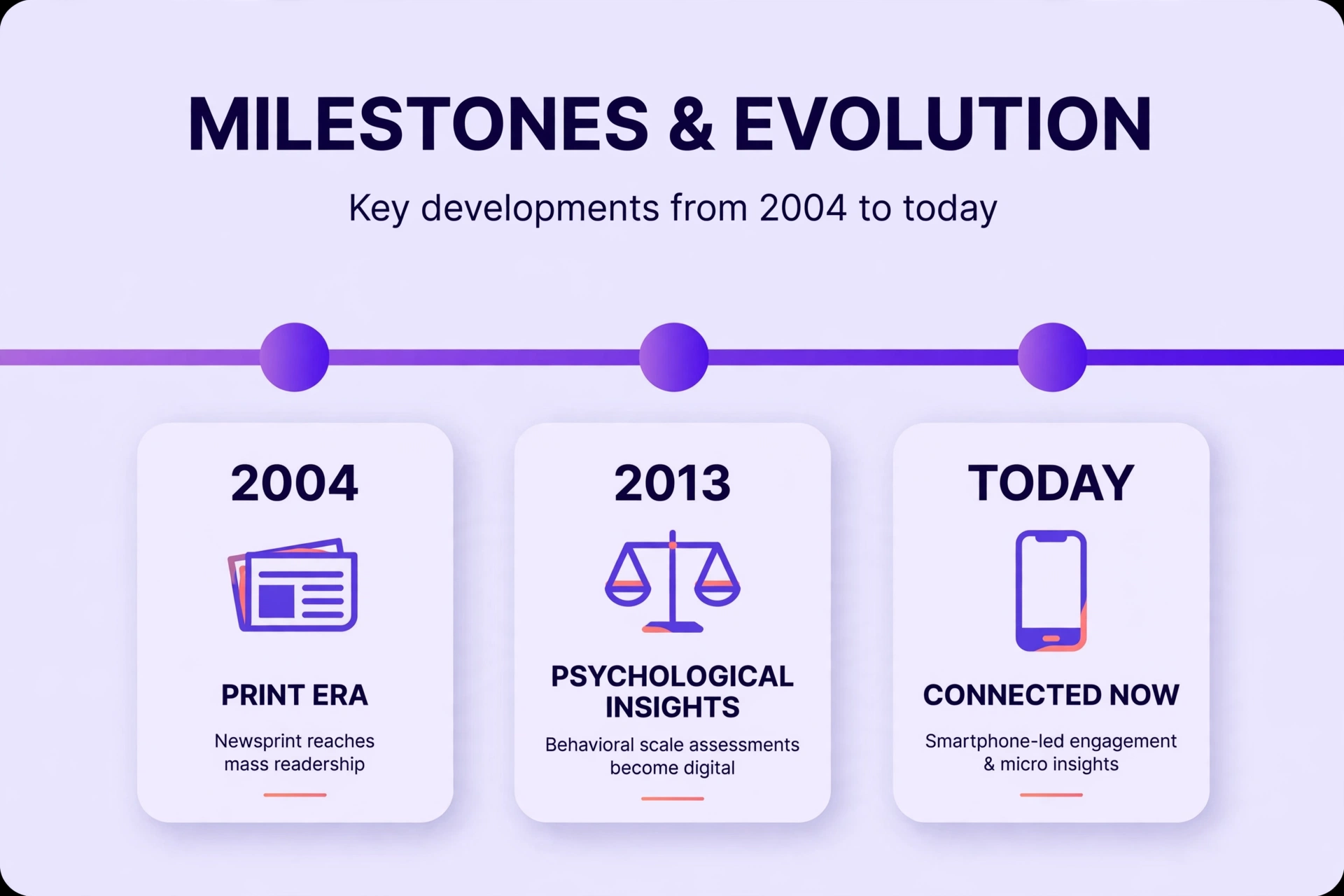
The year is 2004. Facebook is a few months old and limited to college students. The iPhone doesn’t exist. Instagram won’t arrive for six years. And at Harvard Business School, a student named Patrick J. McGinnis is watching his classmates agonize over which parties to attend, which clubs to join, which networking dinners might change their lives — terrified that whichever option they didn’t pick would be the one that mattered.
He wrote about it in The Harbus, the HBS student newspaper, and shortened “fear of missing out” to “fomo.” In a later interview with Monocle, McGinnis described how the term captured a very specific campus pathology: students so afraid of missing the “right” social event that they overcommitted to everything and enjoyed nothing — the 2004 equivalent of watching everyone’s gtg stories pile up while you’re stuck at the library. His own bio notes that he coined both FOMO and its lesser-known twin, FOBO (fear of a better option), in that 2004 article.
So the next time someone tells you FOMO is a social-media disease, you have the correction: social media amplified it. It didn’t invent it. A room full of ambitious twenty-somethings in 2004, with nothing but email and word of mouth, felt it just as sharply.
It Predates Social Media (Way Before)
McGinnis didn’t invent the feeling — he named it. The older cousin has a name too: “keeping up with the Joneses,” the mid-20th-century phrase for the anxiety that your neighbors have a nicer car, a bigger house, a better life. Same engine, different fuel.
What social media changed wasn’t the feeling but the evidence. Before, you imagined what you were missing. Now you watch it happen in real time — the stories, the check-ins, the group photos posted while you’re home on the couch. A 2013 survey found 56% of social media users reported experiencing FOMO. That same year, psychologists formalized it with a 10-item FoMO scale, grounding it in self-determination theory: the anxiety spikes when our need for social connection goes unmet.
The timeline matters because it reframes the advice. If FOMO were caused by phones, the fix would be putting the phone down (and JOMO — joy of missing out — does prescribe exactly that). But since the feeling predates the feed, the real fix is older and harder: deciding what you actually want, independent of what everyone else chose.
The Three Lives of FOMO
Since 2004, the word has split into three distinct jobs. Most people use all three without noticing.
1. The feeling. “I have such FOMO right now.” This is the original: a vulnerable admission of anxiety. Saying it out loud is usually bonding — it tells the other person we all feel this, which is half the cure.
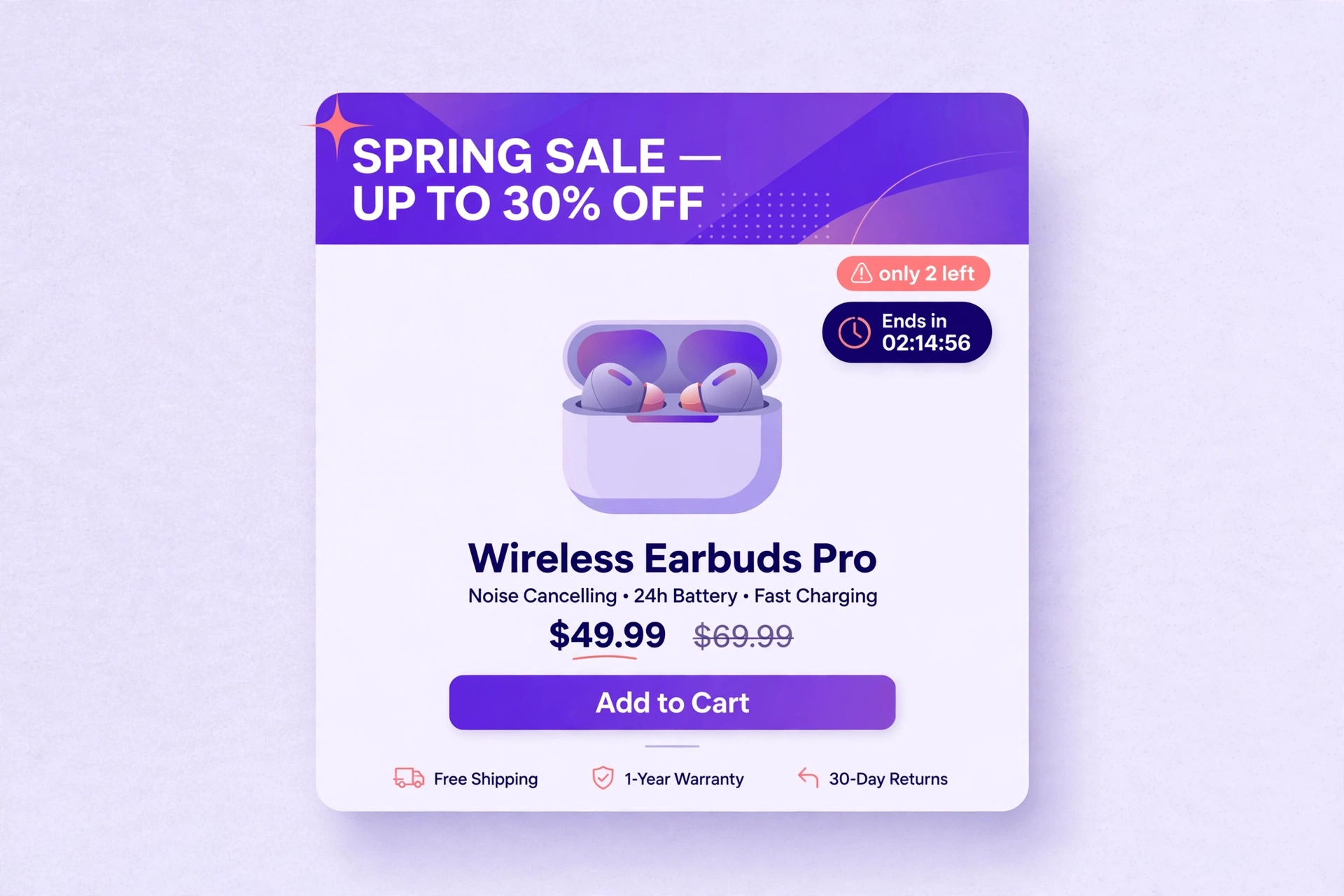
2. The marketing lever. “Only 2 left in stock.” “Sale ends in 3 hours.” “Everyone’s talking about it.” Marketers weaponized FOMO deliberately — manufactured scarcity, countdown timers, drop culture, crypto hype cycles. When a brand makes you feel FOMO, that’s not an accident; it’s the strategy. Recognizing the lever is the defense: ask whether you wanted the thing before you were told it was almost gone.
3. The meme. “POV: your FOMO when you see the group chat planning without you 😭.” As a joke, FOMO is self-aware and communal — laughing at the feeling deflates it, hitting the same nerve as an oml at the plans you missed. The meme version is almost therapeutic: it turns private anxiety into shared comedy.
The tricky part is that the same sentence can be any of the three. “Don’t give me FOMO” from a friend is playful; from an advertiser, it’s a sales funnel. Read the sender, not the letters.
FOMO, FOBO, and JOMO: The Family
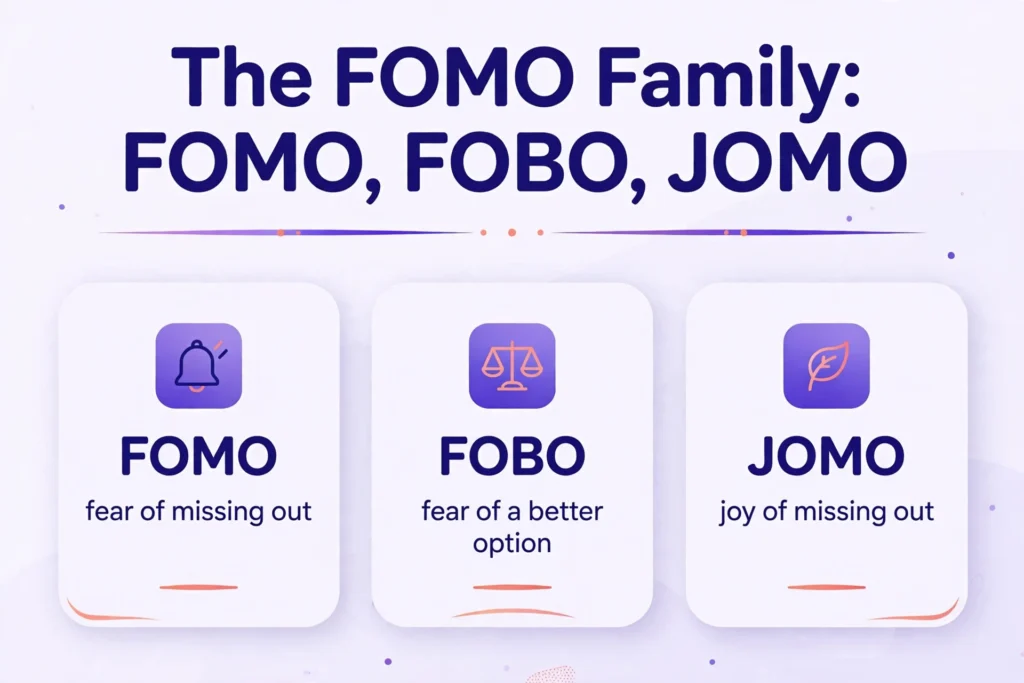
McGinnis coined twins, and the internet added a third sibling. Together they’re a complete philosophy of modern choice-anxiety:
FOMO — fear of missing out. They’re doing something great without me. The anxiety of absence. You say yes to everything and enjoy nothing.
FOBO — fear of a better option. McGinnis’s twin coinage, the subject of his TED talk. What if I pick this and something better comes along? The anxiety of commitment. You research the restaurant for an hour, pick one, then regret it through the whole meal. FOBO is why your group chat takes forty minutes to choose dinner.
JOMO — joy of missing out. The deliberate counter-movement. I’m glad I’m not there. Staying in on purpose, skipping the event with zero regret, finding the evening better for the absence — and the only correct reply to someone’s vacation photos is “mbn 😭” (must be nice), the affectionate cousin of FOMO. JOMO isn’t sour grapes — it’s the skill FOMO never taught: being content with the choice you made.
Teach yourself the trio and you get a diagnostic tool. Feeling itchy about the party? That’s FOMO — ask if you actually want to go. Paralyzed choosing between two plans? That’s FOBO — pick one and commit. Blissfully home while the group chat buzzes? That’s JOMO — protect it.
FOMO as a Word, Not Just a Feeling
Here’s the usage depth most guides skip: FOMO isn’t just a feeling you describe — it’s a word with grammar. It flexes across parts of speech:
- Noun: “I have FOMO.” “The FOMO is real.” (The classic.)
- Adjective: “That party was so FOMO-inducing.” “Stop posting FOMO content 😭.”
- Verb: “I’m FOMOing so hard right now.” “Stop FOMOing and just come.”
That flexibility is why the word survived while other 2000s slang died. It bends to fit whatever sentence you need. And notice the register shift: as a noun it’s sincere; as a verb (“stop fomoing”) it’s almost always playful. The grammar carries the tone.
FOMO in Real Conversations
The exchanges below are illustrative examples, not real messages.
The group-chat planning
- Priya: “we’re all going to the lake house this weekend.”
- Sam: “ughhh I have major FOMO, I can’t come 😭”
- Priya: “lmk if your plans change!!”
Sam’s FOMO is a vulnerable admission and a compliment — it says I wish I were coming, which is nice to hear. Priya reads it right and leaves the door open.
The playful boundary
- Jordan: sends 12 photos from the concert
- Casey: “ok stop you’re giving me FOMO 😭😭”
“Don’t give me FOMO” is the playful boundary — half complaint, half I’m happy for you. The crying emoji does the tonal work: this is affection, not resentment.
The WYA check
- Alex: “wya? everyone’s at Maya’s”
- Riley: “stuck at work, FOMO is killing me”
Riley names the feeling instead of just saying “can’t come.” Naming it is the bonding move — Alex now knows Riley wants to be there, which lands warmer than a flat decline.
The marketing trap (spotted)
- Ad: “FLASH SALE ends in 2 hours — don’t miss out!”
- You, to yourself: “that’s manufactured FOMO. Did I want this yesterday?”
The defense in action. Ask the yesterday test: if you didn’t want it before the countdown appeared, the FOMO is doing the wanting for you.
Using FOMO Well (and Answering It)
Saying it about yourself: “I have FOMO” is disarming and usually gets sympathy. It works because it’s honest — everyone knows the feeling. Just don’t use it as a guilt trip: “I guess I’ll just have FOMO alone” turns a vulnerable admission into manipulation, and people can tell.
Teasing with it: “Stop giving me FOMO 😭” is the friendly version — it tells the other person their good time is worth envying, which is a compliment in disguise. Keep the emoji; without it, the same sentence can read as genuinely bitter.
Answering someone else’s FOMO: match the energy. If they’re joking (“FOMO is killing me 😭”), joke back (“next time you’re coming, no excuses — ttyl”). If they’re genuinely sad about missing out, skip the joke — “we missed you! lmk next time and we’ll plan around you” costs nothing and means a lot.
The upgrade: when FOMO is real and repeated — always the one missing the plans — the word stops being enough. “I feel like I’m always missing out lately, can we plan something soon?” turns the acronym back into a real sentence, and real sentences get real answers.
Quick Answers
What does FOMO mean in text?
“Fear of missing out” — the anxious feeling that others are having rewarding experiences you’re not part of. “I have FOMO” means I wish I were there.
Who invented the word FOMO?
Patrick J. McGinnis, who coined it in a 2004 Harvard Business School student-newspaper article about campus social anxiety — years before Instagram existed.
What’s the difference between FOMO and FOBO?
FOMO is fear of missing out (anxiety about what others are doing without you). FOBO — McGinnis’s twin coinage — is fear of a better option (anxiety about committing to a choice). FOMO says yes to everything; FOBO can’t pick anything.
What is JOMO?
“Joy of missing out” — the deliberate opposite of FOMO. Skipping the event on purpose and feeling good about it. It’s contentment with your own choice, not sour grapes.
Is FOMO caused by social media?
Amplified, not caused. The feeling predates social media (the older name is “keeping up with the Joneses”); phones just gave it a 24/7 highlight reel.
Can FOMO be a verb?
Yes — “I’m FOMOing,” “stop FOMOing.” As a verb it’s almost always playful. The noun (“I have FOMO”) is the sincere version.
How do I reply to someone’s FOMO?
If they’re joking, joke back. If they’re genuinely sad, acknowledge it: “we missed you, let’s plan something soon.” Don’t dismiss it — the feeling is real even when the acronym sounds light.
Is “don’t give me FOMO” rude?
Not with the right tone — it’s usually a playful compliment (your plans look so good I’m jealous). Add an emoji; without one it can read as genuinely resentful.
The Short Version
FOMO is “fear of missing out” — but the word is older than the feed that made it famous, coined in 2004 by a business-school student, not a TikToker. Since then it’s lived three lives: a real feeling, a marketing weapon, and a meme. Learn its siblings — FOBO (fear of a better option) and JOMO (joy of missing out) — and you get a full toolkit for modern choice-anxiety. Use it honestly (“I have FOMO”), playfully (“stop giving me FOMO 😭”), and watch for it in ads, where it’s never an accident.
