
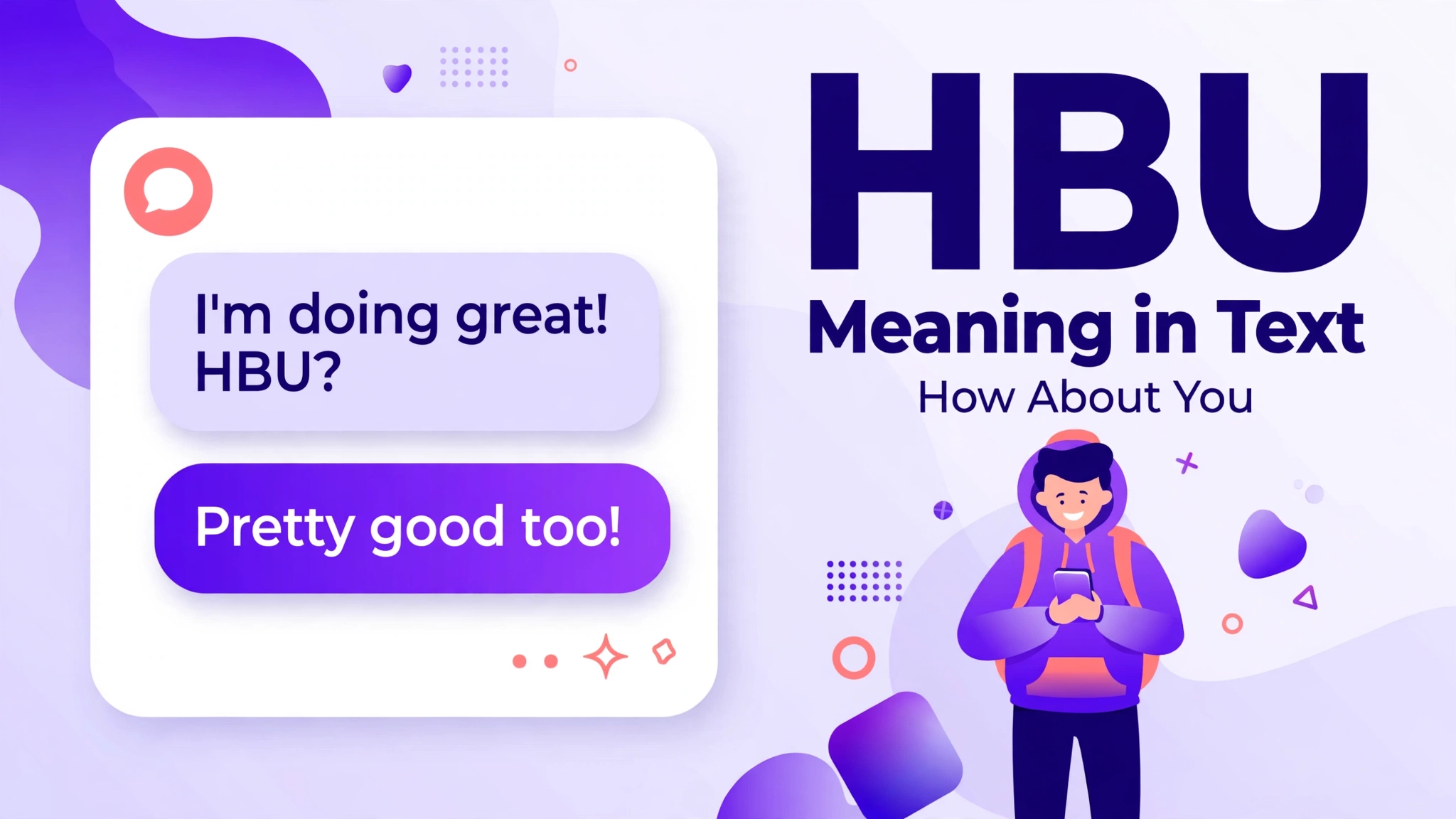
You got a text that reads "I'm doing great! HBU?" — and you're staring at three little letters like they're a riddle. Don't worry: once you learn the hbu meaning in text, you'll start seeing it everywhere, and it'll feel as natural as "lol." HBU stands for "How About You" — the texting world's way of bouncing a question right back after sharing something first.
What Does HBU Mean?
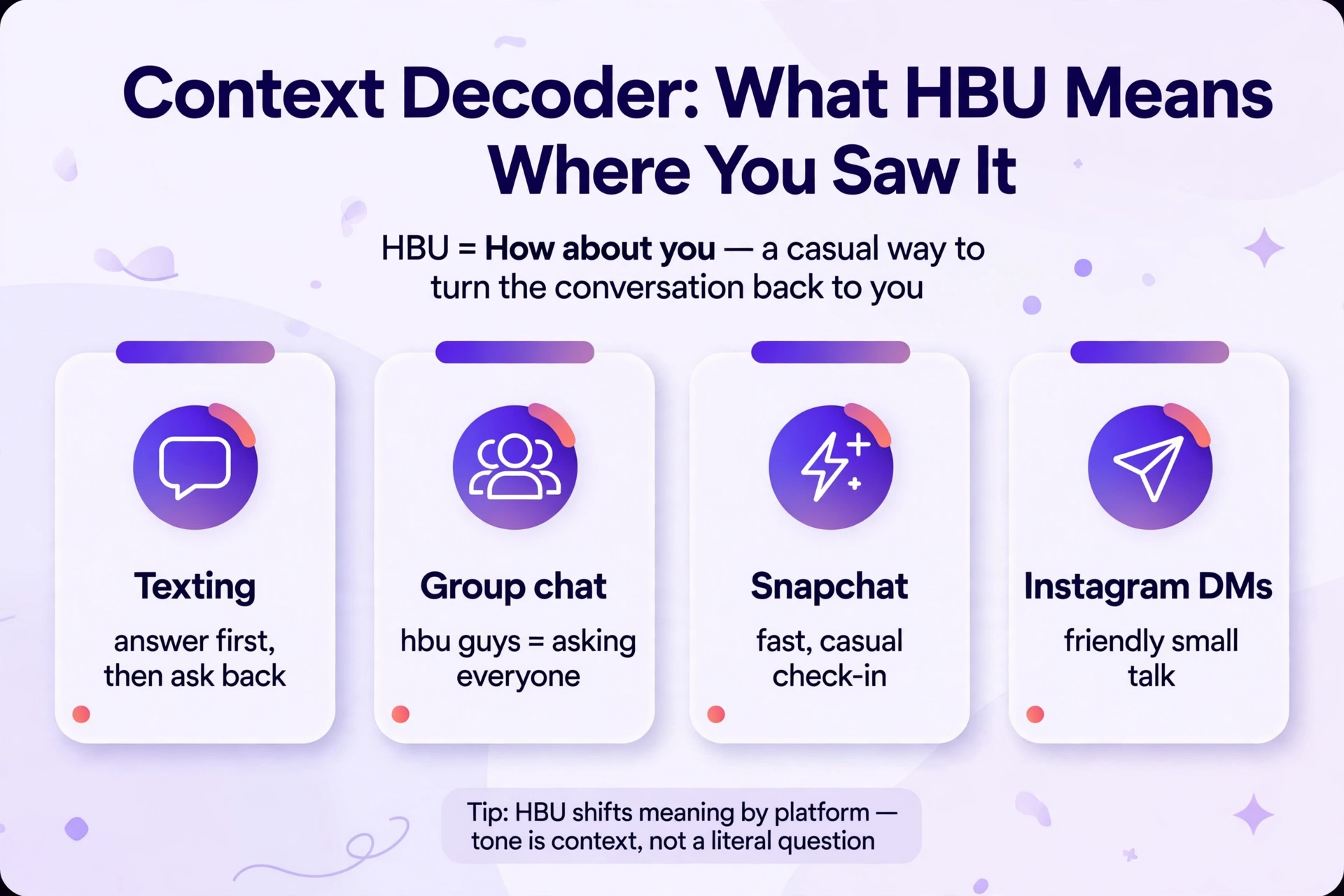
HBU means "How About You" (or, in relaxed pronunciation, "how 'bout you"). It almost always appears right after someone has answered their own question first. The pattern is always the same:
- They share something about themselves.
- They add hbu? to flip the question to you.
Here it is in action:
Maya: Just got home from the gym, totally wiped. HBU?
You: Same honestly, my legs are done.
Dev: I'm grabbing pizza tonight. HBU?
You: Ooh, I'm in. What time?
Notice what HBU is doing in both examples. It's not really asking "how are you" in the formal sense — it's saying "your turn." That's the core of it: HBU keeps the conversation two-sided instead of letting it become a monologue, a lot like its close cousin TBH, which softens honesty the way HBU softens curiosity.
One capitalization note: you'll see hbu in lowercase far more often than HBU. That doesn't change the meaning — lowercase is just the default speed of casual texting.
The Bounce-Back Test: HBU's One Job
Here's the named trick that makes HBU impossible to misread — call it the Bounce-Back Test. When you see "hbu?", ask yourself one question: did this person just tell me something about themselves?
- Yes? Then "hbu?" means "now tell me about you." Answer first, then keep chatting.
- No — it stands alone? Then it's being used as a conversation opener, basically "hey, what's up with you?"
That's genuinely all there is to it. HBU has exactly one job: bounce the question back. It never means "how bad you" or anything cryptic, and it never carries a secret second meaning in normal texting. (In academic or industry writing you might see HBU stand for a university name, but in a chat about feelings, plans, or weekends, it's "how about you" essentially every time.)
The reason this test matters is that most people overthink HBU. They treat it like a puzzle with a hidden answer. There isn't one. Apply the Bounce-Back Test, answer the question being returned to you, and the conversation flows.
HBU vs WBU: The Soft Difference Nobody Tells You
If you text much at all, you've also seen WBU ("what about you"). In everyday use, HBU and WBU are genuinely interchangeable — nobody will correct you for picking the "wrong" one, and most people use them without thinking twice.
That said, there's a soft lean worth knowing, and it changes which one sounds slightly more natural. HBU ("how about you") leans warm and check-in-like — most at home after someone shares a status, mood, or general update: "I'm feeling pretty tired today. HBU?" WBU ("what about you") leans a touch more toward swapping opinions, plans, or preferences: "I'm thinking of ordering pizza tonight. WBU?"
Treat that as a tendency, not a rule — even native texters mix them freely. But if you want the warmest possible read, HBU is your pick.
Where You'll See HBU: TikTok, Snapchat, Instagram, and Texting
HBU doesn't change its meaning across platforms, but its job shifts a little depending on where you spot it. Here's the documented landscape:
Texting (SMS, WhatsApp, iMessage). This is HBU's home turf. It shows up most in one-on-one conversations as the classic bounce-back: share, then ask. "Finished my shift early, hbu?" It also works in family chats, where the tone stays warm and the questions stay simple.
Group chats. In groups, HBU usually picks up a helper word so everyone knows they're included: "hbu guys," "hbu everyone," "hbu all?" Without the helper, a bare "hbu?" in a busy group can feel like it's aimed at one person. Adding "guys" turns it into a friendly poll.
Snapchat. Snapchat moves fast, and HBU fits the speed. On Snap it skews toward quick check-ins between streaks and snaps: "bored rn, hbu?" The tone here is at its most casual — often lowercase, often with no question mark at all.
Instagram DMs. In DMs, HBU does friendly small-talk duty, especially early in a conversation: "loved your story from the concert! hbu, did you go too?" It signals genuine interest without the pressure of a long message.
TikTok comments. You'll see HBU in comment threads where someone shares an experience and invites others in: "this happened to me too, hbu?" Same bounce-back job, just performed in public.
One pattern across all of these: HBU thrives where conversations are fast, casual, and two-sided. The moment a chat turns formal, serious, or professional, HBU starts to feel out of place — which brings us to tone.
HBU Tone Spectrum: Warm, Neutral, or Dry?
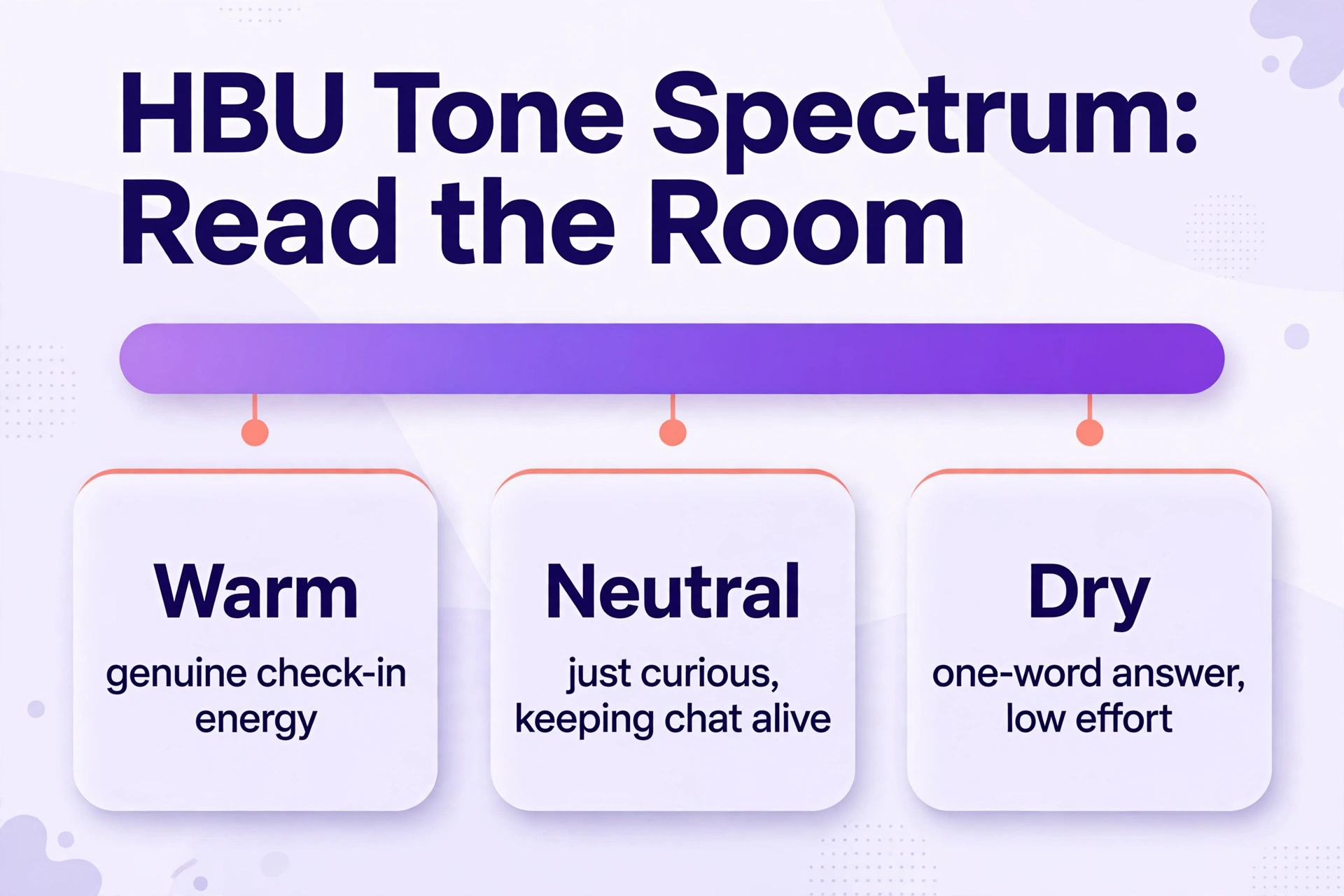
Three letters, three very different energies. Where HBU lands on the spectrum depends on everything around it — the message before it, the punctuation, the emoji, and how much effort the sender put in.
Warm HBU is the genuine check-in, with real content and real interest: "Just got back from vacation, it was amazing! HBU — done anything fun lately?" Exclamation marks, follow-up questions, and specific details all push it toward warm.
Neutral HBU is the conversation-keeper — polite, functional, extremely common: "eating dinner rn, hbu?" Most HBU you see in daily texting lives here.
Dry HBU is the low-effort one: a lone "hbu" after you've poured out a paragraph. It can carry a whisper of IDC energy — not hostile, just not trying very hard. The tell is always the ratio: three words back after your thirty.
Punctuation matters more than people think. "HBU?" reads engaged; "hbu" reads relaxed; "HBU." with a period can read flat or even annoyed. And an HBU paired with an emoji ("hbu? 😊") is almost always warm.
Sender Context: Who Sent It Changes Everything
The same "hbu?" hits differently depending on who's typing it. Here's how to read it by sender:
From a close friend, HBU is pure habit — the verbal equivalent of tossing the ball back. "Gym was brutal today, hbu?" Answer honestly; the friendship can take it.
From a crush, HBU is often doing quiet work. "I'm free this weekend, hbu? 👀" That isn't just a question — it's an invitation. The subtext is "I want to keep talking to you," and the right move is to answer with something that gives them a thread to pull: "Same! Was thinking of checking out that new café, you been?"
From a partner, HBU is usually a check-in with real feeling behind it: "Long day, finally home. HBU?" This one deserves a real answer, not a "fine, hbu." They're asking because they care how your day went.
From a family member (especially a parent), HBU is straightforward and warm: "Your dad and I are doing well. HBU?" No games, no subtext — just answer.
From a coworker in a casual chat, HBU is friendly small talk: "Survived the Monday meeting, hbu?" Keep it light. But if HBU shows up in an actual work email, consider whether you want to match that casual register or gently stay professional.
From someone you barely know, an out-of-the-blue "hbu?" is usually just an opener — the texting equivalent of "hey." It's safe, but you owe them nothing deep. A light answer plus a question back keeps things friendly without over-investing.
How to Reply to HBU Without Killing the Chat
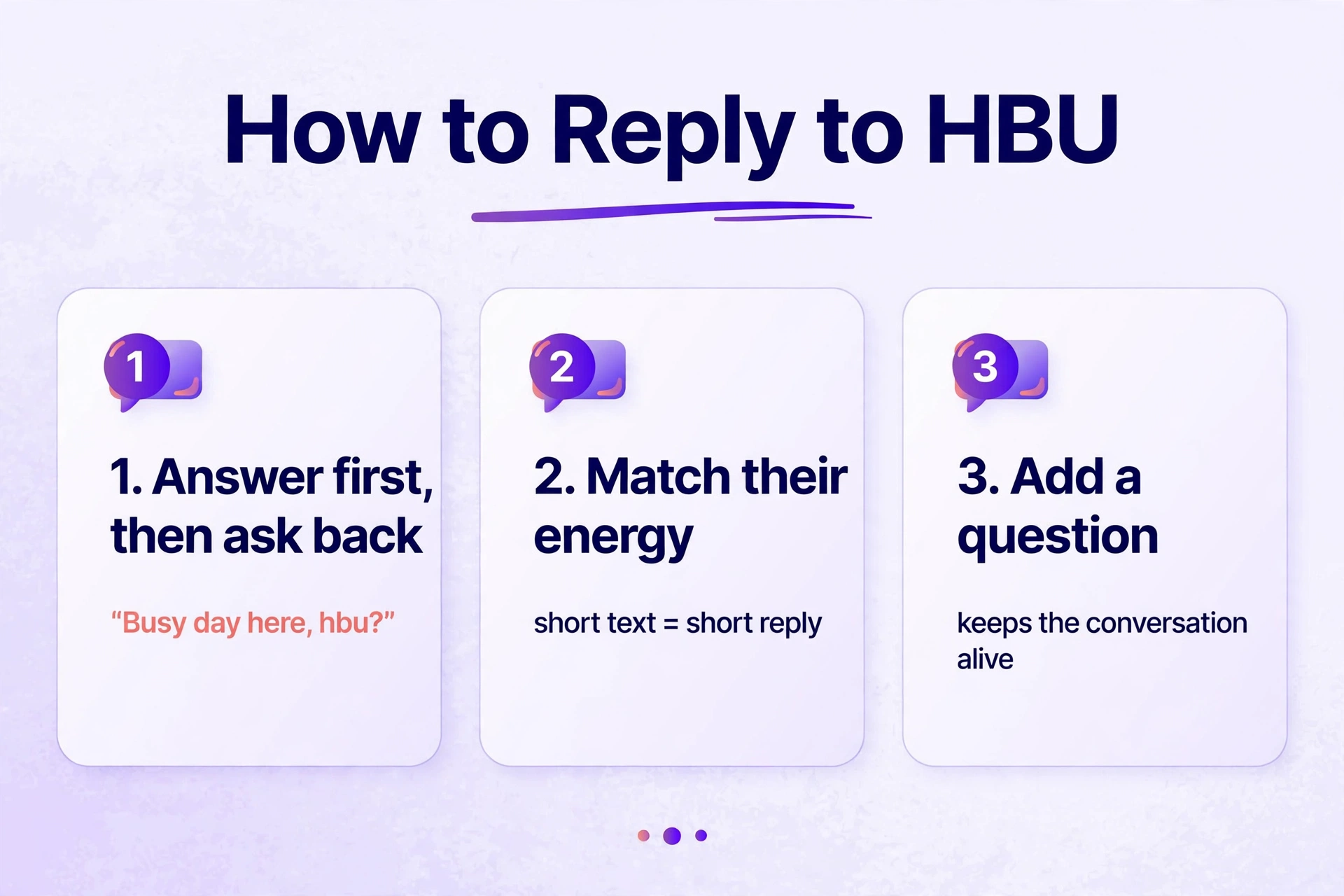
Replying to HBU is easy once you know the three moves that keep a conversation alive:
1. Answer first, then ask back. The golden rule of HBU: never answer with just "good, hbu?" if you can add one real detail. "Pretty good! Finally finished that project I've been stressing about. HBU?" One detail gives the other person something to respond to. Zero details starves the chat.
2. Match their energy. Short text, short reply. Long heartfelt text, longer reply. If someone sends you a paragraph and you fire back "good hbu," the mismatch reads as disinterest — even if you don't mean it that way. Mirroring effort is the quiet grammar of texting.
3. Add a question that isn't HBU. The advanced move: instead of bouncing the same question back a second time, bounce a new one forward. "I'm good! HBU — oh wait, did you end up going to that concert?" This is how chats evolve instead of looping. If you're out of questions, try ending with LMK energy: "I'm good! Lmk when you're free this week."
And if you genuinely didn't understand what they were talking about before the "hbu?", don't fake it — ask what they meant with a quick check of WDYM instead of guessing. Honesty beats a smooth-sounding wrong answer.
A few ready-made replies for different situations:
- Friendly: "Doing great, just got back from a run! HBU?"
- Busy: "Swamped today honestly, hbu?"
- Playful: "Living the dream (the dream is naps). HBU?"
HBU vs Similar Slang: Don't Mix These Up
HBU has a whole family of lookalikes. Here's how to keep them straight:
| Term | Meaning | The difference |
|---|---|---|
| HBU | How about you | Returns the question to you after sharing |
| WBU | What about you | Near-identical twin; slightly more opinion/plan-flavored |
| HRU | How are you | Asks about feelings directly; doesn't require sharing first |
| WYA | Where you at | Asks about location, not about you generally |
| HBY | How 'bout you | Even more relaxed spelling of the same idea |
| TBH | To be honest | Signals honesty is coming; HBU signals curiosity is coming |
The most useful distinction in daily texting is HBU vs HRU. HRU ("how are you") is a standalone question about your state — it works as an opener all by itself. HBU is a return — it only makes full sense after someone has gone first. And when the vibe is short, punchy, and real — the kind of energy FR captures — HBU fits right in: "that test was brutal fr, hbu?"
When Not to Use HBU
HBU is friendly, but it's not universal. Skip it when the situation demands care, clarity, or respect:
- Work emails and formal messages — "Great meeting today, HBU?" reads abrupt. Write "How about you?" instead.
- Serious or emotional conversations — a three-letter bounce-back after heavy news can read as dismissive. Take five seconds and write a real sentence.
- With people who don't text much — parents or grandparents may genuinely not know what HBU means. The full phrase costs nothing.
- When you actually need a real answer — "HBU?" after "I'm thinking of breaking up with him" is not the moment for shorthand. Some conversations deserve full sentences.
Quick Answers
What does HBU mean in text?
HBU means "How About You." It's used to return a question to the other person after sharing something about yourself — for example, "I'm doing great! HBU?"
Is HBU the same as WBU?
Almost. Both return the question to the other person. HBU ("how about you") leans slightly warmer and check-in-like, while WBU ("what about you") leans slightly toward opinions and plans. In practice, people use them interchangeably.
Is HBU rude?
No — HBU is friendly by default. But a bare "hbu" with no effort around it can read as dry or low-effort, especially after a long message. Adding one real detail keeps it warm.
Can I use HBU in a professional setting?
It's best to avoid it in emails or formal messages. In casual chats with coworkers you're friendly with, it's fine — but the full phrase "how about you?" is always the safer choice at work.
What should I reply when someone says HBU?
Answer their question with at least one real detail, match their energy, and ask something back. "Pretty good! Just finished a long shift. HBU?" beats "good hbu" every time.
Does HBU mean anything else?
In texting and social media, essentially no — it's "how about you" every time. Outside of casual chat (academic writing, industry documents), the same letters can stand for organization names, but context makes that obvious.
HBU is one of those rare slang terms that's both extremely common and extremely simple: share, then ask. Run the Bounce-Back Test, keep the energy matched, and you'll never misread it — or misuse it — again.
