

Your friend texts, “ima call you in five minutes.” A TikTok comment reads, “ima try this tonight.” A group chat says, “ima head out, talk later.” Three different rooms, one tiny word doing the same job in all of them: announcing what happens next. That is the whole story of the ima meaning in text — three letters that point forward, like an arrow, at whatever the writer is about to do.
The Short Answer: IMA Is a Plan in Three Letters
IMA means “I’m going to.” It is the spoken phrase “I’m gonna” written down the way it sounds, squeezed into three letters. When someone types it, they are telling you their next move before they make it.
One line covers most of what you need: IMA = “Here is what I am about to do next.” It almost always sits at the start of a sentence, and a verb almost always follows it — “ima call you,” “ima eat first,” “ima head home.”
Cambridge Dictionary lists it plainly: Imma — slang, also I’mma, Ima, I’ma — short form of “I’m going to,” used for saying what you intend to do. Wiktionary agrees: “ima” is an alternative form of “Imma.”
Where It Came From: “I Am Going To” Said Faster and Faster
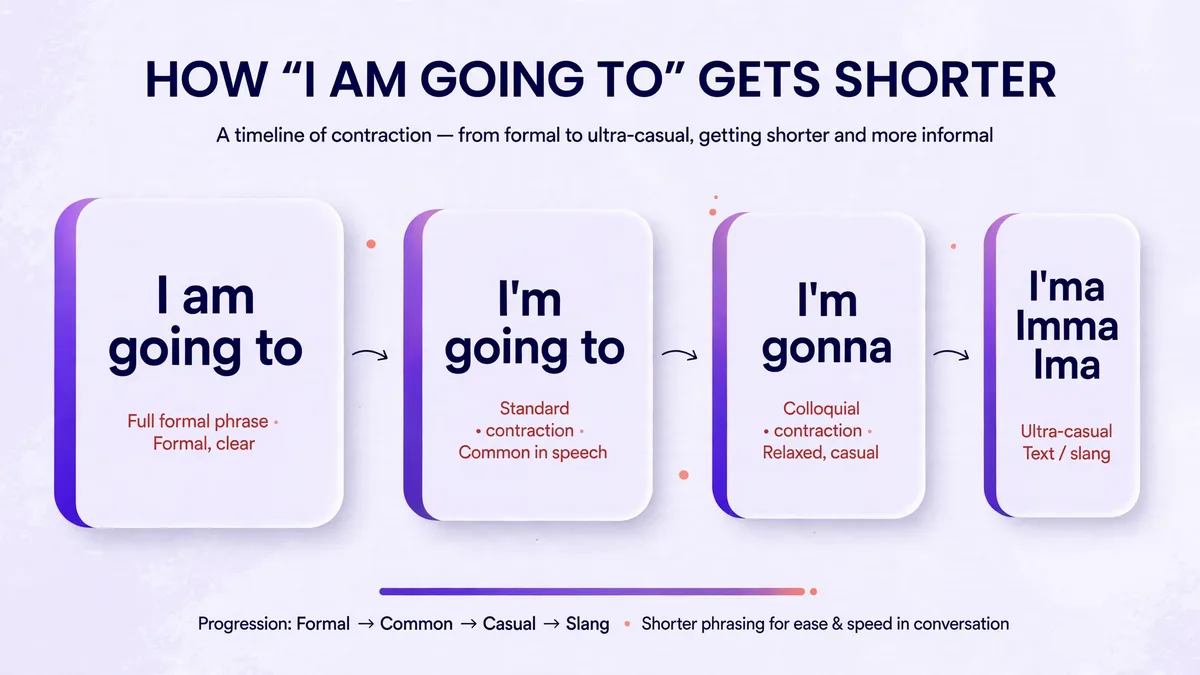
People have shortened “I am going to” in speech for centuries, long before the internet. The path is a straight line, and every step of it is still in use today: “I am going to” becomes “I’m going to,” which becomes “I’m gonna,” which becomes “I’ma,” “Imma,” and “Ima” — the same sounds, fewer and fewer letters.
The guides agree the reduced forms have a long history in African American English, where “I’ma” and “imma” were spoken long before texting existed, and spread wider through hip-hop, music, and popular culture.
That history explains the spelling chaos: IMA, IMMA, I’MA, and I’MMA are four attempts to spell the same sound, and the spelling changes nothing about the meaning — Cambridge lists all of them as variants of one entry.
The Forward Arrow: Why IMA Always Points to What’s Next
Here is the named idea of this article — the Forward Arrow: every IMA sentence has an arrow in it, always pointing forward at the next thing. The reader’s job is to follow the arrow and see where it lands.
The arrow lands in one of three places. On a verb, most of the time — “ima call you,” “ima eat,” “ima leave”: the plan sense, pointing at an action the writer is about to take. On an opinion, sometimes — “IMA, that film was better than I expected”: the confession sense, pointing at an admission. On nothing at all, rarely: a bare “ima” with no words after it, a message that stopped halfway.
Two Jobs, One Spelling: The Plan and the Confession
IMA has two real jobs, and the sentence around it tells you which one it is doing.
Job one: the plan. This is the job IMA does almost every time: a verb follows it, and the writer announces an intention — “ima grab food real quick,” “ima send you the link,” “ima be there in ten minutes.” The plan can be immediate (“ima leave now”) or hours away (“ima call you tomorrow”) — the timing comes from the rest of the sentence, not from IMA itself.
Job two: the confession. Sometimes IMA opens an opinion instead of a plan, and then it means “I must admit” — the giveaway is what follows: an opinion, not a verb of action. “IMA, that film was better than I expected.” “IMA, I was wrong about that restaurant.” CyberDefinitions lists this as a second definition, and several guides confirm it. It is real but much rarer than the plan sense — and a confession sounds nothing like a plan.
The Promise Meter: How Strong Is the Promise?
Not every IMA plan carries the same weight. Think of it as a Promise Meter with three settings — and the setting comes from the words around IMA, not from the letters themselves.
Setting one: the casual plan. “Ima watch that show tonight.” “Ima grab lunch.” This is the everyday setting — a simple announcement of intent, no urgency, no stakes. Most IMA messages live here.
Setting two: the timed promise. Add a clock and the promise gets heavier: “Ima call you back in five minutes.” “Ima be there in ten.” Now the reader can hold the writer to it, and the reply it wants is a confirmation: “sounds good,” “okay, see you then.”
Setting three: the determined declaration. “Ima prove them wrong.” “Ima keep practicing until I get better.” “Ima handle this myself.” Here IMA carries confidence and resolve — the writer is declaring the plan, not just announcing it. The tone comes from the action described, not from the abbreviation.
One honesty rule runs through all three settings: a plan is not a guarantee. “Ima call you tomorrow” says the writer intends to call — it does not prove the call will happen.
Where You Will See IMA: TikTok, Snapchat, Instagram, Gaming, and Work

IMA lives wherever people announce plans in fast, informal writing — the room changes how it sounds, not what it means.
TikTok is its loudest room. IMA fills comments and captions, usually as a public plan: “ima try this tonight,” “ima need that recipe.”
Snapchat and Instagram DMs are its warmest rooms — private messages between friends: “ima send you the picture,” “ima post these tonight.” Here IMA sounds like talking out loud through text — quick, relaxed, and familiar.
Group chats are its busiest rooms. One “ima” can move a whole group: “ima head out now,” “ima grab food, want anything?”
Gaming chats and Discord servers use it the same way, between rounds and after defeats: “ima join the next match,” “ima restart the game,” “ima go AFK for a minute.” When the move is stepping away, AFK meaning in text names the absence itself.
Work chats are where it thins out. It can appear in an informal team message, but in a formal email it has no place — write “I will send the report shortly” in full.
The Three-Second Plan Check
Here is the named test for this article — the Three-Second Plan Check: three questions, asked in order, that settle almost every IMA message.
Question 1: What comes right after IMA — a verb or an opinion? A verb means a plan (“ima call you”); an opinion means a confession (“IMA, that film was better than I expected”). This question alone settles most cases.
Question 2: Is there a clock attached? “In five minutes,” “tonight,” “tomorrow” — a time turns a casual plan into a timed promise, and a timed promise deserves a confirmation in reply.
Question 3: Would you bet on it happening? A determined declaration — “ima prove them wrong” — is a promise the writer means to keep; a casual “ima watch that later” might slide. The strength is in the action described, not the letters. If you would bet on it, treat it as a commitment; if not, treat it as an intention and move on.
IMA in Real Chats: Five Exchanges, Decoded
Five exchanges, each decoded with the Forward Arrow and the Promise Meter.
1. The casual plan. “Ima grab some food, want anything?” — Arrow: verb (grab). Promise: casual, with an offer in the same breath. Reply to the offer: “Grab me one too.”
2. The timed promise. “Ima call you back in five minutes, I am in the middle of something.” — Arrow: verb (call) + clock (five minutes). Promise: timed — the time attached is the commitment. Reply with confirmation: “Sounds good.”
3. The confession. “IMA, that film was better than I expected.” — Arrow: opinion. Promise: none — this is “I must admit.” Reply to the opinion: “I told you!”
4. The determined declaration. “Ima keep practicing until I get better.” — Arrow: verb (keep practicing). Promise: determined — the writer is declaring resolve. Reply to the resolve: “You have got this.”
5. The trap: IMA as an exit. “It is getting late. Ima head out.” — Arrow: verb (head out). Promise: casual — but the plan is a goodbye, so reply with a farewell: “Night, talk tomorrow.” When the plan is leaving, GTG meaning in text is the clean sign-off, and GNG meaning in text is the version for heading out for good.
The Traps: “I Am A…”, “In My Arms”, and the Bare IMA
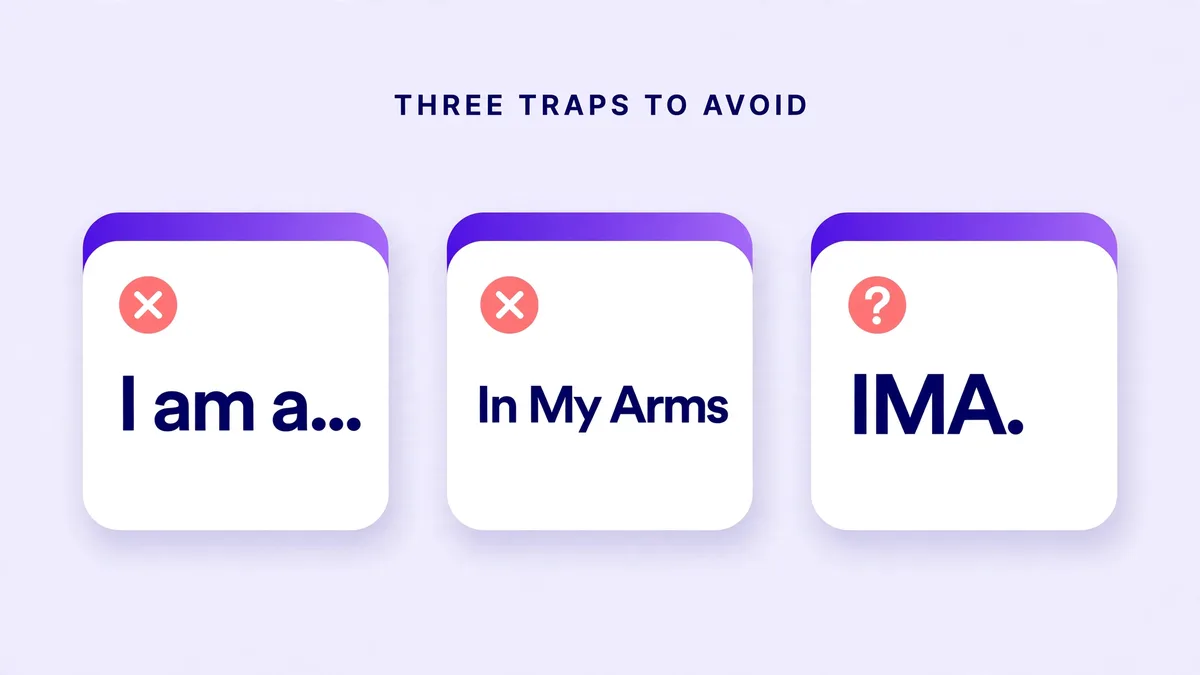
Three traps catch readers who guess instead of reading the sentence. Each one has a simple fix.
Trap 1: reading IMA as “I am a…” This is the most common mistake, and it is easy to see why: “Ima huge fan of that singer” looks like “I’m a huge fan.” But IMA is a contraction of “I’m gonna,” not a fragment of “I am a” — write “IMA student” and most readers will parse “I’m going to student.” The fix is one word: spell it out.
Trap 2: reading IMA as “In My Arms.” One guide lists this as a romantic reading, but no other source agrees, and it matches nothing about how IMA is used in real messages. If a message is romantic, the romance is in the words around IMA, not in the letters — ignore this reading entirely.
Trap 3: the bare IMA. “Ima.” with nothing after it is a message that stopped halfway — IMA signals a plan is coming, and standing alone it leaves the reader waiting for one that never arrives. The fix: finish the sentence, IMA plus a verb, every time.
A fourth trap: treating IMA as a formal acronym — in a chat it is never the Institute of Management Accountants; those expansions belong to business writing.
IMA Next to Gonna, Gotta, Finna, BRB, and IG
IMA belongs to a family of spoken shortcuts. Picking the wrong cousin is how messages get misread.
IMA vs gonna. The same meaning, different shapes: “gonna” is the full spoken form, IMA the same sound squeezed shorter. “I’m gonna call you” and “ima call you” say the same thing.
IMA vs gotta. “Gotta” means “have got to” — an obligation, not a plan. “I gotta call you” says you must; “ima call you” says you will.
IMA vs finna. “Finna” — short for “fixing to” — also announces an upcoming action from the same spoken tradition; the difference is mostly habit.
IMA vs BRB. BRB meaning in text announces a short absence and a quick return. IMA announces whatever comes next — which might be leaving, but might be eating, calling, or watching. BRB is a pause button. IMA is a next step.
IMA vs IG. IG meaning in text — “I guess” — is the opposite energy from IMA. IMA states a plan firmly; IG hedges with a guess. “Ima do it” is a decision; “IG I will do it” is a shrug. If you are not sure about the plan at all, IG fits the maybe better.
IMA vs IDK, TBH, and LMK. IDK meaning in text admits no answer; IMA gives the next step. TBH meaning in text labels honesty; IMA labels intention. LMK meaning in text is the natural reply to an IMA plan — it asks for the update the plan promises.
How to Reply When Someone Says IMA
If it was a casual plan: answer the plan. “Okay, sounds good” or “Grab me one too” is enough.
If it was a timed promise: confirm the time: “Sounds good — see you in five.”
If it was a determined declaration: answer the resolve: “You have got this” or “Go for it.”
If it was a confession: answer the opinion: “I told you!” or “Okay, I will give it another try.”
If you want to use IMA yourself: put it at the start of the sentence and follow it with a verb — “IMA eat first, then I will come over.” Do not use it in a work email, and do not leave it standing alone.
Quick Answers
What does IMA mean in texting?
IMA means “I’m going to” — a contraction of the spoken phrase “I’m gonna” that announces what the writer is about to do, as in “IMA call you back.”
Is IMA the same as IMMA?
Yes — IMA, IMMA, I’MA, and I’MMA are different spellings of the same contraction, and Cambridge lists them all as variants of one entry.
What does IMA mean on TikTok?
On TikTok, IMA usually means “I’m going to” in comments and captions — often a plan like “IMA try this tonight” under a video.
Does IMA mean “I must admit”?
Yes, as a second sense: when IMA opens an opinion instead of a plan — “IMA, that film was better than I expected” — it means “I must admit.” Real, but much rarer.
What does “I might add” have to do with IMA?
Very little. A few guides list it as a minor sense, but only at the end of a statement — “The food was great, IMA” — as a small afterthought. Position is the clue.
Can IMA be flirty?
Not by itself. A plan can sound playful — “ima steal your hoodie” — but the flirting is in the action described, not the letters.
Should I use IMA at work?
No — it is informal slang, and in a work email it looks careless. Write “I will” or “I am going to” in full instead.
Does IMA mean “in my arms”?
No — treat it as unproven. Only one guide claims it, no other source agrees, and it matches nothing about real usage. Do not use IMA that way.
The Final Word on IMA
IMA is a small word with one clear job: it tells you what someone is about to do. It means “I’m going to,” it comes from “I’m gonna,” and in most chats a verb and a plan follow it. The second sense, “I must admit,” turns the same three letters into a confession instead.
Now you can read it at a glance: a verb after IMA means a plan, an opinion means a confession, and a bare IMA means the writer stopped halfway. Follow the arrow, check the clock, and ask whether you would bet on it.