
There’s a text that has launched a thousand arguments about punctuality: “otw.” Three letters, sent from someone who is supposedly moving toward you right now. The only problem? “On the way” covers a lot of territory — from “I’m pulling into your street” to “I haven’t found my keys yet.”
OTW stands for “on the way.” It’s a status update in miniature: the sender wants you to know movement is happening and arrival is coming. This guide covers what OTW means, the honesty gap hiding inside it, how it differs from its close cousins, and what to send back when you get one.
What “OTW” Promises When You Send It
Every “otw” is a small promise. Strip away the informality and what you’re really telling someone is: I’ve started moving toward you, and you can expect me soon. That’s a lot of meaning for three keystrokes — which is exactly why people reach for it.
It works because it answers the question everyone is silently asking when plans are in motion: is this actually happening? A bare “otw” says yes, it’s happening, I’m in motion. Compare it with silence — the person waiting has no idea whether to keep waiting or give up. OTW fills that gap in the cheapest possible way.
It’s also flexible in a way its cousins aren’t. You can say “the pizza is OTW” or “your package is OTW” — things, not just people, can be on the way. Try that with “omw” (on my way) and it sounds odd, because OMW is always personal: I am coming. OTW describes movement in general. That flexibility is part of why it stuck.
The OTW Honesty Scale
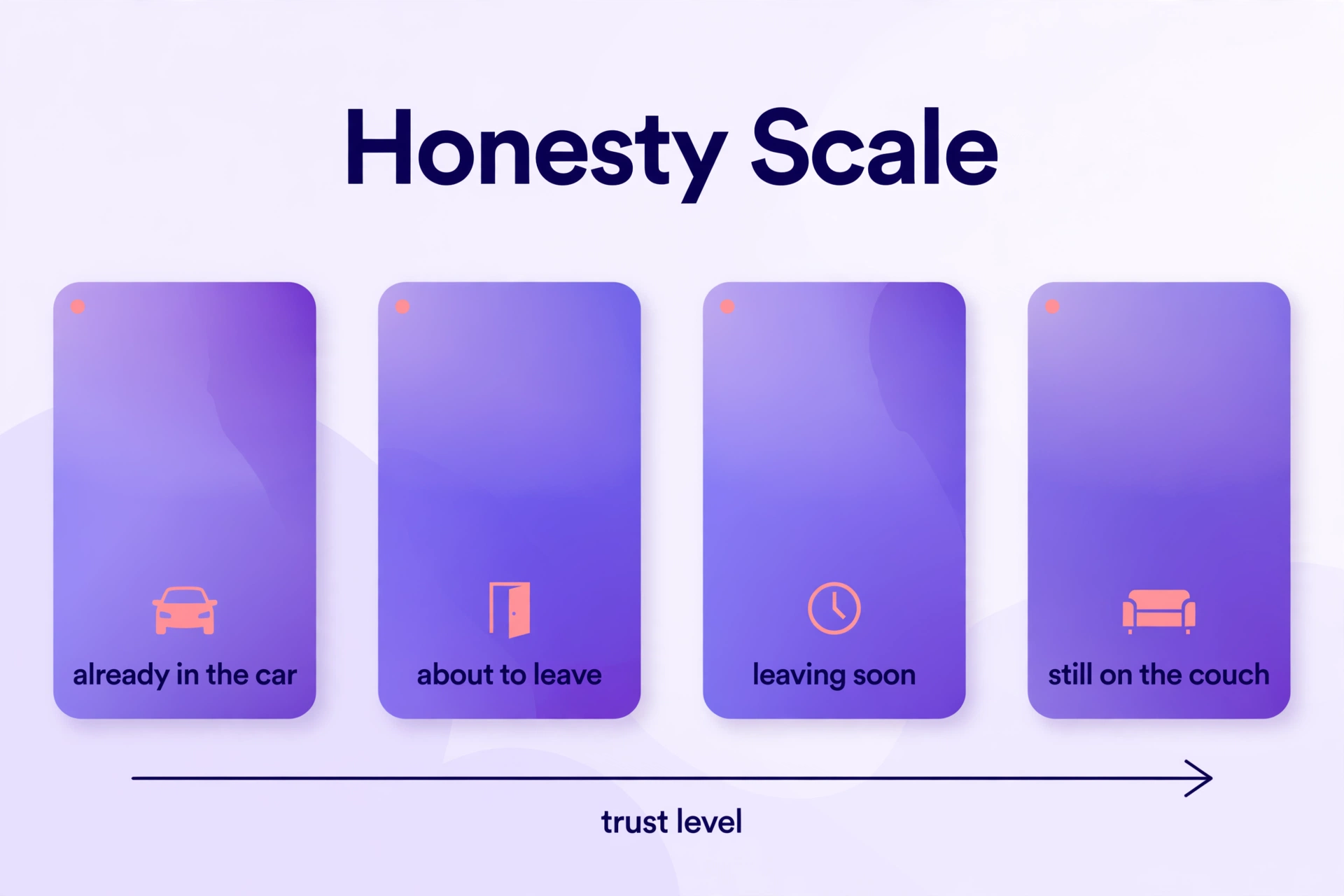
Here’s the part nobody puts in the dictionary definition: OTW does not always mean someone is physically moving. In practice, those three letters cover a whole spectrum of readiness, and learning to read where someone sits on it is the real skill.
Level 1 — Actually moving.
“OTW, 10 min out.” The gold standard. They’re in the car, on the train, walking over. Add a time and it’s nearly always true — specific numbers are hard to fake.
Level 2 — About to leave.
“OTW in a sec.” Shoes on, keys in hand, one foot out the door. Close enough that the distinction barely matters.
Level 3 — Leaving soon (optimistic).
“Yeah yeah, otw now.” They mean it, mostly. They’re finishing something first — one more episode, one more scroll. The intent is real; the timeline is aspirational.
Level 4 — Still on the couch.
The “otw” that means “I acknowledge your existence and plan to move eventually.” Everyone has sent this one. Everyone has received this one.
None of this makes OTW a lie — most of the time it’s optimism, not deception. But it does mean a bare “otw” with no detail is the weakest version of the promise. The more specific the message, the more you can trust it: “otw, parking in 5” is a fact; “otw” alone is a vibe.
There’s even a running joke about it — a well-known bit about what “otw” really means in practice, something like “I’ll be there in about three hours, not any time soon.” It spread because it rings true. For raw, unfiltered examples of how people actually use and joke about it, the Urban Dictionary entry for OTW collects real-world definitions from texters themselves.
OTW in Real Conversations
The exchanges below are illustrative examples, not real messages.
The reliable arrival
- A: “where are you??”
- B: “otw, 10 min out, traffic’s moving”
A needed reassurance; B gave movement plus a time. That’s the full-strength OTW — specific, credible, done.
The optimistic one
- A: “you coming tonight?”
- B: “yeah otw soon”
- A: “…define soon”
“Soon” is doing a lot of heavy lifting here. A knows it. When someone answers “otw soon” with no detail, they’re at Level 3 on the honesty scale, and everyone in the chat can feel it.
The package update
- A: “did you send the charger?”
- B: “yep, otw — should be there tomorrow”
OTW isn’t only about people. Deliveries, food orders, files — anything in transit can be OTW. This is the flexibility that OMW doesn’t have.
The group-chat rally
- A: “who’s coming to the game?”
- B: “otw now”
- C: “otw, bringing snacks”
Two OTWs, zero ambiguity. In a group chat, it’s a headcount in three letters.
OTW vs. OMW, ETA, and BRB
Movement slang clusters together, and these get mixed up constantly.
OTW vs. OMW.
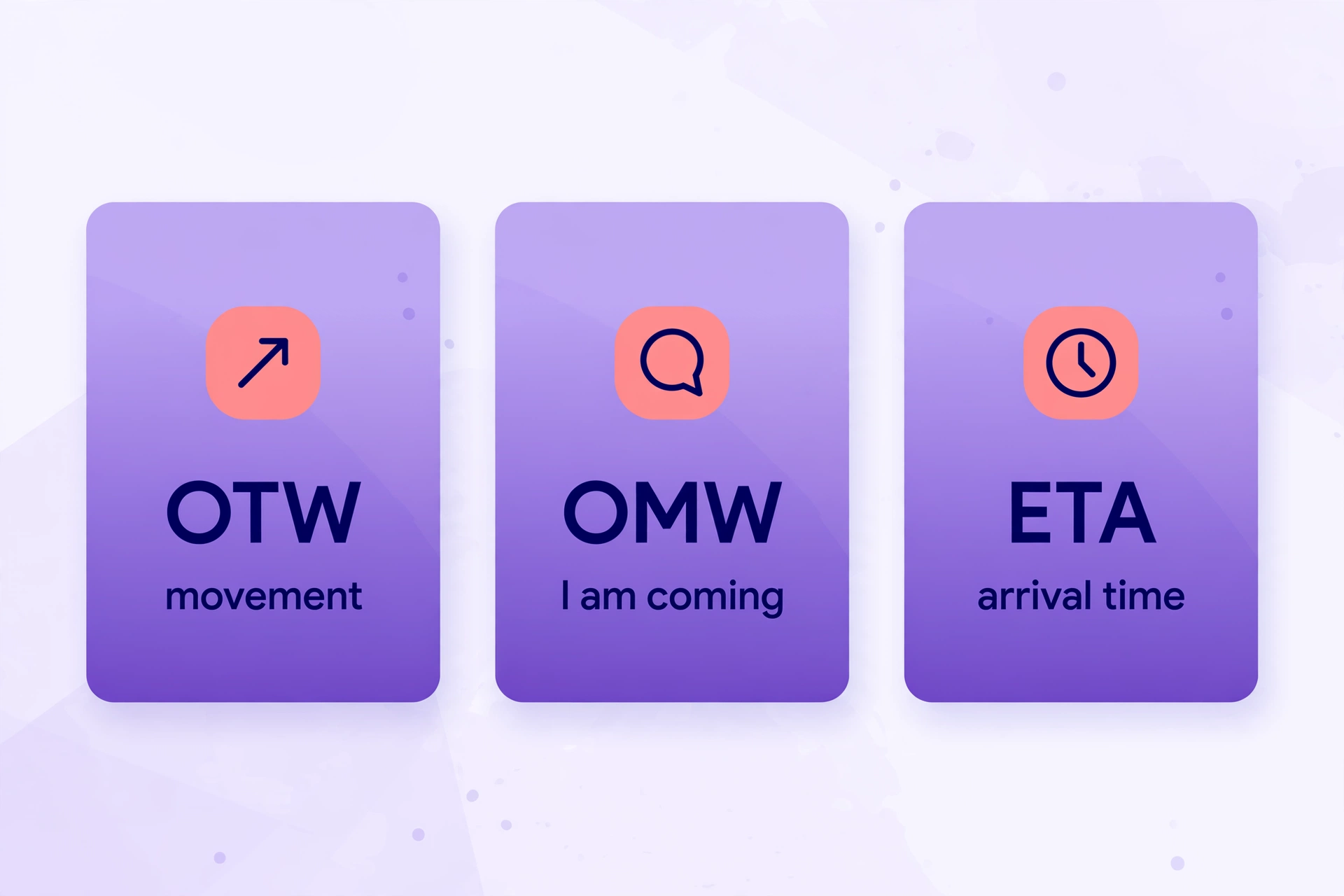
The classic pair. Functionally they’re interchangeable when you’re talking about yourself — “I’m otw” and “I’m omw” land the same way. The difference is scope: OMW (on my way) is always personal — I am coming. OTW (on the way) is broader — it can be you, or the pizza, or the package. If in doubt, OTW is the safer default; it never sounds wrong.
OTW vs. ETA (estimated time of arrival).
These are statement and follow-up. OTW says “I’m moving”; ETA says “I’ll be there at 7:40.” An “otw” without a time is a promise; an “otw, eta 10 min” is a plan. When someone’s time matters — a pickup, a reservation, a ride — skip straight to the ETA. It’s the respectful version.
Opposite directions. OTW means movement toward something; BRB means a short pause where you are. “Otw to the store, brb in 10” actually uses both correctly in one breath — moving, then pausing.
The through-line: OTW is the general-purpose movement word. OMW is its personal twin, ETA adds the clock, and BRB hits pause.
Getting an “OTW”? Here’s What to Send Back
An OTW is good news — someone’s coming. Your reply depends on what you need.
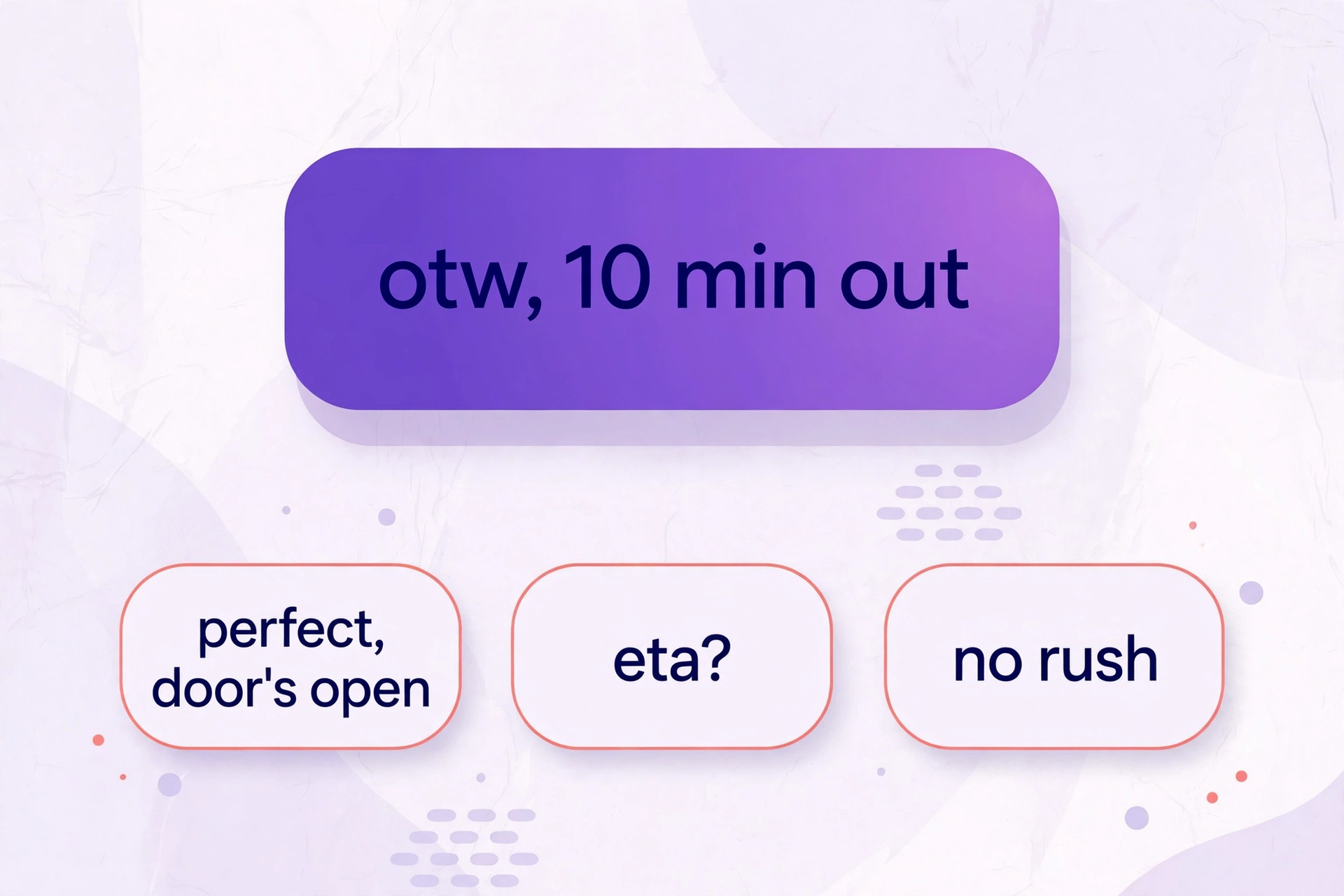
- Confirm and coordinate: “perfect, door’s open” — or “lmk when you’re outside and I’ll come down.”
- Ask for the clock: “eta?” — one word, totally fair. If their OTW had no time attached, asking is your right.
- Buy them time: “no rush, take your time” — defuses the pressure when they’re clearly hurrying.
- Call out the couch: “fr?? you’ve said otw twice” — for the friend who’s been “on the way” for forty minutes. Use with people who can take the joke.
If you’re the one leaving as you reply, GTG (got to go) is the honest sign-off: “otw now — gtg, see you soon.” And when the coordination’s done and there’s nothing left to say, TTYL closes it cleanly.
When to Skip the Abbreviation
OTW is casual by design, and there are rooms it shouldn’t enter. Don’t use it with a boss, a client, or anyone you’re trying to impress — “OTW to the meeting” reads as careless. In those settings, “I’m on my way” or “I’ll be there in ten minutes” costs you four extra seconds and buys you a completely different impression.
It’s also the wrong tool when precision matters. “OTW” tells someone you’re moving; it doesn’t tell them when you’ll arrive. If a driver is waiting, a table is held, or a schedule is tight, give the actual time. And never send “otw” when you’re not actually coming — that’s the one use that burns trust. A fake OTW is worse than silence, because it makes someone wait on a promise you never meant.
Quick Answers
Q: What does OTW mean in a text?
A: “On the way” — the sender is heading toward you (or something is heading your way) and arrival is coming.
Q: What’s the difference between OTW and OMW?
A: Almost none when talking about yourself. OMW (“on my way”) is always personal — I am coming. OTW (“on the way”) is broader and can describe anything in transit, like a delivery.
Q: Is “otw” rude?
A: Not on its own. But a bare “otw” with no detail can feel dismissive if someone’s been waiting — adding a time (“otw, 10 min”) fixes it instantly.
Q: Can I use OTW at work?
A: In a quick team chat, sometimes. In anything formal — emails, client messages, messages to your manager — write it out: “I’m on my way.”
Q: What does “OTW” mean on Snapchat or Instagram?
A: The same as in texts — “on the way,” usually in DMs about meetups. In captions it can also be figurative, like “glow-up OTW” (something big is coming).
Q: Someone’s been “otw” for an hour. What do I say?
A: Ask for the clock: “eta?” If the friendship can take it, “fr??” calls out the couch-level OTW with humor.
Q: Does OTW ever mean something else?
A: Rarely. “Off to work” shows up as a secondary reading in some circles, and “off the wall” (extreme) is very rare. In texts, assume “on the way” unless context says otherwise.
The Short Version
OTW is “on the way” — three letters that promise movement. It’s broader than OMW (things can be OTW, not just people), weaker than an ETA (no clock attached), and only as honest as the detail behind it. Send it with a time and it’s a plan; send it bare and it’s a vibe. Either way, don’t send it from the couch too often — people learn to read the scale.
