
If someone just texted you “rls,” here is the short version: in most casual texts, rls meaning in text is “Real Life Stuff.” It is shorthand for “something in my actual, offline life needs my attention right now.” A friend who goes quiet and then writes “sorry, rls” usually means work, family, school, or something else real got in the way — without spelling out the details.
That is the most likely reading, but not the only one. RLS can also mean relationships on TikTok, a medical condition in a health conversation, or a rougher, emphatic version of the same idea — the meaning changes with the topic, the platform, and who sent it.
The Short Answer: What RLS Usually Means
In a normal text, DM, or group chat, RLS stands for “Real Life Stuff” or, near-identically, “Real Life Situation” — the offline world interrupting the online one. Someone writes it when they are busy, stepping away, or explaining a late reply, and would rather not give a full explanation.
It works because it is deliberately vague. “Sorry, rls” tells the other person enough — I am dealing with something real, I am not ignoring you — and nothing more. It protects the sender’s privacy while still acknowledging the conversation. RLS is informal, so it belongs in chats with friends, not work emails, and it is less common than IRL, so spell it out if the other person looks confused.
The RLS 3-Question Test
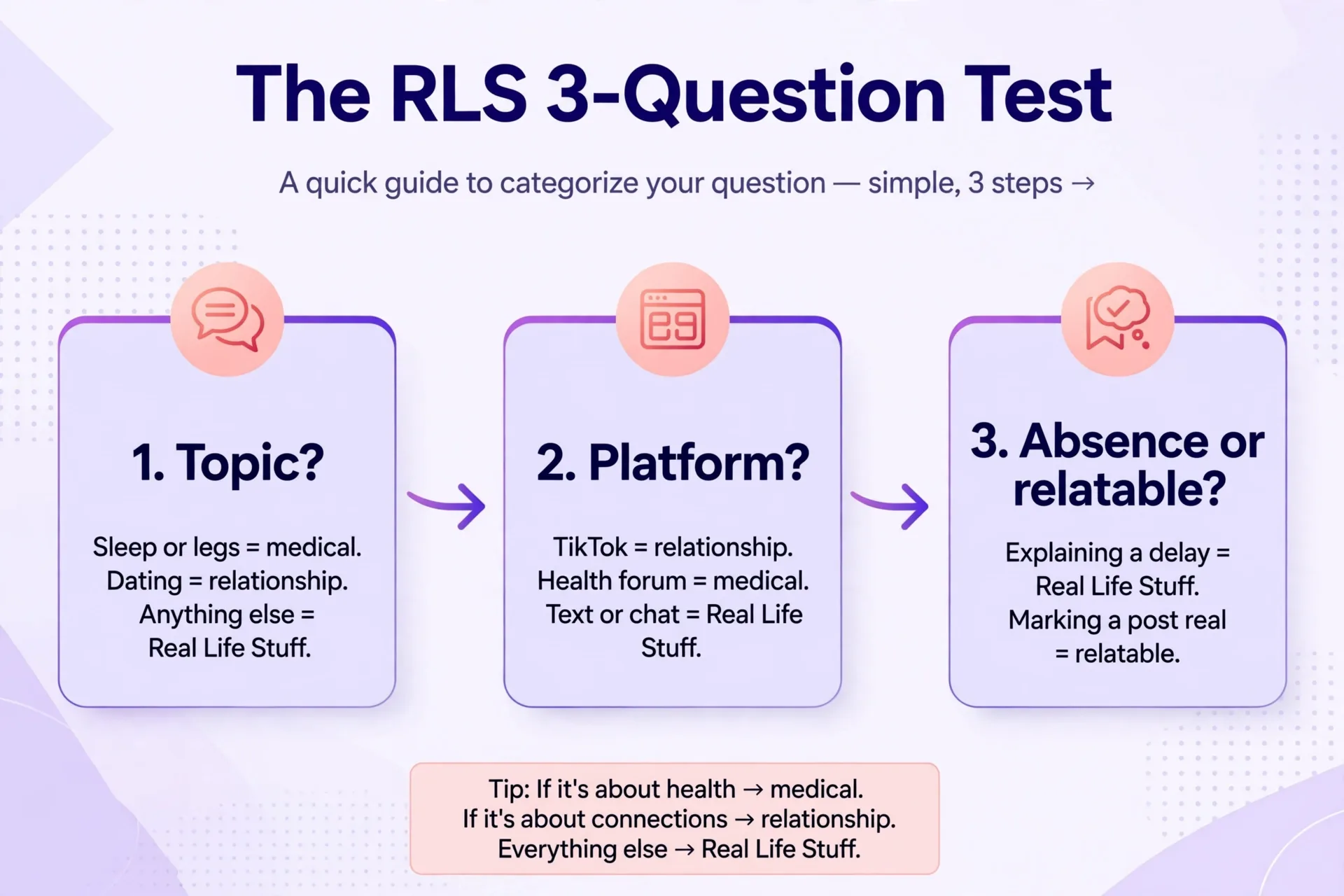
Here is the tool this article is built around. When you see RLS and you are not sure which meaning applies, ask these three questions in order. Usually the first one settles it.
Question 1: What is the conversation about? Sleep, legs, or a doctor’s visit means Restless Legs Syndrome. A breakup or dating means “relationship.” Anything else means “Real Life Stuff.”
Question 2: Where did you see it? Under a TikTok relationship video, lean “relationship.” In a health forum, lean medical. In a text, Discord, or Snapchat, lean “Real Life Stuff.”
Question 3: Absence or relatability? “Can’t talk, rls” explains an absence — classic “Real Life Stuff.” But “this video is so rls” means “this is real, this actually happens.” Same letters, different job. Still unsure? Just ask — “do you mean real life stuff?” takes two seconds.
“Real Life Stuff”: What the Main Meaning Actually Covers
“Real Life Stuff” is a catch-all, and that is why it is useful. It covers anything offline that pulls someone away from their phone: a shift running late, a family obligation, homework, errands, a flat tire. The sender picks RLS precisely because they do not want to list those things.
Look at how it shows up in real messages:
- “Can’t talk rn, rls.” — Something offline needs attention right now.
- “Can’t game tonight, family rls came up.” — Personal matters outrank gaming plans.
Notice the pattern: RLS usually appears with an apology, a delay, or an exit — it rarely starts a conversation. It also travels with other short forms (“brb, rls,” “gtg, rls, ttyl”). The related abbreviation BRB signals a short pause, while RLS supplies the reason; TTYL closes the conversation politely once the reason is given.
There is a quieter second use: in public posts, “rls” can mark something as genuinely relatable. “This meme is too rls” means “this is painfully true to real life” — not “I am busy,” but “this is real.”
The Rougher Version You Will Sometimes See
One honesty note: in some corners of social media, RLS is also used as a masked, emphatic version of the same idea — “real life sh*t” — where the last word adds weight. “That breakup was rls” in that register means “that was seriously real, raw, and heavy,” not just “I was busy.” And “I’m living RLS right now” usually means someone is going through something difficult and real.
You do not need to use this version yourself, and most people do not — the clean “Real Life Stuff” reading is the default in ordinary texting. The rougher variant shows up mainly in captions and venting posts where the tone is already emotional. The clue is tone: if the message feels intense rather than logistical, the emphatic reading is probably intended. Either way, leave RLS out of formal messages.
On TikTok, RLS Often Means Relationships
TikTok is the one place where the default flips: there, RLS usually stands for “relationship” or “relationships,” used when people talk about romantic relationships — real ones and fictional ones. You will see it in comments like “RLS drama is real” under a breakup video, or in captions asking for advice with #RLSAdvice. “Relationship” is a long word to type repeatedly in a fast-moving comment section, and RLS is the shortcut.
This is a platform-specific reading, not a general one: outside TikTok and relationship talk, the evidence for “relationship” is thin. If the video is about a couple, a breakup, or a situationship, RLS means relationship; if it is about anything else, it probably does not.
The Medical Meaning: Restless Legs Syndrome
Then there is the meaning that has nothing to do with texting. In health and medical conversations, RLS is the standard abbreviation for Restless Legs Syndrome, a neurological condition that causes an overwhelming urge to move the legs, usually worse at night, with crawling or tingling sensations that ease with movement. It is also known as Willis–Ekbom disease.
This is the one meaning here backed by medical references rather than slang sites, and the easiest to spot: talk of sleep, legs, symptoms, or doctors. “My doctor thinks it’s RLS” and “can’t sleep, the RLS is back tonight” are medical through and through.
Two rules follow. First, never treat a medical use as slang — if someone tells you about their RLS symptoms, they are sharing a health issue, not making an excuse, so respond with sympathy, not a joke. Second, never use the slang abbreviation in a health conversation; spell out “real life stuff” or you will be misunderstood in exactly the wrong direction. In developer talk, RLS also means Row-Level Security — you will only meet that one if the chat is about tables or SQL.
RLS on TikTok, Snapchat, Instagram, and in Plain Texts
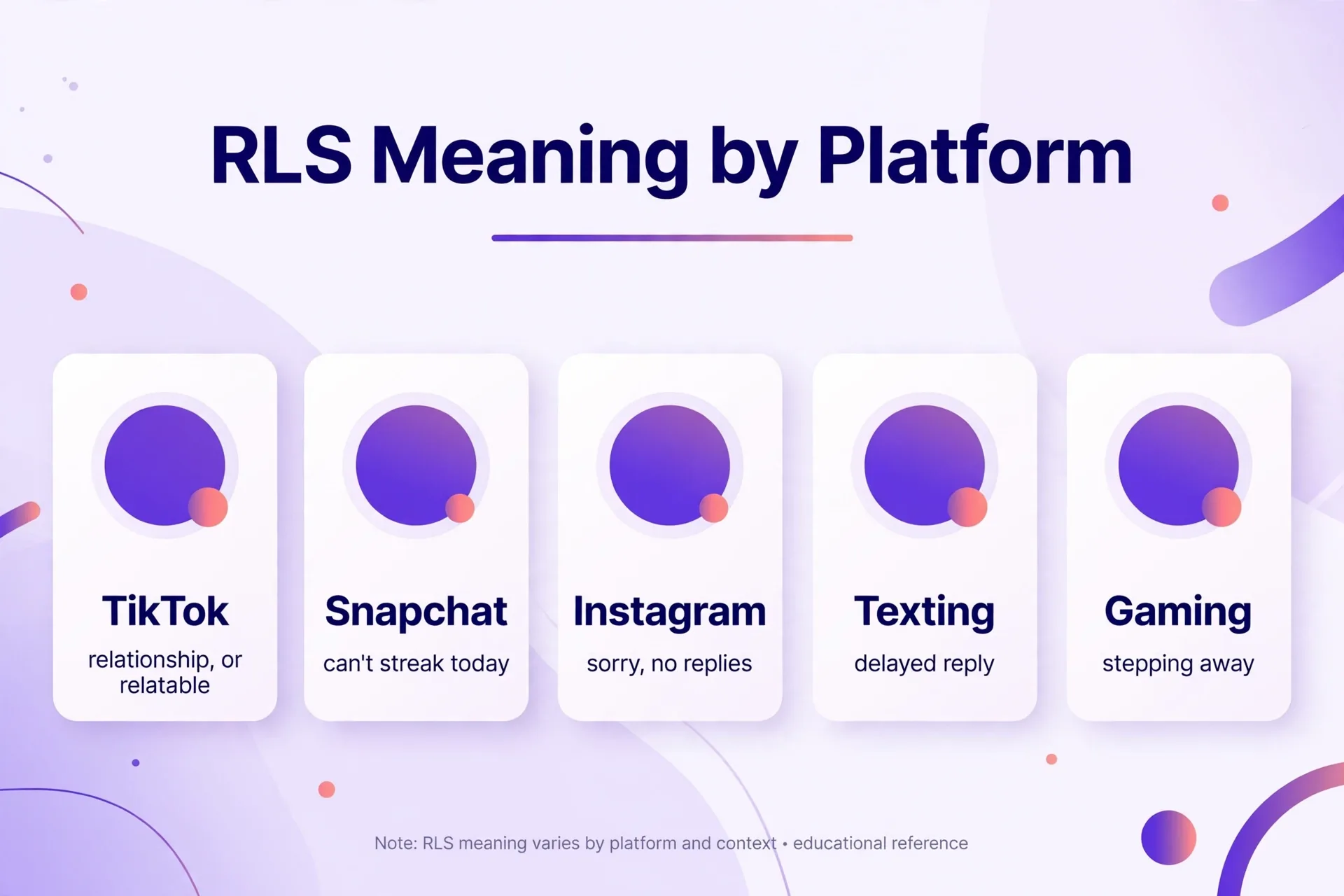
The slang meaning stays the same across platforms, but the job it does shifts slightly.
On TikTok, RLS does double duty: “relationship” in relationship talk, or a relatability marker (“POV: trying to post daily but RLS wins”). On Snapchat, it is usually an absence note — “Can’t streak today, RLS is wild” — because streaks make absence visible. On Instagram, it shows up the same way: “Sorry for no replies, RLS got me.” A fr (“for real”) often sits nearby, underlining that the poster means it.
In plain texting and group chats, RLS is at its most straightforward: delayed replies, cancelled plans, stepped-away friends. In Discord and gaming, it is a session-management tool: “AFK for a bit, rls” tells a team someone is stepping away mid-game and they should carry on — a small social contract where real life takes priority and nobody asks for details. Gaming is also where RLS is most often stacked with other abbreviations, as in “gtg rls ttyl”: going, reason, goodbye, in six letters. The honest summary: TikTok is the only platform where the meaning itself changes.
Who Sent It Changes the Meaning
The same message lands differently depending on who sent it. This is where most misreadings happen.
From a close friend, RLS is almost always “Real Life Stuff,” and usually light: busy, errands, family. Reply with warmth and no pressure — “all good, catch up later.” The vagueness is intentional.
From a crush or someone you are dating, RLS deserves a second look. “Sorry, rls” usually still means they are busy, but a warm follow-up (“rain check tomorrow?”) means interest, while a flat, repeated RLS with no follow-up can mean distance. Do not over-read one message, but notice a pattern.
From a partner, RLS is shorthand between two people who already know each other’s lives: “Rls day, talk later” means a hard day offline. Reply with support, not suspicion: “take your time, I’m here.”
From a coworker, a boss, or a stranger, treat RLS as a flag, not a definition. At work it is vague enough to be unprofessional — ask for the specifics you need, politely and in plain words. From a stranger or a new match, it is usually low-effort filler; do not invest heavily in decoding it. RLS is a low-information message by design: the less you know the sender, the less you should assume.
How to Reply When Someone Sends RLS
The right reply depends on the situation, not on the letters. Explaining a delay or absence: “All good, take your time.” “No worries, catch up later.” Warm, pressure-free, and hard to get wrong. Venting or going through something heavy: “That sounds rough, I’m here if you want to talk.” Skip the jokes — a breezy reply to a heavy message reads as dismissive.
A gaming or group-chat exit: “Got it, we’ll wait” or “no rush, we’ll carry on.” A TikTok relationship comment: reply to the relationship, not the abbreviation — “Breakups are the worst, hope you’re okay” beats any decoding. If “rls” means “this is so real,” a simple agreement works; ISTG is the emphatic agreement you will often see next to it, though stronger than a plain “same.”
If you suspect the medical meaning: “Sorry to hear that, are you getting any help with it?” — and do not use the slang reading back at them. If you genuinely cannot tell: ask plainly. “Do you mean real life stuff, or the sleep thing?” is a normal question, and the fastest way to avoid the classic RLS mix-up.
RLS vs IRL vs BRB vs AFK
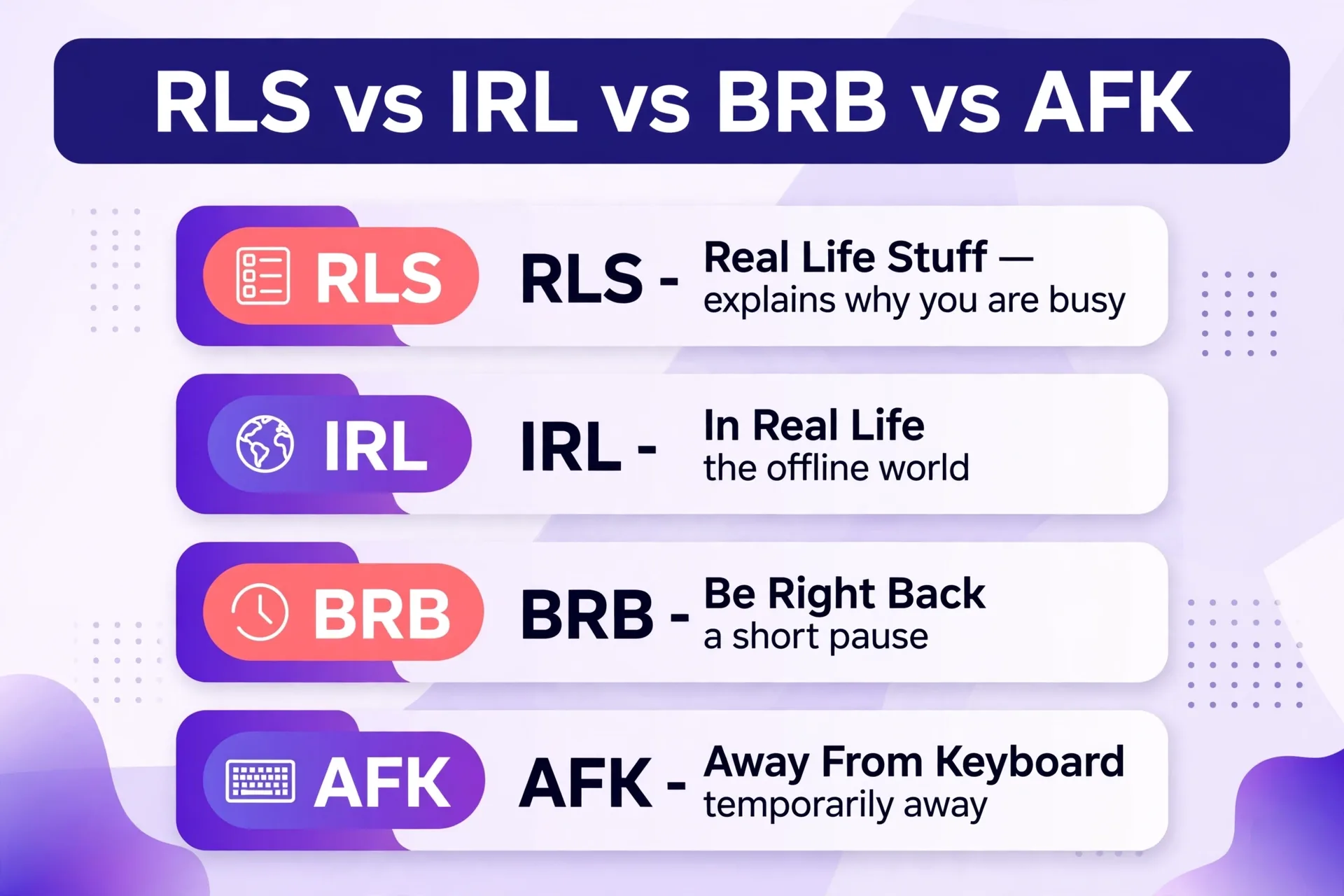
RLS belongs to a family of abbreviations about availability and real life:
| Term | What it means | What it does |
|---|---|---|
| RLS | Real Life Stuff | Explains why someone is busy or away |
| IRL | In Real Life | Contrasts the offline world with the online one |
| BRB | Be Right Back | Announces a short, unexplained pause |
| AFK | Away From Keyboard | Announces a temporary absence, mostly in gaming |
IRL and RLS are the pair people confuse most. IRL describes where something happens (“let’s meet IRL”), while RLS explains why someone is unavailable (“can’t chat, RLS”). SMH sometimes appears alongside RLS in captions — “RLS got me again smh” — adding frustration rather than changing the meaning. And when someone agrees emphatically with a relatable RLS post, you may see IYKYK nearby, or OFC when someone confirms the post is exactly right. The rule: BRB and AFK announce absence, IRL locates something offline, and RLS gives the reason.
When Not to Use RLS
RLS is easy to misuse, mostly because it is vague. Skip it in work emails, school assignments, and formal writing — write “I’m handling something offline” instead. Skip it in serious or emotional conversations, where a three-letter shrug can feel dismissive. Skip it with people who may not know the slang: older relatives or new contacts may read it as a typo — or, worse, as the medical term. And skip it when the details matter: if a time, a place, or a promise is involved, RLS hides exactly the information the other person needs.
Quick Answers
What does RLS mean in text?
Usually “Real Life Stuff” — something offline needs the sender’s attention. On TikTok it can mean “relationship”; in health talk it means Restless Legs Syndrome.
Is RLS the same as IRL?
No. IRL (“In Real Life”) contrasts offline with online; RLS explains why someone is busy because of offline things. IRL locates; RLS explains.
What does RLS mean on TikTok?
Usually “relationship” or “relationships,” especially in comments about dating or breakups. It can also mark a post as painfully relatable.
Can RLS mean something medical?
Yes — Restless Legs Syndrome, a condition causing an urge to move the legs, worse at night. If the talk is about sleep or symptoms, that is the meaning.
Is RLS rude or offensive?
No, “Real Life Stuff” is polite and neutral. But a rougher emphatic variant exists online, so avoid RLS in formal settings.
How do I reply to RLS?
“All good, take your time” for a delay. “Hope everything’s okay” if the tone sounds heavy. In gaming, “Got it, we’ll wait.” When in doubt, ask.
Can I use RLS at work?
Only in very casual team chats. In emails or formal messages, spell out what you mean instead.
Is RLS outdated?
Not exactly — it is less common than IRL, but still used in gaming chats and social captions. Not everyone will recognize it, though.
The Bottom Line
RLS meaning in text is usually “Real Life Stuff” — a short, polite way of saying the offline world needs attention right now. On TikTok it often means “relationship,” and in a health conversation it means Restless Legs Syndrome. Run the 3-Question Test — topic, platform, absence or relatability — and you will read it right almost every time. When you still are not sure, ask. Three letters are never worth a misunderstanding.