
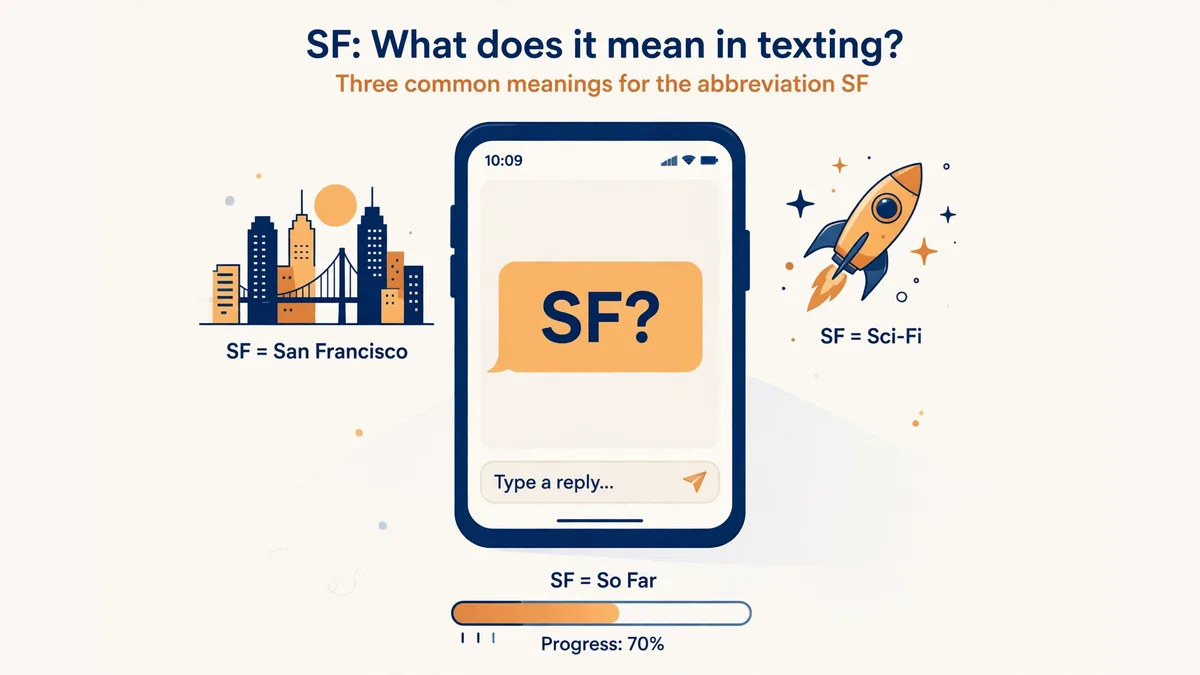
You are scrolling through messages and you see two letters sitting alone in a sentence: “SF.” No emoji, no explanation, nothing to help you. Is your friend talking about a city, a film genre, a basketball position, or how their day is going? That doubt is exactly why the sf meaning in text deserves a careful answer. SF is not one piece of slang with one meaning. It is a borrowed abbreviation with several established lives, and the only way to read it is to work out which room the conversation is standing in.
Here is the short version. SF has no single texting meaning. In most messages it means one of three things: San Francisco, science fiction, or — as an informal shortening — “so far.” Which one applies is decided by the topic, not by the letters. “Flying to SF tomorrow” is a city. “I only read SF” is a genre. “Going well SF” is a progress report. The old version of this page got the ranking wrong: it crowned “so far” as the usual meaning and invented a second meaning out of thin air. This update withdraws both claims, grades every reading against real evidence, and gives you the Room Test. One admission first: SF is barely a texting abbreviation at all — no dictionary lists a texting sense for it.
What SF Actually Means — and Why the Room Decides
SF is an abbreviation, not a piece of slang with one fixed definition. LOL belongs to texting; it was born there. SF was not: it arrived in messages already carrying meanings from maps, bookshops, and basketball courts. That is why asking “what does SF mean?” without context is unanswerable, and why every guide that answers it with one confident line is guessing.
The three readings that actually hold up are easy to state and hard to rank, because their ranking changes with the room. San Francisco is the reading with the widest recognition: SF is the standard abbreviation for the city. Science fiction is the reading with the deepest roots: SF has been the genre’s preferred abbreviation among its own readers and writers for decades. “So far” is the reading with the weakest claim to the letters: people do shorten the phrase to SF in progress updates, but spelling it out is more common and clearer, and no dictionary records the shortening at all.
The old article treated these as four equal meanings — “So Far”, “Sure Fine”, “Science Fiction”, “Small Forward” — and declared the first one the most common. Two of those four do not survive contact with the evidence: “sure fine” has no attestation anywhere, and small forward is real only on a basketball court. Beyond the three main rooms there are smaller field meanings, each owning exactly one room: small forward, semifinal, smoke-free, square feet. None of them ever appears in ordinary chat without its room attached. One more distinction: SF is not SFS, which means “shoutout for shoutout” on Instagram and Snapchat. SF means none of that.
Run the Room Test

Here is the new reader test for this article, built for the hardest version of SF: two letters with no context at all. Call it the Room Test.
Check one is NAME THE ROOM. What is the conversation about? Travel, a trip, or a move means the room is a place, and SF is San Francisco. Books, films, shows, or games mean the room is a genre, and SF is science fiction. A job, a project, or a day being reported means the room is progress, and SF is “so far”. Basketball means the room is the court, and SF is small forward.
Check two is CHECK THE SENTENCE SHAPE. Where does SF sit in the sentence, and what job is it doing? A place SF behaves like a noun: “in SF”, “to SF”, “back from SF”, “SF weather”. A genre SF behaves like a label: “SF books”, “I only read SF”, “an SF film”. A progress SF behaves like a tail on a sentence: “going well SF”, “good SF, thanks”, “better SF”. A standalone SF is the hardest shape: it carries no room with it, so read the message it answers first.
Check three is ANSWER IN KIND. Match the room you found. A place SF earns a place answer; a genre SF earns a genre answer; a progress SF earns a progress answer. The classic mistake is answering across rooms. Try it: “In SF this weekend, you around?” Room: travel. Shape: “in SF” is a place. Answer in kind: “Yes, let’s meet up — where are you staying?”
SF as “So Far”: The Progress Reading
The progress reading is the one the old article got most wrong. “So far” is a real phrase, and people do shorten it to SF when reporting how something is going: “Work is going well SF.” “Feeling better SF.” The meaning is usually clear from the sentence around it. That much the old article got right.
What it got wrong was the weight. It called “so far” the most common meaning of SF, the most popular use, and a widely used daily abbreviation. None of that is supported. The best guide found during research says the opposite: spelling out “so far” is more common and clearer, and SF is not a universally recognised replacement for the full phrase. No dictionary records SF as “so far” at all. The honest grade: “so far” is a real but minor informal shortening — not the main meaning of SF.
The progress reading has a tell: a progress SF almost always comes at the end of a sentence that already says how something is going — “going well SF”, “good SF”, “better SF”. The sentence does the work and SF just stamps it as “up to now”. If clarity matters, write “so far” out in full. If you want a progress abbreviation people will actually recognise, the guide to atm meaning in text covers “at the moment”, and the guide to rn meaning in text covers “right now”.
SF as San Francisco: The Place Reading
The place reading is the strongest one SF has, and it is the one to assume first when the conversation involves travel, a city, or California. SF is the standard, widely recognised abbreviation for San Francisco, used in formal and informal contexts alike: travel plans, addresses, news headlines, sports coverage, and casual chat. When someone writes “Flying to SF tomorrow” or “I live in SF now”, there is no real ambiguity to resolve. The city is the meaning, and the sentence shape — “to SF”, “in SF”, “from SF” — confirms it before you even need the test.
This reading also explains why SF turns up so often on social media. A caption that says “SF weekend” or “back in SF” is not texting slang; it is a place tag in two letters. If the thread contains a single travel word — flight, hotel, weekend, visiting, moved — the place reading wins. One trap: SFO is the airport code for San Francisco International Airport, not the city. The city is SF; the airport is SFO.
SF as Science Fiction: The Genre Reading
The genre reading is the oldest one SF has, and in some rooms it is the only one that matters. Science fiction — abbreviated SF or sci-fi — is a genre of stories about imagined science and technology, space travel, time travel, and future worlds. Within the community of science-fiction readers and writers, SF is the preferred abbreviation, used precisely because it lets people avoid choosing between “science fiction”, “speculative fiction”, and “sci-fi”. It appears on book covers, in magazine titles, in reading lists, and in fan conversation, and it has done so since long before anyone texted.
In messages, the genre reading shows up whenever the conversation is about stories: “I only read SF”, “That film is pure SF”, “Got any good SF recommendations?” A genre SF sits next to a story word — book, film, show, read, watch — or stands as a label on its own: “SF, fantasy, or horror?” If the thread is about what to watch or read tonight, SF is the genre. A little history: science fiction spread through the pulp magazines of the 1930s, and by the 1970s SF was the standard shorthand among readers and writers — roughly ninety years of continuous use.
SF on TikTok, Snapchat, Instagram, and Text Messages

Here is where this article parts company with most guides: the platform matters less for SF than for almost any other term on this site. For SF, the platform does not change the meaning at all. The room does, and the room travels with the conversation, not with the app. An SF about San Francisco means San Francisco on TikTok, on Snapchat, on Instagram, and in a text message.
Each platform makes one room likelier than the others. On Instagram, SF is most often the place: travel captions, city tags, and story replies about a trip. On TikTok, SF turns up in comments about travel and about genre — the video itself is the room, so watch it before you read the letters. On Snapchat, SF leans toward the joking group-chat readings: the top user-generated definition for SF is “stop flirting”, used jokingly in group chats. But note the grading: user-generated attestation only, not a dictionary. In text messages and WhatsApp, SF is at its most mixed, because texting is where all the rooms meet — which is why the Room Test matters most there.
Who Sent It: Friend, Crush, Partner, Group Chat, or Stranger

From a close friend, SF is almost always practical, and the room will be visible in the thread. “SF this weekend?” is the city. “Going well SF” is a progress update expecting a follow-up question. “Finished the SF book, it was brilliant” is genre, expecting a recommendation in return. In each case the reply that works stays in the room. The only real mistake is answering the letters instead of the conversation.
From a crush, SF does quiet extra work, and the tell is how much effort surrounds it. “In SF this weekend, wish you were here” uses the city as a reason to talk to you — the invitation is the point. “SF?” with nothing else is the smallest possible message, letting your answer set the temperature. Either way it is not a declaration of anything: SF alone never proves romantic interest; the effort around it does. From a partner, SF is shorthand inside a shared history, and outsiders cannot decode it — which is fine.
From a group chat, SF is at its thinnest. A bare SF there is usually a joke, a poke, or an unfinished thought. The top user-generated reading, “stop flirting”, lives here, used jokingly when someone is teasing or being teased. After a flirty exchange it is probably that joke; after a travel announcement, probably the city. Read the last ten messages before you read the two letters. From a stranger, SF deserves a light answer or none at all: a bare abbreviation from someone you do not know carries no room with it, and guessing wrong costs more than asking.
How to Use SF Without Being Misread
Move one: name the room before you type. City, genre, progress, court, or listing — pick one before your fingers move. This pause prevents almost every cross-room misfire. If you cannot name the room, your reader cannot either, and you should write the full words instead.
Move two: give the reader the room in the same message. “Flying to SF tomorrow” carries its room with it. “Going well SF” does not, because “going well” could be a job, a diet, or a day. The fix is one extra word: “Work going well SF” is clear; “going well SF” is a coin toss.
Move three: when you receive a bare SF, ask one short question instead of guessing. “Do you mean the city, or how things are going?” takes five seconds and removes the entire ambiguity. The guide to wwa meaning in text shows the same principle at work in a group check-in: when the message is short, the clarifying question is the reply. And if you want the other person to confirm which room they meant, the guide to lmk meaning in text shows how that handoff works.
Move four: know when not to use SF at all. Do not use it in formal writing, work email, or messages to people who may not know the abbreviation. Do not use the progress reading with strangers — it is the least established reading. And do not use SF as a standalone message unless the person receiving it can see the question it answers.
SF vs Similar Terms
SF sits in a small family of two-letter abbreviations, and confusing it with its cousins is the second most common misread after the room mistake. FS means “for sure”, and it is the agreement abbreviation the old article was reaching for when it invented “sure fine”. The guide to fs meaning in text explains why FS is the real term: it is the one people actually type when they agree. If someone replies “SF” to a yes-or-no question and you read it as agreement, you have probably misread a progress report or a place as a yes.
SFS means “shoutout for shoutout”, a mutual promotion exchange on Instagram and Snapchat, and it shares nothing with SF except two letters. The guide to sfs meaning in text covers that exchange: SF is a place, a genre, or a progress report; SFS is a request. WTM asks about the move — “what’s the move?” — and it is narrower than SF, because it only ever asks for a plan. The guide to wtm meaning in text shows a term with one job, while SF has several jobs and needs the room to choose between them. When in doubt, OK answers and SF asks.
Readings This Article Refuses to Count
A slang article that lists every claimed meaning without grading them is not comprehensive; it is a junk drawer. Here are the readings investigated and declined, and why. First, “sure fine”, the old article’s second meaning. No dictionary lists it, no attested exchange supports it, and the only sources that mention it are low-quality guides copying each other. The agreement abbreviation people actually use is FS, for “for sure”. Not counted.
Second, the vulgar expansion “so f***ing” as a standalone SF reading. It is not attested anywhere checked — not in a dictionary, not in a guide, not in an attested exchange. The nearest attested form is SFH, a different term. The masked form is used here on purpose, because the expansion contains a swear word, and this article names the reading only to refuse it. Not counted. Third, the Urban Dictionary joke entries: “stupidity factor”, “sexually frustrated”, and a two-word profane code word for awkward situations. These are user-submitted jokes with no wider attestation, and a joke entry is not a meaning. Not counted.
Fourth, “sforzando”, the music direction: a real term in sheet music, not a texting meaning. Fifth, the spelling traps: SFS is a different term, not a meaning of SF, and SFW, “safe for work”, is a different abbreviation. Finally, the old article’s own mistakes, corrected here in one place. It crowned “so far” as the usual meaning; that ranking is withdrawn. It called SF “short and widely used”; those frequency claims are withdrawn — no study supports them. It presented “sure fine” as a second meaning; that reading is refused outright. Its tone section treated punctuation as a fixed code, and punctuation is a hint, not a code. And it ran to twenty-four headings with a plain-text FAQ; this update replaces that sprawl with a test and properly headed questions.
Quick Answers
What does SF mean in text?
SF has no single texting meaning. In most messages it means San Francisco, science fiction, or — as an informal shortening — “so far”. Which one applies is decided by the topic: travel means the city, books or films mean the genre, and a progress report means “so far”. Run the Room Test in this article.
Is SF short for “so far”?
Sometimes, but it is not the main meaning, and it is not a standard abbreviation. People do shorten “so far” to SF in progress updates like “going well SF”, but spelling the phrase out is more common and clearer, and no dictionary records SF as “so far”.
Can SF mean “sure fine”?
No. “Sure fine” has no dictionary support and no attested use as an SF expansion. The agreement abbreviation people actually use is FS, for “for sure”.
Is SF formal or informal?
SF is informal as a texting shorthand, but the abbreviation itself is neutral: San Francisco and science fiction are written as SF in formal contexts too. The progress reading, “so far”, belongs only in casual chats. In a work email or a message to a teacher, write the full words instead, because the abbreviation depends on shared context.
Can SF be misunderstood?
Yes, easily, because SF has several strong readings and no single default. A place SF misread as a genre SF, or a progress SF misread as agreement, both produce wrong answers. The fastest fix is a clarifying question: “Do you mean the city, or how things are going?”
Should I use SF every day?
Use it where the room is already clear: travel talk for the city, book and film talk for the genre, and progress updates with people who already know the shorthand. Do not use the progress reading with strangers, a bare SF as a cold message, or any reading in formal writing.
Final Thoughts
SF carries a large lesson, and it is the opposite of the one the old version of this page taught. The old version tried to solve a two-letter abbreviation by listing more meanings and ranking them with confidence it had not earned. This update solves it the other way, with fewer claims and a better tool: three main rooms, a handful of field meanings, and the Room Test. Name the room, check the sentence shape, and answer in kind. When the room is not obvious, the honest answer is that you cannot know, and the right move is to ask.