

You're scrolling through a heated comment thread. Everyone's piling on, and then one reply starts with three calm letters: "TBF…" Suddenly the temperature drops a degree. What just happened? The tbf meaning in text is "To Be Fair" — and it's the internet's favorite way to add balance without starting a fight.
TBF stands for "To Be Fair." People use it to introduce a counterpoint, a concession, or a second perspective — usually right before saying something the room doesn't want to hear.
What Does TBF Mean?
TBF means "To Be Fair." It's an initialism documented in the Farlex Dictionary of Idioms as texting/online language used "in justification or defense (of someone or something)," and Cambridge lists it as the written abbreviation of "to be fair," common in social media and messaging.
In action:
Rae: I can't believe he'd say something so insensitive!
You: TBF, I don't think he knew you two are related.
Leo: Everyone recommended these speakers, but I'm really disappointed.
You: They're a good brand, TBF. They just weren't right for your setup.
See the move? In both cases, TBF walks into a one-sided conversation carrying the other side. It's not agreeing, and it's not exactly disagreeing — it's balancing. The Farlex examples nail it: TBF shows up precisely where a defense or justification is needed but nobody wants a confrontation.
Position matters: TBF almost always opens the sentence. "TBF, …" is the standard form — the fairness flag flies before the point it introduces. A mid-sentence "tbf" exists ("they're a good brand, tbf") but it's rarer and reads more British-casual.
One thing TBF is not: "to be frank" is not a real TBF meaning. One secondary source floats it, but no dictionary lists it, and no usage evidence supports it — "to be frank" already belongs to a different family of phrases. In texting, TBF means "to be fair," full stop.
The Scale Test: TBF's One Job
Here's the reader test — the Scale Test. TBF always puts a counterweight on the scale. To decode any "TBF," ask: what is this balancing?
- "TBF, I was really tired when I watched it." → balances "the movie was boring" with "my state affected my judgment."
- "TBF, they did explain why it happened." → balances "I'm upset" with "they had reasons."
- "TBF, he takes the bus, and delays happen." → balances "he's always late" with "the circumstances."
Every TBF has this shape: criticism on one side, context on the other. If you can't find what's being balanced, you haven't understood the TBF yet — re-read the message above it. The Scale Test never fails because TBF never shows up without something to weigh.
This is also why TBF feels so reasonable. It's the linguistic version of holding up both hands: "yes, but also." In a medium famous for hot takes, three letters that say "let's be fair here" carry surprising social power.
TBF vs TBH: The Fairness–Honesty Split
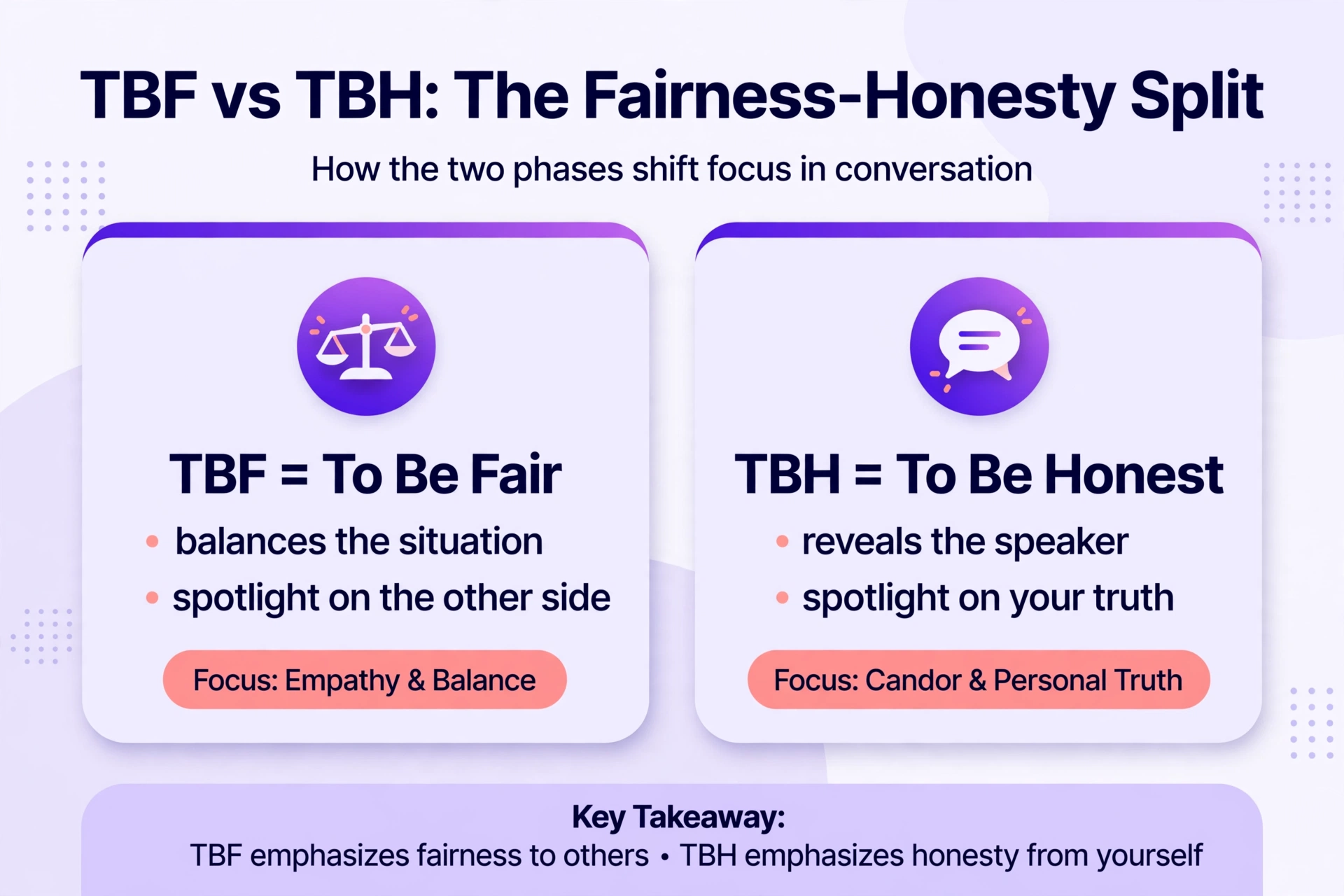
The pair everyone confuses. Both start with "TB," both soften what's coming — but they soften in opposite directions:
- TBH ("to be honest") reveals. It signals that an unfiltered personal truth is coming: "TBH, I didn't enjoy the movie." The spotlight is on the speaker's honesty.
- TBF ("to be fair") balances. It signals that another perspective is coming: "TBF, I was exhausted when I watched it." The spotlight is on the situation's complexity.
Compare them side by side:
- "TBH, you're wrong." → blunt honesty, speaker-centered, can sting.
- "TBF, you might be missing context." → balanced pushback, situation-centered, lands softer.
The practical rule: use TBH when the value is your candor; use TBF when the value is your even-handedness. TBH says "here's what I really think." TBF says "here's what we're not considering." In debates, TBF is the stronger move — it makes you sound thoughtful rather than just opinionated.
Where You'll See TBF: Debates, Comments, and Group Chats
TBF is a creature of discussion more than chat. It thrives wherever opinions collide:
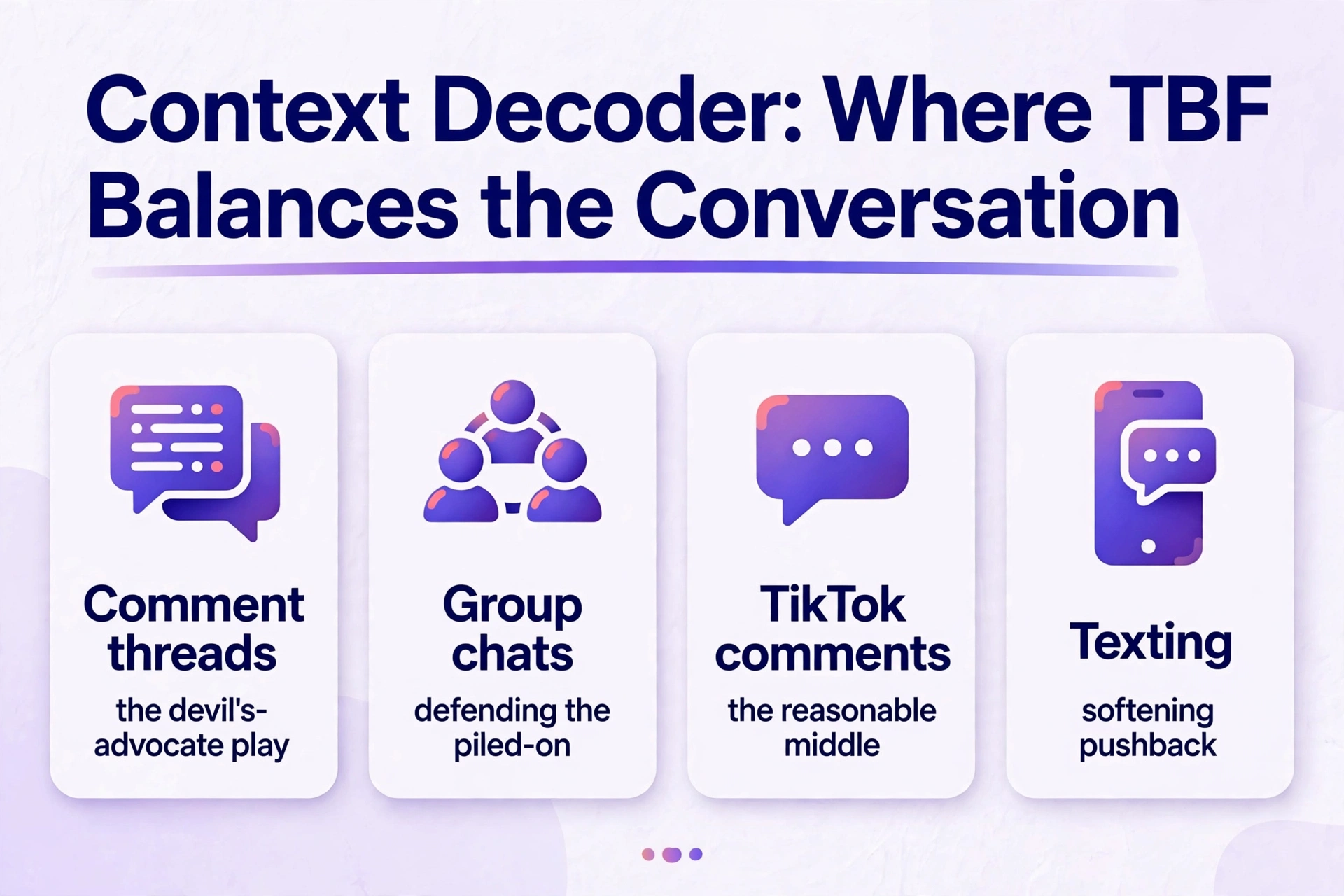
Reddit, X, and comment sections. This is TBF's native habitat. "TBF, pineapple is a pretty delicious fruit" — dropped into a thread where everyone's against pineapple pizza, it's the classic devil's-advocate play. On debate-heavy platforms, TBF is how you disagree without getting ratioed.
TikTok comments. "TBF the editing carried this video" — TikTok TBF usually balances hype or hate in the comments. It's the voice of the reasonable middle in a sea of extremes.
Group chats. "TBF, she did apologize afterward." In groups, TBF often defends someone who's being piled on. It's social mediation in three letters — the friend who says "okay but let's be real" before things go too far.
Discord and gaming chats. "TBF, their comp was just better." Post-match TBF is sportsmanship shorthand: giving credit where it's due instead of making excuses.
Texting (one-on-one). "TBF, I'm not great at texting first 😅" — in private chats, TBF softens self-deprecation or gentle pushback. It's less common here than in public threads, but it works the same way.
Instagram. "TBF this is the best meal I've had all week" — Instagram TBF often balances a lukewarm caption or adds a concession to a hot take in stories and DMs.
Notice the pattern: TBF appears wherever there's an argument to balance, a person to defend, or a take to soften. You won't see it much in pure logistics ("what time?") because there's nothing to weigh.
TBF Tone: Measured, Sometimes Defensive
TBF's default tone is measured and reasonable — that's its brand. But the same three letters can wear different expressions:
Genuine TBF is actual fairness: "TBF, it was their first time performing live." The speaker has considered the other side and means it. This is TBF at its best — generous, thoughtful, disarming.
Diplomatic TBF is conflict management: "TBF, I see where you're coming from." Nobody's mind is being changed here; the TBF is just keeping the peace. Common in group chats and work-adjacent threads.
Defensive TBF is self-protection wearing fairness clothes: "TBF, you always do this." When TBF introduces a counter-accusation rather than a counter-perspective, the fairness is performative. The Scale Test catches this: if the "counterweight" is just blame in a fair-trade costume, it's defensive TBF.
Playful TBF softens a roast among friends: "TBF, your team walked into that one 😂" The fairness framing makes the teasing land as affection, not attack.
The tell is always what follows the comma. Genuine context → genuine TBF. A "but you" → defensive TBF. Read the payload, not the packaging.
Sender Context: Who's Being Fair
From a friend in a debate, TBF is usually genuine: "TBF, the other team played really well too." They're being the reasonable one. Take the concession gracefully.
From a stranger in comments, TBF is debate positioning: "TBF, the data doesn't support that." They're signaling "I'm the rational voice here." Engage with the point, not the posture.
From a partner, TBF often de-escalates: "TBF, I know you've had a long day." That's an olive branch — meet it halfway.
From a coworker in a casual channel, TBF is safe disagreement: "TBF, the client did sign off on the mockups." It's professional enough for work chat because fairness reads as maturity. Still, in formal writing, spell out "to be fair."
From someone you've been arguing with, TBF can be either a genuine concession or a setup: "TBF, you have a point, but—" Watch for the "but." A TBF followed by "but" is often a polite bulldozer.
How to Use TBF in Heated Threads
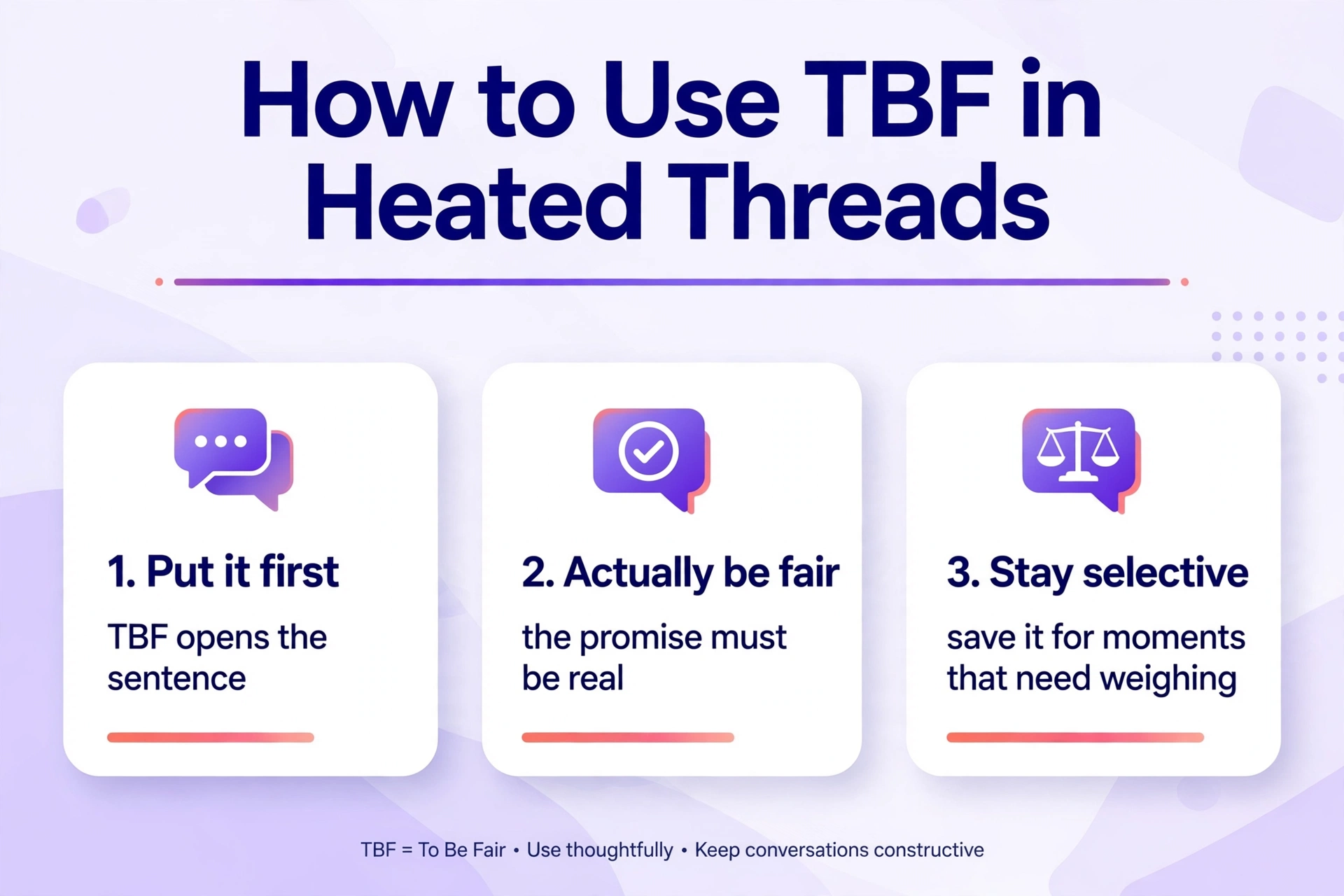
TBF is a precision tool. Three rules for wielding it:
1. Put it first. "TBF, …" at the sentence start is the standard form and reads as intentional fairness. Burying it mid-sentence ("it was fine, tbf") reads as an afterthought and loses half its power.
2. Actually be fair. TBF is a promise — you're claiming the balanced view. "TBF, you're an idiot" breaks the promise instantly and makes you look worse than a plain insult would. The fairness has to be real, or the TBF backfires.
3. Don't TBF every take. Fairness is persuasive because it's selective. If every message starts with TBF, you become the "well, actually" person — technically balanced, socially exhausting. Save it for the moments that need weighing.
Responding to TBF? Acknowledge the counterweight. "Yeah, that's fair" or "True, I hadn't considered that" costs nothing and keeps the thread civil. If the TBF was defensive ("TBF, you always do this"), don't take the bait — address the underlying point, not the framing. And when someone uses TBF to soften honesty, a FR-style direct reply ("fr, good point") keeps things real without escalating.
TBF vs Similar Slang
| Term | Meaning | How it differs from TBF |
|---|---|---|
| TBH | To be honest | Reveals the speaker's truth; TBF reveals the situation's other side |
| IMO | In my opinion | Marks subjectivity; TBF marks balance |
| NGL | Not gonna lie | Casual candor; TBF is measured where NGL is blunt |
| FYI | For your information | Delivers a fact; TBF delivers a perspective |
| IDC | I don't care | Shuts down; TBF opens up. Opposite moves. |
| SMH | Shaking my head | Reacts with disappointment; TBF reacts with consideration |
| WDYM | What do you mean | Asks for clarity; TBF offers it preemptively |
The closest cousin is TBH, and the split is worth memorizing: TBH reveals, TBF balances. If you're about to share an unpopular opinion about yourself, that's TBH. If you're about to complicate someone else's certainty, that's TBF.
When Not to Use TBF
- Formal writing. Essays, reports, cover letters — write "to be fair" in full or restructure. TBF is casual by design.
- When you're not actually being fair. Performative TBF ("TBF, you're wrong about everything") is worse than no TBF. The promise has to be real.
- Serious apologies. "TBF, I didn't mean it" during an apology sounds like you're negotiating the apology. Just apologize.
- With people who don't know it. TBF is less universal than LOL or BTW. With parents, grandparents, or non-native speakers, the full phrase is safer.
- Every single message. Selectivity is the whole power source. Overuse turns fairness into a tic.
Quick Answers
What does TBF mean in text?
TBF means "To Be Fair." It's used to introduce a balanced perspective, a concession, or a counterpoint — for example, "TBF, I was really tired when I watched it."
What's the difference between TBF and TBH?
TBH ("to be honest") reveals the speaker's unfiltered truth; TBF ("to be fair") introduces a balanced perspective on the situation. TBH is about candor, TBF is about even-handedness.
Is TBF rude?
No — it's usually the opposite, a softener. But TBF can sound passive-aggressive if the "fairness" is fake ("TBF, you always do this"). Genuine context keeps it kind.
Can I use TBF at work?
In casual internal chats, yes — it reads as mature and balanced. In formal writing or official statements, spell out "to be fair" instead.
Does TBF ever mean "to be frank"?
No. One secondary source floats it, but no dictionary lists it and there's no real usage behind it. In texting, TBF means "to be fair," full stop.
Where is TBF most common?
In debates and discussion spaces — Reddit, X, TikTok comments, Discord, and group chats — anywhere opinions collide and someone wants to add balance without starting a fight.
TBF is three letters of deliberate reasonableness in a medium that rewards heat. Run the Scale Test — find what it's balancing — and you'll read every "TBF…" exactly as intended. Use it sparingly, mean it genuinely, and it's one of the most socially powerful abbreviations you can type.
