
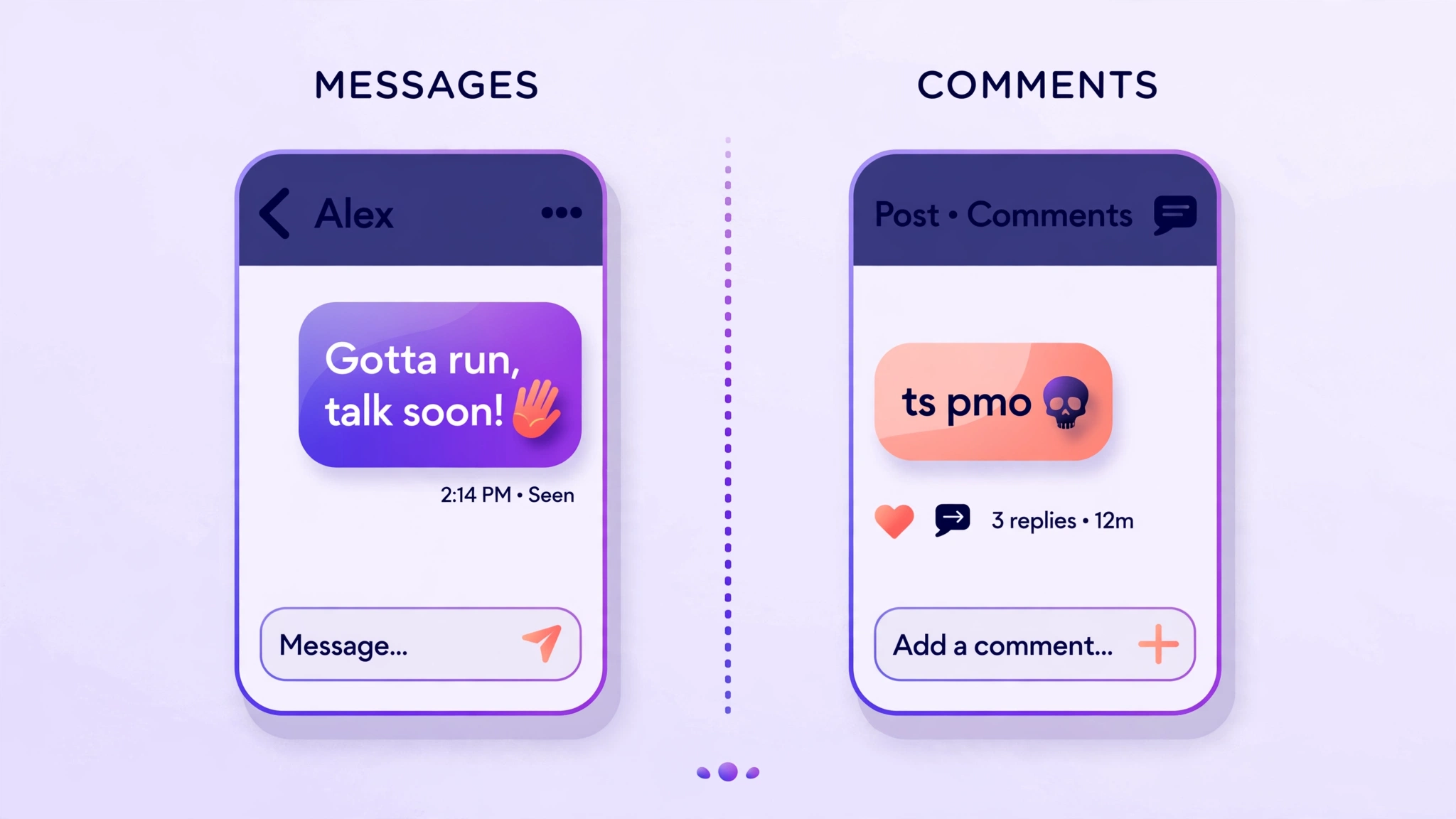
A millennial texts “Gotta run, talk soon!” and abbreviates it “TS.” A Gen-Z commenter writes “ts pmo” under a TikTok. Same two letters, opposite jobs — one is a polite goodbye, the other is an exasperated eye-roll. If you got a “ts” and it made no sense, you probably met the wrong generation’s version.
The ts meaning in text depends entirely on who sent it and where you saw it. This guide covers both worlds: the dominant new TikTok reading, the classic “talk soon” sign-off, the combo grammar (“ts pmo icl”), and a one-question rescue for when you’re not sure which one you got.
The Short Answer
| Question | Answer |
|---|---|
| What it means | Either “talk soon” (classic sign-off) or “this sh*t” / “this” (TikTok slang) |
| What it does | As “talk soon”: a warm goodbye. As “this”: an intensifier for frustration or emphasis |
| How to tell | Sender’s age + platform: texts from older senders = “talk soon”; TikTok/comments from younger = “this” |
| Tone | “Talk soon” is warm; the TikTok reading is comedic, exasperated, or dismissive |
| Where it sits | End of a message (“talk soon!”) vs. mid-sentence (“ts pmo”) |
| Register | Casual only — never work or formal messages |
| Formal alternative | “Talk soon” spelled out, or “this” spelled out |
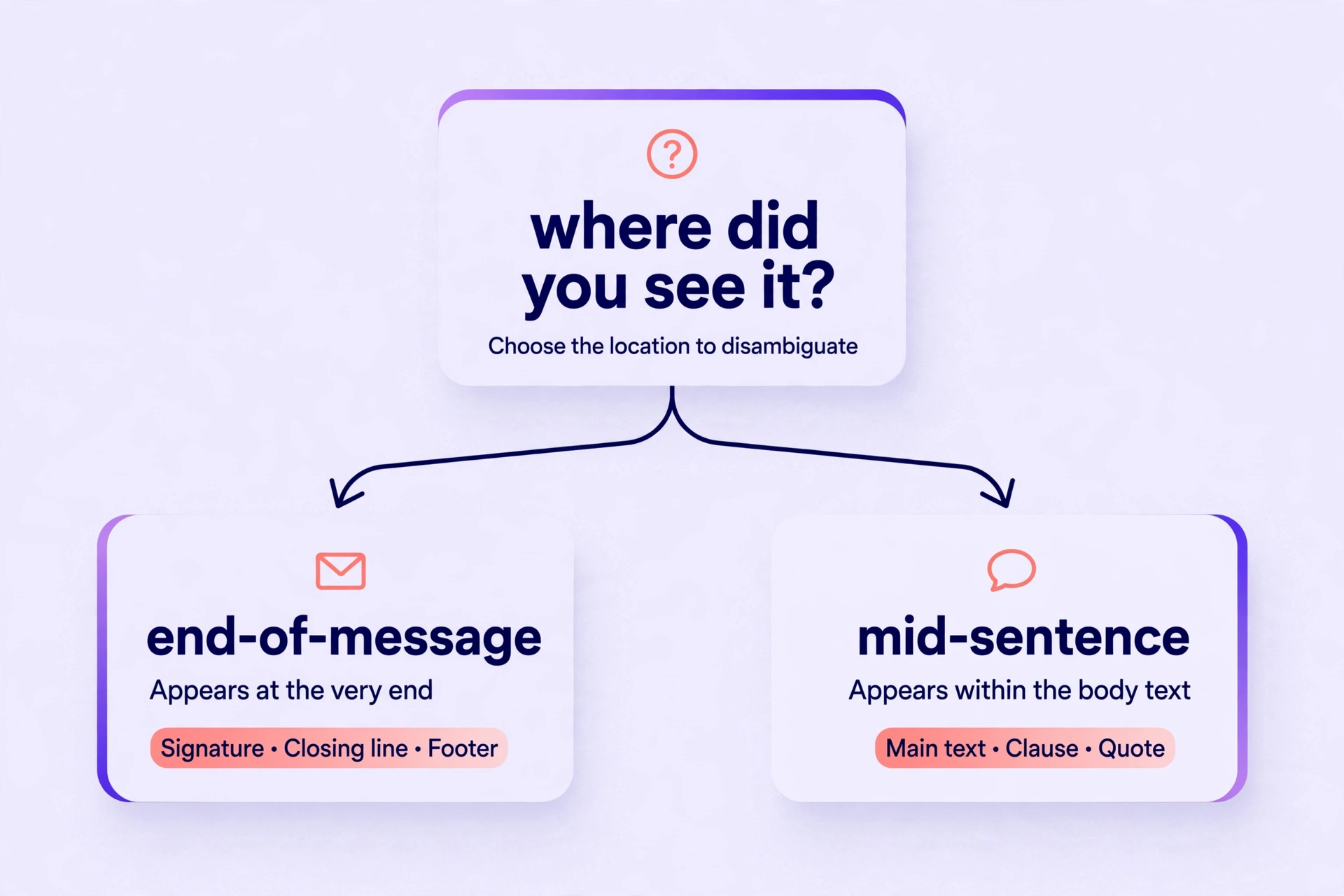
The Disambiguation Frame: Who Sent It + Where You Saw It
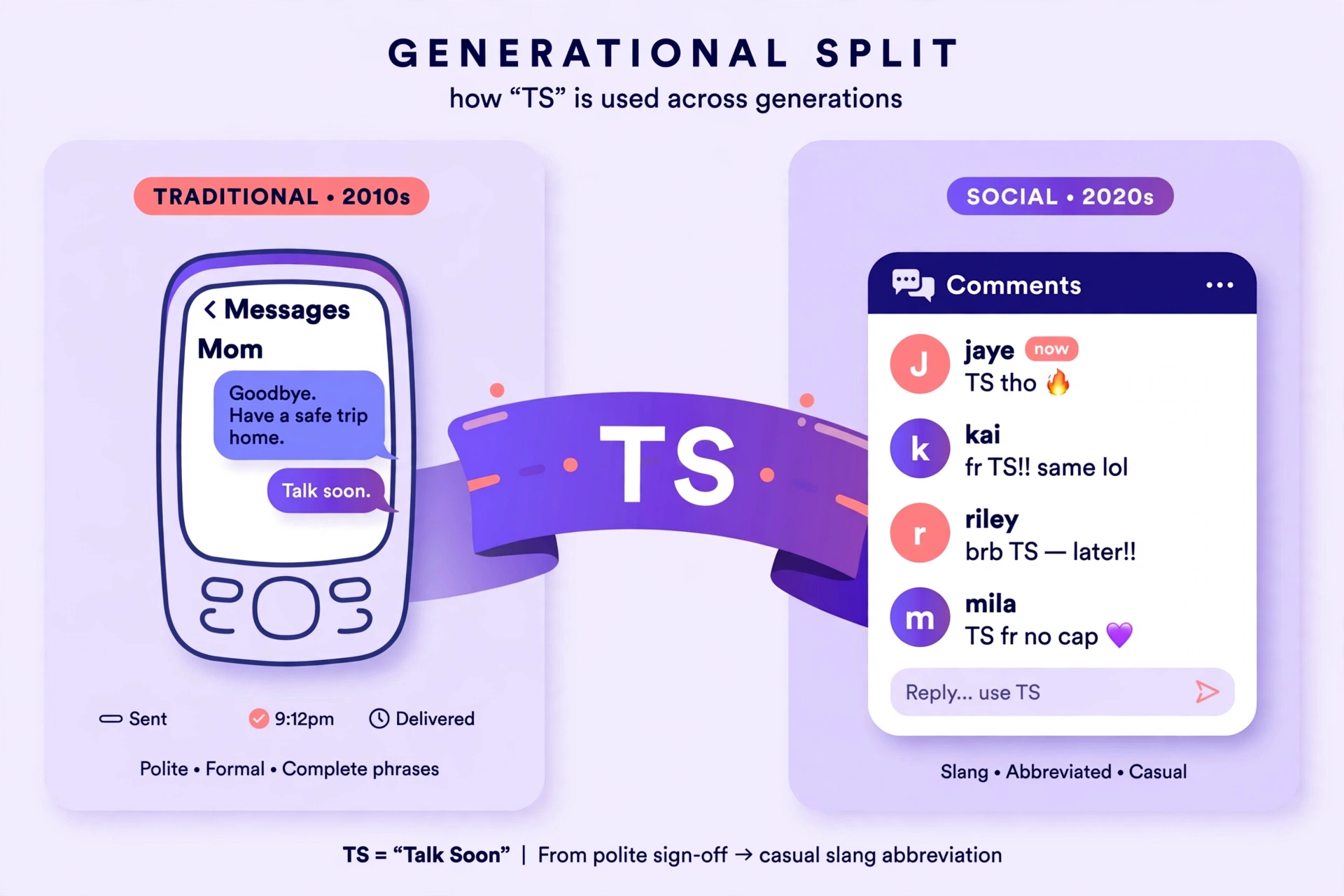
Forget memorizing definitions — TS is a two-question puzzle:
- Who sent it? A parent, a millennial coworker, anyone over ~30 in a text thread: almost certainly “talk soon.” A teenager, a TikTok commenter, anyone under ~25: almost certainly the “this” reading.
- Where did you see it? At the end of a message (“Gotta run, TS!”) — that’s a sign-off, that’s “talk soon.” In the middle of a sentence (“ts pmo”) — that’s the intensifier, that’s “this.”
Those two questions resolve 95% of cases. The remaining 5% — the genuinely ambiguous ones — get the rescue question at the end of this guide.
The “This” Reading: How TikTok Rewrote TS
Sometime in 2024, TS acquired a new dominant meaning on TikTok and in Gen-Z texting: “this sh*t” — usually softened in practice to just “this,” with the edge intact. Know Your Meme’s slang guide puts it plainly: in “TS PMO,” the “TS” means “this sh*t,” making the whole phrase “this sh*t pissing me off.”
In practice, the “sh*t” is more grammatical than literal. “Ts pmo” rarely describes actual anger — it’s comedic exaggeration, the textual equivalent of an eye-roll with a laugh. The “ts” works as an intensifier: it takes “pmo” (piss me off) and cranks the emphasis. You’ll also see it softened to “this” in mixed company, same job, less edge.
Why “ts” instead of “this”? Speed plus emphasis. Two keystrokes instead of four, and the abbreviation itself signals I’m speaking internet — it’s a register marker as much as a shortcut. That’s why spelling it out (“this pmo”) reads slightly off to native users: the abbreviation is part of the voice.
A note on roots. Multiple slang sources trace the TS/PMO cluster to African American Vernacular English, where it lived before TikTok made it mainstream. That’s worth one line of respect: the words you’re stacking for jokes come from a real linguistic tradition. Use them correctly — which this guide teaches — and you’re fine.
The Combo Grammar: “ts pmo”, “ts pmo icl”, and Beyond
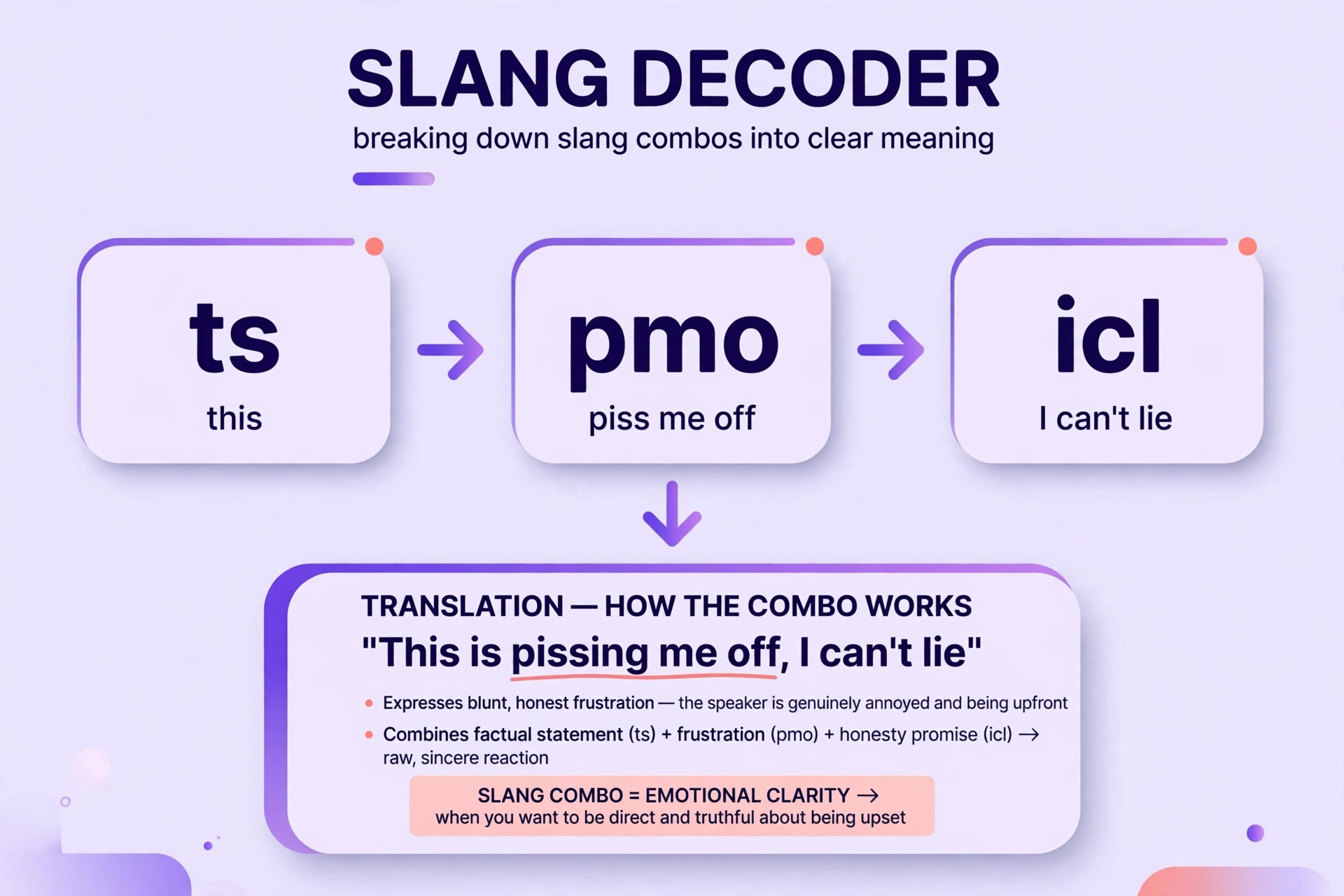
TS rarely travels alone. It stacks with other abbreviations in a combo grammar that went viral in late 2024 and early 2025. Each slot does a job:
- “ts pmo” — “this sh*t pissing me off.” The base combo. Frustration, usually comedic.
- “ts pmo icl” — adds “icl” (I can’t lie): “this sh*t pissing me off, I can’t lie.” The “icl” is a sincerity stamp — I’m being real about this.
- “icl ts pmo” — same parts, reordered. Word order is flexible; emphasis shifts slightly to the honesty.
- “icl ts pmo sm” — adds “sm” (so much): the maximalist stack. Each addition is one more gear of exaggeration.
The stacks are deliberately excessive — that’s the joke. Nobody needs four abbreviations to say they’re annoyed; the pile-up is the humor. Which leads to the satire layer: people now deliberately stack TS wrong (“delete ts sh*t before you pmo off”) as a meme about people who stack it wrong. If you see a stack that makes no grammatical sense, it might be the joke, not a mistake. Welcome to slang in 2025.
“Talk Soon”: The Classic Reading Is Still Alive
Before TikTok, TS had a perfectly good meaning, and it hasn’t gone anywhere: “talk soon.” The warm sign-off. “Gotta run, talk soon!” “TS!”
This is the safe reading for:
- Texts from parents, older relatives, millennial friends
- The end of a conversation (“ok gtg, TS!” — or “brb, talk soon!” when they’re actually just stepping away)
- Anyone who types in complete sentences and uses proper punctuation
The tell is position and punctuation. “Talk soon” almost always appears as the full phrase or at the very end of a message, often with an exclamation mark or a wave emoji. “Gotta run, talk soon!” and “ts pmo” don’t just mean different things — they don’t even look like the same species. The exclamation mark is doing disambiguation work: nobody writes “ts pmo!” because the combo grammar doesn’t take that punctuation.
If your mom texts “TS!” she’s not being edgy. She’s being a mom. Read the sender.
The Dismissive Edge: “Tough Sh*t”
One more reading, vulgar-adjacent and worth knowing so you can recognize it: “tough sh*t” — the dismissive shrug. “I lost my charger” → “ts, buy a new one.” It’s the textual equivalent of a shrug with an edge: that’s your problem.
This one is always dismissive, never playful. The difference from the TikTok “this” reading is the target: “ts pmo” is annoyed at a situation (usually comedically); “tough sh*t” is dismissive of a person. If someone aims it at you, that’s not banter — that’s cold. The reply is either a boundary (“not cool”) or disengagement, not a lol.
TeamSpeak and TypeScript: The Niche Readings
Two more meanings exist in narrow contexts:
TeamSpeak — the gaming voice-chat platform, big in the 2000s and 2010s. “Hop on TS” in a gaming lobby means the app, not the slang. Fading as Discord ate its lunch, but still alive in older gaming communities.
TypeScript — the programming language. “This project is in TS” in a dev chat is never slang. Context is absolute here: if the conversation is about code, it’s the language.
Neither of these will ever appear in a TikTok comment or a goodbye text. They’re context-locked, and the lock is obvious.
The Rescue Question: “ts as in?”
For the genuinely ambiguous 5% — the text from someone whose age you don’t know, the comment with no context — there’s a one-line rescue, and it comes recommended by the slang guides themselves: just ask.
“ts as in?” — four characters, zero embarrassment. It signals I know it’s slang, I just don’t know which slang, which is the exact right amount of knowledge to admit — and it works like “lmk” (short, clear, nobody thinks twice). Native speakers answer happily (“talk soon!” / “this sh*t lol”) because everyone knows the letters are overloaded.
What not to do: don’t guess out loud and get it wrong (“haha yeah talk soon!” under a “ts pmo” comment). The guess reveals more than the question does. Asking is the smooth move.
TS in Real Conversations
The exchanges below are illustrative examples, not real messages.
The millennial sign-off
Classic TS. Warm, punctuated, at the end. No ambiguity — unless you’re Gen Z reading your mom’s texts.
The TikTok comment
- Video: someone’s alarm fails, they’re late, chaos ensues
- Comment: “ts pmo”
Translation: “this sh*t pissing me off” — except it’s not anger, it’s comedy. The skull emojis mark it as I’m laughing at this disaster. This is the dominant 2025 usage.
The combo stack
- Sam: “icl ts pmo sm rn”
- Riley: “what happened??”
- Sam: “nothing, just my wifi”
“I can’t lie, this sh*t is pissing me off so much right now” — about wifi. The stack’s excessiveness is the joke; Riley correctly reads it as venting, not crisis.
The ambiguous one
- Alex: “hey, ts?”
- Casey: “ts as in?”
- Alex: “talk soon! just heading out”
The rescue question in action. Four characters, problem solved, nobody embarrassed. (Casey could also have opened with “wtw?” — but “ts as in?” gets the specific answer faster.)
Quick Answers
What does TS mean in text? It depends on the sender: “talk soon” (classic sign-off, common with older texters) or “this sh*t” / “this” (TikTok slang, common with younger users). Check who sent it and where it appeared.
What does “ts pmo” mean? “This sh*t pissing me off” — usually comedic exaggeration rather than literal anger. The skull emoji usually marks it as a joke.
What does “ts pmo icl” mean? “Ts pmo” plus “icl” (I can’t lie): “this sh*t pissing me off, I can’t lie.” The “icl” adds a sincerity stamp.
Is TS a bad word? The “talk soon” reading is completely innocent. The TikTok “this sh*t” reading contains profanity, so keep it out of work chats, school, and messages to parents or teachers.
What does TS mean from a guy / from a girl? Gender doesn’t decide it — generation and platform do. A “ts” at the end of a goodbye text is “talk soon” regardless of who sent it.
What does TS mean on TikTok? “This sh*t” (often softened to “this”) — an intensifier, usually in combos like “ts pmo.” It’s the dominant meaning on TikTok and in Gen-Z comments.
Does TS mean TeamSpeak? In gaming lobbies, yes — “hop on TS” means the voice-chat app. Everywhere else, no.
How do I ask what someone meant by “ts”? “ts as in?” — it’s the smooth, native-speaker move. Everyone knows the abbreviation is overloaded.
The Short Version
TS is two abbreviations wearing one trench coat: “talk soon” (the classic sign-off, alive and well with older texters) and “this sh*t” (the TikTok intensifier, dominant with younger users). Who sent it and where you saw it decides — end-of-message with an exclamation mark is a goodbye; mid-sentence in a comment is the meme. Learn the combo grammar (“ts pmo icl”), respect the AAVE roots, and when in doubt, ask: “ts as in?”
