
You are chatting with someone new, the conversation is going well, and then a single message lands: “wyll?” If you have ever stared at those four letters and wondered what you are actually being asked, you are asking the right question, because the wyll meaning in text is not quite what it looks like. On the surface it is a simple question. In practice it is usually a request for a photo, and knowing the difference changes how you should answer it.
WYLL stands for “what you look like,” a compressed version of “what do you look like?” with the “do” dropped, the way texting drops filler words. It shows up when two people have been talking through usernames and screens without a face attached, and one of them wants to fix that. Sometimes the sender would accept a written description. Almost always, they are hoping for a picture. This article explains the meaning, the moment it turns awkward, and a simple test for telling curiosity from screening, plus exactly what to say in each case.
What WYLL Actually Means
The letters are straightforward: W for what, Y for you, L for look, L for like. The question is a direct ask about appearance, and it lives almost entirely in private chats rather than public posts: Snapchat DMs, Instagram messages, dating app chats, and plain text threads between people who have not met in person. You will see it written as WYLL in all caps in definitions and as lowercase wyll in actual messages; the capitalization does not change the meaning. Most people say it out loud as “will” or simply spell out the letters.
What matters more than the letters is the unspoken part. When someone asks WYLL, the expected answer in most cases is a selfie or a recent photo, not a paragraph of description. That expectation is rarely stated, which is why the message can feel confusing: you were asked a question, but you sense you were actually asked for something else. You were. A description is a valid answer, and this article will show you how to give one, but do not pretend the photo expectation is not there. Naming it is the first step to handling it well.
WYLL belongs to a family of compressed questions that all start with WY. WYD asks what you are doing, WYA asks where you are, and WYO asks what you are getting into, and the guide to wyo meaning in text shows how that cousin works. WYLL stands out from the family because it is the only one asking for something visual and personal about you. WYD asks about your activity, WYA asks about your location, and WYLL asks you to reveal yourself. That is why it carries more social weight than the others, and why it gets a reaction that “wyd?” simply does not.
Two honesty notes about sourcing belong here. First, Wiktionary has no entry for wyll, so this article does not pretend a dictionary blesses the term. The documented record is user-generated: the first verifiable public definition appeared on Urban Dictionary in April 2022, and slang pages documented citations from 2023 and 2024, when mainstream visibility peaked. Those dates describe when the term was documented, not when it was invented. Second, the old version of this article described WYLL as commonly used and popular, claims this update withdraws, because no usage study supports them. The term is documented and recognizable; that is all the evidence allows us to say.
Run the Mirror Test
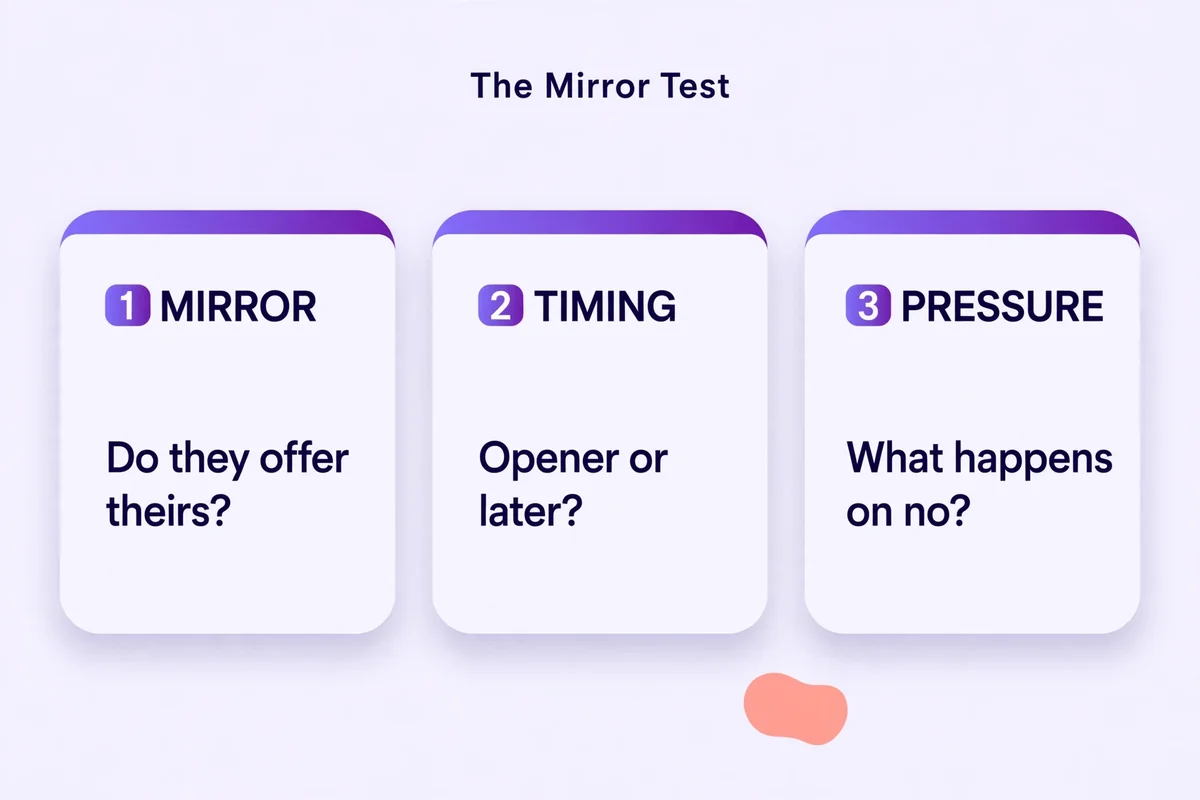
Here is the tool this article is built around. When WYLL arrives, hold it up to a mirror and check three signals before you answer. The signals are mirror, timing, and pressure, and together they tell you whether you are looking at curiosity or screening.
Signal one is MIRROR. Has the sender shown themselves first, or offered to? A mutual exchange, “want to swap pics?”, is a different message from a one-way request, even though both use the same four letters. If the sender’s profile already shows their face, or they send a photo unprompted alongside the question, the mirror is balanced. If they are faceless and asking you to be the first and only face in the conversation, the mirror is one-way, and one-way is the shape screening takes.
Signal two is TIMING. When in the conversation did WYLL arrive? After days of real back-and-forth, it reads as a natural next step, the moment when two people who like talking decide they would like to see each other. As the opening message, or within the first few exchanges, it reads as a filter applied before any conversation has happened. The same question, the same letters, and a completely different meaning, decided by timing alone.
Signal three is PRESSURE. What happens when you deflect? A curious person accepts a description, a joke, or a “let’s talk a bit more first” without a fuss. A screening person pushes: they repeat the question, add “wyll tho” for emphasis, or vanish the moment they do not get a photo. Pressure is the most reliable signal of the three, because it is the only one that shows you what the sender does when they do not get their way.
Put the signals together on three common cases. Balanced mirror, late timing, no pressure: curiosity, and you can answer however you like. One-way mirror, opener timing, no pressure yet: appearance-first interest, and you owe it nothing until the conversation earns it. Any mirror, any timing, pressure on deflection: screening, and the right answer is a boundary, not a photo. The test does not read minds; it reads behavior, and behavior is the only evidence you actually have.
Two contrasts sharpen the test. HMU is an open invitation to contact, a door held open, while WYLL is a request to inspect, and the guide to hmu meaning in text shows how that invitation works. And if the sender already has your profile picture in front of them, check the guide to pfp meaning in text before deciding whether they are asking about a photo they could already see.
The WYLL Warrior Problem
No WYLL article is complete without the phrase that grew up around it, because the phrase is how the internet named the problem. A “WYLL Warrior” is someone who treats WYLL as a screening tool rather than a conversation, and the label has two related senses, both uncomplimentary.
In the first sense, the WYLL Warrior adds you, immediately sends WYLL, and then disappears after seeing your photo, unadding or blocking you once they have the information they wanted or have decided they are not interested based on your appearance. In the second, broader sense, the WYLL Warrior mass-adds strangers and sends WYLL as the only opening message, sometimes to dozens of people at once, leading entirely with appearance before even saying hello. Both senses share the same critique: the person treats appearance as the first and sometimes only priority, skipping past the human being on the other side.
Why does this matter for a reader who just wants a definition? Because the backlash is part of the word’s story now. When WYLL arrives as an opener, many recipients hear the pattern, not the letters, and answer the pattern. Senders who do not know the pattern get confused by cold responses; receivers who know it get tired of explaining why a four-letter opener feels off. Knowing the label helps both sides.
One clarification matters. The meaning of WYLL is the same regardless of who sends it; there is no secret gender-specific meaning. What changes with the sender is the social context around the message, and context is already covered by the Mirror Test. Do not let anyone tell you the letters mean one thing from one person and another from someone else. They mean one thing. The timing and the pressure decide how that thing lands.
WYLL on Snapchat, Instagram, TikTok, and Dating Apps
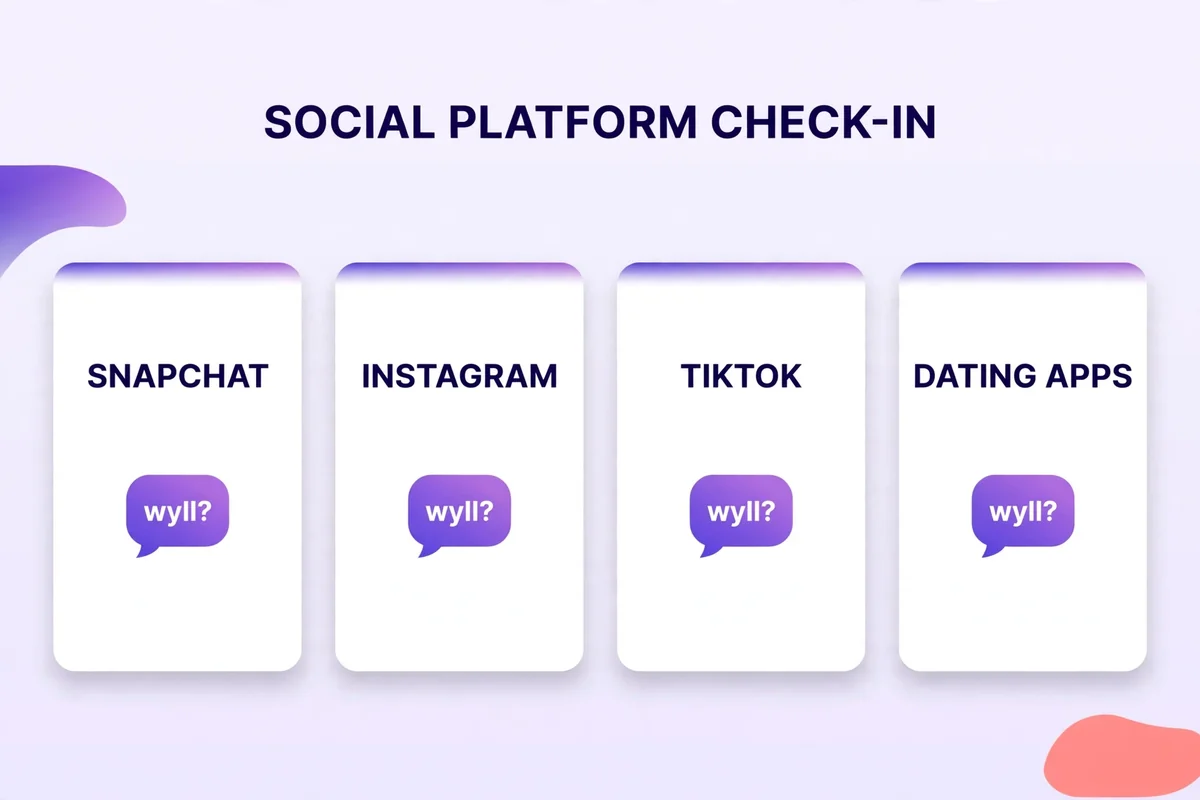
The meaning does not change from app to app. The expected answer format and the social cost of refusing do, and that is what this section maps. No platform gets its own invented definition here, because no source supports one.
Snapchat is WYLL’s natural home, and the reason is structural. The app is built around photos that disappear, so asking “what do you look like?” on an app where every message can be a photo feels almost built in. On Snapchat, WYLL almost always expects a snap back, a quick selfie rather than a description, and it often arrives right after a new add, before any real exchange. That combination is exactly why the WYLL Warrior label stuck to Snapchat first.
Instagram DMs work differently. The question usually comes from a new follower or someone in a comment thread, and because Instagram profiles often already show photos, a WYLL there can mean the sender wants something more recent or more casual than the curated profile shots. It tends to read as more direct and less meme-like than TikTok, and a refusal costs less socially, because the conversation is not built on disappearing photos.
TikTok is where WYLL gets joked about most. It shows up in comments and DMs, often performatively: reaction videos and comedy about receiving WYLL messages turned the opener into a meme format, and meme replies, like answering with a photo of a pet, are common. That does not make TikTok WYLL harmless by default, but it is more likely to be a joke than a Snapchat one, and the Mirror Test still applies either way.
Dating apps are the odd case. Profiles already include photos, so WYLL is less common there, and when it appears it usually means the sender wants more recent or unfiltered photos beyond the curated set. That is a request worth weighing carefully, because it asks you to step outside the presentation you chose. A description is the weakest answer here: the sender has already seen pictures, so what they want is specifically more pictures.
WYLL lives in direct messages above all. It is rarely in videos or hashtags, and it is not a public-post format. If you are wondering whether a WYLL you saw was meant for you, check the room first: a DM is a request, a comment is often a performance, and the two deserve different answers. The guide to dm meaning in text explains the room itself, and it is worth reading if DMs are where most of your WYLLs arrive.
Variants: Wyll Tho, Age WYLL, and BTW WYLL
WYLL has grown three common variants, and each one adjusts the pressure without changing the meaning. Knowing them keeps you from being surprised by a version you have not seen before.
Wyll tho, or “wyll though,” is the most common variant, and the “tho” adds emphasis somewhere between curious and insistent. It often shows up mid-conversation, when someone has been holding back from asking and finally decides to go for it. A casual “we’ve been talking for two weeks, wyll tho lol” reads as genuine curiosity with the edge softened. A bare “but wyll tho” after you have already deflected reads as pressure, and the Mirror Test’s third signal is the one that catches it.
Age WYLL, written “age wyll” or “age and wyll?”, combines two requests in one message: your age and your appearance. It is most common on anonymous platforms or in quick-add scenarios where the sender has no profile picture or bio to reference. This combination deserves more caution than either question alone, especially from a stranger. You are never obligated to answer both at once, or either at all, and asking why they need that information before responding is a reasonable move, not a rude one.
BTW WYLL frames the question as a casual aside: “by the way, what do you look like?” The “btw” makes it feel offhand, as if the sender thought of it mid-message. It usually feels less forward than a standalone WYLL, but the underlying request is identical, and the same three signals apply. Do not let a casual frame talk you into an answer you would not give to the direct version.
Not That Wyll: A Game Character, a Spelling, and a Contested Reading
Three lookalikes cause confusion, and clearing them up takes one short section. First, the game character: Wyll Ravengard is an origin character in Baldur’s Gate 3, the 2023 role-playing game, a warlock known as the Blade of Frontiers. If you see “Wyll” next to words like warlock, companion, or Faerun, that is the character, not the slang term. If you see it in a text or DM next to Snapchat or TikTok, that is the slang. Same spelling, separate conversations.
Second, the stylized spelling: some people write “wyll” as a playful spelling of “will,” as in “I wyll call you later.” This usage exists on a few pages, but it is far weaker than the main meaning, and it is easy to tell apart, because it sits inside a sentence where “will” fits grammatically, not alone as a question. Treat it as a footnote.
Third, the contested reading: two low-authority pages claim wyll mainly means “will you,” as in “wyll hang out later?” That reading runs against the consensus of every stronger source, and no dictionary or slang database backs it as the primary meaning. This article mentions it once, here, so that a reader who meets it elsewhere knows it is contested, and then sets it aside. Do not use “will you” as your default reading of WYLL; the evidence does not support it.
How to Reply to WYLL
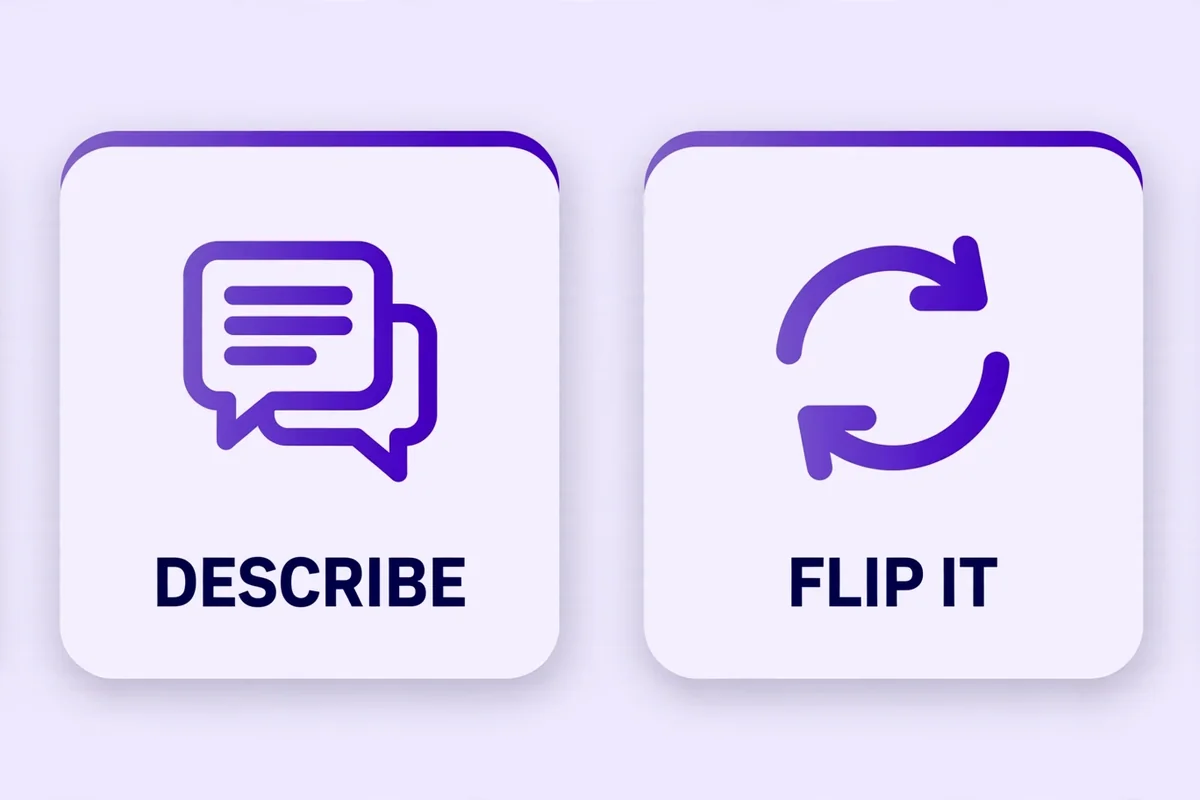
You have four good moves, and the right one depends on your comfort, not on what the sender expects. There is no fifth move in which you owe a photo to someone you barely know, and any guide that implies otherwise is selling you something.
If you are comfortable, send a recent photo you are happy with, or share a profile where your photos already live. Keeping it casual works better than a formal headshot, and on Snapchat this is the expected flow: you send a snap, they usually send one back. Only send what you would be comfortable seeing forwarded, because once a photo leaves your phone, you do not control where it goes.
If you would rather not share a photo yet, describe yourself in a few words. Something like “tall, dark hair, usually holding a coffee” answers the question without handing over an image, and it keeps things personal rather than transactional. This is also a soft way of signaling that you are not ready for photos yet, without making a big deal of it. Honesty helps here more than cleverness, and the guide to tbh meaning in text shows how directness reads when you want to be clear.
If you want to flip it, ask first: “You go first!” This is low-pressure, it shows you are not going to be a pushover, and it filters out screening senders immediately, because they tend to lose interest when the exchange becomes two-sided. A playful non-answer works the same way between friends: a joke, a meme, or a celebrity you have been told you look like buys you time and shows personality.
If you are not comfortable, say so directly or redirect. “I prefer not to share photos until I know someone a bit better” needs no further explanation. “Let’s talk a little more first” is a complete answer. And if the message came out of nowhere from a stranger, ignoring it, changing the subject, or blocking entirely are all valid choices. The guide to ttyl meaning in text covers the redirect move in detail, and the guide to brb meaning in text covers the short pause, but neither is a substitute for a boundary when you need one. If someone pushes hard after you have declined, that tells you something useful about them, and the useful thing is to stop engaging.
Quick Answers
What does WYLL mean in text?
WYLL stands for “what you look like,” a compressed form of “what do you look like?” It is a request for a photo or a physical description, used mostly in private chats and DMs between people who have not met in person. In practice, the expected answer is usually a photo.
Is WYLL rude?
Not always, but it can feel rude depending on timing. After a real conversation, it reads as natural curiosity. As an opening message from a stranger, it often reads as shallow or presumptuous, because it puts appearance before any conversation. The Mirror Test in this article tells you which case you have.
What is a WYLL Warrior?
A WYLL Warrior is someone who uses WYLL as a screening tool. In one sense, they add you, send WYLL immediately, and disappear after seeing your photo. In the broader sense, they mass-add strangers and send WYLL as their only opening message. Either way, the label is not a compliment.
Do I have to send a photo if someone asks WYLL?
No. You are never obligated to send a photo or a description to anyone, no matter how long you have been talking. A written description, a playful flip, a direct decline, or no reply at all are all valid answers.
What does “wyll tho” mean?
“Wyll tho” is a more insistent version of WYLL, closer to “but seriously, what do you look like?” The “tho” adds emphasis, and after a deflection it reads as pressure rather than curiosity.
What does WYLL mean in Baldur’s Gate 3?
Nothing to do with the slang term. Wyll Ravengard is a playable warlock character in Baldur’s Gate 3, known as the Blade of Frontiers. If the context is gaming, that is the Wyll you are looking at.
Final Thoughts
WYLL is four letters that ask for more than they say. The question on the surface is “what do you look like?” The question underneath is “will you show me?” The Mirror Test exists to keep them separate: check whether the exchange is mutual, check when it arrived, and check what happens when you deflect. Those three signals will tell you more than the letters ever will.
Two habits will serve you well. If you are sending WYLL, earn it first: have a real conversation, show yourself too, and accept a description or a decline without pushing. If you are receiving it, answer from your comfort, not from their expectation, and let a boundary be a complete sentence. A photo is a gift, not a toll, and the conversations worth having are the ones that do not charge it at the door.
