
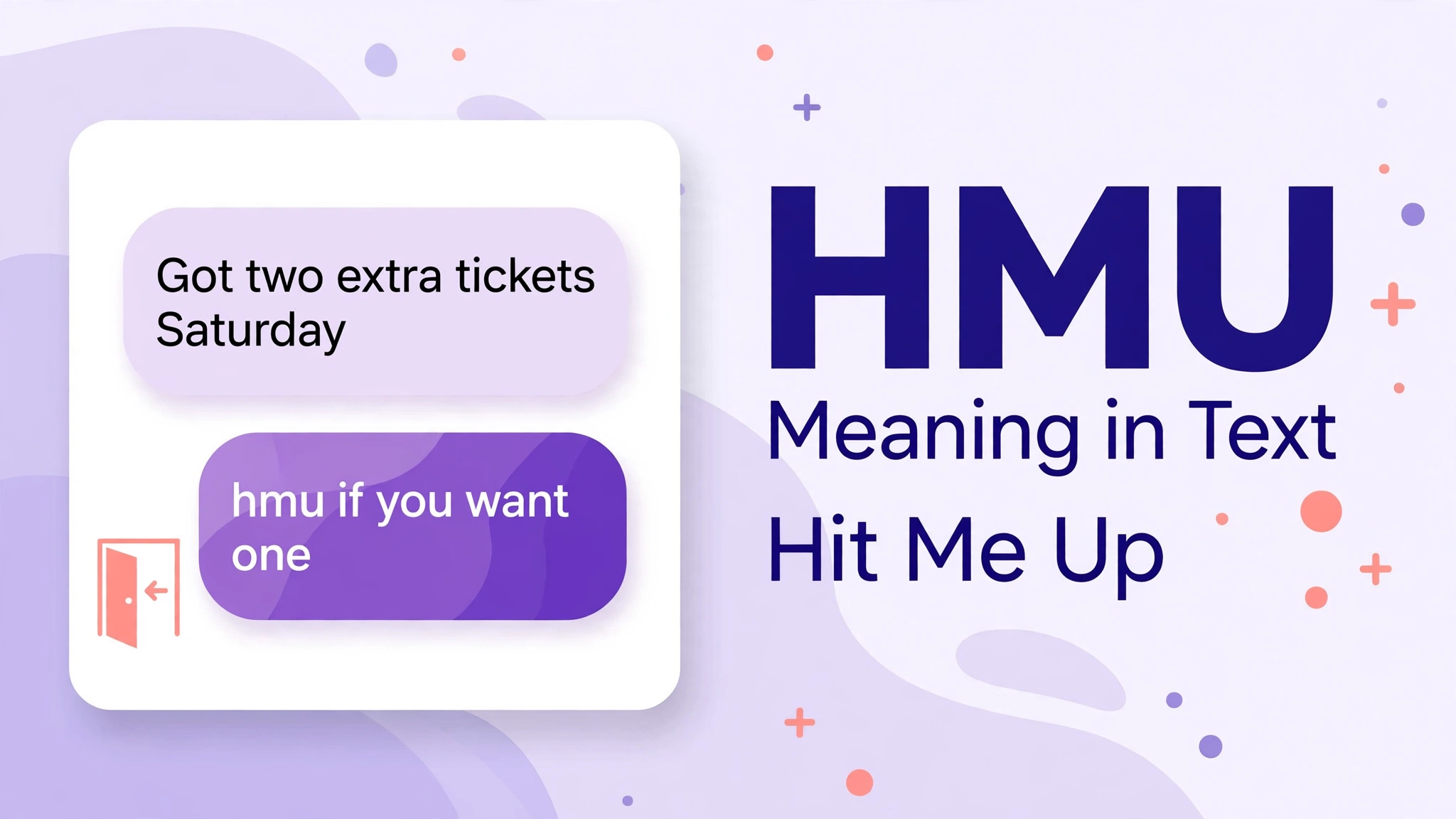
"hmu when you're free." Three letters, zero pressure, one open door. If you've ever wondered about the hmu meaning in text, here it is: HMU stands for "hit me up" — internet shorthand for "contact me when you're ready." It's an invitation, not a demand, and that distinction is the whole game.
What Does HMU Actually Mean?
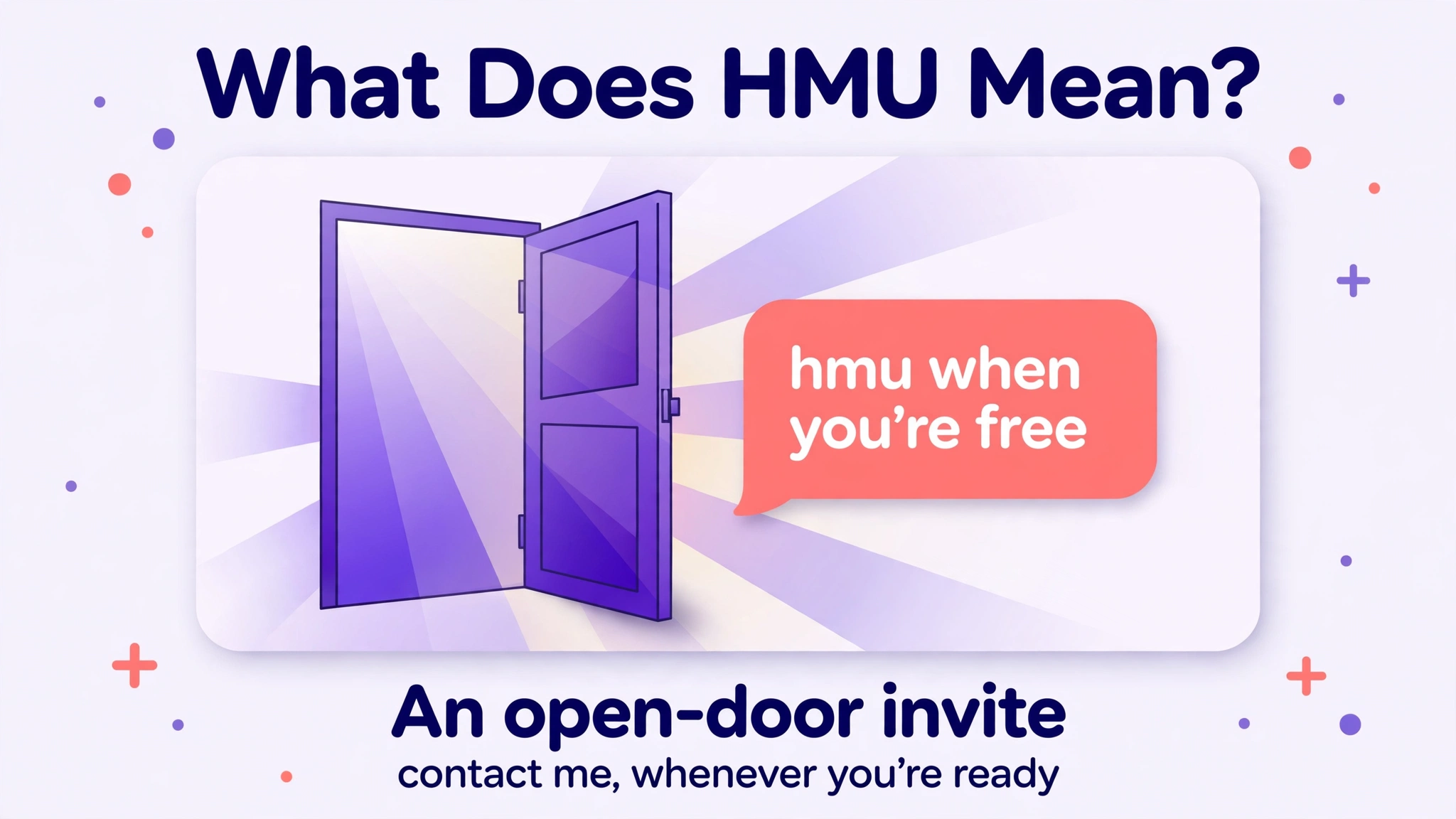
HMU means "hit me up" — a casual invitation to get in touch. The "me" is the sender, the "up" is just flavor, and the "hit" means text, call, DM, or snap — whatever channel you two normally use.
In action:
Jordan: Got two extra tickets for Saturday. Hmu if you want one.
You: Yes!! I'll text you after work.
Priya: hmu when you're done with class, need your opinion on something
You: Free at 4, calling then.
Notice what HMU is doing in both exchanges. It's not asking for anything right now — it's handing you the next move. "Hit me up" means the ball is in your court, on your schedule. That's what separates it from "wyd" ("what you doing") texts — those want an answer now, a tap on the shoulder, while HMU is a note slipped under the door for whenever.
One secondary reading, honestly graded: "hook me up" — as in, set me up with a favor, a deal, tickets, or an introduction. "Hmu with that discount code" leans this way. It's real but secondary: no dictionary headword, always decided by context. If there's a favor in the sentence, it's "hook me up"; if there's just an invitation, it's "hit me up." Either way, the door is open.
And the joke reading — "hold my unicorn" — is exactly that, a joke from an old internet spoof about how many meanings acronyms can carry. Funny, not a definition.
The Next-Move Test: Who Has the Ball?
Here's the named trick that makes every HMU exchange readable — call it the Next-Move Test. HMU means the sender just handed you the next move. So look at your own reply and ask: did I keep it moving?
- You propose something specific — a time, a method, a question: "free after 6, want to grab dinner?" / "still got those tickets?" → the door stays open. Conversation lives.
- You reply "ok" and nothing else → the HMU dies with it. Not rudely — just physically. An open door with nobody walking through it closes on its own.
That's the entire mechanics of HMU: it's an invitation that only works if the invitee moves. Score any HMU exchange in five seconds — who has the ball, and did they keep it moving? Most "hmu didn't work" stories are really "I said 'ok' and the plan evaporated" stories.
This test also explains why a bare, standalone "hmu" so often goes nowhere. With no reason, no condition, no context attached, the recipient has nothing to move toward. "Hmu" alone is a door with no room behind it. Always give people something to walk into: a reason, a timeframe, a topic.
HMU's Contact-Term Constellation: LMK, WYD, TTYL, and DM Me
HMU doesn't live alone — it's part of a small family of contact-management terms, and knowing the family makes each member clearer. No other article in this batch maps the full constellation, so here it is:
HMU vs LMK: the canonical pair. Documented by slang lexicographers as the key contrast: LMK asks for an answer, HMU asks for contact. "Lmk if you're coming" wants a yes or no. "Hmu when you're free" wants you, whenever. LMK closes a question; HMU opens a channel. They stack beautifully: "lmk if you're interested, hmu anytime."
HMU vs WYD: now vs whenever. "WYD" ("what you doing") wants a reply right now — it's a tap on the shoulder. "HMU" is a note slipped under the door: read it whenever, respond whenever. If someone texts "wyd" they're standing at your door; if they text "hmu" they left it unlocked for later.
HMU vs TTYL: mirror images. TTYL ("talk to you later") ends a conversation gracefully. HMU begins one eventually. One closes the door softly; the other leaves it open.
HMU vs "DM me" / "text me": the specificity ladder. "DM me" names the channel. "Text me" names the channel and the medium. "HMU" names nothing — deliberately. That vagueness is the point: it's the lowest-pressure invite in the family, which is why it works for everything from concert tickets to crushes.
Learn the constellation and you'll never misuse one for another: LMK for answers, WYD for now, TTYL for later, DM-me for the channel, and HMU for the open door.
Where You'll See HMU: TikTok, Snapchat, Instagram, and Texting
The meaning never changes across platforms — only the channel does. Here's the documented landscape:
Texting (SMS, WhatsApp, iMessage). HMU's home turf. In one-on-one texts it's the classic soft invite: "hmu when you're free," "hmu if you change your mind." In group chats it becomes a broadcast: "got extra tickets, hmu" — first come, first served, no pressure on anyone specifically. The group-chat version is HMU at its most efficient.
Snapchat. Snapchat is arguably HMU's second home. The app's whole design is ephemeral contact, so "hmu" fits natively: "hmu on snap," "streaks hmu." Here it often means "add me / message me here," and the expected response time is fast — Snapchat HMU is the least patient flavor, because the platform itself is impatient.
Instagram DMs. In DMs, HMU does networking and social duty: "hmu if you're in LA this weekend," "collab? hmu." It's the polite cold-open of Instagram — warmer than "DM me" (which can read transactional), because the vagueness softens the ask. Story replies are a common delivery vehicle: react to a story, add "hmu sometime," door opened.
TikTok. On TikTok, HMU lives in comments and captions, and it's the most public flavor: "hmu if you were at this concert 😭" under a video, "part 2? hmu" as engagement bait. Creators use it to convert viewers into followers; commenters use it to find their people. Same invitation, performed on a stage.
One pattern across all four: HMU always includes an implicit "whenever." The moment someone needs you now, they stop saying HMU and start saying "call me." That "whenever" is the word to listen for.
HMU Tone Decoder: Friendly, Flirty, or Just Logistics?
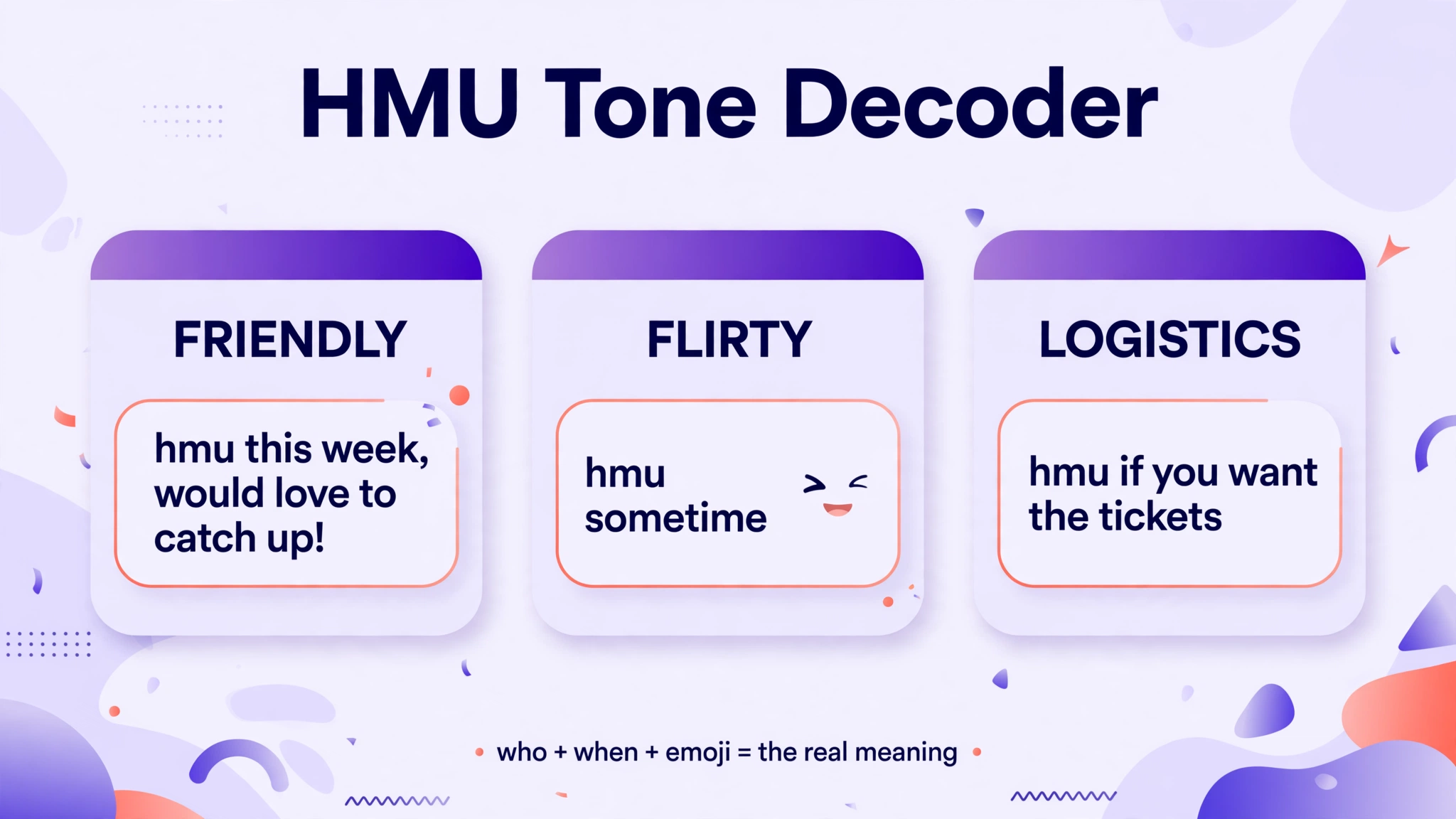
Three letters, three very different energies. HMU's tone is never in the letters — it's in the who, the when, the what-around-it, and the where. Here's the decoder:
Friendly HMU is the default: a genuine, low-pressure invite with real content around it. "Hmu when you're free this week, would love to catch up!" Exclamation marks, specific timeframes, warm context — this is a friend who means it. Respond like a friend.
Logistics HMU is the transactional one: tickets, plans, favors, coordination. "Hmu if you want the tickets, going fast." No warmth, no chill — just information with a door attached. The correct response is equally transactional: yes/no, then details. Don't read romance into logistics; don't read coldness into efficiency.
Flirty HMU is the one everyone asks about, so let's be honest about the evidence: a late-night "hmu" from a crush, especially with a 😉 or on Snapchat at 1 a.m., tends to carry intent. But — and this is the evidence-graded part — it's a tendency, never a rule. The signals are sender + timing + emoji + platform, taken together. One signal alone (it's late!) proves nothing. Three together (crush + 1 a.m. + 😉) is a pattern worth noticing. The article's position: read the pattern, not the letters.
Dry HMU is the blunt one: a standalone "HMU" in all caps, or a bare "hmu" with no reason attached. It can read abrupt or even demanding — the open door slammed into a command. The fix is always the same: add the reason. "Hmu" → "hmu when you're free, got a question about Saturday."
And a quick note on the FOMO connection: a surprising amount of HMU usage is FOMO-driven — "hmu if you're going" under concert posts, "hmu before they're gone" on ticket offers. The invitation works because the opportunity might not last. Recognize the mechanism and you'll spot it everywhere.
Sender Context: Who Sent It Changes the Read
From a close friend, HMU is pure logistics with love: "hmu after work." No games. The friendship supplies the warmth the letters don't.
From a crush, HMU is doing quiet work — it's the lowest-risk way to say "I want to talk to you more." "Hmu sometime 👀" is an invitation wearing a disguise. The Next-Move Test is your friend here: keep it moving with something specific — a little TBH energy ("tbh I've been wanting to talk to you") turns the vague invite into a real one — and you'll find out fast whether the door was real.
From someone you barely know, an out-of-the-blue "hmu" is usually networking, sales, or a mass invite. Check the context before investing: is there a reason, or is this a broadcast? Broadcasts deserve broadcast-level effort back.
From family, HMU is endearingly formal-casual: "hmu when you land, dad." It's a parent using internet slang to sound current, and it's working. Just call.
At work (casual channels only), "hmu if you need anything on the deck" is friendly and fine. In email, write "let me know" or "reach out" instead — HMU in a formal email reads like sneakers at a wedding.
How to Reply to HMU (Without Killing the Plan)
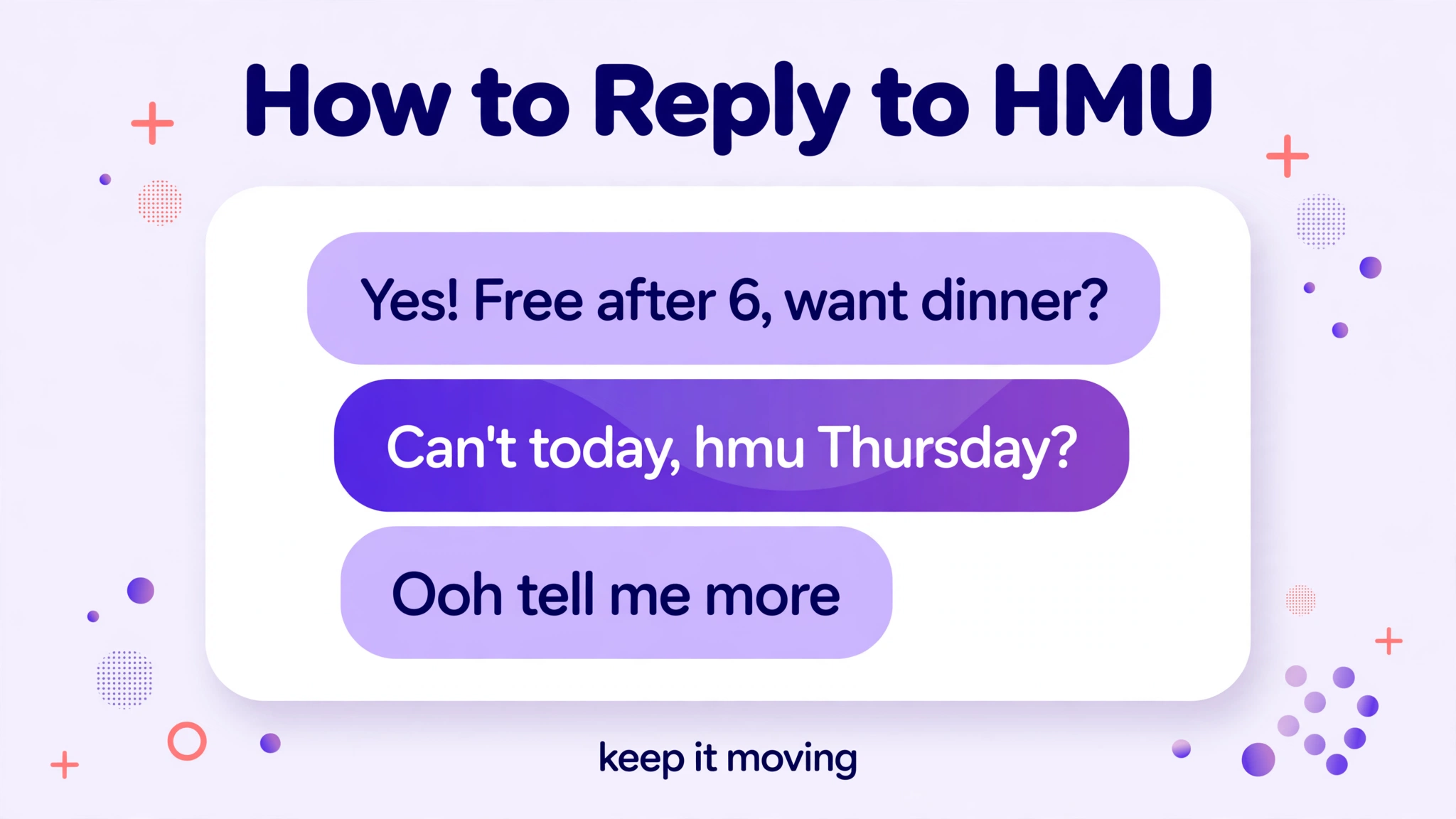
The golden rule, from the Next-Move Test: never let your reply be the place the plan dies. (Plans still forming? That's what TBD is for — but an HMU needs a next move, not a placeholder.) Ready-made moves:
- Enthusiastic yes: "Yes!! Free after 6 — want to grab dinner?"
- Interested but busy: "Can't today, but hmu Thursday? I'm free then." (Note the mirror: bounce the HMU back with a timeframe.)
- Need details first: "Ooh tell me more — what did you have in mind?"
- Polite no: "Appreciate it! Can't make it this time, but lmk about the next one." (Borrow LMK's answer-energy to close the loop cleanly.)
- The plan-saver: if you already killed an HMU with "ok" two days ago, revive it: "hey, about Saturday — are those tickets still available?"
- Keep the chat alive after yes: once you've accepted, bounce the question back so the conversation doesn't stall: "yes! free after 6, want to grab dinner? WBU — what does your week look like?"
And if the HMU came with a favor attached ("hmu with that code"), answer the favor directly. Don't make people ask twice — the fastest way to close a door someone opened for you.
A Little History: Older Than You Think
HMU feels like pure internet slang, but "hit me up" is older than texting — it comes from 1990s pager and hip-hop culture ("hitting" someone's beeper), was recorded as U.S. campus slang in 2001, hit Urban Dictionary in 2009, and exploded mainstream around 2010–2011. The abbreviation is internet-era; the invitation is decades old. That's why it feels so natural: a very old human gesture — "come find me when you're ready" — in very new clothes.
When Not to Use HMU
- When you need an answer, not contact. "Hmu if you're coming" when you need a headcount by Friday is a misuse — that's an LMK job. HMU withers under deadlines.
- In formal or professional writing. Emails, cover letters, client messages: write "please reach out" or "let me know." HMU is for casual channels only.
- As a standalone with no reason. "Hmu." Full stop. Nobody knows what for, and most people will ignore it. Always attach the reason.
- When you're actually upset. "Hmu when you want to talk about what you did" isn't an invitation — it's a summons wearing an invitation's clothes. Say the hard thing directly instead.
- Repeatedly, to the same person, with no response. One unanswered HMU is an open door. Three is knocking. Stop knocking.
Quick Answers
What does HMU mean in text?
HMU means "hit me up" — a casual invitation to contact the sender by text, call, DM, or snap, whenever you're ready. Example: "Got extra tickets, hmu if you want one."
Is HMU flirty?
It can be, but the letters alone aren't. A late-night HMU from a crush with a 😉 carries flirty tendency — but tone comes from the sender, timing, emoji, and platform together, never from the abbreviation itself.
What's the difference between HMU and LMK?
LMK ("let me know") asks for an answer — a yes or no. HMU ("hit me up") asks for contact — you, whenever. LMK closes a question; HMU opens a channel.
Why does nobody reply to my "hmu"?
Probably because it was a bare "hmu" with no reason attached. Give people something to walk toward: "hmu when you're free, got a question about Saturday" beats "hmu." every time.
Can I use HMU at work?
In casual team chats, yes ("hmu if you need anything on the deck"). In emails or formal messages, no — write "let me know" or "reach out" instead.
Does HMU mean "hold my unicorn"?
No — that's an old internet joke about acronym overload, never a real meaning. In texting, HMU is "hit me up" (occasionally "hook me up" when a favor is involved). In wedding and beauty contexts, the same letters mean "hair and makeup" — context decides.
HMU is the open door of texting slang: low pressure, high warmth, and entirely dependent on someone walking through it. Run the Next-Move Test on every HMU you get, attach a reason to every HMU you send, and you'll never watch a good plan die of vagueness again. And if you're the one who said "ok" and killed it — you know what to do. HBU the conversation back to life: "hey, about Saturday —"
