
Two letters that close the politeness loop: “yw.” Someone says thanks, you say yw, and the exchange is complete. If you’re looking up the yw meaning in text, there’s little mystery — but the small choices around those two letters (caps, punctuation, emoji) change how warm they feel, and there’s a sarcastic reading worth knowing about.
YW stands for “you’re welcome” — the quick, casual reply to “thank you” in texts, DMs, and chats. This guide covers how the exchange works, how tone shifts the meaning, the alternatives for different situations, and when to spell it out.
The Short Answer
| Question | Answer |
|---|---|
| What it means | “You’re welcome” — the reply to “thank you” |
| What it does | Acknowledges gratitude quickly and keeps things friendly |
| Tone | Casual and polite; warmth depends on punctuation and context |
| Where it sits | Right after thanks, usually standalone (“yw!”) or with a follow-up |
| Register | Casual — friends, DMs, group chats, comments, gaming |
| Formal alternative | “You’re welcome,” “happy to help,” or “anytime” spelled out |
The Thank-You / You’re-Welcome Exchange
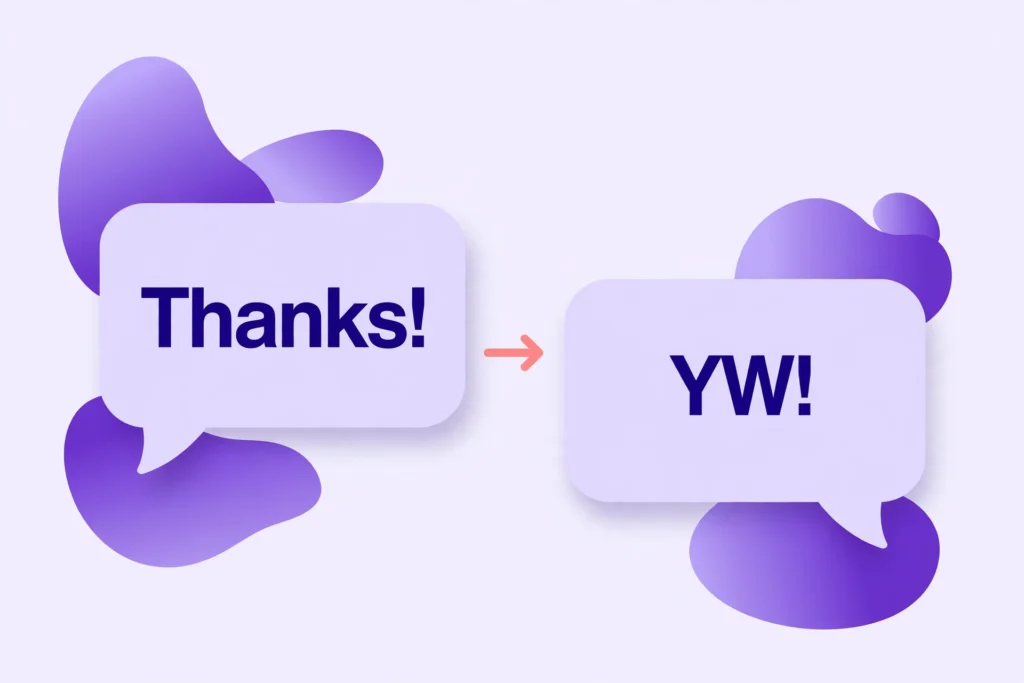
Texting runs on tiny rituals, and the gratitude exchange is one of the oldest. In person it goes: “thanks!” → “you’re welcome!” → nod. In texting, the same ritual got compressed: “ty!” → “yw!” → done. Two letters each way, politeness preserved.
YW almost never appears without a “thank you” before it. It’s a response-only abbreviation — nobody opens a conversation with “yw.” Its whole job is reactive: someone expressed gratitude, and YW says “received, and you’re welcome” in the smallest possible package.
The abbreviation emerged in the 1990s–2000s with early internet chat and SMS. “You’re welcome” is thirteen characters; “yw” is two. The politeness survived the compression.
YW in Real Conversations
The exchanges below are illustrative examples, not real messages.
The quick favor
- Alex: “thanks for sending the notes!”
- Sam: “yw, anytime”
The textbook exchange. Thanks given, welcome returned, door left open for next time.
The gaming assist
- Player 1: “ty for the revive”
- Player 2: “yw lol”
Two taps between rounds. The “lol” keeps it light — this is politeness at gaming speed, where a full sentence would cost you the match.
The heading out
- Jordan: “thanks for covering me today, seriously”
- Casey: “yw! gtg — talk later”
Gratitude acknowledged, exit made. The YW keeps the departure warm instead of abrupt.
The warm follow-up
- Riley: “thank you!! you saved my presentation”
- Morgan: “yw! lmk if you need anything else”
The upgrade: YW plus an open offer. This is the difference between closing the exchange and extending the relationship.
The weekend plan
- Taylor: “thanks for inviting me!”
- Alex: “yw! wtw this weekend?”
Thanks returned, conversation restarted. YW doesn’t have to end the chat — it can pivot it.
The Warmth Dial: How Tone Changes YW
YW is a small word carrying a variable amount of warmth, and the dial is controlled by tiny signals.
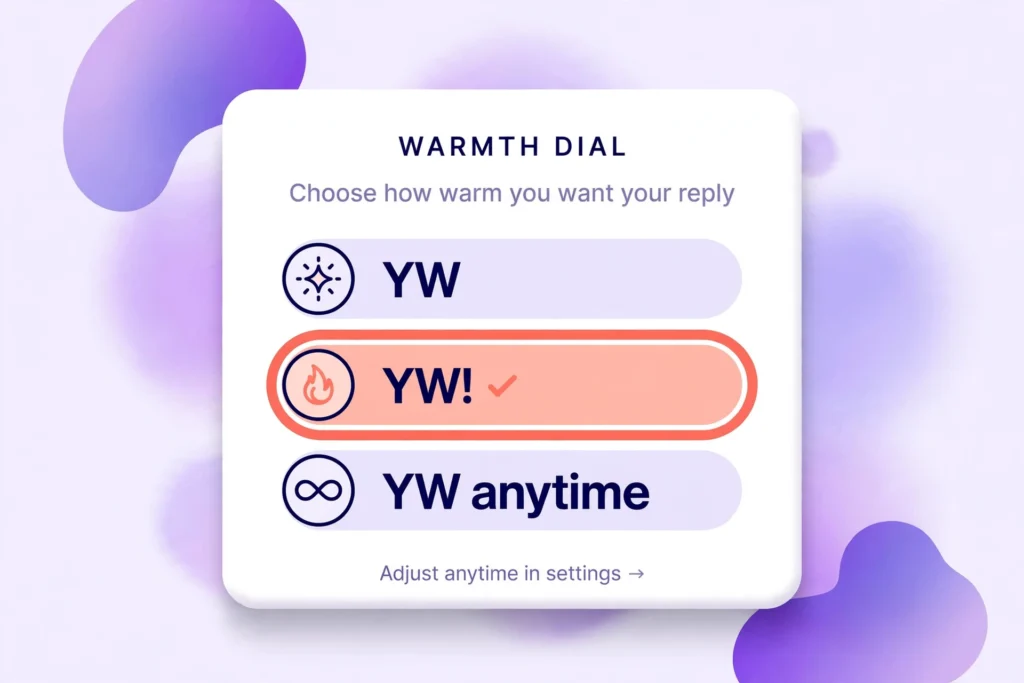
“YW!” — the friendly default. The exclamation mark adds genuine warmth; this is the version that feels like a smile.
“yw” — neutral and casual. Fine between friends, perfectly polite, just less expressive. The lowercase keeps it breezy.
“yw 😊” — the warmth upgrade. An emoji does what the exclamation mark does, with feeling. This is the version for when you actually enjoyed helping.
“yw.” — careful. The period flattens it. In a warm conversation it’s probably nothing, but after a tense exchange, “yw.” can read clipped — politeness performed rather than felt.
“yw lol” — the casual softener. The laugh-out-loud keeps everything light between friends, but it can look flippant if the thanks was heartfelt. Match the thanker’s energy: big thanks deserve more than “yw lol.”
“YW” in all caps — slightly more present, slightly more formal-feeling. Not shouting, just deliberate. Works well when you want the acknowledgment to land clearly.
The rule: YW’s politeness is constant, but its warmth is adjustable. When someone’s thanks felt big, give the YW some company — an exclamation mark, an emoji, a follow-up sentence.
YW vs. Its Alternatives
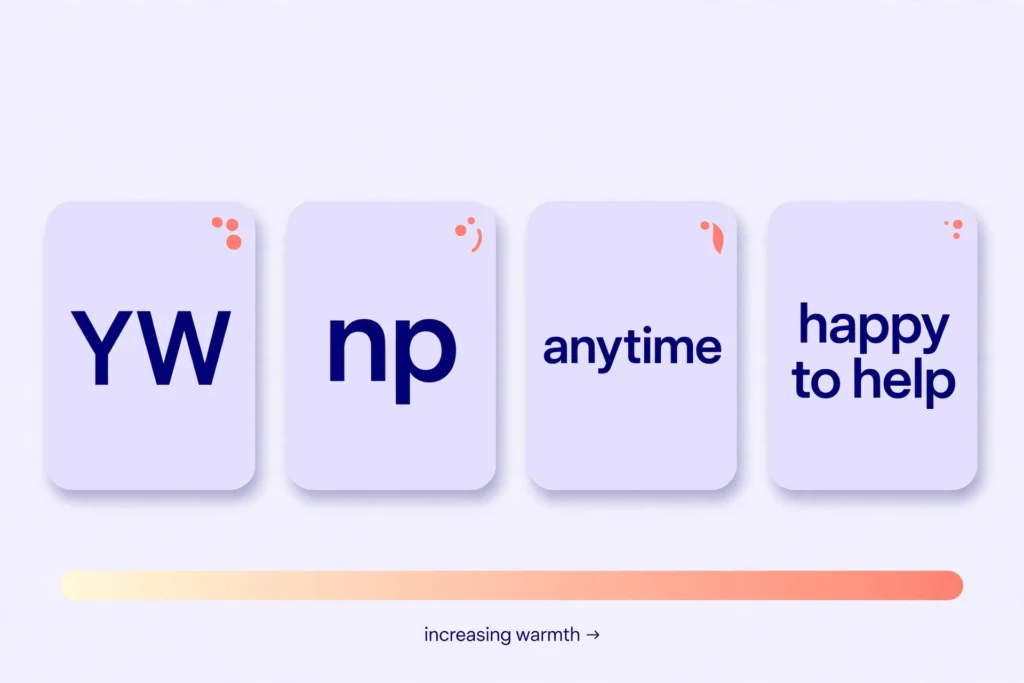
“You’re welcome” has a whole family of casual stand-ins, and they’re not quite interchangeable.
YW vs. “np” (no problem). The closest pair — genuinely interchangeable most of the time. The shade of difference: YW is the direct answer to thanks (“you’re welcome”), while “np” frames the favor as no burden (“it was no problem”). YW feels a touch more formal; “np” feels breezier.
YW vs. “anytime.” “Anytime” adds an open offer — not just “you’re welcome,” but “come back whenever.” Use it when you mean it; it’s warmer and more inviting than a bare YW.
YW vs. “of course.” “Of course” implies the help was obvious — “naturally I’d help you.” It’s warm among close friends but can sound presumptuous with strangers (“of course I’d do this for you” to someone you just met is a lot).
YW vs. “no worries.” The most relaxed of the bunch. “No worries” says the favor didn’t even register as effort. Great for tiny things; too casual when someone is deeply grateful.
YW vs. “happy to help.” The most sincere-sounding. When someone’s thanks felt big, “happy to help” carries more weight than “yw” — it says the helping itself was the reward.
The practical move: default to YW for everyday thanks, and reach up the warmth ladder (“anytime,” “happy to help”) when the gratitude felt significant.
The Sarcastic Reading: “Yeah, Whatever”
Honest footnote: YW has a rare sarcastic reading — “yeah, whatever.” It’s uncommon, and it’s only ever identifiable from tone.
It shows up in tense exchanges, where the “thanks” was sarcastic first: “thanks for nothing” → “yw.” The period, the timing, the argument before it — everything around the letters says this isn’t politeness. It’s dismissal wearing politeness as a costume.
You’ll know it when you see it, because the conversation makes it unmistakable. In ordinary friendly chats, this reading never applies — don’t go hunting for sarcasm in a normal “yw!” The default is always “you’re welcome” unless the context screams otherwise.
Where YW Fits and Where It Doesn’t
Where it shines: texts with friends, DMs, group chats, social media comments, gaming lobbies. Anywhere the tone is casual and the thanks was casual.
Where it needs more: work emails, client messages, formal thanks, anyone who went out of their way. “YW” to your manager after a thoughtful favor reads as breezy at best. Write it out: “You’re welcome — happy to help.”
The heartfelt thanks: when someone’s gratitude is clearly deep — they wrote a paragraph, they’re emotional — a two-letter “yw” can feel disproportionate. Match their energy: “of course, anytime — really glad I could help” costs seconds and lands completely differently.
The generational note: YW is digital-native shorthand. Older relatives or anyone outside texting culture may stare at it blankly. With them, the full “you’re welcome” is always safe.
What to Say Instead
For when YW is too small for the moment:
| Situation | Instead of “yw” | Try |
|---|---|---|
| Big favor | “yw” | “Anytime — really glad I could help” |
| Work context | “yw” | “You’re welcome! Happy to help” |
| Heartfelt thanks | “yw” | “Of course — it meant a lot to be there” |
| Ongoing offer | “yw” | “Anytime, seriously — lmk whenever” |
| Quick exit after thanks | “yw” | “yw! ttyl“ |
| Stepping away briefly | “yw” | “yw! brb“ |
Specific beats abbreviated when the moment matters.
Quick Answers
What does YW mean in text?
“You’re welcome” — the quick, casual reply to “thank you.” “Thanks for the notes!” → “yw, anytime.”
Is YW rude?
No — it’s polite by design. It only reads cold when the thanks was heartfelt and “yw” is all you offer, or when the period-and-lowercase combo (“yw.”) lands flat.
What’s the difference between YW and “np”?
Almost nothing — they’re interchangeable most of the time. YW directly answers the thanks; “np” (no problem) frames the favor as no burden. YW feels a touch more direct.
Can YW mean “yeah, whatever”?
Rarely, and only sarcastically in tense exchanges. In normal friendly chats, it always means “you’re welcome” — don’t hunt for sarcasm where there is none.
Should I use YW at work?
In casual internal chat, fine. In emails, client messages, or after a significant favor — write “you’re welcome” out.
Why do people write “yw” instead of “you’re welcome”?
Speed and tone. It preserves the politeness in two keystrokes and matches the casual rhythm of texting.
How do I make YW warmer?
Add an exclamation mark (“YW!”), an emoji (“yw 😊”), or a follow-up (“yw, anytime”). Any of the three upgrades the warmth instantly.
What’s the full thank-you/you’re-welcome pair in texting?
“Ty” (thank you) → “yw” (you’re welcome). The compressed politeness ritual — two letters each way.
The Short Version
YW is “you’re welcome” — the two-letter close to the thank-you exchange. It works because it preserves politeness at texting speed: thanks given, welcome returned, everyone moves on. Tune the warmth with punctuation and emoji, reach for bigger words when the thanks felt big, and save the full “you’re welcome” for work and heartfelt moments. Small abbreviation, good manners, zero confusion — as long as the conversation is friendly, which it almost always is.
