
If someone just replied “ditto” to your message, they weren’t ignoring you — they were agreeing with you. Ditto is the one-word way of saying “same here,” “I agree,” or “me too.” It’s quick, friendly, and does a surprising amount of work for five letters.
Unlike most texting slang, ditto isn’t an abbreviation at all. It’s a real English word with centuries of history behind it — and in chats it has become the fastest way to say “what you said goes for me too.” This guide explains what the sender means, when the word fits, what to send back, and how it compares to similar replies.
What the Sender Really Means
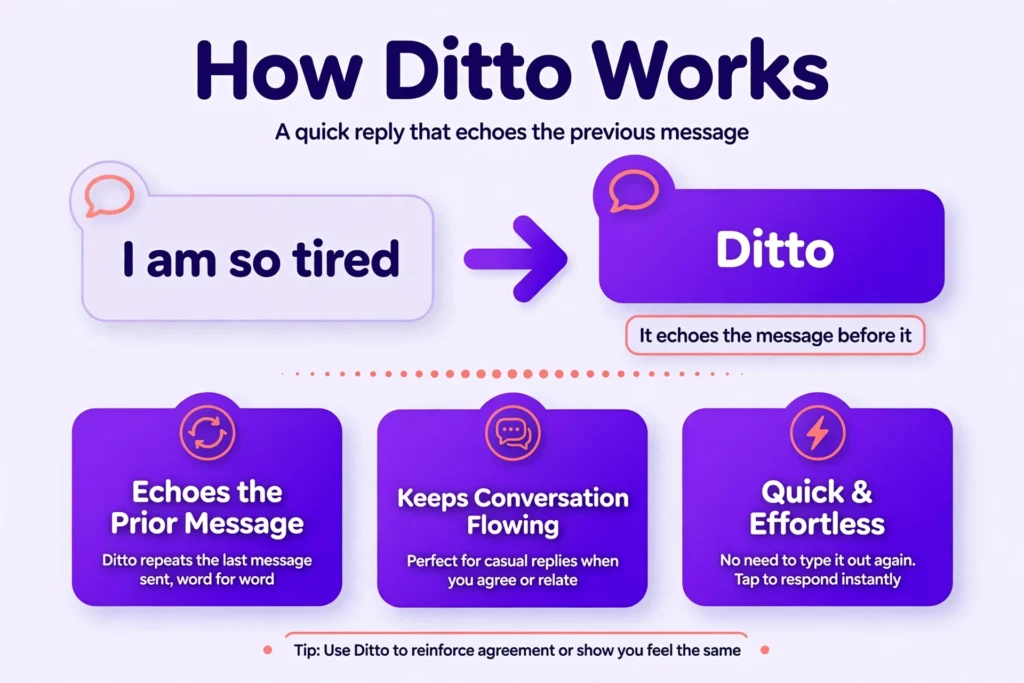
Ditto always points backward. It borrows the meaning of the message right before it and applies it to the sender. “I’m exhausted” → “ditto” means “I’m exhausted too.” “Best pizza in town” → “ditto” means “I agree completely.”
Dictionaries define ditto as “as stated before” or “in the same way” — see the Merriam-Webster entry for the full definition. In a text, that “same as before” idea turns into agreement: instead of retyping your sentence, the other person stamps it with one word.
Ditto handles more than feelings. It can echo a plan (“Dinner at seven?” → “ditto” means “works for me”), an observation (“This traffic is unreal” → “ditto”), or a joke (“I just tripped over nothing” → “Ditto [laugh emoji]”). The rule never changes: whatever was just said now applies to the sender too.
One important detail: ditto is a reply, not an opener. It only makes sense as a response to something. If it arrives at the start of a conversation with nothing to point back at, the sender probably hit send too early — or meant to reply to a different message.
A Short History of a Long Word
Ditto comes from the Italian “detto” (from the Latin “dictus”), meaning “said.” It entered English in the 1600s, where clerks used ditto marks — pairs of small quotation-like marks — to avoid rewriting repeated words in lists and ledgers.
Over the centuries it drifted from paperwork into conversation, becoming a casual way to say “the same thing again.” Texting simply gave it a new job: the one-word agreement. Few slang terms can claim a 400-year résumé.
Ditto in Realistic Conversations
The exchanges below are illustrative examples, not real messages. Each shows the word doing its usual job.
Sharing a feeling
- A: “I’m so tired I could fall asleep standing up”
- B: “Ditto [sleep emoji]”
- B feels it too — no extra words needed.
Agreeing with an opinion
- A: “That finale was perfect, no notes”
- B: “Ditto. Best episode in years”
- Agreement, plus a small top-up of enthusiasm.
Echoing affection
- A: “Miss you [heart emoji]”
- B: “Ditto [heart emoji]”
- A shortcut for “I miss you too” — warm when the relationship is warm.
Playing along
- A: “I’m broke until payday [money emoji]”
- B: “Ditto lol”
- Shared misery, delivered with a laugh.
Settling it in a group chat
- A: “Pizza Friday? Everyone in?”
- B: “Ditto”
- C: “+1”
- D: “Ditto [pizza emoji]”
- Four messages, one decision, zero repetition.
Where You’re Most Likely to See Ditto
The meaning doesn’t change from app to app — there’s no secret platform-specific definition. What changes is the situation around it.
- One-to-one texts and DMs: the classic spot. Someone shares a feeling, an opinion or news, and “ditto” echoes it back.
- Group chats: where ditto earns its keep. Ten people agreeing on pizza doesn’t need ten paragraphs — a run of “ditto” and “+1” settles it.
- Social comments: under relatable posts, “ditto” works like a public nod. (“Mondays, am I right?” → “Ditto [eye-roll emoji]”)
- Dating apps: usually warm — echoing a shared interest or returning affection. Read the surrounding chat; in a new match it can also be a low-effort dodge.
- Gaming chats: quick alignment between rounds. (“Same strategy again?” → “Ditto.”)
When Ditto Fits — and When It Doesn’t
Ditto is perfect for casual agreement: friends, group chats, quick alignment on plans or opinions. It keeps the conversation moving and signals “I’m with you” without slowing anything down.
But the word’s very efficiency is its weakness. On serious topics — an apology, bad news, a heartfelt message — a one-word echo can read as lazy or dismissive. “I’m really sorry about your loss” should never get a “ditto” in return.
Great fit: opinions, plans, shared complaints, jokes, affection between people who are close.
Bad fit: condolences, apologies, work feedback, anything where the other person needs to feel heard.
Rule of thumb: if a real sentence would take you ten seconds to write, write it. Ditto is for moments when the meaning is already obvious.
What to Send Back
Got a “ditto” and not sure what to do with it? It usually needs no reply at all — it’s an acknowledgment, not a question. But when you want to keep the chat alive:
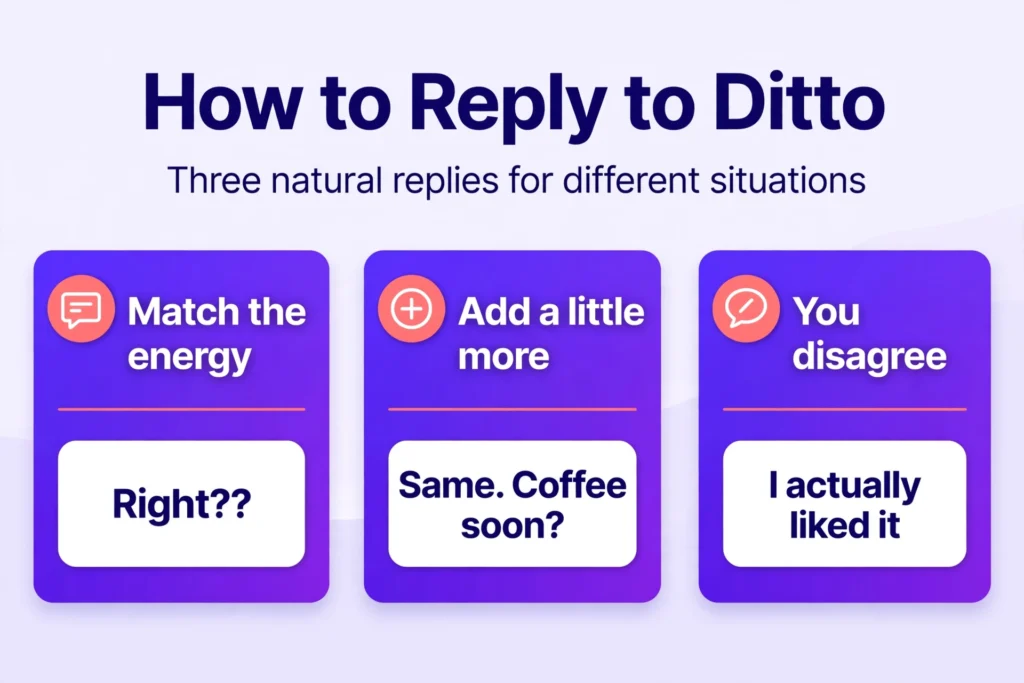
Match the energy
- “Right??”
- “Glad I’m not the only one”
- “Ditto back at you [smile emoji]”
Add a little more
- “Ditto — we’re getting pizza Friday then”
- “Same. Want to complain about it over coffee?”
Useful phrases for these moments: let me know when you want to move from agreeing to planning, and I don’t mind when you’re happy to go along with whatever’s decided.
When you don’t actually agree
Don’t ditto what you don’t mean. A quick “Hmm, I actually liked it” or “I’m not sure I agree” keeps things honest without starting a fight.
Ditto vs. Similar Words
A few replies do the same job with a slightly different flavor.
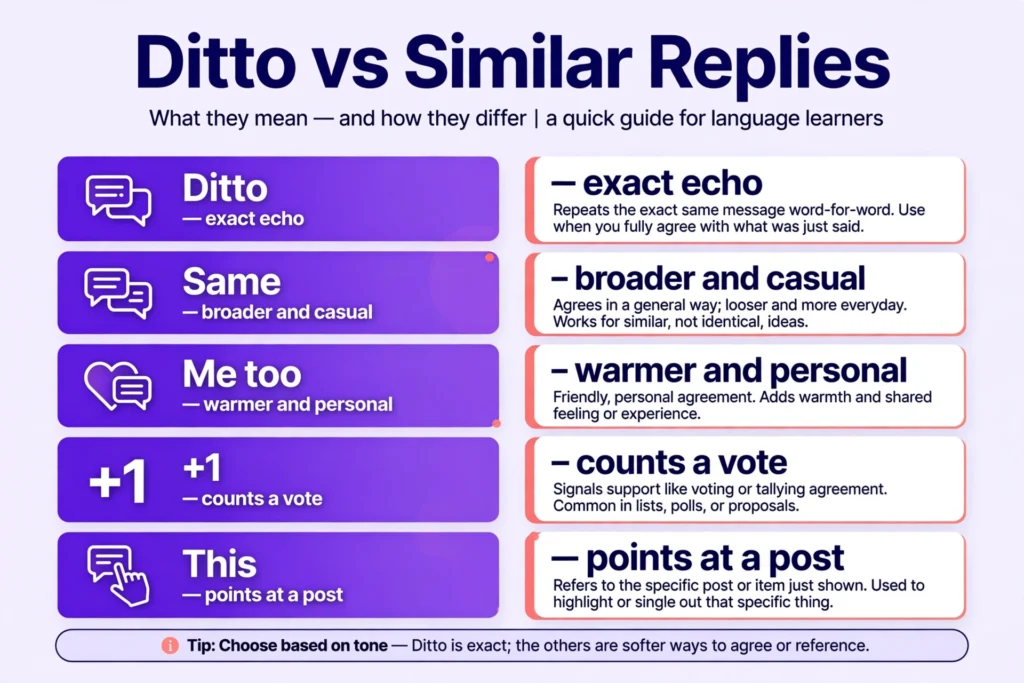
| Reply | Flavor | Example |
|---|---|---|
| Ditto | Exact echo of what was said | “I’m tired” → “Ditto.” |
| Same | Broader, slightly more casual | “I’m tired” → “Same [laugh emoji]” |
| Me too | Warmer, more personal | “I miss you” → “Me too [heart emoji]” |
| +1 | Counts a vote, common in groups | “Pizza Friday?” → “+1” |
| This | Points at a post or message | (under a relatable post) “This.” |
Two cousins worth knowing: alr is the short acknowledgment — it confirms receipt more than agreement — and whatever is the shrug: it waves a topic away where ditto embraces it. In feeling-heavy chats, what you feeling asks about emotions rather than echoing them, and in group banter what you on checks the vibe instead of matching it.
One Pop-Culture Mix-Up
If “ditto” makes you think of a pink blob, that’s the Pokémon named Ditto — famous for transforming to copy other Pokémon’s appearance. The name is a nod to the same “sameness” idea. In a text, though, nobody is talking about Pokémon unless the conversation is already about games.
Frequently Asked Questions
What does ditto mean in a text?
“Same here,” “I agree,” or “me too.” It echoes the previous message and applies it to the sender.
Is ditto rude?
Not on its own. It’s casual and usually friendly. It only feels dismissive when it lands on a serious or emotional message that deserved a real answer.
Is ditto slang or a real word?
Both. It’s a legitimate English word with Italian roots going back to the 1600s, and it doubles as casual texting shorthand.
Can I use ditto at work?
In quick team chats, occasionally — “Ditto on the timeline” reads fine. In emails or formal writing, use “I agree” or “the same applies” instead.
What’s the difference between ditto and same?
They overlap heavily. Ditto echoes the exact statement; “same” is a touch broader and more casual. Most readers treat them as interchangeable.
What does “ditto” mean as a reply to “I love you”?
It means “I love you too” — a playful shortcut for returning affection. (Film fans may recognize it from Ghost.)
Can ditto sound sarcastic?
Yes — tone does the heavy lifting. “Ditto [laugh emoji]” after a joke is playful; a bare “ditto” after “I’m doing all the work here” can read as mocking. When in doubt, an emoji removes the ambiguity.
What’s a ditto mark?
The original meaning: a pair of small marks (“) written under a word in a list to mean “the same as above.” Clerks used them for centuries to avoid rewriting repeated entries — the texting sense is the same idea, spoken aloud.
Does ditto only work as a reply?
Yes. It needs a previous message to point back at, so it can’t open a conversation on its own.
The Short Version
Ditto means “the same goes for me” — agreement, echoed back in a single word. It’s one of the oldest words in texting slang and one of the simplest: use it when you genuinely share the feeling, and save your real sentences for the moments that deserve them.
