
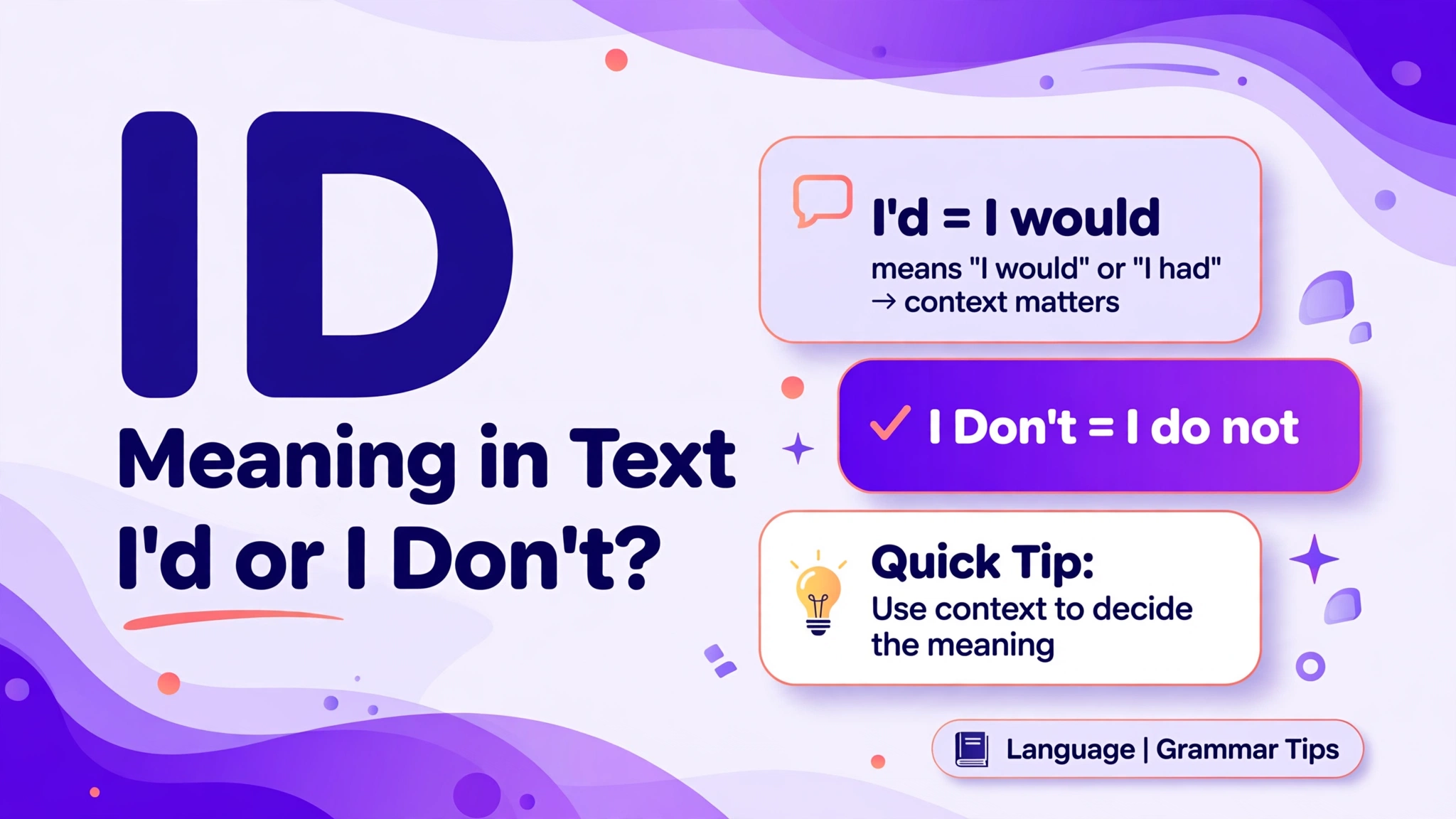
Two little letters, three different jobs. When someone types “id” in a message, they usually mean “I’d” (I would) or “I don’t” — the apostrophe just didn’t make the trip. But type those same letters in capitals — “ID” — and you’re in completely different territory: identification.
The good news: you almost never have to guess. The capitalization and the word right after “id” tell you which reading fits. This guide shows you how to read all three, what to send back, and which look-alikes to ignore.
The Short Answer: Check the Case First
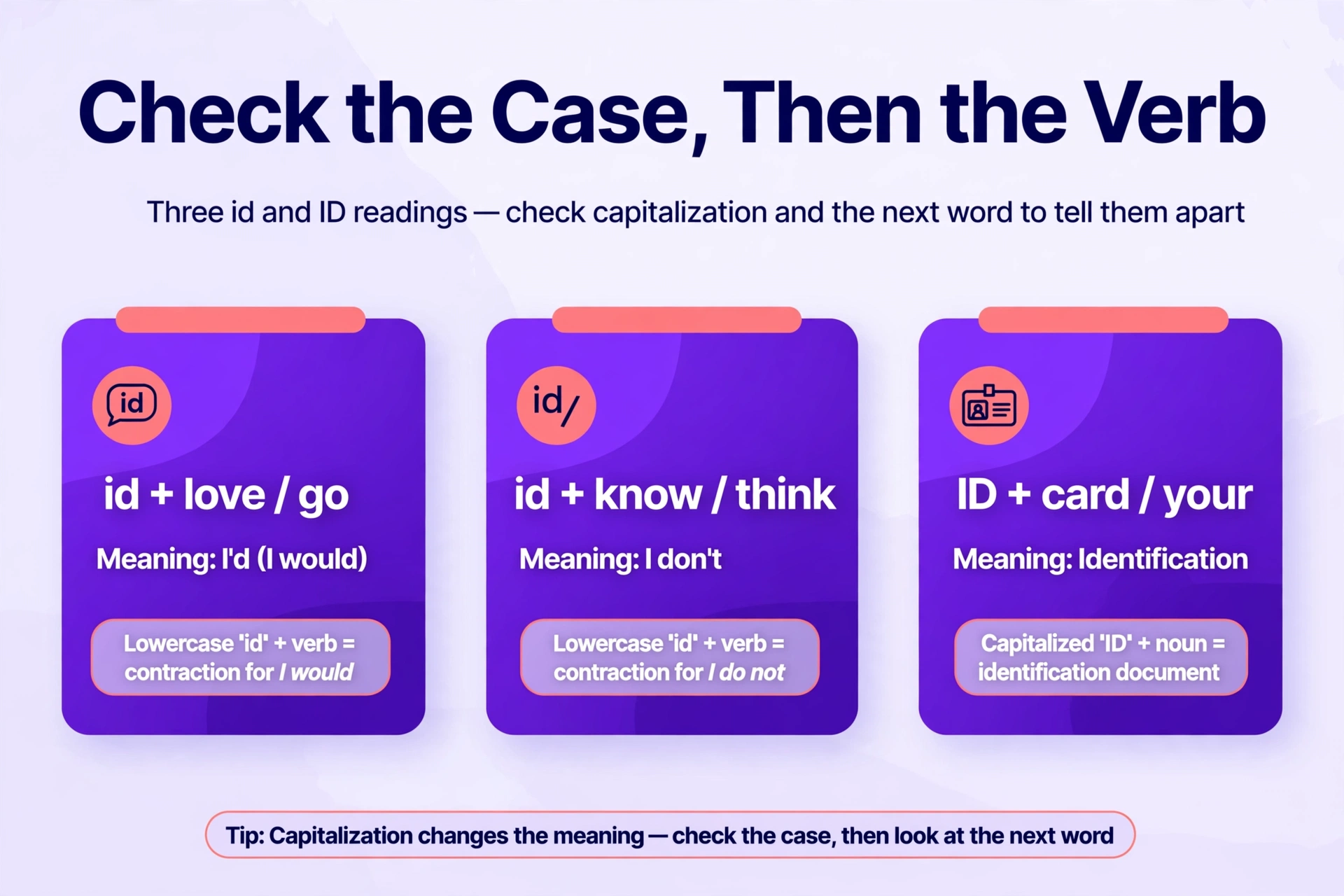
- “id” (lowercase) inside a casual sentence → “I’d” (I would / I had) or “I don’t”.
- “ID” (capitals) → identification, an identity document, or a user ID.
- The verb right after lowercase “id” decides between the first two.
“id” as “I’d” — I Would / I Had
The contraction “I’d” is standard English for “I would” or “I had” — see the Merriam-Webster entry for the full definition. In fast texting the apostrophe gets dropped: “id love to join” is just “I’d love to join” typed quickly.
- “id love to come tomorrow” → I’d love to come
- “id go if I had the time” → I’d go
- “id already left by then” → I’d (I had) already left
This is the best-supported reading for lowercase “id” followed by verbs like love, like, go, do or be — the contraction itself is dictionary-standard English, and dropping the apostrophe is a normal texting habit.
“id” as “I Don’t”
The same two letters do a second job: “I don’t,” with the apostrophe and the space dropped. It grew naturally out of the “idk” (I don’t know) and “idc” (I don’t care) family — once those became standalone words, bare “id” picked up the same job.
- “id know tbh” → I don’t know
- “id think so” → I don’t think so
- “id wanna go out today” → I don’t wanna go
Usage examples on Urban Dictionary show the “I don’t” pattern across multiple entries (e.g. “Id want that!” for “I don’t want that”), which is why it’s treated as a contextually supported reading rather than a proven universal one.
Why the Apostrophe Disappears
The missing apostrophe isn’t laziness — it’s efficiency. On a phone keyboard, the apostrophe takes an extra tap, so casual typists drop it everywhere: “dont” for don’t, “cant” for can’t, “wont” for won’t. “id” for “I’d” is the same habit.
This is also why “id” picked up the “I don’t” job. Once “idk” and “idc” became standalone words, readers learned to sound out “id-” as “I don’t” automatically — so bare “id” inherited both meanings at once. The spelling didn’t change; the reading habit did.
If you’re writing somewhere the apostrophe matters — work email, an application, anything formal — put it back in. “I’d” with the apostrophe is never wrong; “id” without it is only safe among friends.
How to Tell Which One: Read the Next Word
The word after “id” does the disambiguating.
| Pattern | Reading | Example |
|---|---|---|
| id + love / like / go / do / be | I’d (I would) | “id love to” |
| id + know / think / care / understand / wanna | I don’t | “id know” |
| ID + card / number / send / your | identification | “send your ID” |
When the sentence works with “I would,” it’s “I’d.” When it works with “I don’t,” it’s “I don’t.” If neither fits, check the capitals — you’re probably looking at identification.
“ID” in Capitals: Identification
All-caps “ID” is the familiar abbreviation for identification: an ID card, a user ID, a login. “Send me your ID,” “What’s your player ID?”, “ID required at the door.” This reading is strongly supported — it’s standard dictionary English, not slang.
On social and gaming platforms “ID” also means username or handle — the name the system knows you by.
ID in Realistic Conversations
The exchanges below are illustrative examples, not real messages.
“I’d” — enthusiasm
- A: “We’re doing dinner Friday, you in?”
- B: “id love to come!”
- B means “I’d love to” — pure enthusiasm.
“I don’t” — indifference
- A: “This song has ten million plays”
- B: “id get the hype lol”
- B means “I don’t get the hype.”
“ID” — identification
- A: “To enter the tournament, send your ID”
- B: “On it, one sec”
- Nothing casual here — A wants a username or document.
Where You’ll See Each Reading
- One-to-one texts and DMs: the casual readings live here — “I’d” and “I don’t” in fast, lowercase typing.
- Group chats: both casual readings show up, especially “I don’t” as a quick reaction.
- Work and school messages: “ID” as identification (“bring your ID”). The casual lowercase readings don’t belong here.
- Gaming: “ID” as user ID or player ID (“what’s your ID?”).
What to Send Back
Match the reading, not just the letters.
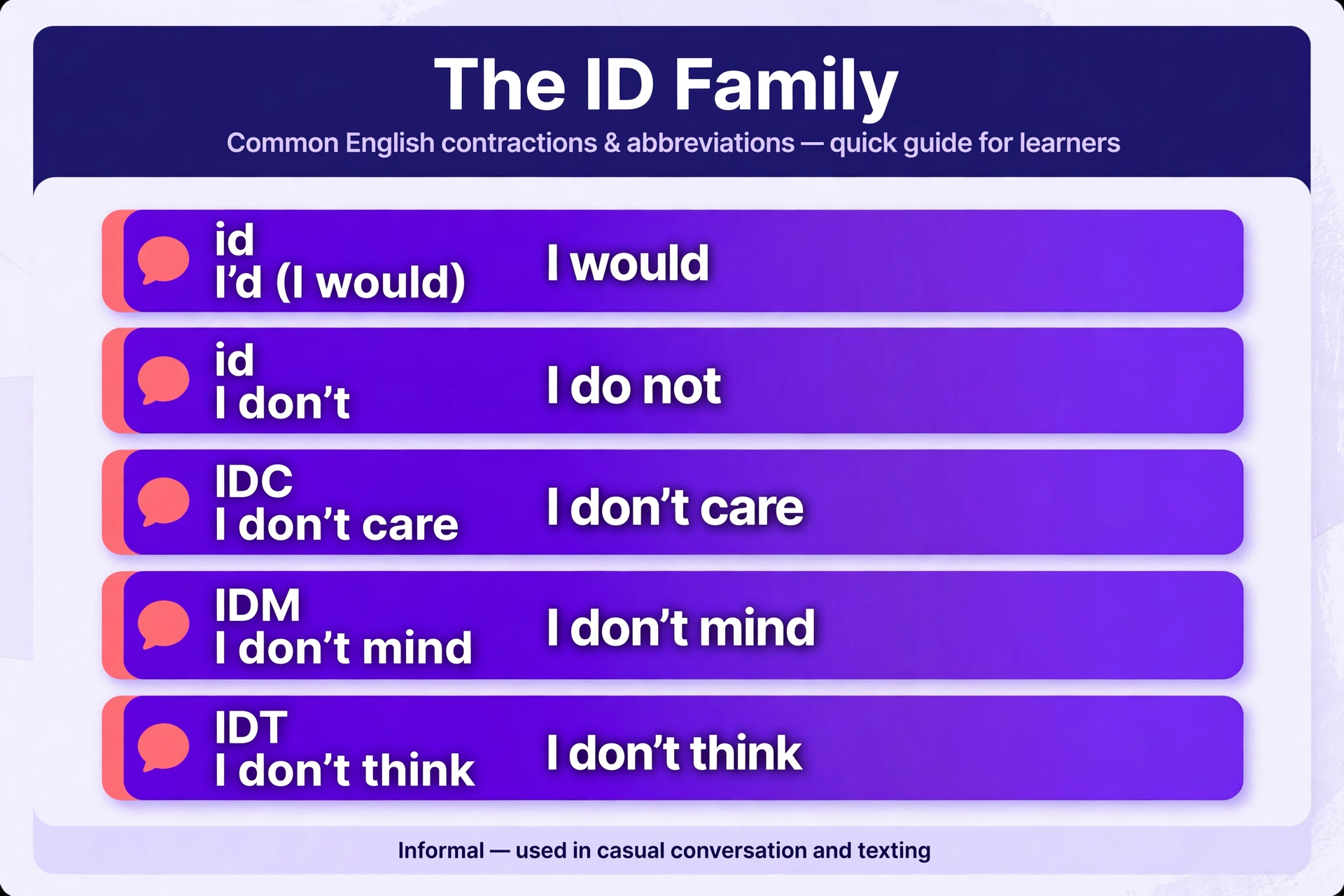
- They meant “I’d love to” → answer the enthusiasm: “Yesss, see you there!”
- They meant “I don’t know / think” → “No worries” or “Fair enough.”
- They asked for ID → send it if appropriate, or ask which one they need.
Useful phrases for these moments: let me know when you’re offering to explain something they don’t get, a short alr to acknowledge without fuss, and ttyl when they write “id catch up tomorrow” (“I’d catch up tomorrow”) — “Sounds good, ttyl!”
The Whole ID- Family
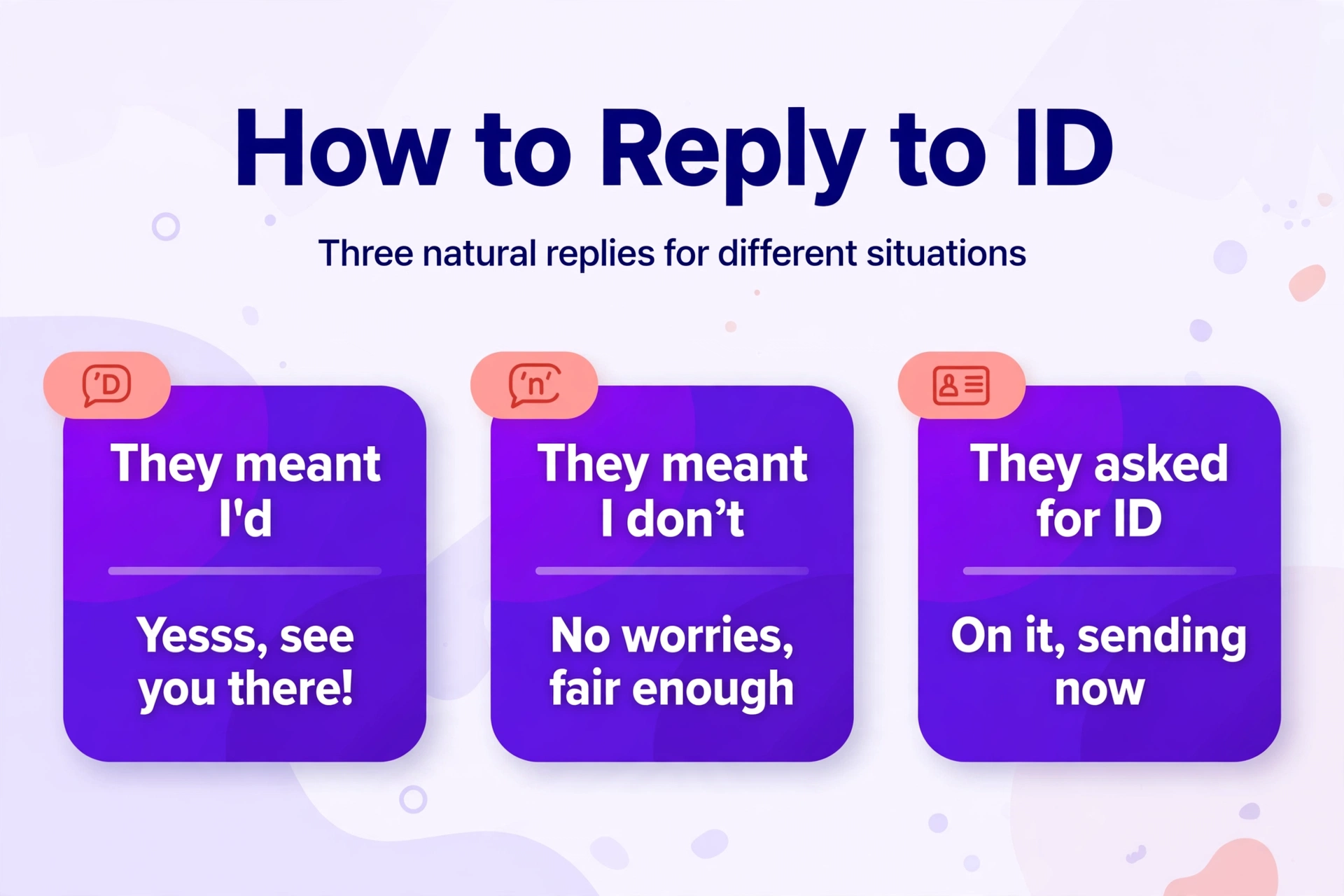
These live in the same chats and share the same DNA.
| Abbreviation | Means | Example |
|---|---|---|
| id | I’d (I would) | “id love to” |
| id | I don’t | “id know” |
| IDC | I don’t care | “idc tbh” |
| IDM | I don’t mind | “idm either way” |
| IDT | I don’t think | “idt so” |
The family resemblance is the point: once “idk” and “idc” trained everyone to read “id-” as “I don’t,” bare “id” picked up the same job. IDC is the blunt one, IDM the flexible one, and IDT the doubtful one.
Two Things Not to Confuse
Freud’s “id” is a different word
In psychology, the id is one of the three parts of the psyche — id, ego, superego. It’s a real word with a real meaning, but nobody in a text thread is discussing psychoanalysis. If the chat isn’t about psychology, it isn’t this.
“Idiot” isn’t supported
A couple of Urban Dictionary entries claim “id” means “idiot” (“ur such an id”). No reliable usage evidence backs it as a real reading — treat it as noise, not a meaning.
Quick Check: Can You Read These?
Try decoding these before peeking at the answers.
- “id be down for that” → I’d be down (I would)
- “id really know what to say” → tricky: with “really” between, read it as “I don’t really know”
- “Can you send your ID?” → identification (capitals + “your”)
- “id already told them” → I’d (I had) already told them
- “id care either way” → I don’t care
The pattern holds every time: case first, then the verb.
Frequently Asked Questions
What does “id” mean in a text?
Usually “I’d” (I would) or “I don’t” — check the capitalization and the word right after it. In capitals (“ID”), it means identification.
What’s the difference between “id” and “I’d”?
Nothing in meaning — the apostrophe is simply dropped for typing speed. “id love to” is “I’d love to.”
How do I tell “I’d” from “I don’t”?
Read the verb after it. “id love / like / go” points to “I’d”; “id know / think / care” points to “I don’t.”
Does “ID” always mean identification?
In capitals, almost always — an identity document, a user ID, or a username. Context (documents, logins, gaming) confirms it.
Can I use “id” at work?
“ID” for identification is perfectly fine. Lowercase “id” for “I’d” or “I don’t” is too casual — write the words out in work messages.
Is “id” rude?
No — it’s just casual. Neither “I’d” nor “I don’t” carries attitude on its own; tone comes from the rest of the sentence.
What do “ide” and “idely” mean?
“I don’t even” — niche slang for being speechless or dismissive. Rarely used; you can safely ignore it unless the chat is very online.
What is Freud’s “id”?
The impulsive, instinct-driven part of the psyche in Freudian theory. A real term — just not texting slang.
Is “idc” related to “id”?
Yes — “idc” (I don’t care) is part of the same family that taught readers to sound out “id-” as “I don’t.” It’s one reason bare “id” can mean “I don’t.”
What does “id” mean on Instagram?
Usually a user ID or handle (“what’s your ID?”), or identification in verification contexts. In casual comments, the lowercase readings (“I’d” / “I don’t”) apply the same as anywhere else.
The Short Version
Lowercase “id” usually means “I’d” (I would) or “I don’t” — the word after it tells you which. Capital “ID” means identification. Read the case, read the verb, and you’ll get it right.
