
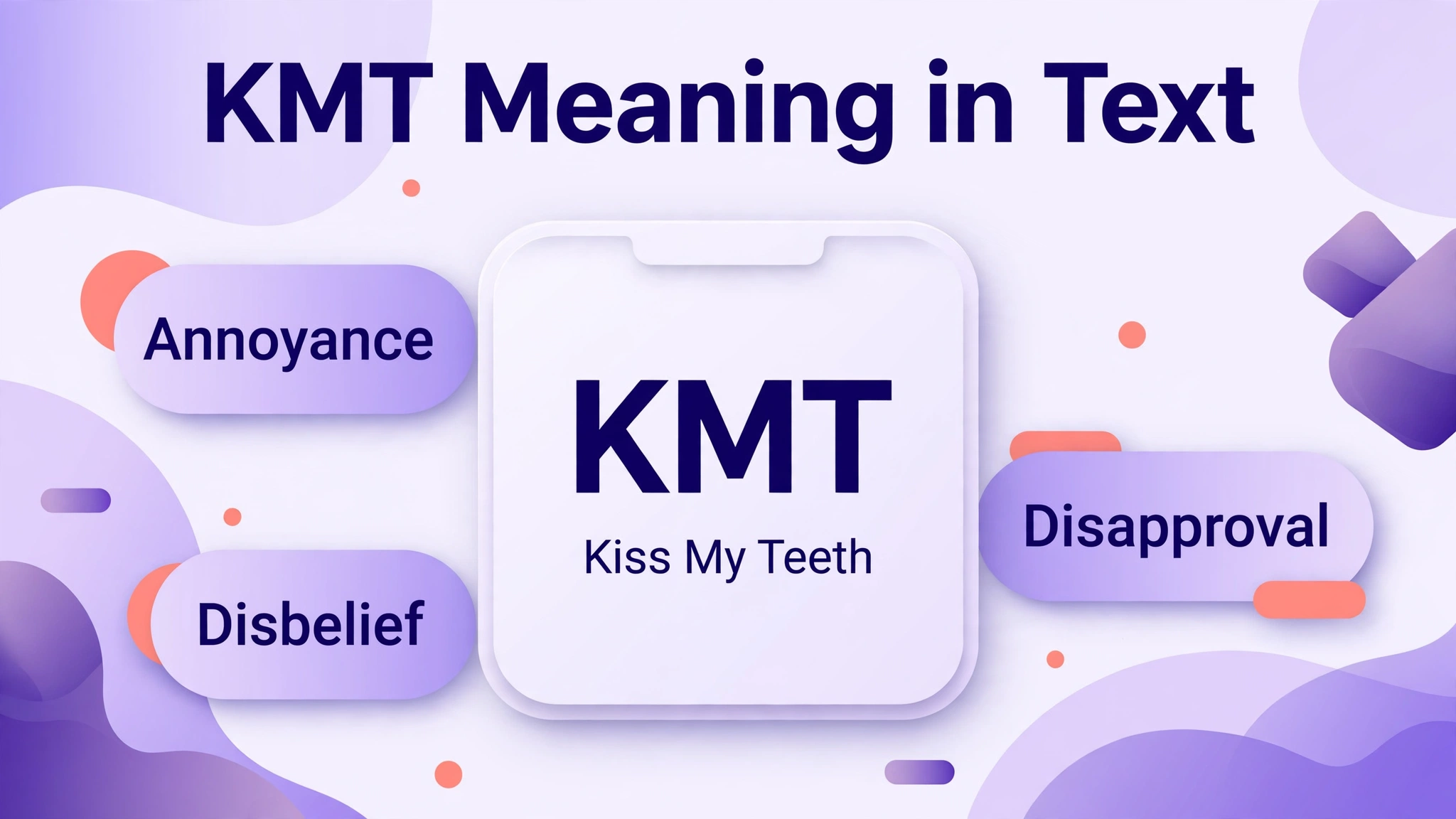
KMT means “kiss my teeth.” It’s the typed version of sucking air through your teeth — that sharp little hiss people make when something annoys them, disappoints them, or just sounds ridiculous. If you’ve ever seen someone do the teeth-suck and eye-roll combo in real life, you already know exactly what KMT feels like.
The phrase has its roots in Jamaican and Caribbean slang, where “kissing teeth” (also written as “kissing your teeth”) is a well-known nonverbal gesture of disapproval. British urban slang picked it up too, and from there it moved into texting: why make the gesture when you can type it?
Here’s the key thing: KMT is almost never about actual kissing. It’s attitude, typed out.
The Short Answer
- KMT = “kiss my teeth” — a typed teeth-suck expressing disapproval, annoyance, disbelief, or dismissal.
- It works the same in uppercase or lowercase.
- It’s aimed at something — a statement, a situation, a decision — rarely a person you actually hate.
- Most of the time it’s casual and even playful; tone depends on who’s sending it and why.
The Gesture Behind the Letters
To get KMT, picture the gesture. You press your tongue behind your front teeth and pull air through them, making a short hissing or clicking sound. In Jamaican and Caribbean culture this is called kissing teeth (sometimes “sucking teeth”), and it’s understood instantly: I am not pleased with this.
It’s not a smile. It’s not a kiss. It’s the sound of someone who has run out of patience — or at least wants you to think so.
The abbreviation is believed to have taken hold in texting around the late 2000s and early 2010s, when Urban Dictionary entries for it start appearing. Once it was typed, it traveled: from Caribbean diaspora communities to British urban slang, and from there into the general mix of texting abbreviations people look up when a message doesn’t make sense.
What KMT Actually Signals
KMT is a small word with a flexible job. Here are the flavors it carries, from mildest to sharpest:
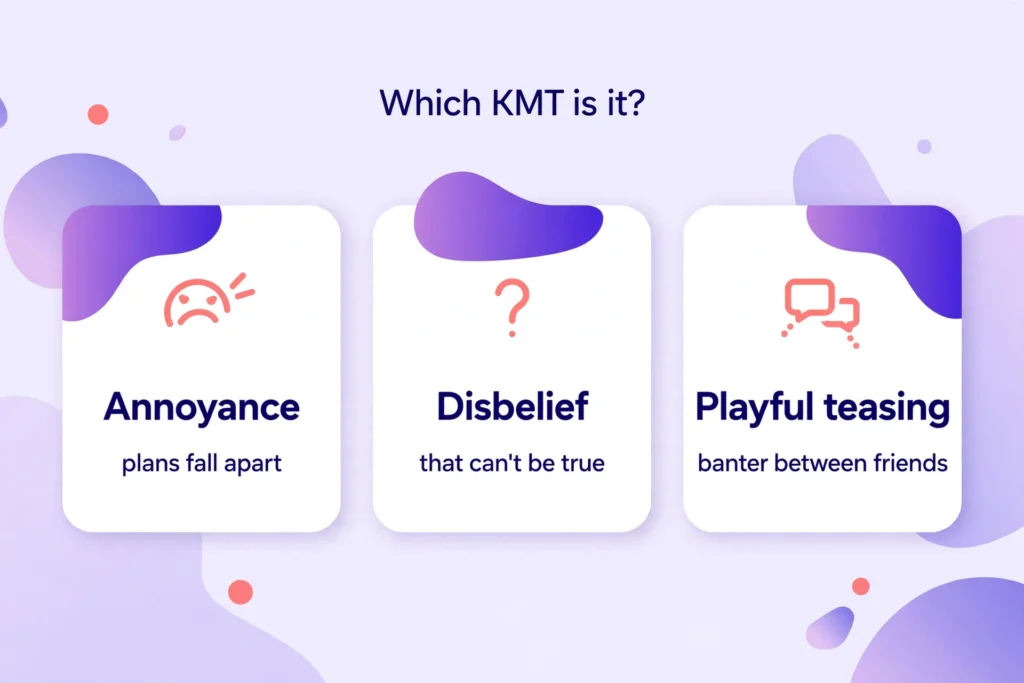
Disbelief
“The bus is late again, KMT!” says it all — “You can’t be serious.”
Annoyance
Pure irritation. A friend cancels plans for the third time; KMT is the typed sigh. “KMT, I told you not to do that.”
Disapproval
The classic use. Someone says or does something the sender thinks is out of line, and KMT lands like a referee’s whistle. “Your outfit is so tacky.” → “KMT, I think it’s stylish.”
Dismissal
Brushing something off. Not worth a full sentence, so it gets three letters. “KMT, whatever.”
Playful teasing
Among friends, KMT can be pure banter. The gesture gets exaggerated on purpose, and everyone knows it’s a joke. This is where tone and relationship matter most — the same message from a stranger reads very differently.
KMT in Realistic Conversations
The exchanges below are illustrative examples, not real messages.
Annoyance — the canceled plan
- A: “Hey, I can’t make it tonight, something came up”
- B: “KMT, you said that last week too”
B isn’t furious — but the patience is gone.
Disbelief — the wild claim
- A: “I heard she’s moving to another country next month”
- B: “KMT, she literally just got a promotion”
B means “there’s no way that’s true” in three letters.
Playful teasing — between friends
- A: “I just ate the last slice of your pizza”
- B: “kmt, you’re paying for the next one”
Lowercase, no hard feelings — this one comes with a grin.
Uppercase or Lowercase? It Doesn’t Matter
Unlike some abbreviations where case changes the meaning, KMT reads the same either way. People type “KMT” and “kmt” interchangeably, and no source treats them as different words. If you see it mid-sentence in lowercase, don’t hunt for a second meaning — it’s the same teeth-suck.
Where You’ll See It (and Where You Won’t)
- One-to-one texts and DMs: This is KMT’s natural habitat — quick reactions to something a friend said.
- Group chats: Shows up as a reaction to plans falling apart or wild statements.
- Social media comments: Used on Snapchat, WhatsApp, Instagram, TikTok, and the rest — anywhere casual slang lives.
- Work emails and formal messages: KMT does not belong here. The gesture reads as disrespectful in professional settings, and the abbreviation reads as baffling.
The core point: KMT is casual-only. If the setting has a dress code for language, leave it out.
What to Send Back
Match the tone, not just the letters.
If they’re genuinely annoyed with you:
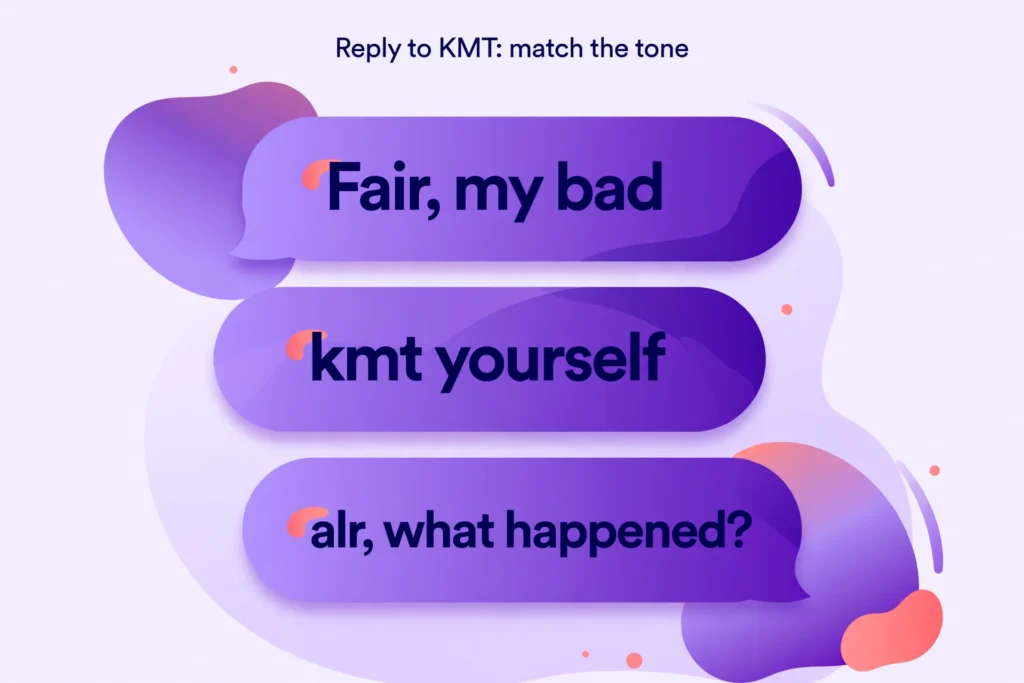
- Acknowledge it: “Fair, my bad — I’ll fix it.”
- Don’t argue with the gesture; address the reason behind it.
If it’s playful banter:
- Give it back: “kmt yourself 😂”
- “You know you love me.”
If you’re not sure how serious it is:
A short alr (“alr, what happened?”) keeps things open without escalating.
Let me know if you need a beat to figure it out: “lmk what I did and I’ll sort it.”
If they’re disapproving of a third party:
A for real backs them up: “fr, that was out of line.”
Nearby Expressions Worth Knowing
KMT has family members. A few live right next door:
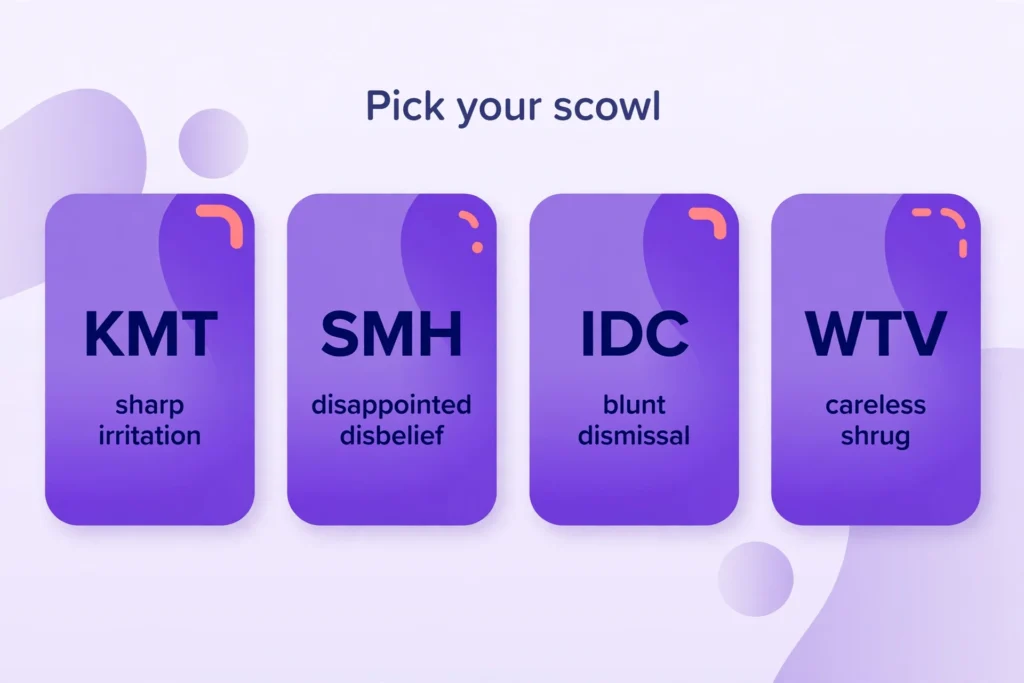
- SMH (“shake my head”) — the closest cousin. Both are typed-out body language of disapproval. SMH leans toward disappointed disbelief; KMT leans toward sharper irritation.
- IDC (“I don’t care”) — the blunter relative. IDC shuts the conversation down; KMT judges it.
- WTV (“whatever”) — the shrug to KMT’s scowl. WTV waves something away; KMT waves it away with attitude.
And one cultural note worth having: the actual teeth-sucking gesture has cousins everywhere — “tsk,” “tch,” and “mtchew” in other spellings all write out the same sound. KMT is just the three-letter version. Usage examples on Urban Dictionary document the “kiss my teeth” reading.
One Claim Not to Trust
A single slang-dictionary entry claims KMT is short for a vulgar phrase (“kiss my tip…”). That entry is one anonymous submission with no corroboration anywhere else — no usage examples, no other dictionary, no attested texting use. Treat it as noise, not a meaning. The documented reading, across every other source, is “kiss my teeth.”
Frequently Asked Questions
What does KMT mean in a text?
“Kiss my teeth” — the typed version of sucking your teeth in disapproval, annoyance, or disbelief. It comes from Jamaican and Caribbean slang.
Is KMT rude?
It can be. The gesture itself signals disapproval, so aimed at a stranger it reads as disrespectful. Between friends it’s usually playful. Read the relationship, not just the letters.
Where did KMT come from?
From “kissing teeth,” a nonverbal gesture of disapproval rooted in Jamaican and Caribbean culture. It moved into British urban slang and then into texting, with typed usage documented from around the late 2000s.
Can I use KMT at work?
No. It’s casual slang that reads as dismissive — the professional equivalent is saying the actual words, politely.
What’s the difference between KMT and SMH?
Both are typed body language of disapproval. SMH (“shake my head”) is disappointed disbelief; KMT (“kiss my teeth”) is sharper — more irritation, more attitude. See the SMH breakdown for the full comparison.
Is KMT only used in the UK?
No. It’s strongly associated with Caribbean diaspora communities and British urban slang, but the abbreviation is documented across English-speaking texting generally — it’s not platform-specific or country-locked.
Does it matter if it’s uppercase or lowercase?
No. “KMT” and “kmt” mean the same thing; people use both.
What should I reply when someone sends KMT?
It depends on the tone. If they’re annoyed with you, acknowledge it (“fair, my bad”). If it’s banter, give it back. If you’re unsure, a short “alr, what happened?” keeps the door open.
The Short Version
KMT means “kiss my teeth” — three letters for the teeth-sucking sound of disapproval, annoyance, or disbelief. It grew out of Jamaican and Caribbean slang, traveled through British urban texting, and works the same in any case. Read the tone: between friends it’s banter, toward strangers it’s a warning shot.
