
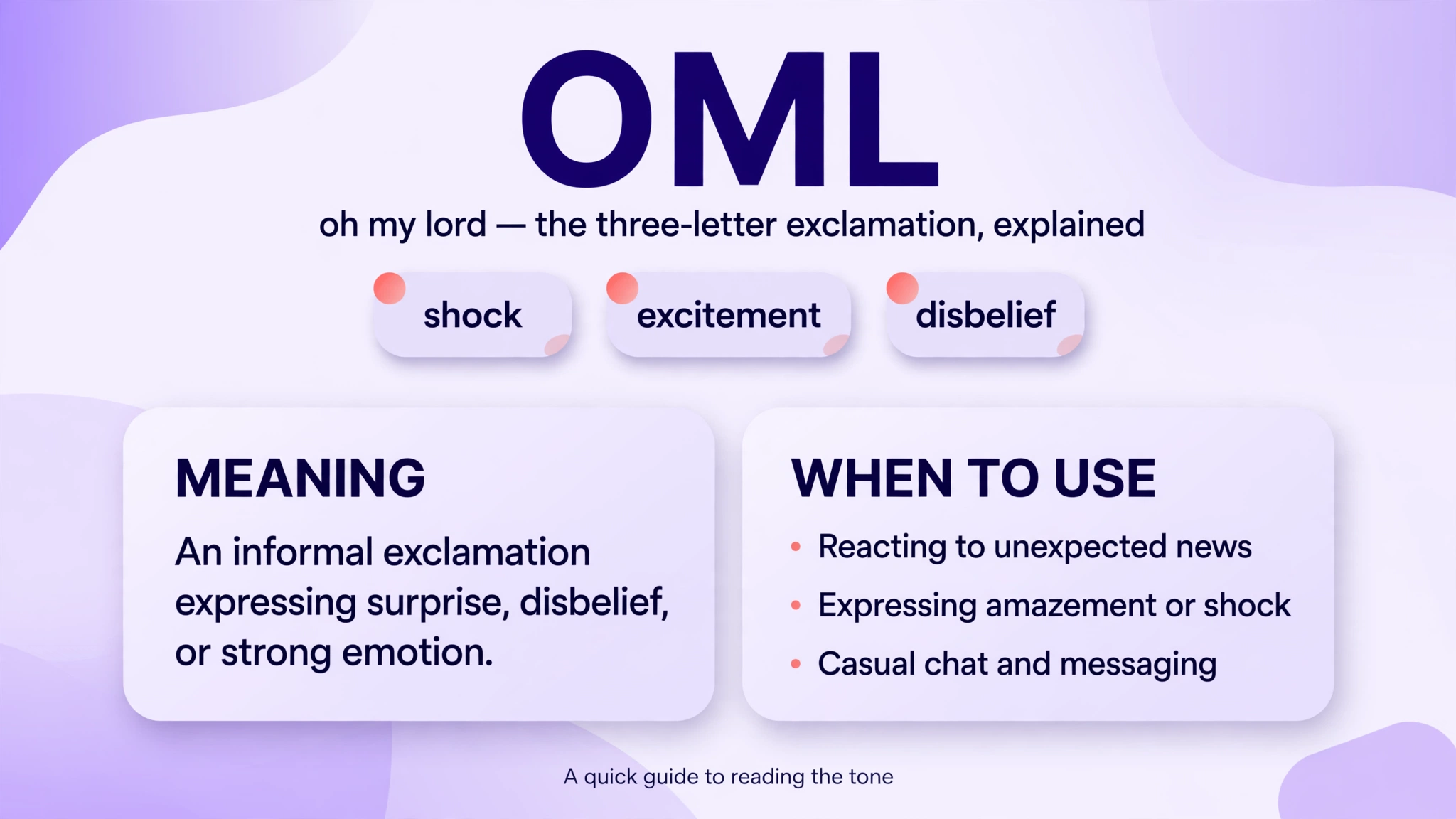
Some messages don’t ask for anything. They just detonate. You’re scrolling through a group chat, half paying attention, when three letters land like a firecracker: “oml.” No question, no request — just pure reaction, and suddenly everyone wants to know what happened.
OML stands for “oh my lord.” It’s an exclamation — the texting equivalent of throwing your hands up. Surprise, shock, excitement, disbelief, secondhand embarrassment: whatever the feeling, OML is what it looks like compressed into three keystrokes. This guide covers what OML means, the many moods it carries, the second meaning hiding behind it, and how to use it without sounding like a group-chat gremlin.
What OML Stands For
The default reading — the one behind nearly every “oml” you’ll ever receive — is “oh my lord.” It’s a reaction, not a question. Nobody texts “oml” to start a conversation; they text it because something just happened and their fingers couldn’t wait for a full sentence.
It works as a stand-in for the longer outbursts people make out loud: “oh my gosh,” “I can’t believe it,” “you’ve got to be kidding me.” The abbreviation keeps the emotion and drops the syllables. “OML that ending was insane” carries the same punch as a whole paragraph of disbelief.
There’s a second reading worth knowing: “on my life.” Same letters, completely different job. Where “oh my lord” is a reaction, “on my life” is an oath — a way of swearing something is true. “I didn’t touch your phone, oml” isn’t shock; it’s insistence. The sentence structure gives it away: when OML sits at the end of a denial or a claim, it’s the oath. When it leads the message, it’s the reaction.
A rarer variant, “oh my life,” floats around in some corners of texting. It means roughly the same as “oh my lord” — an emotional burst — but it’s uncommon enough that you shouldn’t assume it. Default to “oh my lord” unless the conversation points elsewhere.
The Many Moods of Three Letters
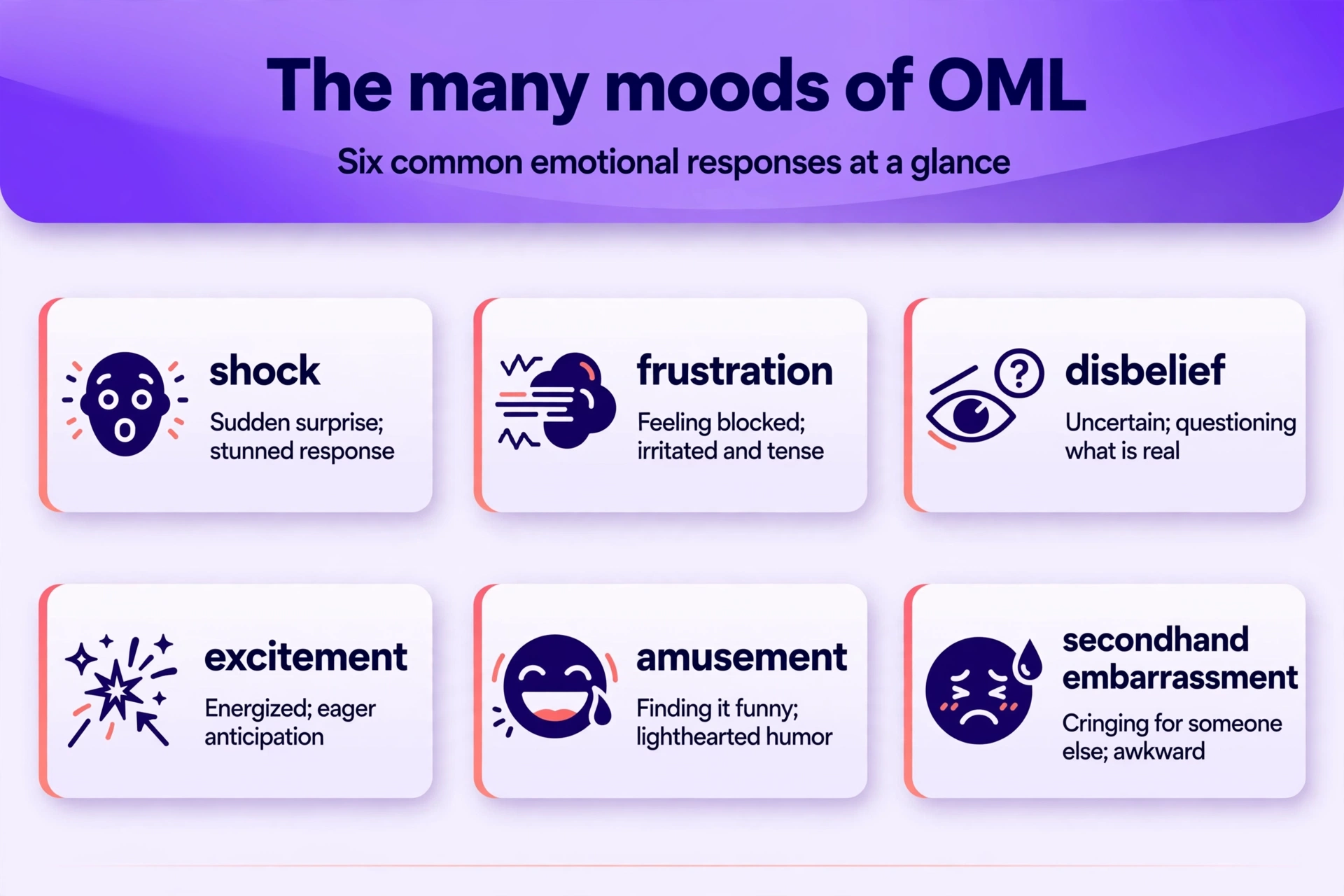
Here’s what makes OML tricky: it doesn’t belong to one emotion. It belongs to emotional intensity. The same three letters can mean wildly different things depending on what triggered them.
Shock:
“OML, did that really just happen?” — the jaw-drop. Something unexpected, and the texter is still processing it.
Excitement:
“OML we’re actually going!” — good news, big energy. This is the happy cousin of the shock version, and honestly the most common one in friendly chats.
Frustration:
“oml this traffic is unreal” — the vent. Not shocked, not happy — just at the end of a rope, and three letters is all the patience that’s left.
Amusement:
“oml stop, that’s so funny” — laughing through the keyboard. Often paired with crying-laughing emojis, which is how you know this one’s affectionate.
Disbelief:
“oml there’s no way” — the skeptic. Something sounds too wild to be true, and the texter needs convincing.
Secondhand embarrassment:
“oml I can’t watch this” — the cringe reaction. Someone else’s disaster, felt in your own stomach.
The punctuation is the decoder ring. A bare lowercase “oml” is usually soft — amused, mild, conversational. “OML” in capitals turns the volume up. “OML!!” or “oml??” is someone at peak feeling, whatever the feeling is. And “oml…” with an ellipsis has gone quiet — that’s disappointment or dread settling in.
For raw, unfiltered examples of how people actually use it, the Urban Dictionary entry for OML collects real-world definitions from texters themselves.
OML in Real Conversations
The exchanges below are illustrative examples, not real messages.
The good-news blast
- A: “I got the tickets!!”
- B: “OML YES we’re going!!”
Pure excitement, matched energy. When someone shares good news, an OML back says “I’m as hyped as you are” faster than any sentence could.
The plot twist
- A: “so he actually showed up”
- B: “oml stop. no way.”
Disbelief with a side of delight. B needs details, and “oml” buys the half-second before the follow-up question lands.
The vent
- A: “third delay this week, I’m going to lose it”
- B: “oml that’s actually awful”
Sympathy in three letters. B isn’t shocked — they’re commiserating. Same abbreviation, completely different temperature from the examples above.
The cringe watch
- A: “he just waved at someone who wasn’t waving at him”
- B: “oml I felt that in my soul”
Secondhand embarrassment, shared. This is OML as social bonding: I’ve been there, I feel your pain.
The oath
- A: “you ate my leftovers??”
- B: “I swear I didn’t, oml”
Here’s the second meaning in the wild. B isn’t reacting — they’re insisting. The OML sits at the end like a signature on a denial.
OML vs. the Other Exclamations
Reaction slang travels in packs, and these get mixed up.
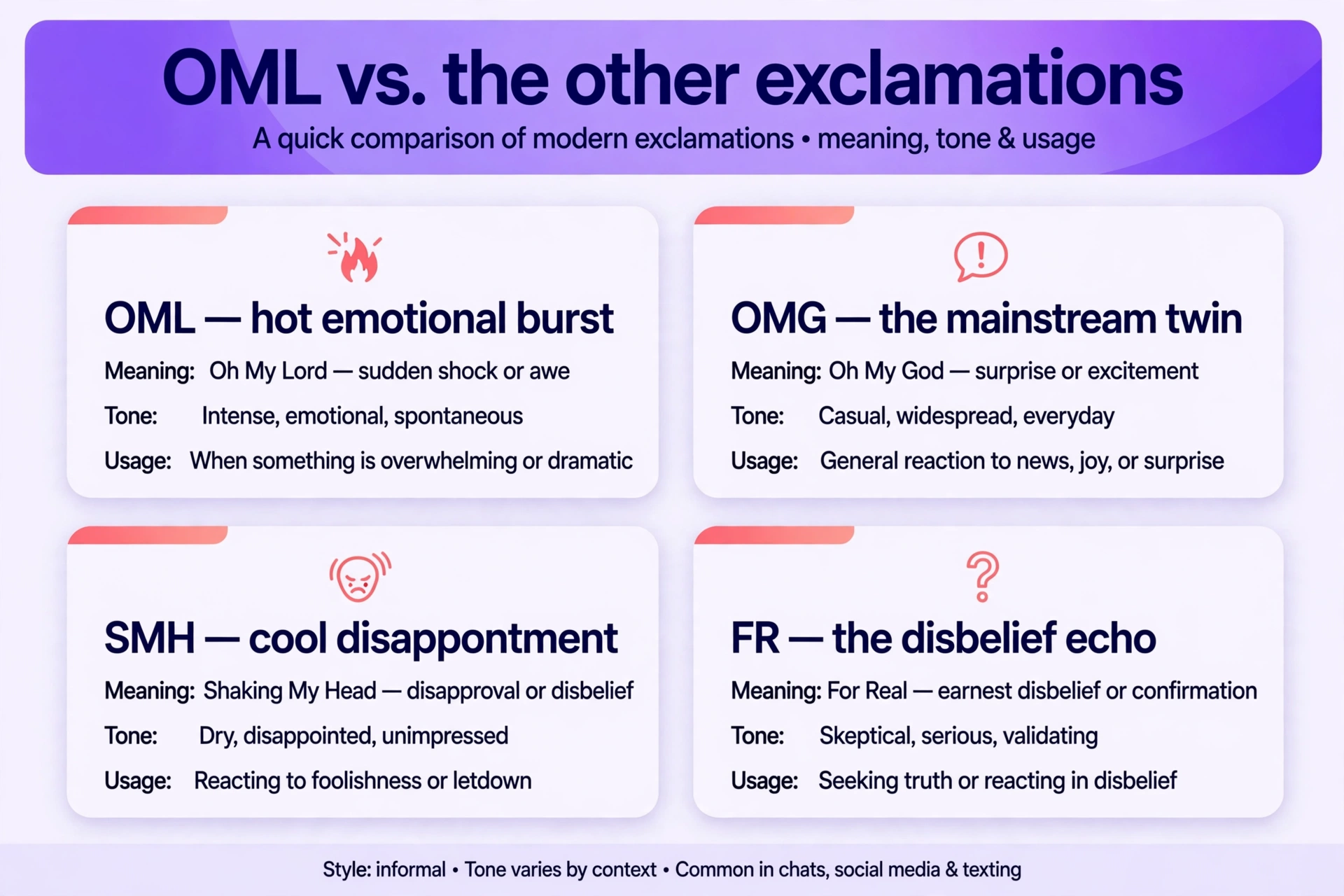
OML vs. OMG.
The obvious pair. They do the same job — emotional outburst — and in most texts they’re interchangeable. The difference is mostly flavor: OMG (“oh my god”) is the mainstream default; OML (“oh my lord”) feels a touch more dramatic, like something a character in a period drama would yell. Some people also reach for OML when they want to avoid “God” specifically. In practice, nobody will misunderstand you either way.
These are emotional opposites wearing similar clothes. OML is hot — shock, excitement, can’t-believe-it energy. SMH (shaking my head) is cool — disappointment, disapproval, “I expected better.” “OML he did WHAT” is scandalized delight; “smh he did what” is tired resignation. One’s a gasp, the other’s a sigh.
FR (“for real”) is the disbelief amplifier. Where OML is the initial burst, FR is what comes after: “oml??” … “fr?!” They’re teammates, not twins — OML reacts to the news, FR reacts to the reaction. You’ll often see them stacked together in group chats, each one turning the volume up a notch.
The through-line: OML is the all-purpose emotional flare. OMG is its mainstream twin, SMH is its cooler opposite, and FR is the echo that follows it.
How to Answer an “OML”
An OML doesn’t always need a reply — sometimes it’s just a reaction hanging in the chat, and the conversation moves on. But when it clearly wants a response, match the energy.
- Match the excitement: “IKR?!” — when the OML is happy, reflect it back. Enthusiasm loves company.
- Feed the curiosity: “okay spill, what happened” — when the OML is shock or disbelief, they want details. Ask.
- Offer the sympathy: “that’s rough, I’m sorry” — when the OML is frustration, don’t try to fix it. Just land next to them.
- Keep it moving: “let me know how it goes” — when the OML is about unfolding news, this hands the conversation a next step without demanding one now.
- Laugh along: “I’m crying, that’s hilarious” — when the OML is amusement, the only wrong answer is a dry “lol.”
And when the chat has run its course — the reaction’s been had, the story’s been told — TTYL closes it cleanly. If you’re heading out mid-conversation, GTG (got to go) is the honest exit: “this is wild — gtg, update me later.”
One thing not to do: don’t answer a shocked “oml” with a flat “ok.” It’s the conversational equivalent of shrugging at someone’s fireworks.

When OML Doesn’t Fit
OML is casual to its bones, and there are rooms it shouldn’t enter. Don’t use it with a boss, a client, a professor, or anyone you’re trying to impress — “OML the deadline moved” reads as unprofessional no matter how surprised you are. In those settings, write the feeling out: “That’s surprising news” costs you nothing and keeps your credibility.
It’s also the wrong tool when someone needs steadiness, not energy. If a friend is sharing genuinely bad news — a loss, a scare, a crisis — an “oml” can read as performative or flippant. Match the gravity instead: “I’m so sorry, are you okay?” lands better than any abbreviation.
And a note on the oath version: “on my life” carries weight precisely because it sounds like a vow. Don’t spend it on small things. Swearing “oml” over who finished the chips cheapens it for the moments when you actually need someone to believe you. (For the opposite end of the emotional spectrum — the flat, unbothered shrug — that’s IDC territory.)
Quick Answers
Q: What does OML mean in a text?
A: “Oh my lord” — an exclamation of surprise, shock, excitement, or disbelief.
Q: Is OML the same as OMG?
A: Almost. They do the same job, and most of the time they’re interchangeable. OML feels slightly more dramatic; OMG is the mainstream default.
Q: What does “oml” mean at the end of a sentence, like “I didn’t do it, oml”?
A: That’s the second meaning: “on my life” — an oath insisting something is true, not a reaction.
Q: How do you reply to OML?
A: Match the energy: share the excitement, ask for details, or offer sympathy — depending on which mood the OML is carrying.
Q: Is OML rude?
A: Not by itself. But it can feel flippant in serious moments or with people you don’t know well. Context sets the tone.
Q: Can I use OML at work?
A: No. It’s too casual for professional settings. Write the feeling out instead.
Q: What’s the difference between OML and SMH?
A: OML is hot emotion — shock, excitement, disbelief. SMH (shaking my head) is cool disappointment. A gasp versus a sigh.
Q: Does OML mean anything on Snapchat or Instagram?
A: The same as in texts — a reaction exclamation, in DMs, comments, and captions alike.
The Short Version
OML is “oh my lord” — three letters for the moments when a full sentence would take too long and feel too small. It carries whatever emotion is loudest in the room: shock, joy, frustration, secondhand embarrassment. Watch for the quieter second meaning (“on my life”) when it lands at the end of a denial, keep it away from work chats and heavy moments, and match the energy when someone fires one at you. Three letters, one rule: feel it first, type it second.
