
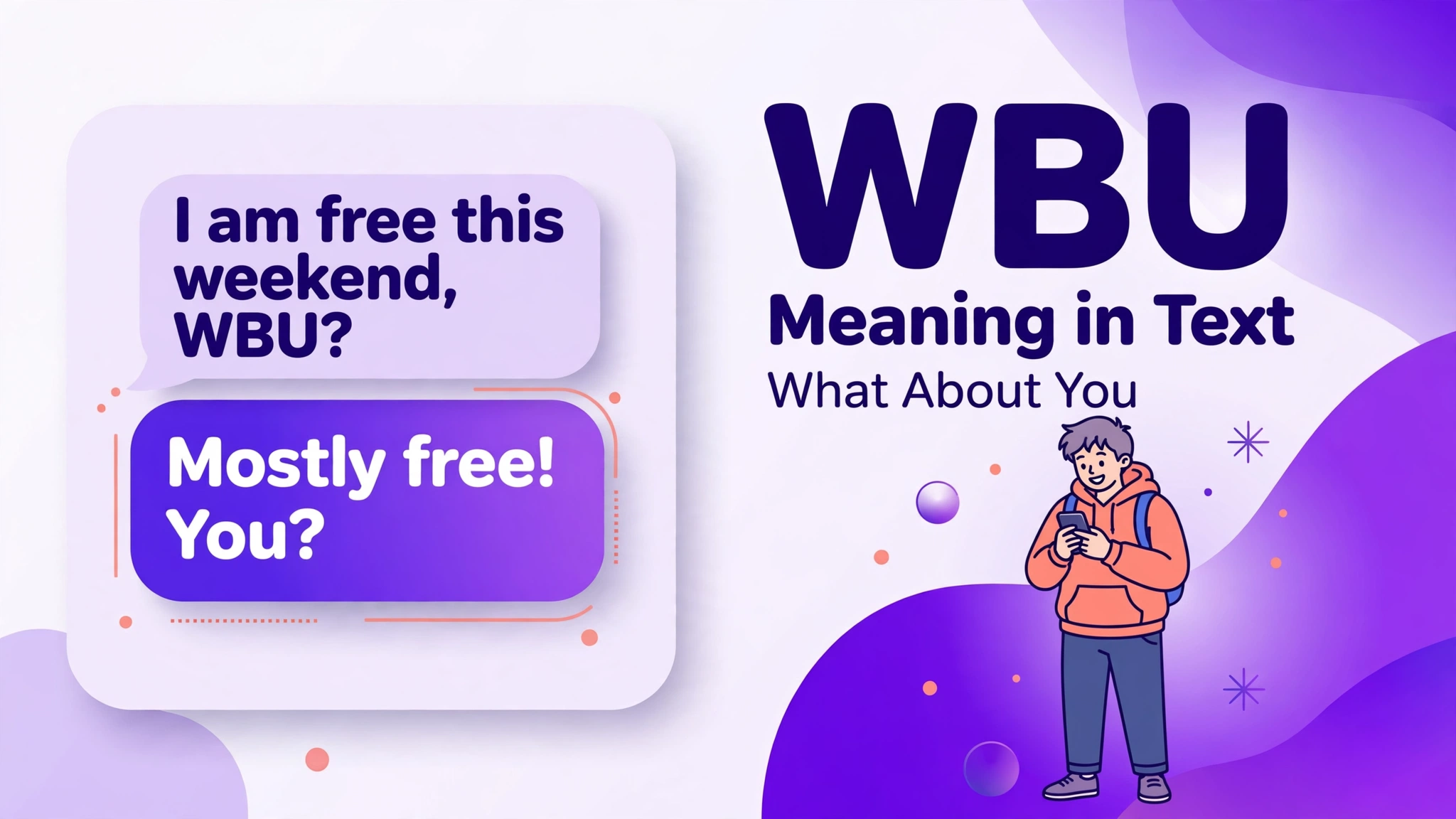
Someone just texted you "I'm free this weekend, WBU?" — and now you're wondering what those three letters want from you. Here's the short version: the wbu meaning in text is "What About You." It's the quickest way to hand a conversation back to the other person.
WBU stands for "What About You." After sharing something about themselves — a plan, an opinion, a feeling — the sender adds "wbu?" to ask for your side. It's the texting equivalent of tossing the ball back over the net.
What Does WBU Mean?
WBU means "What About You." The mechanics are dead simple:
- They tell you something about themselves.
- They add wbu? to ask the same thing about you.
In action:
Sam: I'm thinking of ordering pizza tonight. WBU?
You: I'm in. Half pepperoni?
Jess: I miss hanging out like we used to. WBU?
You: Same here, it's been too long. We should fix that.
Notice the shape of both examples: statement first, "wbu?" second. That order is the whole grammar of WBU. It almost never opens a conversation on its own — it returns one. In that way it's a close sibling of HBU ("how about you"), and most people use the two interchangeably without a second thought.
One spelling note: you'll usually see wbu in lowercase, because that's the speed of casual texting. Capitalization changes nothing. And yes, "about" became "bout" became "bu" — that's just how spoken shortcuts get fossilized into text.
The Topic-Mirror Test: WBU's Real Job
Here's the reader test that makes WBU click — call it the Topic-Mirror Test. WBU doesn't just return a question. It returns the topic. To decode any "wbu?", look at the sentence right before it and ask: what is that sentence about?
- "I'm free this weekend, WBU?" → the topic is weekend plans. They're asking about your plans.
- "I love horror movies, WBU?" → the topic is taste in movies. They're asking for your pick.
- "I'm exhausted today, WBU?" → the topic is how you're feeling. They're asking about your state.
See the pattern? WBU is a mirror. Whatever the sentence before it is about — plans, opinions, feelings, experiences — WBU points that exact topic at you. This is why a bare "wbu?" with no setup feels confusing: there's nothing to mirror. The test fails, and so does the message.
This mirror quality is also what separates WBU from a plain question. "What are you doing tonight?" asks one specific thing. "I'm going out tonight, WBU?" asks whatever you want to share about tonight — plans, mood, excuses, all fair game. WBU is wider and warmer than a direct question, which is exactly why people reach for it in casual chat.
WBU vs HBU: "What" vs "How" Actually Matters
Let's settle the internet's favorite tiny debate. HBU ("how about you") and WBU ("what about you") are used interchangeably by most texters — nobody will misunderstand you if you swap them. But the words underneath carry a real, if subtle, difference:
- HBU = "HOW about you" → asks about your state. How are you feeling? How's your day going? How's life? It leans toward moods and conditions.
- WBU = "WHAT about you" → asks about your content. What do you think? What are your plans? What about your side of this? It leans toward opinions, preferences, and plans.
Compare:
- "I'm feeling pretty tired today. HBU?" → natural. (State → state.)
- "I'm thinking of ordering pizza tonight. WBU?" → natural. (Plan → plan.)
- "I'm feeling pretty tired today. WBU?" → fine, nobody blinks.
- "I'm thinking of ordering pizza tonight. HBU?" → also fine, nobody blinks.
So it's a lean, not a law. But here's the practical takeaway: when you're swapping opinions or making plans, WBU sounds a hair more natural. When you're checking in on someone's mood or day, HBU sounds a hair warmer. Native texters feel this without being able to explain it — now you can.
Where You'll See WBU: TikTok, Snapchat, Instagram, and Texting
WBU keeps the same meaning everywhere, but each platform gives it a slightly different stage:
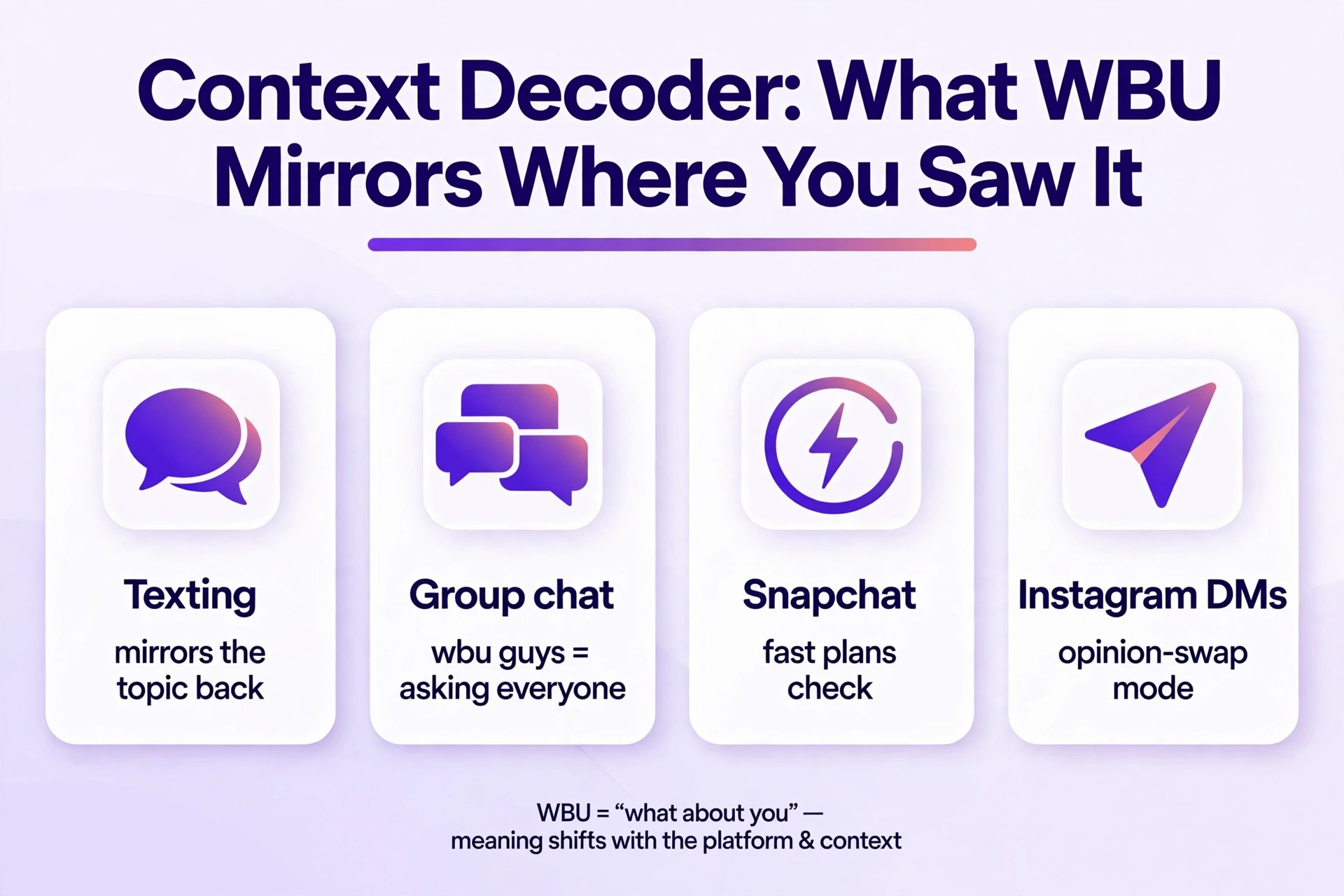
Texting (SMS, WhatsApp, iMessage). WBU's natural habitat. One-on-one chats are where the mirror works best: "I'm about to grab some food, WBU?" Quick, balanced, done. It also shows up in family group chats, where it does the polite work of including everyone.
Group chats. Like its sibling HBU, WBU picks up a helper in groups: "wbu guys?" / "wbu everyone?" A bare "wbu?" in a 12-person chat creates a bystander effect — everyone assumes someone else will answer. The helper word fixes that.
Snapchat. Fast and casual, often mid-streak: "on my way home, WBU?" On Snap, WBU skews toward logistics and immediate plans rather than deep feelings. The platform's speed rewards the shortest possible bounce-back.
Instagram DMs. In DMs, WBU shines in early conversations and comment replies: "Just posted my new setup, WBU — what are you working with?" It's an invitation disguised as a question, and it works because answering feels easy.
TikTok comments. "This trend is so overdone, WBU?" — comment-section WBU is almost always opinion-swap mode. Someone states a take, then mirrors it at the crowd. Expect hot takes in the replies.
Discord and gaming chats. "Grinding ranked tonight, WBU?" Gaming WBU is pure coordination: who's in, who's out, what's the plan. The mirror here reflects availability, not feelings.
WBU Tone Check: Direct, Warm, or Flat?
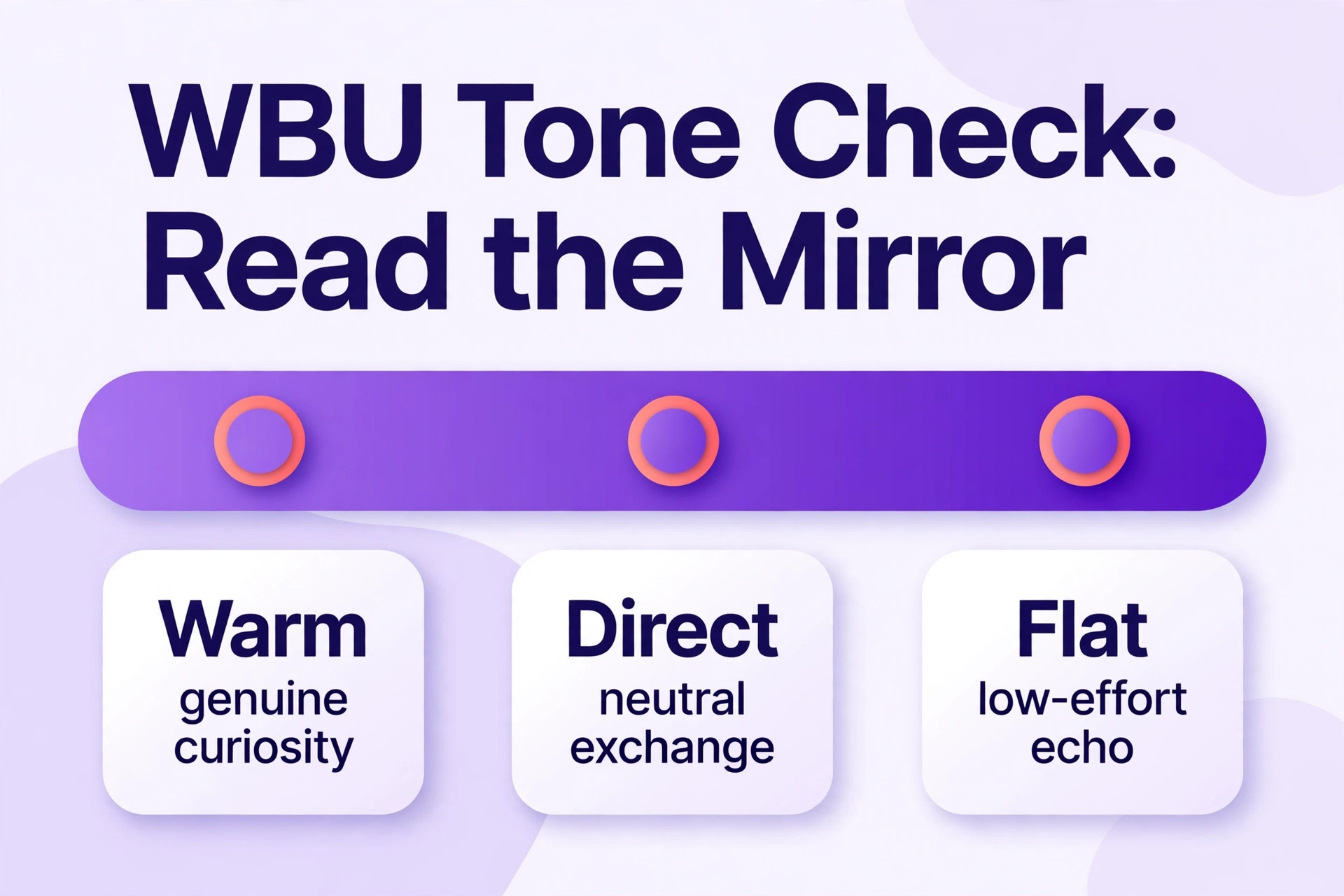
WBU's tone lives or dies on context. Three readings to watch for:
Warm WBU genuinely wants your answer. It comes wrapped in real sharing and often a follow-up: "I love hiking at dawn, it's my reset. WBU — do you have a thing like that?" The sender has invested; they're inviting you to invest too.
Direct WBU is neutral and functional — the conversational equivalent of a nod: "I'm grabbing coffee, WBU?" No warmth, no coldness, just the exchange ticking along. This is the default setting of most WBU you'll encounter.
Flat WBU is the low-effort echo. You've written three thoughtful paragraphs about your week; back comes "ok wbu." That flatness can sting, because the mirror is reflecting your effort back at a fraction of its size. A flat WBU sometimes carries a whisper of IDC energy — not rude exactly, just checked out.
How to tell them apart? Look at the ratio of what came before the WBU. Long, detailed setup → the WBU inherits warmth. Two-word setup → the WBU is just keeping the lights on. And punctuation talks: "WBU?" is engaged, "wbu" is chill, "wbu." with a period can read clipped.
Sender Context: Who's Asking Changes the Question
The mirror reflects the sender too. The same "wbu?" means different things from different people:
From a friend, WBU is conversational autopilot — the friendly habit of never letting a chat go one-sided. "I hate Monday mornings, WBU?" Answer with the same honesty you'd want back.
From a crush, WBU is often a door held open. "I love this song, WBU?" isn't really about the song — it's about keeping you talking. The move: answer, then give them something to grab onto. "Same! Have you heard the acoustic version?"
From a partner, WBU usually carries real curiosity: "I'm thinking we should get away this weekend, WBU?" They're not making small talk; they're making plans with you. Treat it like the invitation it is.
From a coworker in a casual channel, WBU is safe small talk: "I'm done for today, WBU?" Keep it light and brief. In anything resembling a formal thread, spell it out — "What about you?" costs four extra seconds and buys a lot of professionalism.
In a dating-app chat, WBU does heavy lifting in the getting-to-know-you phase: "I'm really into photography, WBU?" It's low-pressure by design. Answer with something specific — "same" kills momentum, but "I'm more of a film-camera person, still learning" gives them three threads to pull.
From a stranger in comments, WBU is crowd-work: "Unpopular opinion: this movie is boring, WBU?" They're not asking you specifically — they're asking the room. Reply only if you want the debate.
How to Reply to WBU Without Sounding Robotic
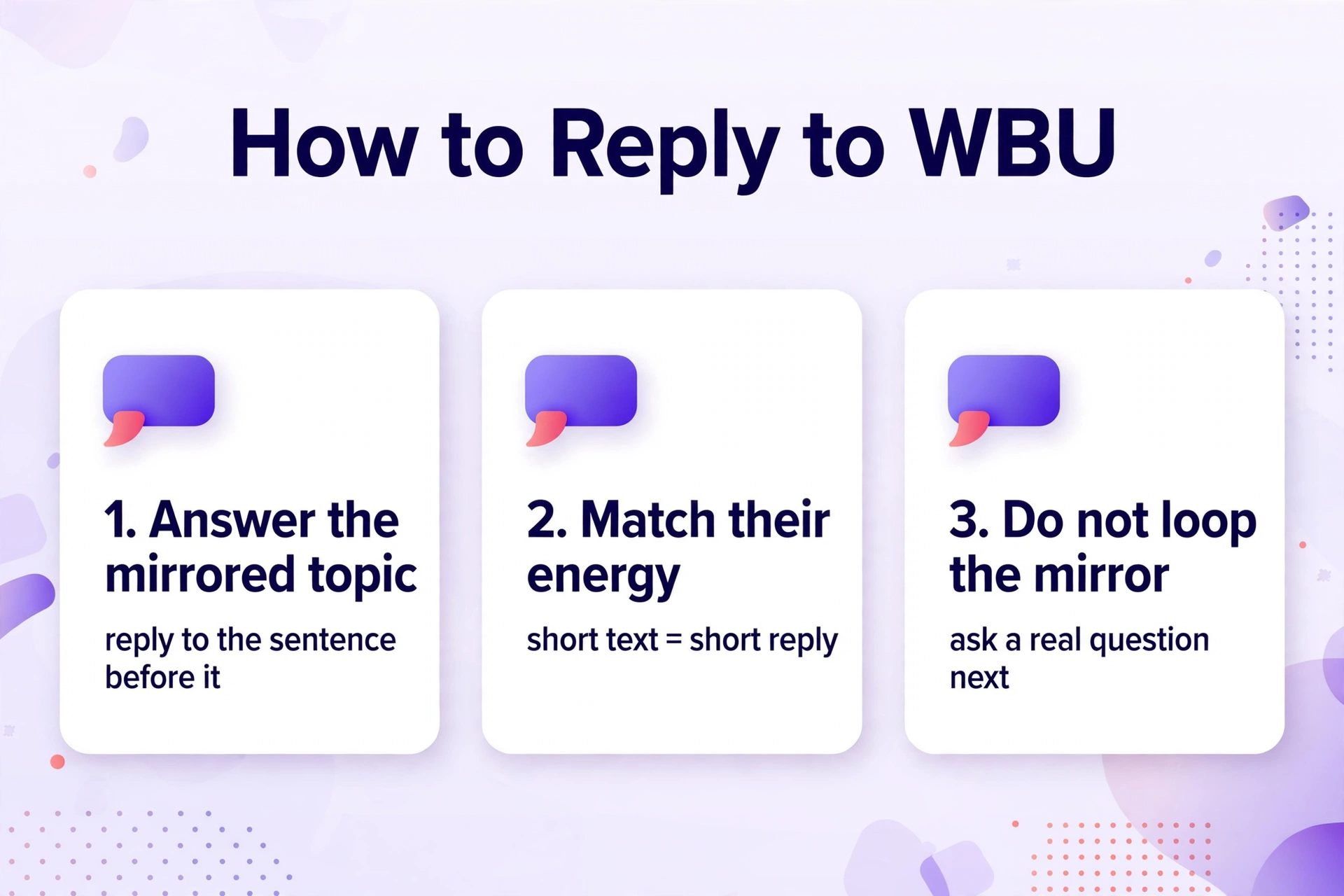
The golden rule: answer the mirrored topic, not just the letters. WBU is asking about something specific — the sentence before it. Reply to that.
1. Mirror back with substance. "I'm free this weekend, WBU?" → "Mostly free! Was thinking of a hike Saturday. WBU — I mean, beyond asking me?" One real detail beats ten empty words. (Okay, skip the joke. Mostly.)
2. Match their energy, then add one thread. Short text → short reply. Long text → longer reply. Then add one new question or detail so the chat has somewhere to go: "Same here, just chilling at home. Seen anything good lately?"
3. Don't loop the mirror. "WBU?" → "nm, wbu?" → "same, wbu?" is how conversations go to die. If you've bounced it back twice, break the loop with a real question: "Okay enough wbu-tennis — what did you think of the game last night?"
When you don't want to answer, you can deflect without being rude: "Haha, long story — let's talk later?" or pivot with LMK: "Not sure yet, LMK what you end up doing." WBU doesn't obligate you to a full autobiography.
And if their message genuinely confused you before the "wbu?" landed, check WDYM first. Answering the wrong mirrored topic is worse than asking for clarity.
A few ready-made replies:
- Casual: "Not much, just relaxing at home. WBU?"
- Friendly: "Pretty good actually! What made your day crazy?"
- Playful: "Saving the world, you know, the usual 😎 WBU?"
- Honest: "Honestly? Tired. This week's been a lot. WBU?"
WBU vs Similar Slang
| Term | Meaning | How it differs from WBU |
|---|---|---|
| HBU | How about you | Near-twin; "how" leans to state/mood, "what" leans to opinions/plans |
| WYD | What you doing | Asks about current activity; works as a standalone opener |
| WYA | Where you at | Asks about location specifically — a narrower mirror |
| HRU | How are you | Asks about feelings directly; doesn't need a setup sentence |
| TBH | To be honest | Signals honesty incoming; WBU signals curiosity incoming |
| FR | For real | Adds sincerity emphasis; often pairs with WBU: "that test was brutal fr, wbu?" |
The trickiest pair is WBU vs WYD. WYD ("what you doing") is an opener — it starts conversations by asking about right now. WBU is a return — it continues conversations by mirroring the topic. "WYD tonight?" starts the plan; "I'm free tonight, WBU?" continues it.
When Not to Use WBU
WBU is friendly, but it has boundaries:
- Work emails and formal writing. "I've completed my section of the proposal. WBU?" reads abrupt. Write "What are your thoughts?" or "How about you?" instead.
- Serious or emotional moments. "Sorry for your loss, wbu?" is the canonical example of what not to do. Some sentences should never be mirrored.
- When you need depth. If the conversation matters, spell things out. "WBU?" after a heartfelt confession can feel like you skimmed it.
- With people unfamiliar with slang. Not everyone texts in abbreviations. With parents, teachers, or clients, the full "what about you?" is always safe.
- On the third bounce. If you've already traded "wbu?" twice, a third one isn't polite — it's a loop. Ask a real question instead.
Quick Answers
What does WBU mean in text?
WBU means "What About You." It's used to return a question or topic to the other person after sharing something about yourself — for example, "I'm free this weekend, WBU?"
Is WBU the same as HBU?
Functionally, yes — most people use them interchangeably. The subtle difference: HBU ("how about you") leans toward asking about someone's state or mood, while WBU ("what about you") leans toward opinions, plans, and preferences.
Is WBU rude?
No. WBU is friendly by default. But a bare "wbu" after a long, heartfelt message can read as low-effort or dismissive — match the other person's energy.
Can I use WBU at work?
Avoid it in emails and formal messages. In casual chats with friendly coworkers it's fine, but "what about you?" spelled out is the safer choice.
What's the best reply to WBU?
Answer the topic they mirrored — not just the letters. Give one real detail, match their energy, and add a question or thread so the conversation keeps moving.
Does WBU mean anything else?
In texting, no — it's "what about you" essentially every time. The same letters are also used by a few organizations (like a university or a boxing body), but in a chat, context makes the meaning obvious.
WBU is the mirror of modern texting: whatever someone holds up — a plan, an opinion, a feeling — it reflects right back at you. Run the Topic-Mirror Test, answer the topic instead of the letters, and you'll never get stuck on "wbu?" again.
