
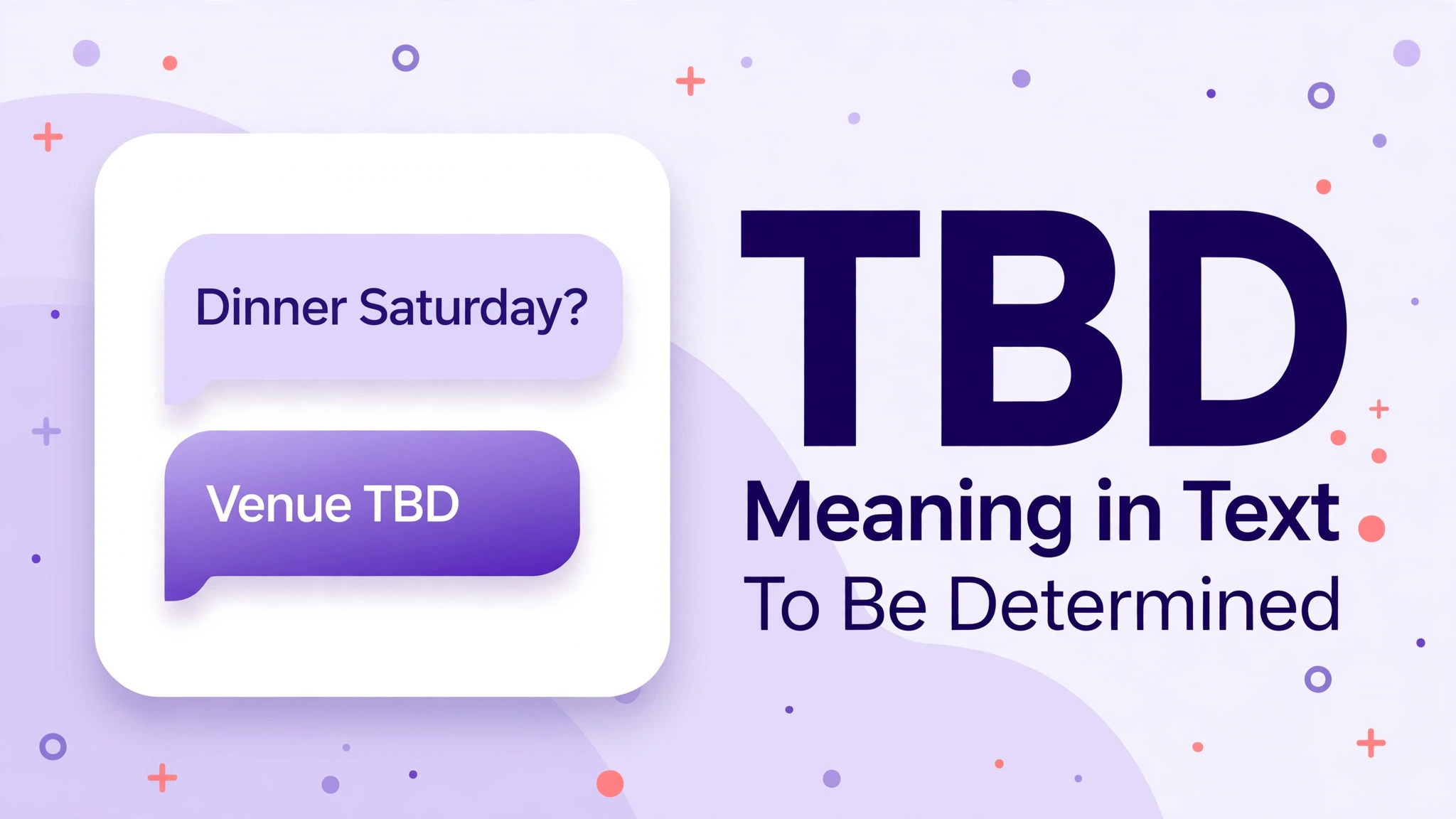
"Movie night Friday, time TBD." You stare at the message. Is this a real plan, or is it evaporating before your eyes? Welcome to the most useful three letters in group-chat history — once you understand the tbd meaning in text, you'll know exactly when to relax and when to nudge.
TBD stands for "to be determined" (or, interchangeably, "to be decided"). It's a placeholder, not a promise — a way of saying "this part of the plan exists, but the details aren't locked yet." Think of it as the texting world's loading screen.
What Does TBD Mean?
TBD means one specific detail is still undecided. That's the whole idea, and it's worth stating plainly because people misuse it constantly: TBD attaches to one missing piece of an otherwise real plan.
Real-world TBD, done right:
Sam: Dinner Saturday? Venue TBD, but let's say 7pm.
You: Sounds good, lmk when you pick a spot.
The plan is real (dinner, Saturday, 7pm). One detail is TBD (the venue). That's the pattern — a sentence with a spine, and one soft spot.
Where people go wrong is the floating TBD, the kind that attaches to nothing:
Sam: We should hang out sometime. Plans TBD.
There is no plan here. There's a vibe. And that difference — a named missing piece versus a vague wish — is the most important thing this article will teach you, so let's make it a test.
The Placeholder-vs-Punt Test
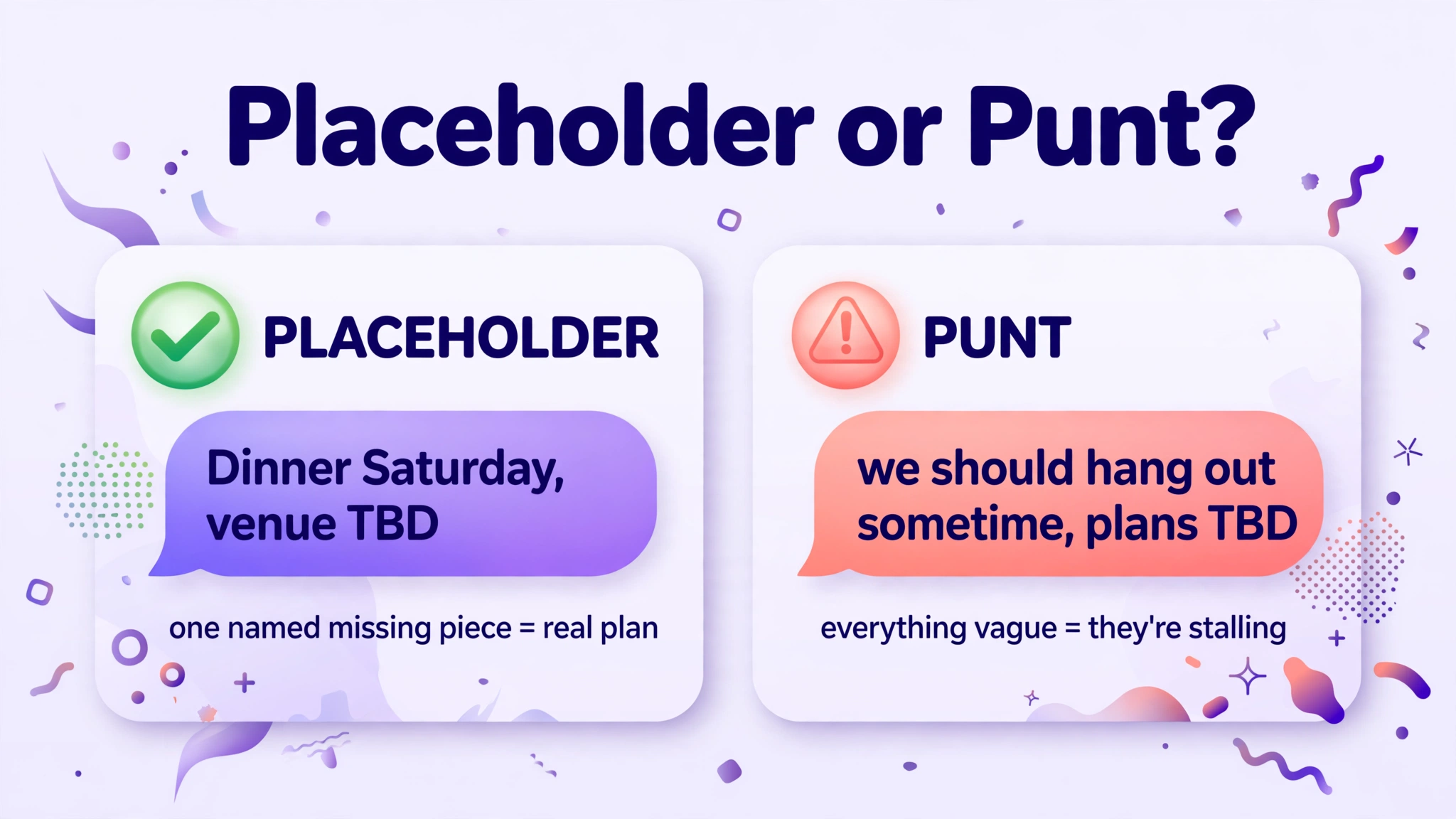
Here's the named trick for reading any TBD you receive. It's called the Placeholder-vs-Punt Test, and it takes about three seconds.
Step 1: Ask what the TBD is attached to. Did the sender name one specific missing detail — a time, a venue, a date, a name? Examples: "time TBD," "location TBD," "date TBD."
- One named missing piece → PLACEHOLDER. The plan is real. Sit tight and wait for the update — or ask one clean follow-up question (more on that below).
Step 2: If everything is TBD — the when, the where, the what — it's a PUNT. "Plans TBD" with no specifics isn't a plan; it's a way of sounding busy without committing. Don't chase it. One light nudge is fine ("no worries, lmk when it firms up"), and then let it go.
This test matters because TBD is the most-abused abbreviation in casual planning. Run the test and you'll instantly know whether you're looking at a calendar entry or a polite dodge. And yes — the same reading skill works on IDC energy, where a shrug can mean "genuinely indifferent" or "I don't want to decide"; context, not the letters, decides.
One more note while we're here: "to be decided" and "to be determined" mean the same thing in a text. Dictionaries list both, and no source separates them by context. If someone tries to correct you on which one TBD "really" stands for, they're inventing a rule that doesn't exist.
TBD vs TBA vs TBC: The Decision Ladder
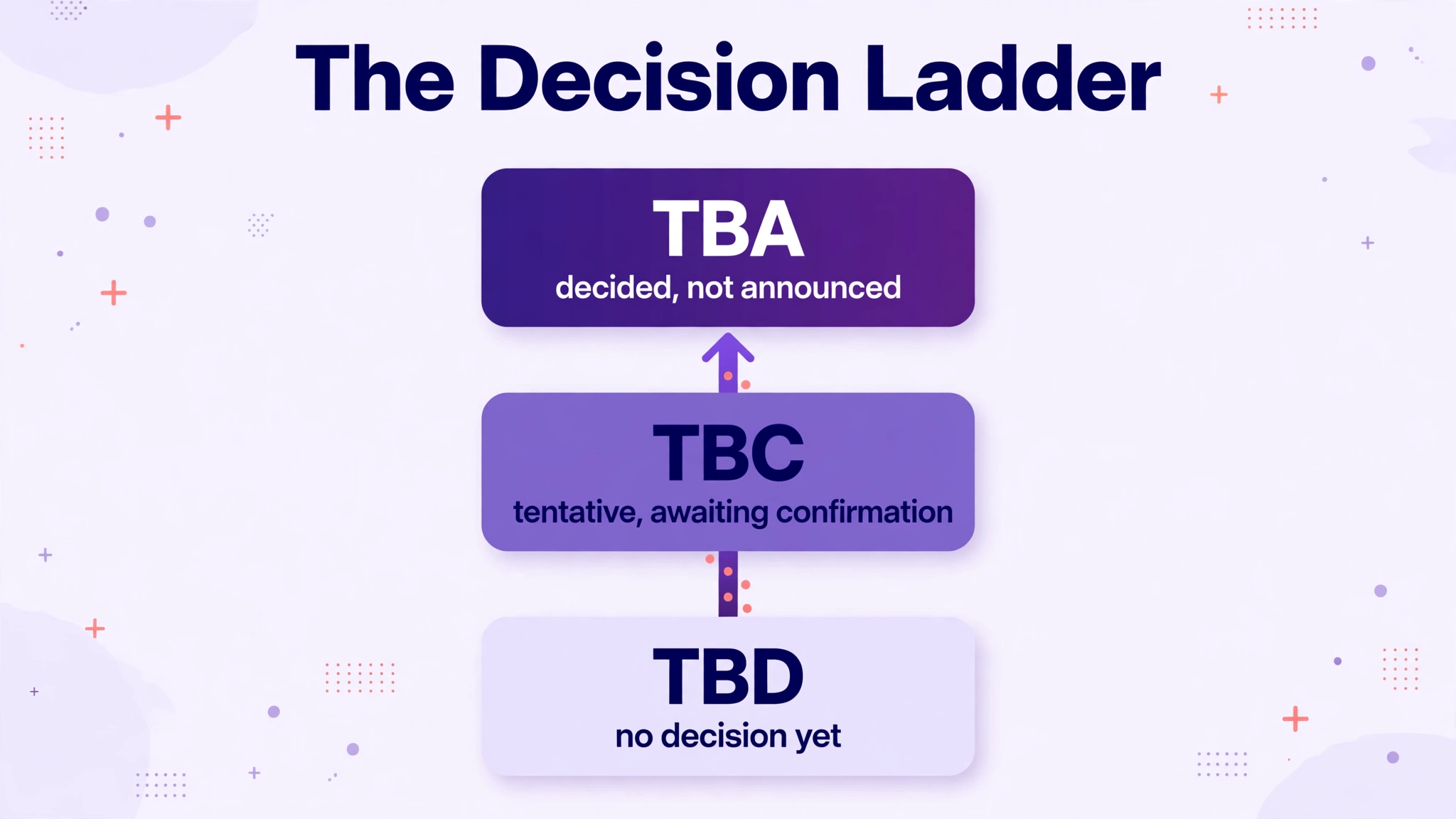
TBD has two close cousins, and mixing them up is how plans die. Here's the distinction most people never learn — call it the Decision Ladder. Each rung is a different stage of decided-ness:
| Abbreviation | Stands for | What it actually means | When to use it |
|---|---|---|---|
| TBD | To be determined | No decision has been made yet | "Catering TBD" — nobody has chosen the caterer |
| TBC | To be confirmed | A tentative choice exists, awaiting confirmation | "Venue TBC (Rooftop Bar)" — leaning yes, not locked |
| TBA | To be announced | Decided, but not yet public | "Headliner TBA" — they know, they're building suspense |
Walk up the ladder: TBD is the least certain, TBC is the middle, TBA is basically decided. Using "TBA" when you actually mean "we have no idea" creates false confidence; using "TBD" when the decision is made just looks disorganized. Get the rung right and your group chat will run noticeably smoother.
This isn't just pedantry — the ladder is the operational upgrade this article adds over anything else ranking for this keyword. Nobody else states it as a rule. Memorize the ladder, and every schedule you read gets clearer.
Where You'll See TBD: TikTok, Snapchat, Instagram, and Texting
TBD means exactly the same thing everywhere — no platform changes the definition. What changes is what people attach it to. Here's the documented landscape:
Texting (SMS, WhatsApp, iMessage, group chats). This is TBD's home turf and where the Placeholder-vs-Punt Test earns its keep. Group-chat planning is the classic use: "Dinner Saturday, venue TBD." One-on-one, it softens scheduling pressure: "I can do Friday or Saturday, time TBD." It's also the natural partner of LMK — "venue TBD, lmk if you have ideas" is practically a template at this point.
Instagram. On Instagram, TBD lives in captions and stories: countdown stickers with "date TBD," event announcements, "drop TBD" on merch posts. It's the public-facing version of the same placeholder — a promise of something coming, with one detail held back. Stories are its favorite habitat, because the 24-hour format forgives vagueness.
TikTok. In TikTok comments and captions, TBD skews playful: "part 2 TBD 👀" under a viral video, "storytime TBD" as a teaser. The meaning is identical — one undecided detail — but the vibe is hype-building rather than planning. Creators use it the way event organizers use TBA's little brother.
Snapchat. On Snap, TBD is quick and disposable, matching the app's speed: "pulling up, time TBD" in a streak conversation, or a snap caption of an unfinished plan. It rarely survives long enough to need a follow-up, which is fine — Snapchat TBDs are placeholders for the next few hours, not the next few weeks.
Notice the pattern: the meaning never moves. Only the stakes change — a wedding venue TBD is a bigger deal than a Snapchat plan TBD, and your follow-up should match.
Reading the TBD You Got: Tone and Sender Context
TBD is tone-neutral by default — dictionaries mark it flatly, with no attitude attached. But in real conversations, it picks up color from who's sending it and what came with it.
The diligent planner sends TBDs with specifics and follow-through: "Venue TBD — checking two places tonight, will confirm by 9." This person is using the abbreviation correctly. Trust them.
The chronic TBD-er sends floating TBDs as a lifestyle: "we should do something, plans TBD" every other week, with no follow-up ever arriving. Run the Placeholder-vs-Punt Test, recognize the punt, and stop building your weekend around them.
The workplace TBD is its own species: "Meeting agenda TBD," "Q3 dates TBD." In professional contexts it's completely standard — it means someone owns the decision and hasn't made it yet, a close cousin of the FYI heads-up. Treat it as neutral, and if you need the answer, ask the owner directly instead of replying-all with a WDYM-style "wait, what does that mean?"
The soft letdown is the one to watch for: "Friday still on? — hmm, time TBD 😅" after days of silence. That TBD isn't a placeholder; it's padding around a no. The emoji is doing the apologizing the words won't. A little TBH-style honesty ("tbh, I don't think Friday works for me") would be kinder — but read the TBD kindly anyway, and accurately.
From a crush or someone new, an early TBD is neutral-to-positive: "Coffee sometime? Place TBD" means they're interested but genuinely undecided — not playing games. Don't overthink it; suggest a place and watch what happens.
How to Reply to TBD Without Sounding Pushy
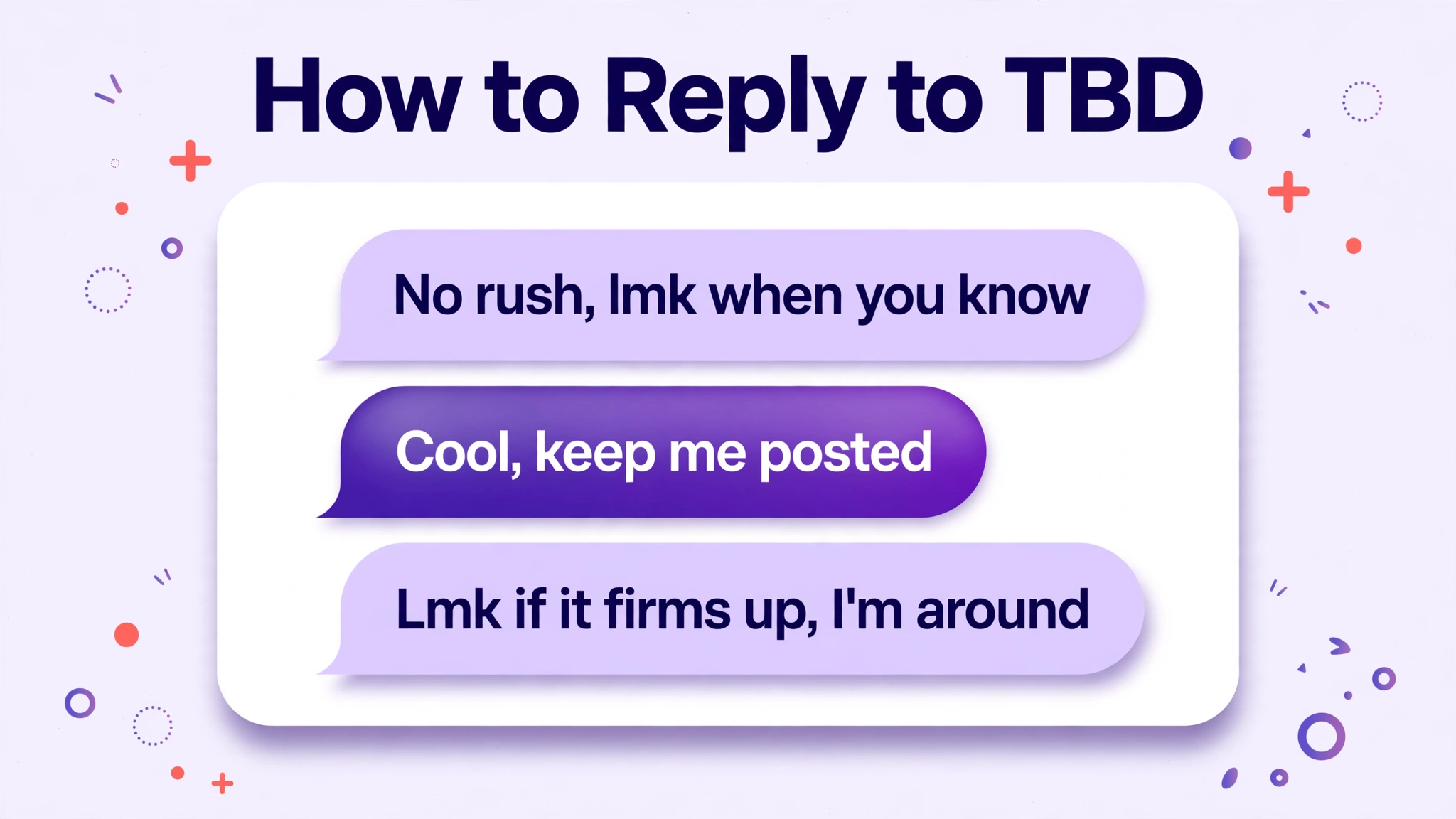
Responding to a TBD is a social skill, because the line between "helpful follow-up" and "annoying pressure" is thin. Here are copy-ready moves for each situation:
The placeholder (one named missing piece). One clean question, zero pressure:
- "No rush — just lmk when you know the time."
- "Cool, happy with either place. Keep me posted."
- "Sounds good! Ping me when the venue's set."
The punt (everything TBD). Nudge once, lightly, then release:
- "Haha fair — lmk if it firms up, I'm around."
- "No worries, just loop me in if it becomes a thing."
When YOU need the answer. Sometimes the TBD is blocking your own plans. Then you're allowed one direct ask:
- "Hey, any update on the time? Need to plan around it."
- "Just checking in — has the venue been confirmed?"
When you're the one sending TBD. Use it well: name the missing piece, name the decision-maker (even if it's you), and give a when: "Venue TBD — I'm calling them tomorrow, will confirm by evening." That one sentence is the difference between a planner and a flake. If the plan isn't real yet, don't dress it in TBD; a BTW-style honest aside works better: "btw this is still just an idea, nothing set."
TBD vs Similar Slang: Don't Mix These Up
TBD lives in the planning corner of texting slang. Here's how it relates to its neighbors:
| Term | Meaning | The difference |
|---|---|---|
| TBD | To be determined | One detail undecided; the rest is real |
| TBA | To be announced | Already decided, just not public yet |
| TBC | To be confirmed | Tentative choice exists, awaiting lock-in |
| LMK | Let me know | The follow-up instruction; pairs naturally with TBD |
| IDC | I don't care | A shrug about the decision; TBD is about the decision being pending |
| FYI | For your information | A heads-up with no action needed; TBD usually wants a future update |
| AFK | Away from keyboard | About availability right now, not about undecided plans |
| WYD | What you doing | Asks about the present moment; TBD is about the future |
The most useful pair in daily texting is TBD + LMK. TBD names the gap; LMK assigns the follow-up. Together they're the complete grammar of casual planning.
Debunked: What TBD Does NOT Mean
Because TBD is short and common, junk meanings have accumulated around it. Let's clear them honestly:
- "To be discussed" — wrong. This one shows up on thin content sites, and at least one competitor explicitly calls it a misconception. There is no dictionary support for it. If the plan needs discussion, that's a meeting, not a TBD.
- Flirty or sarcastic secret meanings — invented. One thin site claims a winking "plans TBD 😉" is Gen-Z flirt code. No dictionary, no attestation, no evidence. A wink after a TBD is the sender being playful, not the abbreviation having a second definition.
- Technical expansions (Temporary Backup Device, Torpedo Boat Destroyer, etc.) — real, but not texting. These are genuine initialisms in military, tech, and engineering writing. In a chat about Friday plans, they never apply. In texting, TBD is "to be determined/decided" every single time.
When Not to Use TBD
TBD is useful, but it has failure modes. Skip it when:
- The plan needs a decision from you right now. "Dinner tonight? — venue TBD" when you're the one who was supposed to book is just procrastination with better branding.
- Someone is waiting on you for something time-sensitive. A bare "TBD" on a deadline reads evasive. Give the date you'll have the answer instead.
- You've used it three times on the same plan. Repeated TBDs without updates train people to stop believing your plans. Either decide or admit it's not happening.
- The news is bad. "Results TBD" after a medical test or a job interview isn't reassuring — it's suspense nobody asked for. A real sentence is kinder.
Quick Answers
What does TBD mean in text?
TBD means "to be determined" (or "to be decided"). It marks one specific detail of a plan as still undecided — for example, "Dinner Saturday, venue TBD" means the dinner is real but the venue isn't chosen yet.
Is TBD the same as TBA?
No. TBD means no decision has been made yet. TBA ("to be announced") means the decision is already made but hasn't been shared publicly. TBC ("to be confirmed") sits between them — a tentative choice awaiting lock-in.
What should I reply when someone texts TBD?
If it's a placeholder (one named missing piece), one light follow-up is perfect: "No rush, lmk when you know." If it's a punt (everything vague), nudge once — "lmk if it firms up" — and let it go.
Is TBD rude?
No, it's neutral. But a floating TBD with no specifics and no follow-up can read as evasive or non-committal, especially if it becomes a pattern. Name the missing piece and give a timeline to keep it friendly.
Can I use TBD at work?
Absolutely — it's standard in professional writing: "Agenda TBD," "Q3 dates TBD." It's one of the few texting abbreviations that's fully at home in an office.
Does TBD mean anything else?
In texting, no — it's "to be determined/decided" every time. In technical or military writing the same letters can stand for other things (like "torpedo boat destroyer"), but context makes that obvious.
TBD is a small abbreviation doing a big job: it keeps plans alive while the details catch up. Run the Placeholder-vs-Punt Test on every TBD you get, climb the Decision Ladder when you send one, and your group chats will quietly become the best-organized ones you know.
