
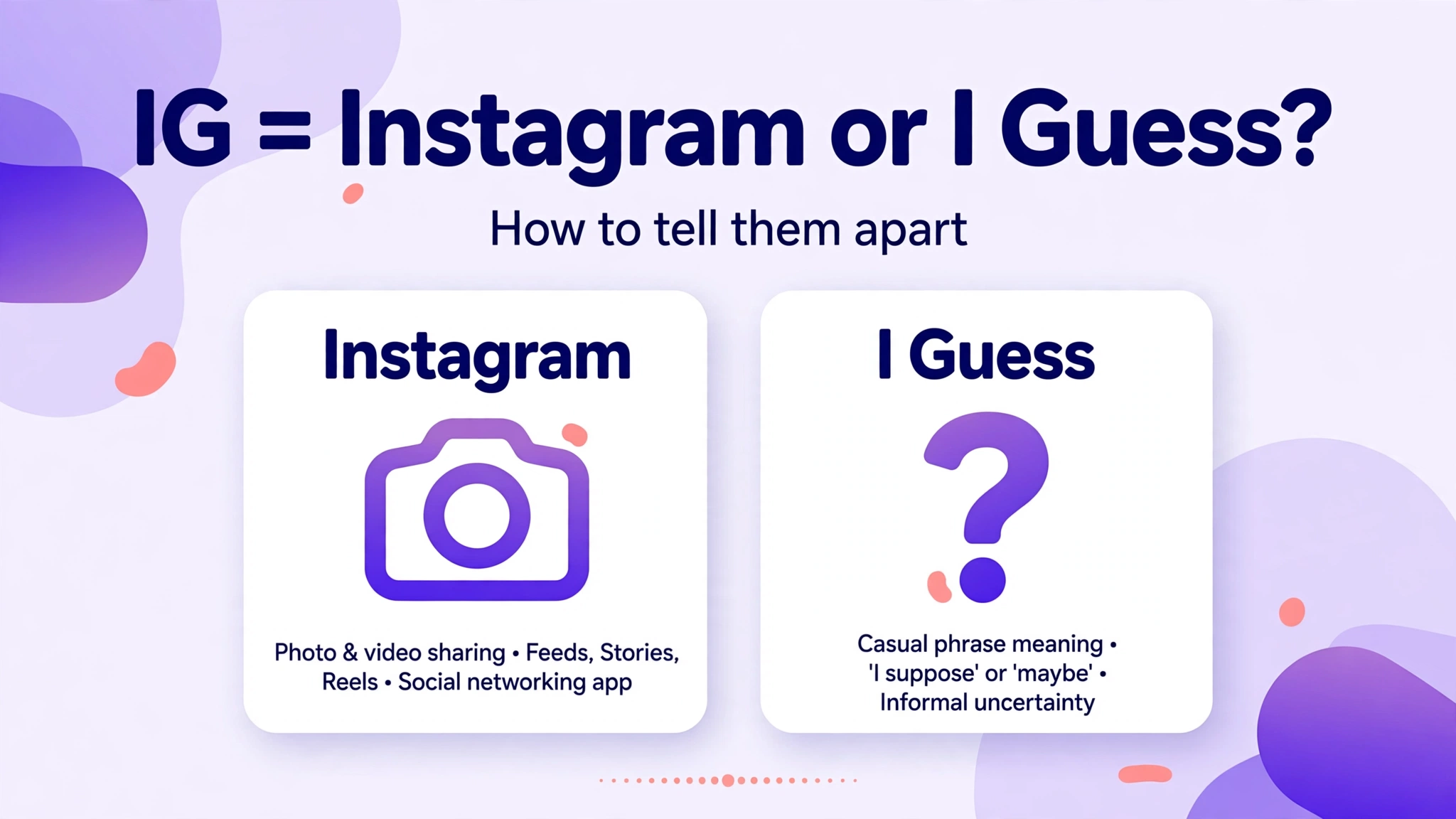
You get a message that just says “ig” and you freeze. Instagram, or a shrug? The ig meaning in text is two different things wearing the same two letters. Misread it and you hunt for a post that does not exist, or miss a photo or a follow invitation.
In short: capital “IG” usually names Instagram. Lowercase “ig” usually means “I guess”: a small, uncertain, sometimes reluctant yes. Capitalisation is a hint, not a rule; the sentence is the evidence, and the Swap Test below shows you how to use it.
What IG Means in Text
IG is an initialism, spoken as “eye-jee”, never as a word. “I guess” has been in English for centuries, and “ig” grew up with texting in the early 2000s. Instagram launched in 2010, and people shortened its name to IG shortly afterwards, as Facebook became FB.
No honest ranking exists: some guides lead with Instagram, others with “I guess”. No frequency study could settle which people type more often, so anyone giving you a percentage is selling a guess as data. Read the sentence instead.
The Swap Test
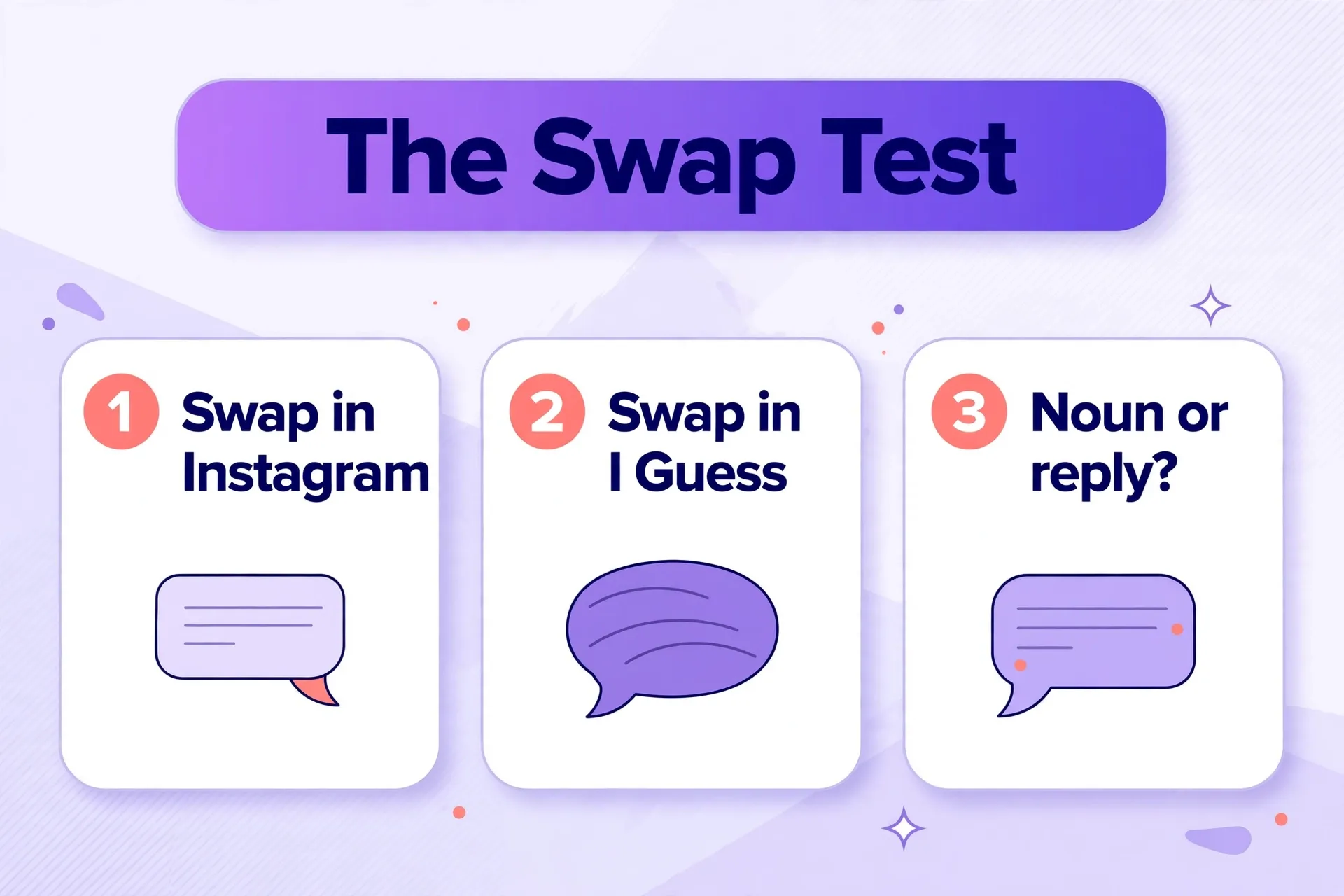
Here is this article’s named method, the Swap Test. It has three checks, run in order.
Check one: swap in “Instagram”. “Check out my IG” becomes “Check out my Instagram”, which works perfectly. A person cannot be followed on “I guess”, so the swap exposes the app reading instantly.
Check two: swap in “I guess”. “Movie night? ig” becomes “Movie night? I guess”, a real if unenthusiastic answer. If that version sounds broken, it is not the shrug.
Check three: is IG a noun or a reply? The app behaves like a noun: “on IG”, “my IG”, “follow me on IG”. The shrug behaves like a reply: it answers a question or softens a statement, often standing alone. Capitals can back you up, but treat them as a whisper, not a verdict. The swap is the verdict.
Try it: “Just hit 1k on IG!” only works as Instagram. “Ok ig” only works as “I guess”. “ig I’ll do the dishes then” becomes “I guess I’ll do the dishes then”, a reluctant yes.
IG as Instagram: The App Nickname
When IG means Instagram, it is simply the platform’s nickname, fitting wherever Instagram fits: accounts, posts, Stories, Reels, followers, DMs. “Link’s on my IG” means the link is on their profile; “IG handle” means their username. Words like post, story, follow, and handle are app words, and they travel with the app reading.
People most often write “IG” when they are not on Instagram at all: a TikTok bio saying “IG: @yourname” points elsewhere. Inside Instagram itself, people rarely bother, because everyone already knows where they are. Practical rule: “find us on IG” is useless without a handle, because the reader still has to search. Give the handle. And “DM me on IG” names the channel, a private message rather than a public comment, which is why the DM guide on this site treats the audience, not the app, as the definition of a direct message.
ig as “I Guess”: The Shrug in Two Letters
Lowercase “ig” means “I guess”, the work of a shrug in text form, with shades set by the sentence. Uncertainty: “IG she forgot about the meeting” means the speaker thinks so but is not sure. Tentative opinion: “The new version is better, ig” offers a view without planting a flag. Reluctant agreement causes the most trouble: “Yeah, ig we could go” agrees without enthusiasm, and the receiver feels the gap. Resignation: “IG we don’t have another choice” accepts a situation without liking it.
Position changes the flavour: at the end, “fine ig” lands as a sigh, where reluctant agreement is strongest. A bare “ig” alone leaves the feeling for the reader to fill in, which is why it can read as passive-aggressive: it agrees while signalling the agreement cost something. Between friends it is often just lazy agreement; in reply to a big ask, it can mean they are not keen but will not say no. If you keep getting “ig” replies, ask: “you sure? No pressure.” Honesty markers work in reverse: a TBH stamps a sentence as the speaker’s real view, while “ig” stamps it as a view not fully behind.
When IG Means Something Else Entirely
Most IG messages are the app or the shrug. The rest belong to other rooms. In gaming chats, IG can mean “in-game”: something inside a game. “Meet me IG” means meet inside the game, not on Instagram. This reading is real but not universal, so write “in-game” in full unless your group already uses the short form. Trap: “IG I can play tonight” almost certainly means “I guess”, while “IG currency” means in-game currency. The Swap Test still works.
Outside casual conversation, IG is standard in two professional rooms. In government writing it means Inspector General, the official who investigates a department: “the agency’s IG released a new report”. In finance it means investment grade, a rating for relatively low-risk bonds. Neither will turn up in your DMs, but both will turn up in headlines. Spelling trap: in medicine, immunoglobulin is normally “Ig” with a lowercase g, not “IG”.
IG on TikTok, Snapchat, Instagram, and in Texting
No platform owns a meaning of IG, but it is worth proving platform by platform, because several guides imply otherwise.
In plain texting, both readings live side by side: “ig” answering a plan is the shrug; “saw your post on IG” is the app.
On Snapchat, both readings show up. In direct messages, “ig” expresses uncertainty or reluctant agreement. But users also point at Instagram constantly, as in “follow my IG”. A caption about a photo shoot is the app; a DM reply of “ig” is the shrug.
On Instagram itself, the app reading dominates: you are already there, so “IG story” and “IG handle” are the platform talking about itself in shorthand. But the shrug sneaks in even here, in comments and DMs answering a question.
On TikTok, the split follows the public-private line. In comments, IG usually points at Instagram. In DMs, the shrug returns. A comment saying “her IG is so good” is about the app; a DM answering “wanna collab?” with “ig” is a hesitant yes. If you are sorting out a question like “wya” in the same thread, remember: a question invites a reply, and a reply-shaped “ig” is the shrug.
Tone and Sender Context: Who Is Saying IG, and Why It Lands Differently
The same letters land differently depending on who sends them. They carry no tone of their own; the relationship supplies it.
From a close friend, “ig” is almost always warmth with laziness attached: someone typing fast. From a crush or partner, the shrug gets heavier: “ig” replying to a date suggestion can feel like disinterest when it is only uncertainty about timing. Ask a follow-up instead: “Want to do Friday instead?”
From family, IG usually arrives as the app: a relative asking about a post. When family uses the shrug, it tends to be gentle uncertainty rather than reluctance. From a stranger, the app dominates, because strangers point at profiles: “check my IG” is an invitation to look. At work, neither belongs in short form: spell out Instagram, and never send the shrug, which sounds unsure even meant casually.
How to Reply to IG, and When to Spell It Out
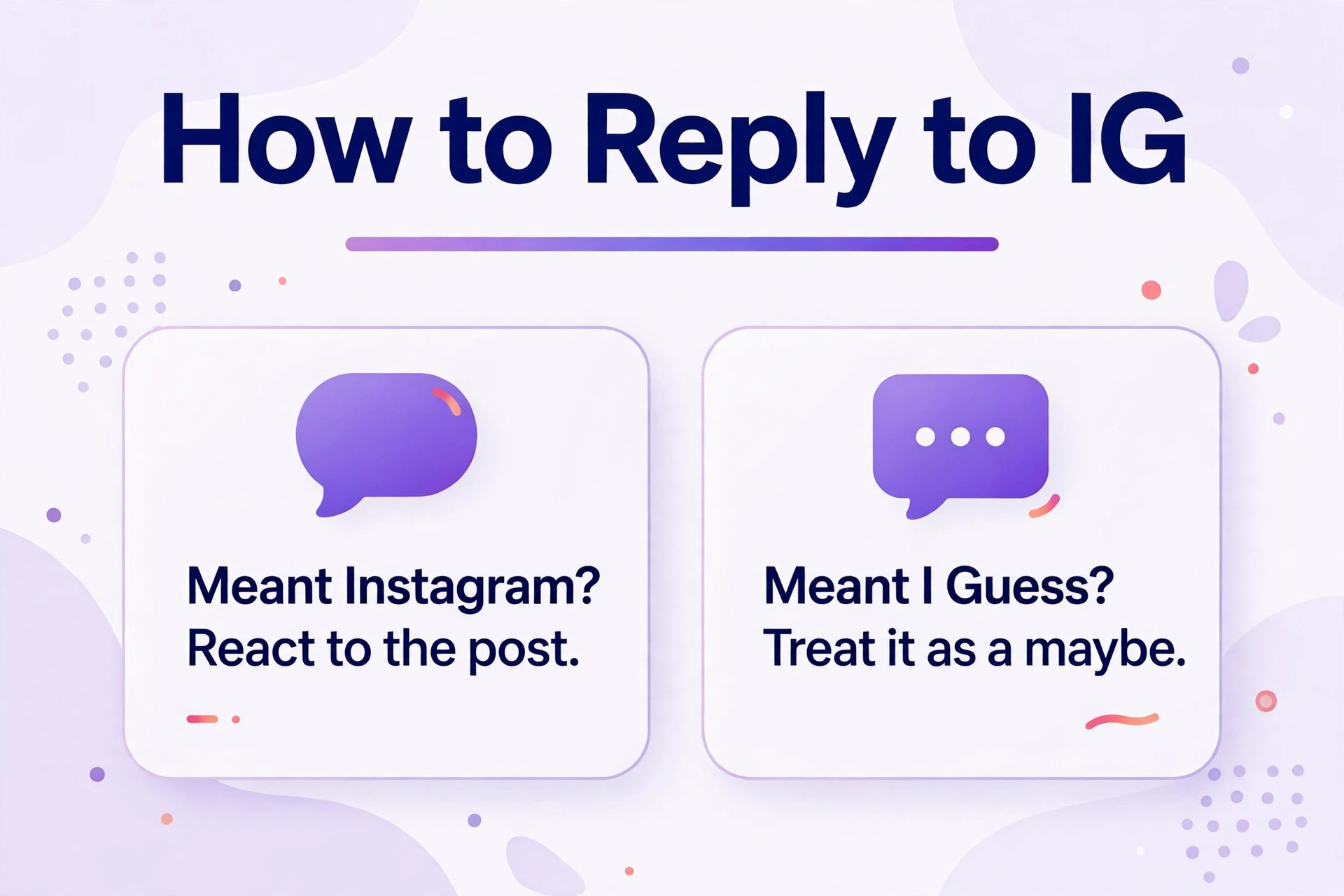
Match the reading and keep it short. If they meant Instagram and pointed you at a post, react to the post: “Just saw it, love the photo” is the whole reply. If they pointed at a profile without a handle, ask: “What’s your handle?” If they said “DM me on IG”, move there: “Messaging you there now.”
If they meant “I guess” and you got a hesitant yes, treat it as a maybe. “No pressure, let me know when you’re sure” respects the hedge. If you got a shrug to a question needing a real answer, ask again cleanly: “Is that a yes or a no?” gives permission to stop hedging. And if you add a side note while replying, the BTW guide on this site explains why a side note should never carry the main news.
If you are sending “ig”, ask whether the shrug is doing work you should do yourself. Genuinely unsure? “ig” is honest among friends. Actually mean no? It backfires, because the other person plans around a yes you never gave. Actually mean yes? Say yes: “yeah, let’s go” removes a whole layer of doubt. Spell it out when the reader may not know the slang, when the setting is professional, or when the conversation is tense, where a bare “ig” reads as a shutdown.
IG vs Related Terms
IG sits in a family of short forms that all do different jobs.
| Term | Full form | How it differs from IG |
|---|---|---|
| IG (app) | A noun naming a platform. You post on it and follow on it. | |
| ig (shrug) | I guess | A reply shading a yes with uncertainty or reluctance. |
| IDK | I don’t know | Admits no knowledge. “ig” admits a view held weakly; IDK admits no view at all. |
| TBH | To be honest | Certifies a sentence as the speaker’s real view. “ig” weakens the certification. |
| ID | Identification | A document or username. “What’s your ID?” asks for proof; “what’s your IG?” asks for a profile. |
| OTW | On the way | Announces movement toward you. IG never announces movement. |
Most useful pair: ig versus IDK. “Do you like it? ig” means “I suppose so, weakly.” “Do you like it? IDK” means “I have not decided.”
Debunked: What IG Does NOT Mean
Short letters collect false meanings. IG does not mean one fixed thing per app: both readings appear on every platform, and the sentence decides. IG does not mean “I’m good”: that claim appears in one low-quality page with no dictionary behind it, so this article rejects it outright. IG does not mean “intellectually gifted” in any live texting sense: it appears only as a passing mention in two guides, with no examples of anyone using it that way.
IG does not mean “ignore” in normal texting either. Wiktionary lists a verb sense related to “igg”, to ignore, but that is a gaming-forum verb, not the “ig” typed in answer to a question. And IG is not a popularity contest with a winner: claims about which reading is most common come from listicles, not studies, so this article prints none.
When Not to Use IG
Skip it when formal: client emails and applications are not the place for either reading in short form. Skip the shrug when the answer matters: a job offer or a serious invitation deserves a real yes, no, or “I’m not sure yet”. Skip the app short form when the reader may not know it: write Instagram out and include the handle. Skip gaming or professional readings without context: “IG event” to an outsider confuses more than it clarifies. And skip the shrug after a disagreement, where it reads as a shutdown.
Quick Answers
What does IG mean in text?
IG usually means Instagram, or lowercase “ig” means “I guess”, a hesitant yes. App words like post and follow point to Instagram; a reply to a question points to “I guess”.
How can I tell whether IG means Instagram or “I guess”?
Run the Swap Test: swap in “Instagram”, then “I guess”. “Follow me on IG” only works as Instagram; “movie night? ig” only works as “I guess”.
What does “ig” mean from a crush?
Usually the same as from anyone else: a hesitant reply, not a verdict on you. It may mean uncertainty about timing, not disinterest. Ask a follow-up instead of reading it as rejection.
What does IG mean in gaming?
It can mean “in-game”, as in “IG event”. But “IG I can play tonight” almost certainly means “I guess”. Swap in both and only one sounds right.
What does IG mean on Snapchat?
Both readings appear. In DMs, “ig” as “I guess” is common. In captions and bios, IG usually points at Instagram. The app does not decide; the sentence does.
What does IG mean on Instagram?
Usually the app itself, as in “IG story” or “IG handle”. In comments and DMs, though, lowercase “ig” can still mean “I guess” when it answers a question.
Is “ig” passive-aggressive?
It can read that way, agreeing while signalling low enthusiasm. Between close friends it is usually just lazy agreement. If you mean yes, say yes; if you mean no, say no; save “ig” for genuine uncertainty.
Can I use IG at work?
Spell it out: Instagram in full for the app, and “I guess” or a firmer phrase for the shrug. The short form sounds unsure, and the shrug can make agreement sound reluctant.
Final Thoughts
IG is two shortcuts that collided: a platform’s nickname and a shrug’s initials. Stop asking which meaning is “the” meaning and ask what the sentence is doing. Run the Swap Test before you read it and before you send it. Get that right, and IG stops being a puzzle: either a place to look, or a person not quite sure.
