
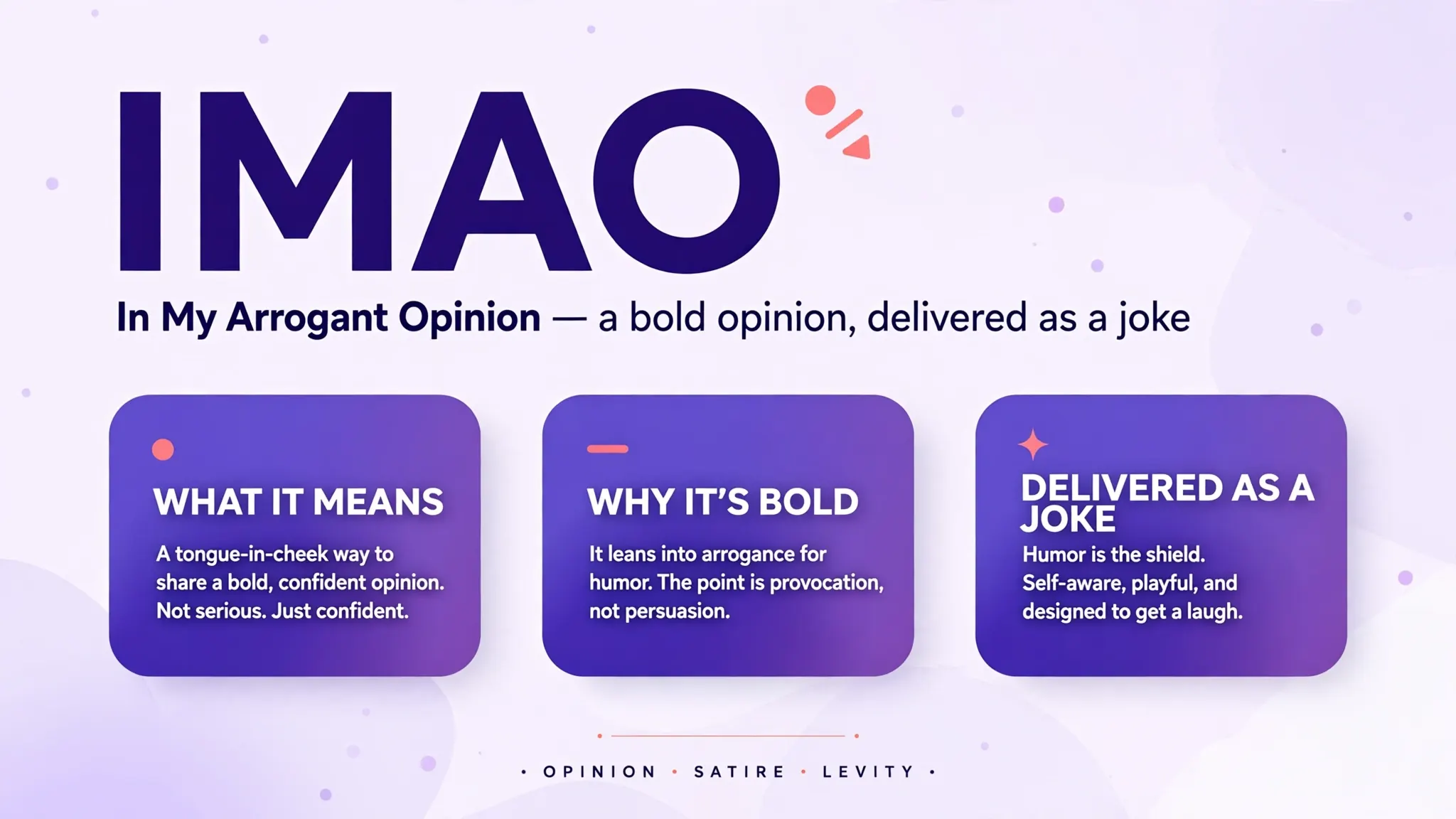
Someone drops “IMAO, that sequel was a waste of time” into the group chat, and half the room laughs while the other half wonders whether they just got insulted. The imao meaning in text is simpler than that pause suggests: IMAO stands for “in my arrogant opinion” — a joke worn on the outside of an opinion.
In short: IMAO introduces a strong personal opinion with deliberate, playful overconfidence. It is the opposite number of IMHO, “in my humble opinion”: where IMHO softens a view, IMAO turns the confidence up on purpose. The arrogance is almost always a performance, not a confession.
What IMAO Means in Text
IMAO is an initialism, read letter by letter as “eye-em-ay-oh”, never pronounced as a word: I for “in”, M for “my”, A for “arrogant”, O for “opinion”. It belongs to a family of opinion openers that frame what follows as one person’s view and differ only in attitude. IMO is neutral, IMHO is modest (sometimes sarcastically so), and IMAO is deliberately bold.
That joke has a long history. The earliest documented use traces to a May 1989 Usenet discussion about the band the Grateful Dead, where a poster used IMAO before rating different periods of the band, then had to explain it because readers kept asking what it meant. Anyone telling you it was invented by a 2008 film has the timeline backwards.
IMAO is also a niche abbreviation, far less common than IMO, IMHO, or LMAO. That rarity signals fluency in internet in-jokes — and explains misfires, since a reader who does not know the joke may take “arrogant” at face value.
The Delete-and-Flip Test
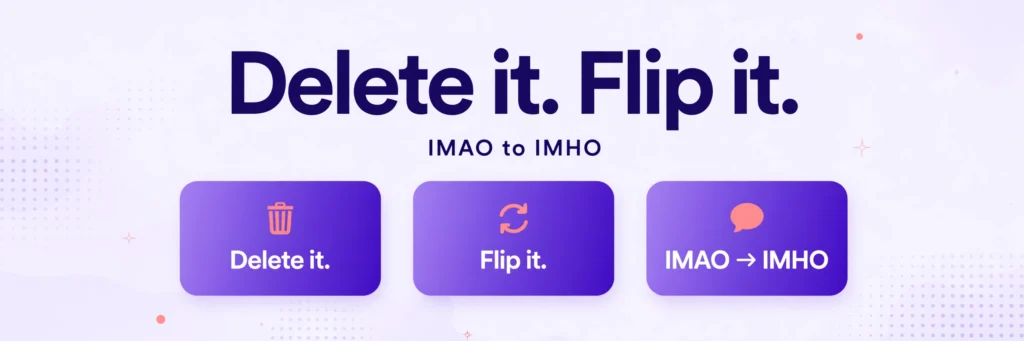
Here is this article’s named method, the Delete-and-Flip Test: two moves that answer at once whether this is really IMAO, and whether the arrogance is a joke.
Move one: delete it. If what remains is still a complete opinion — “that sequel was a waste of time” — then IMAO was never carrying information, only attitude. If deleting it leaves something that is not an opinion at all, such as a burst of laughter, you are probably looking at a different abbreviation, most likely LMAO misread where a lowercase L looks like a capital I.
Move two: flip it. Replace IMAO with IMHO: “IMHO, that sequel was a waste of time” is the same opinion wearing a polite cardigan. If the flip changes only the swagger and not the sense, you have confirmed IMAO. If it makes the sentence strange, the original was never an opinion opener.
Try it: “IMAO, pineapple belongs on pizza” deletes to a food opinion and flips cleanly to IMHO — genuine IMAO, playful brag. The test works because IMAO is pure framing: it never adds a fact, only a posture.
How IMAO Works: The Joke Inside the Letters
The joke only lands if you know what it is joking about. IMHO pretends to humility, often while delivering a very firm opinion. IMAO answers it by dropping the pretence: instead of claiming humility the writer does not feel, the writer claims arrogance nobody is supposed to believe. A writer who genuinely believed their opinion outranked everyone else’s would not need to announce it with a four-letter joke.
Position changes the flavour: at the start, “IMAO, the old design looked much better” is a confident opening; at the end, it is a punchline. Capitalisation does not change the meaning, though all-caps scans more boldly.
Punctuation matters more than capitalisation. “IMAO, …” with a comma is the standard opener. “IMAO.” as a standalone reply borrows someone else’s claim and stamps it as your own verdict, which can read as dismissive. Two inflated cousins exist — IMMAO, “in my most arrogant opinion”, and IMNSHO, “in my not-so-humble opinion” — both real, both rare.
IMAO on TikTok, Snapchat, Instagram, and in Texting

No platform owns a meaning of IMAO or changes it: it means the same thing everywhere, a bold opinion delivered as a joke.
In plain texting, IMAO shows up when someone wants to land a verdict without starting a fight. “IMAO, the black pair looks better” answers a shopping question with confidence and a smile built in, and in a group chat it defuses disagreement before it starts.
On TikTok, IMAO lives in comments and captions attached to hot takes about music, films, games, and trends. “IMAO, this update made the app worse” is a performance for other commenters, not a review. Because TikTok comments are public and fast-moving, the joke framing matters more here — a bare bold claim reads as aggression, while the same claim with IMAO reads as banter.
On Snapchat, IMAO appears in direct messages and story captions, in the same opinion-opener role: a DM saying “IMAO, that restaurant is way better than the one we tried last week” is a private verdict, and the joke lands because the friendship supplies the context. On Instagram, IMAO turns up in comments, captions, and story replies the same way — “IMAO, cats are better than dogs” under a pet photo is a joke verdict, not a feature of Instagram itself. If a conversation moves to private messages, the DM guide on this site explains why the channel changes the stakes: a bold opinion in a DM lands more personally than in a public comment thread.
Tone and Sender Context: Who Is Saying IMAO, and Why It Lands Differently
IMAO carries no tone of its own beyond the joke; the relationship supplies the rest. From a close friend, it is almost always pure play: “IMAO, that movie was overrated” invites a happy argument about films. From a crush or partner, the same line gets heavier, since a bold verdict about something they like can feel like a judgement. Check the rest of the message first — the joke framing usually means teasing, not attacking.
From family, IMAO is rarer and often lands oddly, since a reader who lacks the IMHO reference point may take “arrogant” literally. From a stranger, it is a public performance played to the thread. From a coworker, it depends on the channel: fine in a casual team chat, risky with a manager or client.
Tone markers tell you which version you got. With laughing emojis or “of course”, it is self-mockery. With “fight me” or “don’t @ me”, it is playful defiance. Standing alone after someone else’s opinion, with no softening, it leans closest to genuine dismissal — the one shape worth treating carefully. Note the reverse honesty marker: a TBH stamps a sentence as the speaker’s real view, while IMAO stamps it as deliberately overstated.
How to Reply to IMAO, and When to Spell It Out
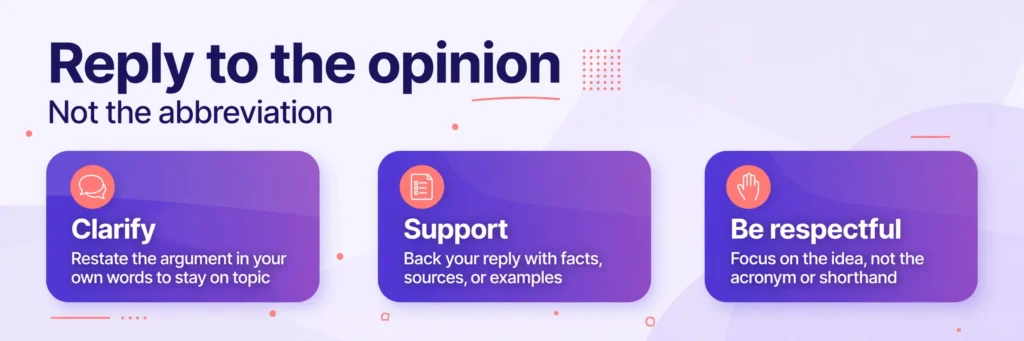
Reply to the opinion, not the abbreviation. If a friend writes “IMAO, the first one is much better” about two films, answer the film question: “I liked the second one’s ending more, honestly.” Engaging with the verdict respects the joke; engaging with the word “arrogant” turns a playful message into an argument about manners. If you disagree, disagree with the claim, not the confidence. If IMAO feels like a dodge on a sensitive topic, ask gently: “That’s a strong take — do you actually think that, or just winding me up?”
If you are sending IMAO, run the Delete-and-Flip Test on yourself first. Delete it: is the opinion underneath something you stand behind? If you would only say it while hiding behind a joke, do not send it — the joke does not make a cruel verdict kind. And if you add a side note while replying, the BTW guide on this site explains why a side note should never carry the main news.
Spell IMAO out in full — “in my arrogant opinion” — when the reader may not know the abbreviation, when the setting is professional, or when the conversation is tense. In formal writing, skip both forms and use “in my opinion” instead. Never use IMAO to soften a verdict you are not willing to defend: the reader still hears the verdict, and now also hears you hiding behind a joke.
IMAO vs Related Terms
IMAO sits in a family of opinion openers that all do different jobs. Confusing them is how most misreadings happen.
| Term | Full form | How it differs from IMAO |
|---|---|---|
| IMO | In my opinion | Neutral. Flags a view without adding attitude. IMAO adds deliberate swagger to the same view. |
| IMHO | In my humble opinion | Modest, sometimes sarcastically so. IMAO is its mirror image: the same joke with the humility swapped out. |
| IMNSHO | In my not-so-humble opinion | Playfully confident, like IMAO, but built from the IMHO side. Rarer than IMAO. |
| IMMAO | In my most arrogant opinion | IMAO turned up one notch further. Same joke, louder. |
| TBH | To be honest | Certifies a sentence as the speaker’s real view. IMAO flags its view as deliberately overstated. |
| ID | Identification | Asks for or names proof of identity. It never frames an opinion. |
| OTW | On the way | Announces movement toward you. IMAO never announces movement; it announces a verdict. |
| WYA | Where are you at | Asks for a location. IMAO gives an opinion, never a location. |
Most useful pair: IMAO versus IMHO — the same sentence with one word changed, flipping the signal from modesty to mock arrogance. Second is IMAO versus LMAO: one introduces an opinion, the other reacts with laughter; they share only four similar-looking letters.
Debunked: What IMAO Does NOT Mean
Short abbreviations collect false expansions. None of IMAO’s survives a dictionary check.
IMAO does not mean “in my anxious opinion”. That expansion appears in a couple of listicles alongside “in my awkward opinion” and “in my absolute opinion”, but no dictionary records any of them. They are guesses built by swapping the A-word; the A in IMAO is “arrogant”, and the whole joke depends on it.
IMAO does not mean laughter, and it is not a typo for LMAO. The two look alike — a lowercase L and a capital I are near-identical in many fonts — so misreading happens constantly, but misreading is not meaning. LMAO reacts to something funny; IMAO introduces an opinion, and the Delete-and-Flip Test makes the difference mechanical.
IMAO does not mean something different when a girl sends it, or something different on any one platform. Several guides run “from a girl” sections, but the meaning does not change with the sender’s gender, and no evidence supports a gendered reading. IMAO was not invented by a 2008 film either: it appears in Usenet discussions from May 1989, nearly two decades earlier. Use is not invention.
When Not to Use IMAO
Skip it when formal: client emails, job applications, academic writing, and professional reports are not the place for a joke about your own arrogance. Skip it when the opinion is serious and the stakes are real — a medical decision, a safety concern, or feedback someone needs to act on deserves a plain statement, not a swagger frame.
Skip it when the reader may not know it: IMAO then reads as a typo or an insult, so write “in my opinion” instead. Skip it after a disagreement, where a joke-framed verdict reads as refusing to engage. And skip it when you are not willing to defend the opinion underneath — the joke frame is not a shield.
Quick Answers
What does IMAO mean in text?
IMAO stands for “in my arrogant opinion”. It introduces a strong personal opinion in a playful, deliberately overconfident way, as a joke twist on IMHO, “in my humble opinion”.
How can I tell whether IMAO is a joke or real arrogance?
Run the Delete-and-Flip Test: delete IMAO and check a complete opinion remains, then flip it to IMHO and check only the swagger changes. If both work, the arrogance is a performance.
What is the difference between IMAO and IMHO?
They are mirror images: IMHO claims humility, sometimes sarcastically; IMAO claims arrogance, almost always jokingly.
Is IMAO the same as LMAO?
No. IMAO introduces an opinion; LMAO reacts with laughter. They look alike because a lowercase L resembles a capital I in many fonts, but they do completely different jobs in a sentence.
What does IMAO mean on TikTok?
The same as everywhere else: a bold opinion delivered as a joke, usually in comments or captions attached to hot takes. TikTok gives IMAO no special meaning.
What does IMAO mean on Snapchat?
The same opinion opener, used in direct messages and story captions between friends. The meaning does not change.
Is IMAO rude?
Not usually: the “arrogant” part is normally self-mockery. It can read as rude about a sensitive topic, after a disagreement, or with someone who does not know the joke.
Can I use IMAO at work?
In casual team chats with people who share the joke, sometimes. In emails, reports, or messages to clients, no: write “in my opinion” instead.
Final Thoughts
IMAO is a small joke with a long history: a single swapped word that turns false modesty into mock arrogance, used since 1989 to say bold things without starting fights. Run the Delete-and-Flip Test before you read it and before you send it — delete it to find the opinion, flip it to IMHO to hear the swagger — and IMAO stops being a puzzle. It is just an opinion, delivered with a grin.
