
Someone asks “Are we still on for tonight?” and the reply comes back: “mhm.” Someone else tells a long story, and between the messages sits a lone “mhm.” The mhm meaning in text is the same three letters in both chats, but not the same job. In the first, mhm is an answer. In the second, it is a nod.
In short: mhm is the written form of the spoken sound “mm-hmm,” used to say yes, show agreement, or signal that you are listening. It is not an acronym, and it has no hidden expansion to decode. The trick with mhm is not what the letters stand for — it is whether the sender is answering you or simply keeping you talking. The Question-or-Story Test below tells you which one you just received.
What MHM Means in Text
Mhm is an interjection, not an abbreviation. It spells out a sound people have made in conversation far longer than they have typed it: the nasal “mm-hmm” that means yes, or I hear you, without interrupting the speaker. Dictionary.com describes mhm as a version of mm-hmm, an interjection variously used to express agreement or make an acknowledgment, especially common in the casual writing of the internet and text messaging. Wiktionary-derived entries agree.
The spoken sound is old. Dictionary.com traces mm-hmm in recorded English back to at least 1934, and notes the first Urban Dictionary entry for MHM dates to 2004. So mhm did not begin online like most texting slang. It began in speech, then moved into typing. In speech, “mm-hmm” answers a question or keeps a speaker going. In text, mhm keeps both jobs.
The Question-or-Story Test
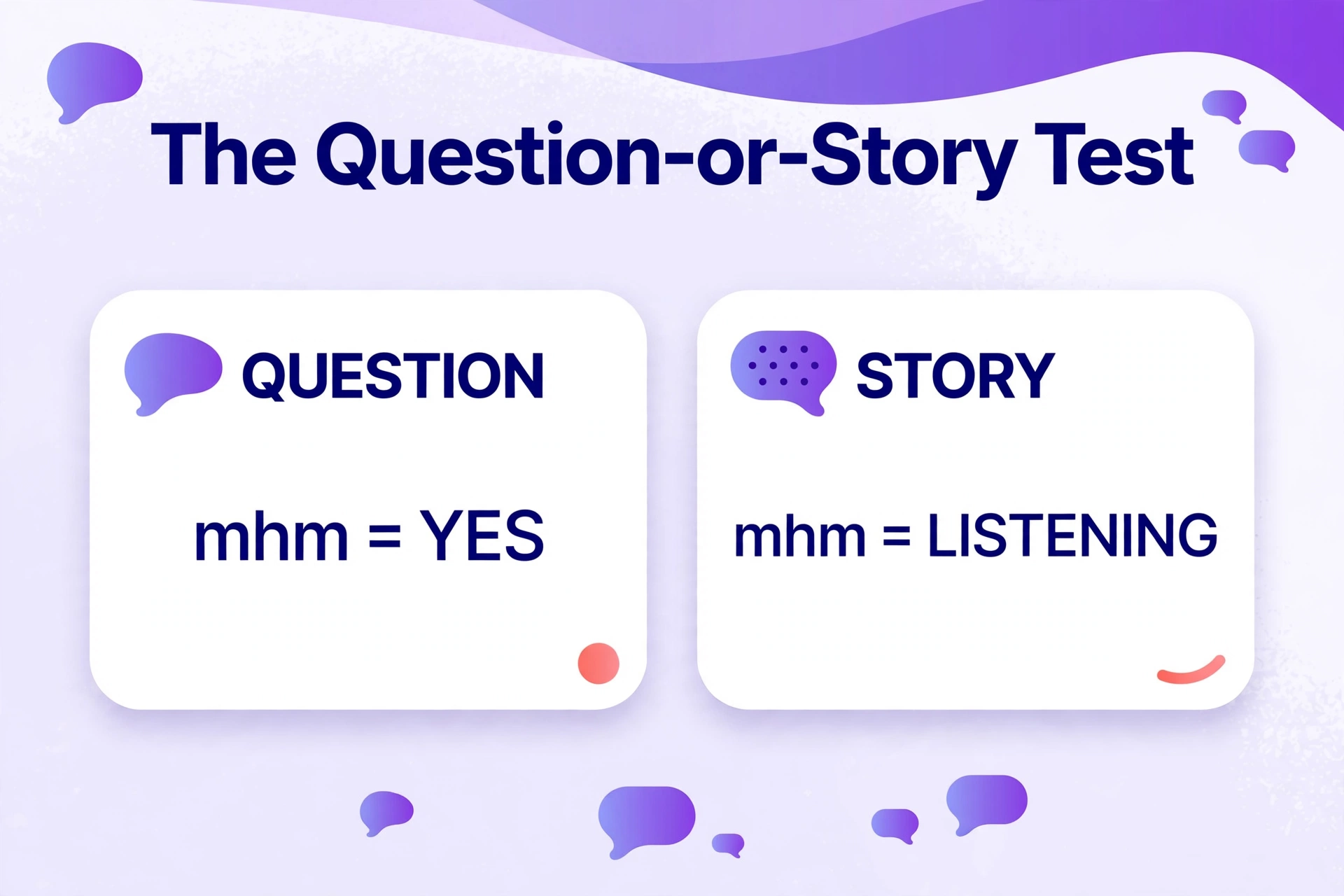
Here is this article’s named method, the Question-or-Story Test: one question, asked about the message that came before the mhm, sorting nearly every mhm you will ever receive.
Ask: was the mhm answering a question, or landing in the middle of a story? If it answers a yes-or-no question, treat it as a yes: “Are you free Saturday?” — “Mhm” is a yes, soft but real. If it lands mid-story, treat it as a listening cue, not a verdict: “mhm” after three paragraphs of a bad day means “I am with you, keep going,” not “I agree with everything you just said.” If it follows a plain statement — “Dinner is ready” — treat it as acknowledgment: heard, understood, noted. Unlike earlier removal and substitution tests here, this one is a placement test.
The Four Jobs of MHM
The test sorts mhm into four jobs. The warm yes: the speaker agrees and means it. “That show was actually good.” — “Mhm, I told you” is agreement with a smile in it, and it rarely travels alone.
The listening cue: the speaker is holding the floor open for you. “Mhm… yeah… go on” is the classic shape, most common in long, emotional messages. Do not mistake this one for agreement: a friend who sends “mhm” while you vent has stayed on the line, not taken your side.
The reluctant or flat yes: agreement without enthusiasm. “You are okay with this plan?” — “mhm…” is technically a yes, but the trailing dots are doing real work. It can mean tired, busy, or unimpressed — or just a person typing one-handed while cooking dinner.
The sarcastic or knowing mhm: the drawn-out, pointed kind. “You are totally going to clean your room today, right?” — “Mhm. Sure.” is disbelief wearing agreement’s clothes. Never assume this job from a single message with no history behind it.
How Spelling and Punctuation Change MHM
Mhm carries tone without carrying content, so the small things around it do the talking. A bare “mhm” is neutral: yes, okay, I hear you. Add a period, “mhm.”, and it settles into something calmer and more final. Add an ellipsis, “mhm…”, and it turns hesitant, the written version of trailing off. Capitals turn the volume up, not the meaning: “MHM” reads stronger or more sarcastic, never like a different word.
Stretch the letters and the feeling stretches with them: “mhmm” reads slightly more enthusiastic, while a long “mhhhhhm” leans playful or sarcastic. Pair it with words and the job sharpens: “mhm lol” is casual and playful, and “mhm okay” closes a topic with agreement. Emoji do the same work.
One spelling warning, plainly: mhm is not “hmm.” Hmm is thinking, unsure, not convinced yet. Mhm is agreement or listening. Swap the first letter and you flip the meaning: “hmm” after your plan means doubt, “mhm” means go ahead. The same goes for “mmm,” which leans toward pleasure, not agreement. Three lookalike hums, three different messages.
MHM on TikTok, Snapchat, Instagram, and in Texting
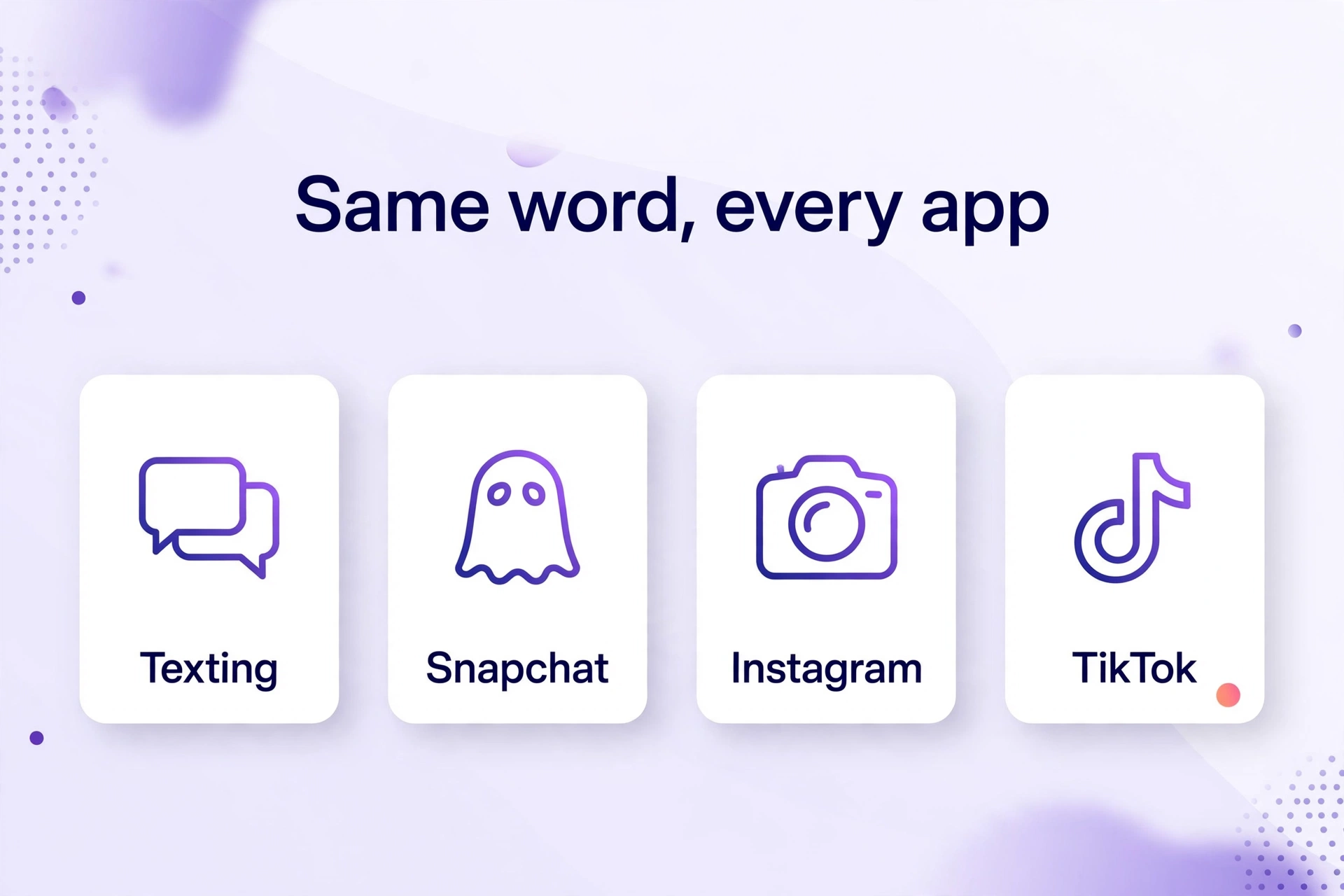
Mhm means the same thing on every platform; what changes is where it sits and how fast the conversation moves. In plain texting, mhm is at home: quick confirmations, listening cues in long threads, and one-word replies between friends and family. A texting mhm often arrives while someone is multitasking, and that is not rudeness — that is just how texting works. The BRB guide covers stepping away honestly.
On Snapchat, mhm gets shorter and punchier: captions, quick replies, and story reactions, where the photo supplies half the meaning. On Instagram, mhm lives in comments, captions, and DMs. In comments it is usually a public reaction: “mhm” under a relatable video tells everyone reading that the commenter agrees. In DMs it behaves like texting — and our IG guide covers the app’s own short form. Mhm is not an Instagram term. The app changes the speed, not the word.
On TikTok, mhm is a comment-section reflex. Comments are instant reactions, so TikTok mhm leans toward emphatic agreement: chains of “mhm” under a popular comment work like a group “exactly” or “same.”
Tone and Sender Context: Who Is Sending MHM, and Why It Lands Differently
Mhm carries almost no tone of its own. The tone comes from the conversation around it, the punctuation attached to it, and the person sending it. A bare “mhm” after a joke reads warm; after a heartfelt message, cold. The word did not change; the room did.
From a close friend, mhm is usually warmth with low effort attached: someone typing fast, or someone who texts in short replies by nature. From a crush or partner, it gets heavier, because a short reply from someone you care about feels like a signal. From a stranger, mhm is almost always public performance. One honest limit: the sender’s gender does not change what mhm means. Reading flirtation or coldness into a short reply based on who sent it is projection, not reading.
How to Reply to MHM, and When to Spell It Out
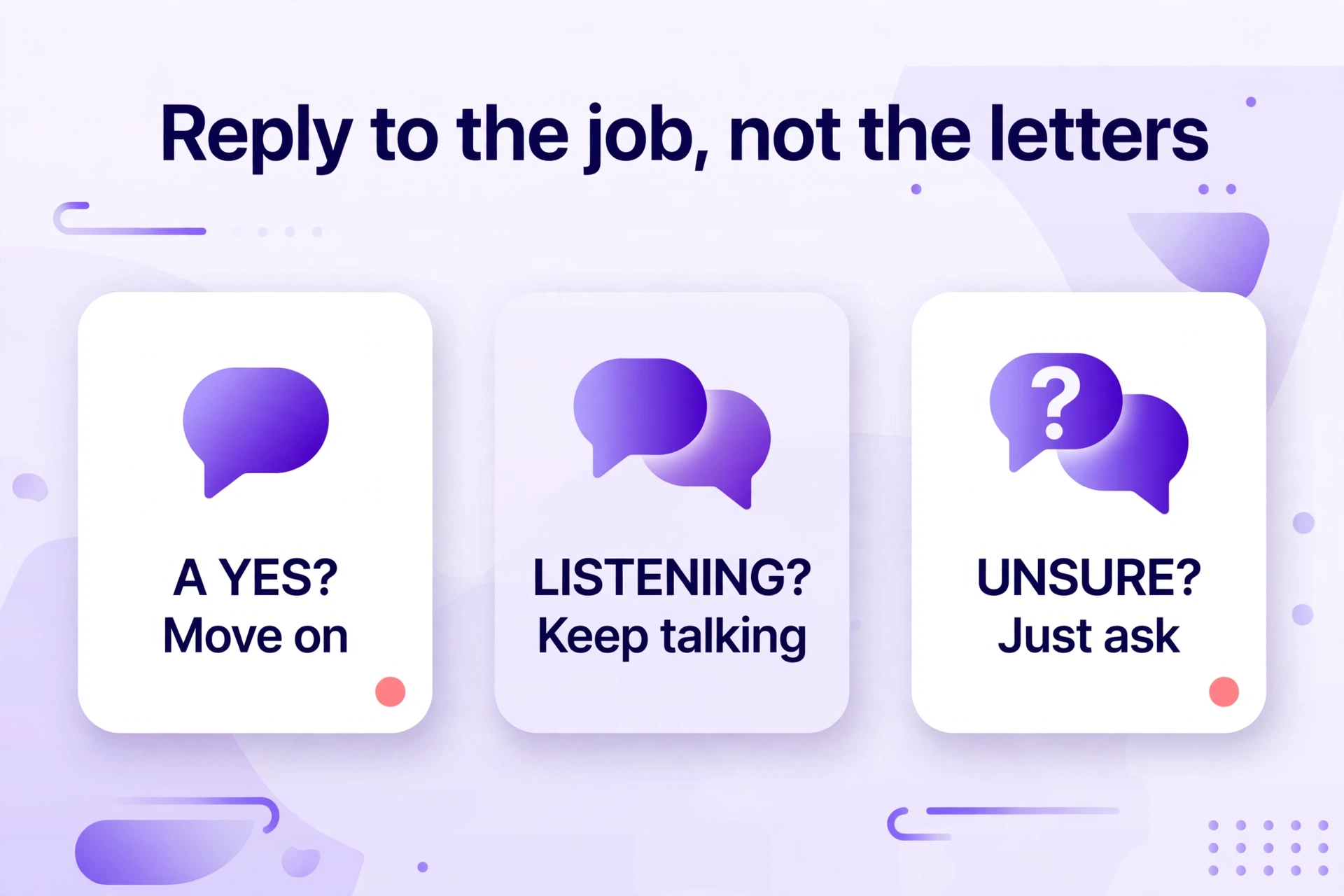
Reply to the job, not the letters. If the mhm answered your question, treat it as a yes and move on. If it was a listening cue, keep talking — that is what the sender invited you to do. If it was a reluctant yes, and the answer matters, confirm gently: “Just to be sure, is that a yes?” If it was sarcastic, laugh or push back lightly.
If the tone is unclear, do not guess at full volume. “Haha, is that a yes or a keep-going?” is a fair question among friends. If you are confused about a longer message around the mhm, ask directly — the WDYM guide covers how to ask without sounding confrontational. If you add a side note while replying, remember the BTW guide: a side note should never carry the main news, so put the real reply first. And if you are sending mhm, ask whether three letters are enough: when the answer matters or the conversation is tense, spell it out — “yes,” “got it,” or “I am listening.”
MHM vs Related Terms
Mhm sits in a family of short replies that all do different jobs, and mixing them up is how replies go wrong.
| Term | Core meaning | How it differs from MHM |
|---|---|---|
| MHM | Soft yes, agreement, or listening cue | The nod. Answers a question or holds the floor open. |
| HMM | Thinking, unsure, not convinced yet | The pause. Hmm doubts where mhm agrees. |
| MMM | Pleasure or delight | The savor. Mmm enjoys where mhm agrees. |
| UH-HUH | Yes, sure | The spoken twin, sometimes more sarcastic. |
| YEAH / YEP | Yes | More direct. Yeah commits where mhm can merely listen. |
| OKAY | Acceptance | More final. Okay closes a topic; mhm can keep one open. |
| K | Minimal acknowledgment | Colder. Mhm is softer than k, less expressive than yeah. |
| SMH | Shaking my head, disbelief | The opposite. SMH disapproves; mhm agrees or listens. |
| LOL | Laughing out loud, or softening | The laugh. “Mhm lol” blends humor with agreement. |
| TBH | To be honest | The frame. TBH certifies the speaker’s view; mhm nods at another’s. |
Debunked: What MHM Does NOT Mean
Short letters collect false meanings. Mhm is not an acronym, so it does not stand for anything — there is no hidden phrase to decode, and any list claiming one is inventing it. It is a spelled-out sound.
Mhm does not mean no. Even a reluctant mhm is technically agreement, just without enthusiasm; the only exception is sarcasm, where the conversation makes the flip obvious. Mhm is also not flirting, not rudeness, and not anger on its own — many people text briefly out of habit, tiredness, or multitasking, not emotion. And mhm has no fixed meaning per platform or per gender: the sentence and the conversation decide, not the app and not the sender.
Two more claims, graded honestly. A few pages claim mhm means “I told you so,” used to scold someone who ignored advice. That reading is only a special case of the knowing, sarcastic job — “Mhm, that is what I thought” — not a separate dictionary meaning, so this article grades it Contextually supported at best. Outside texting, all-caps MHM also names real initialisms, such as Master of Hotel Management — real in its own room, irrelevant in a chat thread. Finally, no popularity ranking is printed here: one competitor published precise percentages from its own small chat-log sample, but no method or dataset was shown, so this article repeats no percentages or frequency claims.
When Not to Use MHM
Skip it when formal: job applications, professional emails, and messages to clients are not the place for a three-letter hum. “Understood” or “yes, that works” carries the same confirmation without the risk. Skip it when clarity matters more than speed: an important decision or a serious apology deserves a full yes, not a sound that could be read as either agreement or mere listening.
Skip it when the conversation is already tense. After a disagreement, a bare “mhm” reads as a shutdown even when you mean agreement. Skip it, too, after three in a row: a chain of mhms stops sounding like listening and starts sounding like you have left the conversation. And skip it as the only reply to bad news — “mhm” after something painful reads as indifference, where “I am here, tell me more” does the job you actually meant. One related note: mhm is a cousin of “I don’t care,” not a synonym — our IDC guide covers that word’s bluntness.
Quick Answers
What does MHM mean in text?
Mhm is the written form of “mm-hmm”: a yes, an agreement, or a listening signal — an interjection, not an acronym.
Is MHM a yes or a no?
Almost always a yes — or at minimum, “I acknowledge this.” It is not a no. Even a reluctant mhm is technically agreement, just without enthusiasm, except in sarcasm, where the conversation makes the flip obvious.
How can I tell what kind of MHM I just received?
Run the Question-or-Story Test: a yes-or-no question gets a yes, a mid-story mhm is a listening cue, and one after a plain statement is acknowledgment.
What is the difference between MHM and HMM?
Mhm means agreement or listening. Hmm means thinking, unsure, or not convinced yet. Swap the first letter and you flip the meaning.
Does MHM mean the same thing on TikTok, Snapchat, and Instagram?
Yes. The meaning stays the same on every platform; only the speed and setting change: TikTok leans toward comment-section agreement, Snapchat toward quick replies, Instagram toward comments and DMs.
Is MHM rude or dismissive?
Not by itself. It is informal and short, but not rude. It can feel dismissive if overused, sent repeatedly in a tense conversation, or used as the only reply to serious news.
Does MHM mean something different when a girl sends it?
No. The sender’s gender does not change what mhm means; the conversation around it is what changes how it feels.
Can I use MHM at work?
Better not. At work, write it out: “Understood” or “yes, that works.” Mhm reads as too casual for professional messages.
Final Thoughts
Mhm is a small sound doing a quiet job: agreeing, acknowledging, keeping a conversation alive. It is not cold, warm, flirty, or rude on its own. The conversation around it is what turns it into something specific.
When you get a mhm and you are not sure how to read it, do not stare at the word. Ask whether it answered a question or landed in a story, then read everything that came before it.
