
If you’re trying to work out the sb meaning in text, here’s the short version: in most messages, SB means “somebody” — an unnamed person. On Snapchat, though, it usually means “snap back,” as in “reply to my snap.” Same two letters, two jobs, and the platform plus the sentence will tell you which one you’re looking at.
SB Meaning in Text: The Short Answer
In everyday texting, SB stands for “somebody” — the full word, typed faster. “Can SB pick me up?” means “Can somebody pick me up?” The sender doesn’t know who it was, doesn’t think the name matters, or doesn’t want to name the person. Tone comes from the rest of the sentence, not the two letters.
The big exception is Snapchat, where SB almost always means “snap back” — someone asking you to send a snap in return, usually to keep a Snapstreak going. Other meanings (“soft block,” “small business,” a degree) live in specific places.
| Where you see SB | What it usually means | Quick example |
|---|---|---|
| Ordinary text, WhatsApp, iMessage | Somebody | “Did SB call about the tickets?” |
| Snapchat | Snap back | “SB!” on a streak photo |
| TikTok / Instagram comments | Somebody | “SB in the comments said it first” |
| X (Twitter) / Instagram follower talk | Soft block | “I had to SB them” |
| Business or shop posts | Small business | “Support your local SBs” |
| Dating apps | Sugar-dating shorthand (context only) | Profile shorthand, not general texting |
| School, news, sports | Degree, Senate Bill, season’s best | “SB 204”, “new SB in the 200m” |
The SB Swap Test: How to Tell Which Meaning Fits
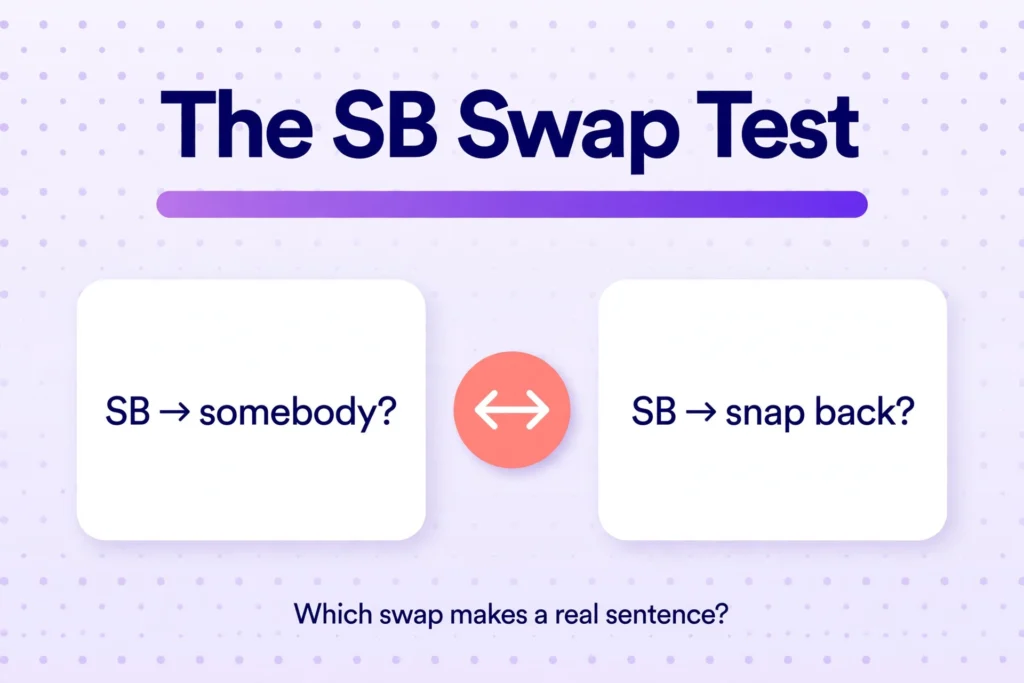
Here’s the test this article is built around: the SB Swap Test. Swap in “somebody” and read the message back, then swap in “snap back.” Whichever swap makes a normal sentence is almost certainly what the sender meant.
Try it: “SB knows where the charger is.” Swap one gives “Somebody knows where the charger is” — perfect. Swap two gives “Snap back knows where the charger is” — nonsense. So SB means “somebody” here. Now try “Streaks! SB please.” Swap one gives “Streaks! Somebody please” — somebody what? Swap two gives “Streaks! Snap back please” — a normal request. So on Snapchat, SB is a verb, an instruction: send a snap back.
The test works because of grammar: “somebody” is a noun filling a person-shaped hole in a sentence, while “snap back” is a verb phrase telling someone to do something. Two rules sit underneath the test: check the platform first — Snapchat flips the default — and if neither swap makes sense, ask the sender.
SB as “Somebody”: How It Works in Everyday Texts
The “somebody” meaning is the oldest and most common. Long before chats, “sb” was the shorthand dictionaries used for “somebody” in example sentences (“ask sb for help”) to save space. Texting picked up the same habit: two letters beats eight when the person’s identity doesn’t matter.
In a sentence, SB behaves exactly like the word “somebody.” It can be the subject (“SB told me you were coming”), the object (“I need to ask SB about the homework”), or a question (“Does SB know where the keys are?”). It can also be vague on purpose: “SB keeps leaving their stuff in the car” avoids naming anyone, and in group chats “SB needs to bring snacks” is a call for a volunteer.
One thing SB doesn’t do on its own is carry emotion. “SB said hi” is neutral. Whether the message is warm, annoyed, or flirty depends on the words around it — “SB said hi, they miss you” is warm because of “miss you,” not because of SB. Think of SB as a pronoun, not an opinion word: ngl and imo add attitude, while SB just swaps in for a person.
SB on Snapchat: When It Means “Snap Back”
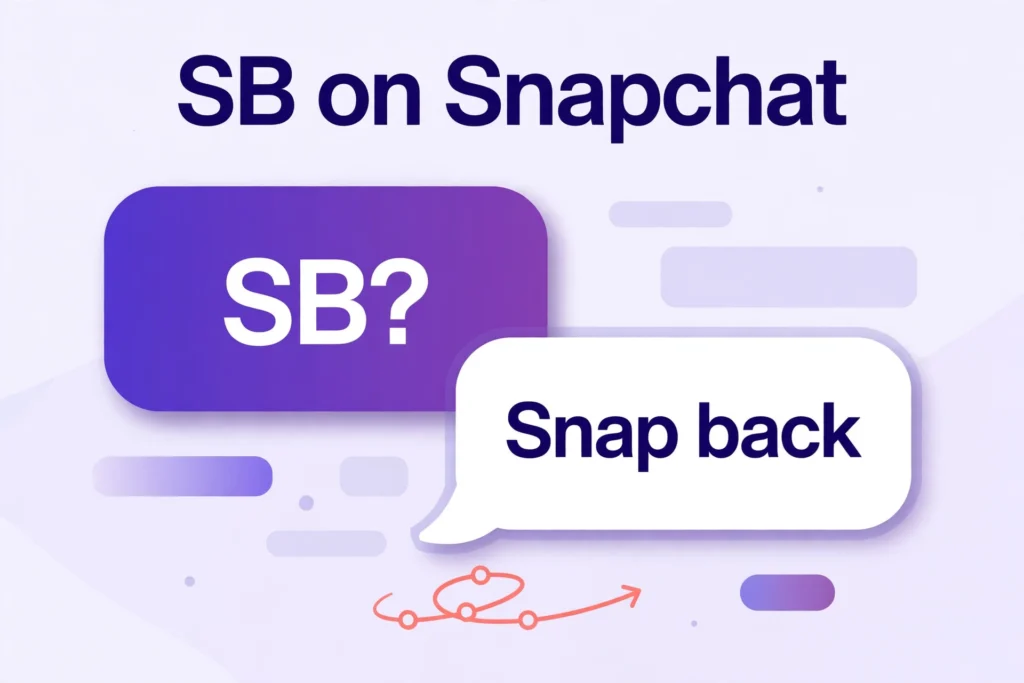
On Snapchat, SB means “snap back” — send me a snap in return. You’ll see it on its own (“SB?”), on a streak photo (“Streaks! SB”), or after a picture of someone’s ceiling (“SB pls”). The sender wants a reply, usually fast, because Snapchat streaks die if nobody replies within 24 hours.
“SB?” can’t become “Somebody?” and still make sense as a request. SB on Snapchat usually arrives with a photo — often a black screen or a random shot — sent to a whole list of people at once. The sender isn’t starting a conversation; they’re keeping streaks alive.
To reply, send a snap back if you want to keep the streak — any photo works. If you don’t, the streak simply ends. A short text (“just saw this, sending one now”) works too. Don’t read a Snapchat “SB” as “somebody” — replying “Who?” to “SB?” will just confuse both of you.
SB on TikTok and Instagram: Mostly “Somebody,” Sometimes Something Else
Outside Snapchat, SB goes back to meaning “somebody.” In comments you’ll see “SB in the comments said it first” or “SB ate with this edit” — in each case the Swap Test gives you “somebody”: an unnamed person, usually another commenter. Instagram DMs work the same way.
The exception is Instagram shop posts, where SB can mean “small business”: “support your local somebodies” is nonsense, while “support your local small businesses” fits. If the account is a shop or market, read SB as “small business” first.
One wrinkle: in relationship captions, SB occasionally shows up as dating shorthand — the sugar-dating meaning from dating apps. It only fits when the whole conversation is about dating or money. SB sits next to terms like iykyk — shortcuts that only make sense with the in-group context.
SB as “Soft Block” on X and Instagram
There’s one more platform-bound meaning: on X (formerly Twitter) and sometimes on Instagram, SB can mean “soft block.” A soft block is a quiet way to remove someone from your followers. You block them, then immediately unblock them. The block itself lasts seconds, but the side effect sticks: the other person stops following you, without the drama of a permanent block or a notification that says what happened.
You’ll hear it as a verb: “I had to SB them.” The Swap Test flags it, because “somebody” doesn’t fit “I had to somebody them” — the grammar breaks. The tone is usually dry or mildly annoyed, more like muting than blocking. If someone SB’d you, you can follow them again; there’s no permanent ban. This meaning barely exists outside social-media talk.
The Other Meanings You’ll Run Into
In dating-app contexts, SB is sometimes shorthand for a sugar-dating role — the one meaning that deserves a second look, because it changes the conversation from casual to transactional. You’ll only see it where the whole profile or chat is already about dating, money, or allowances. In an ordinary text from a friend, it doesn’t apply.
In informal chats, SB can also be short for “so bad” — as in “I miss you sb.” Wiktionary records this as internet slang, but it’s uncommon, and it only works when “somebody” makes no sense: “I miss you somebody” is broken English; “I miss you so bad” is natural.
Then there are the formal meanings, which aren’t slang at all: a Bachelor of Science degree (S.B.), a Senate Bill (“SB 204”), an athlete’s season’s best (“a new SB in the 200m”), and in business writing “small business” or “standby.” In sneaker talk, Nike SB is Nike’s skateboarding line — if the conversation is about shoes, SB is a brand label. Two readings on low-quality pages are best ignored: “should be” and “substitute” have no dictionary backing.
Tone and Sender Context: Who Sent It Changes How You Read It
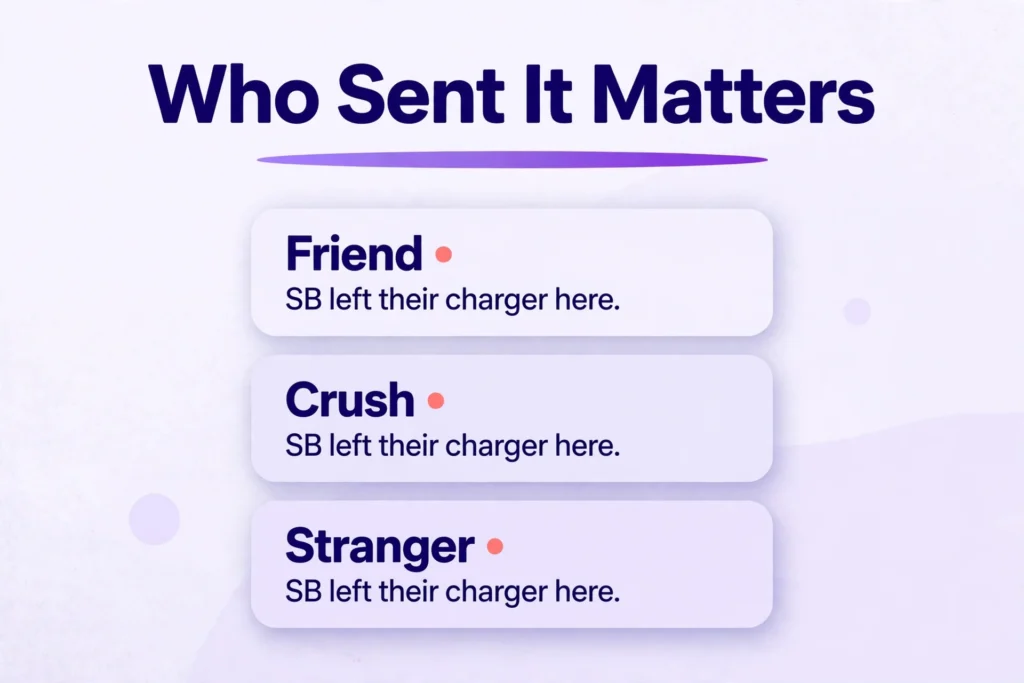
SB itself is neutral; tone comes from the sentence, punctuation, and relationship. From a close friend, SB is casual and low-stakes: “SB left their charger at mine” is just news. From a crush, “SB told me you liked my post” is a feeler — the sender passes along information while keeping their distance. The same logic applies to otp conversations, where the real question is usually about the relationship.
From a stranger, SB is worth a pause. On Snapchat, a stranger’s “SB?” is usually a mass streak message — harmless, ignorable. In a dating-app chat, the sugar-dating reading becomes possible; talk of allowances or “spoiling” points one way, ordinary small talk the other. From a work contact, teacher, or parent, SB almost always means plain “somebody.”
Punctuation adds the last layer: “SB.” is flat, “SB?” is a request, “SB!!” is urgent — about what the sentence says, not the abbreviation. An emoji does the same work: “SB 😂” jokes about somebody, “SB 🔥” is about the streak.
How to Reply to SB
Your reply depends on which SB you got, so run the Swap Test first. If SB means “somebody,” just answer normally — “SB knows where the charger is” gets “Can you ask them to bring it?” If you don’t know who SB is, “Who’s SB?” works fine.
If SB means “snap back,” the reply is an action: send a snap back and the streak survives. A quick text (“just saw this, sending one in a bit”) works if you can’t snap now; saying nothing lets the streak lapse. If SB means “soft block,” there’s nothing to reply to — “I SB’d them” is a report, not a question.
If you’re the one using SB, spell it out when the reader might not know the code — “snap back” for Snapchat newcomers, “somebody” in anything formal. And never use SB when the person’s identity is the whole point: “SB is coming to the party” is fine; “SB got the job” is frustrating when everyone wants the name. When you can’t tell which meaning fits, ask: “What do you mean by SB?” The same holds for ntm or istg — asking beats assuming.
SB vs. Similar Shortcuts
SB vs. s/o: “S/o” can mean “someone” or “shoutout.” The difference is habit: SB is the dictionary-style shorthand for “somebody,” while “s/o” leans toward “shoutout” in captions (“s/o to SB for the help” uses both). Think shoutout first for “s/o,” somebody first for SB.
SB vs. “somebody” spelled out: no meaning difference, only register. SB is for fast, casual typing; “somebody” is for anything formal or where clarity beats speed. SB vs. “snap back” spelled out: same split — the full phrase is clearer for anyone who doesn’t live on Snapchat.
SB vs. “soft block” spelled out: the abbreviation hides what the full phrase reveals — “I soft-blocked them” makes clear a block happened. The short form is faster, the long form is clearer; the right choice depends on who you’re talking to. You’ll spot the same pattern in tbd plans and irl stories.
Quick Answers
What does SB mean in text?
In most texts, SB means “somebody” — an unnamed person. “Can SB help me?” means “Can somebody help me?” On Snapchat, though, SB usually means “snap back,” so always check the platform first.
What does SB mean on Snapchat?
On Snapchat, SB means “snap back” — the sender is asking you to send a snap in return, usually to keep a Snapstreak alive. A lone “SB?” is a request for a reply, not a reference to a person.
What does SB mean in text from a guy?
It usually still means “somebody” — the sender’s gender doesn’t change the abbreviation. If the message feels flirty, that feeling comes from the rest of the sentence, not from SB.
What does SB mean in text from a girl?
The same thing: usually “somebody” in ordinary texts and “snap back” on Snapchat. There is no separate girls-only meaning — read the sentence and the platform, not the sender.
Can SB mean “soft block”?
Yes, in social-media conversations — mostly on X (Twitter) and Instagram. To “SB someone” is to block and immediately unblock them so they stop following you. It only fits when the conversation is about followers or feeds.
Is SB a bad word?
No. SB on its own is neutral. It only becomes sensitive on dating apps, where it can be shorthand for a sugar-dating role. Everywhere else it’s harmless shorthand for “somebody” or “snap back.”
What does SB mean by “so bad”?
Rarely, SB can be short for “so bad,” as in “I miss you sb.” Wiktionary records this usage, but it’s uncommon — it only fits when “somebody” makes no sense in the sentence.
Is SB formal English?
No, not as texting shorthand for “somebody.” In casual messages it’s fine, but in school work or formal emails, write the full word instead. The formal uses — a degree, a Senate Bill, a season’s best — belong in their own contexts.
Final Thoughts
SB confuses people because it does two jobs: in a text it’s a noun (somebody); on Snapchat it’s a verb (snap back). Everything else lives in its own corner, and the Swap Test plus a glance at the platform will get you to the right one almost every time.