
You open a group chat and someone writes, "IMO, the sequel was better." The imo meaning in text is simple: IMO stands for "in my opinion." Those three letters label a sentence as one person's view, invite disagreement without a fight, and soften a blunt take.
In short: IMO is an initialism, spoken as "eye-em-oh" when spoken at all. It belongs in informal writing — texts, comments, chats, forums — and it works only on opinions. The Disagreement Test below shows how to tell the difference.
What IMO Means in Text
IMO is an initialism for "in my opinion." It is not pronounced as a word; nobody says "ee-moh" and expects to be understood. It grew up in early internet chat rooms and message boards in the 1980s and 1990s, when typing was slow and screen space was small.
Its job is labeling. A bare sentence — "The sequel was better" — presents itself as a judgement anyone should accept. Add IMO and the contract changes: "IMO, the sequel was better" means "this is my take, and yours may differ." Two placements cover nearly every use: at the start or at the end of the sentence. Capitalisation changes nothing: "IMO" looks standard, lowercase "imo" more casual.
The Disagreement Test

Here is this article's named method, the Disagreement Test. It answers the one question every IMO user should ask before sending: does this sentence deserve an opinion label at all?
Step one: find the judgement. In "IMO, the Thai place has better portions," the judgement is about portion sizes. Without a judgement, there is nothing for IMO to label.
Step two: imagine the fair reply. Could a reasonable person answer "I see it differently" without disputing any fact? If yes, IMO fits.
Step three: check whether the only fair reply is a correction. If the sentence states something verifiable — a date, a price, a place — the fair reply is "that is wrong," not "I disagree." "IMO, Paris is in France" sounds strange because nobody can fairly disagree; they can only correct you.
What IMO Does to a Sentence
IMO does three things at once. First, it labels: it marks the sentence as subjective, so the reader does not mistake a take for a fact. Second, it softens: a labelled opinion lands more gently, because the reader hears room for their own view. Third, it invites: by admitting "this is just my take," the writer opens the door to disagreement without escalation.
None of those effects is politeness on its own, and labelling is not hedging. A sure writer can still use IMO; the label says "this is my view," not "I am not sure." That is the difference between IMO and an uncertainty marker: IDK admits the writer does not know, while IMO asserts a view held as opinion.
The softening has a hard limit: IMO cannot launder rudeness. "IMO, you're terrible at this" is still an insult, now with a label on it. If the sentence would be harsh without IMO, it is harsh with it. One IMO per message is plenty.
IMO vs IMHO vs IMNSHO
IMHO stands for "in my humble opinion" or, in some hands, "in my honest opinion." The humble reading is the original: it adds modesty, a small bow before the opinion. The honest reading is newer and sharper: it frames the opinion as a plain truth the writer will not dress up. Context usually tells you which one is meant, but the ambiguity is real, and it is one reason IMO is the cleaner default.
The practical difference is tone, not meaning. IMO is direct and neutral: "IMO, the update made it worse." IMHO is softer or more self-aware, and that softness can curdle into irony: "IMHO, you should never touch the thermostat again" is not humble at all. IMNSHO — "in my not-so-humble opinion" — is the family's joker: far rarer, almost always playful or boastful, and safe only where the joke will be recognised.
IMO on TikTok, Snapchat, Instagram, and in Texting

IMO means the same thing on every platform. No platform owns a special definition of it. What changes is the shape of the conversation around it — and that shape changes how IMO lands.
In plain texting, IMO does its most personal work. Texts go to people you know, so the label reads against a real relationship: a recommendation to a friend ("IMO, the Thai place") is a nudge, while the same label in a tense exchange ("IMO, you overreacted") is a judgement with a disclaimer.
On TikTok, IMO lives in comments and captions, where it labels hot takes for strangers. "Imo, this sound is overused" invites agreement or argument, and the label does crowd work: it says "argue with the take, not with me." On Snapchat it shows up in quick replies, and on Instagram in comments, captions, and DMs — short verdicts for friends and followers.
Tone and Sender Context: Who Is Saying IMO, and Why It Lands Differently
IMO carries no tone of its own; the sentence and the relationship supply it. From a close friend, IMO usually reads as warmth with a light touch: "IMO, you should go for it" is encouragement, and the label keeps it from sounding like an order. From a crush or partner, the same label gets heavier: "IMO, we should slow down" is a real view about the relationship.
From family, IMO tends to arrive as practical advice — a parent's "IMO, the other school is better" — offered as a view while leaving the decision with the reader. At work, it is a borderline case: fine in a casual team chat, but spell it out in client emails and reports.
How to Reply to IMO, and When to Spell It Out
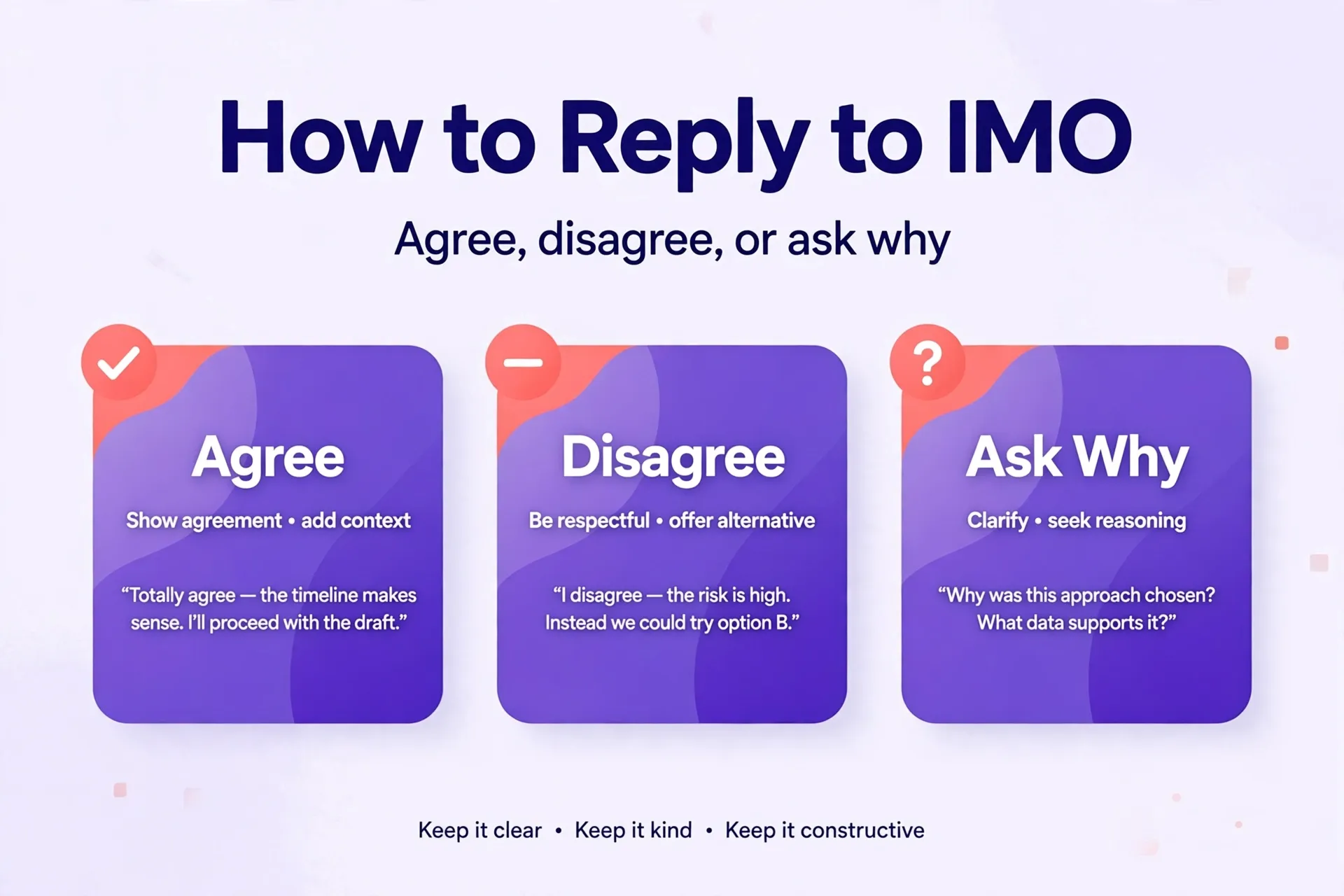
Replying to IMO is replying to an opinion, so the honest replies are the ones the Disagreement Test predicts: agree, disagree, or ask why. "Same, honestly" accepts the invitation. "I see it differently, but I get your point" disagrees without turning the exchange into a fight. "Why do you think that?" asks for the reasoning behind the label — often the most productive reply.
If the opinion came with a recommendation — "IMO, wait a day before replying" — address the recommendation, not the label: "Good call, I'll wait" or "I think sooner is better, because…" If the opinion was a judgement about you — "IMO, you overreacted" — do not argue about the label. Argue about the judgement, calmly, or say the label does not change the content: "Even as an opinion, that stings."
When you are sending IMO, spell it out when the reader may not know the slang, when the setting is formal, and when the conversation is serious or sensitive. And give the opinion its reason whenever the opinion matters: "IMO, the second option is cheaper" is stronger with "because the first charges for delivery."
IMO vs Related Terms
IMO sits in a family of short forms that all frame a sentence, but each frames it differently.
| Term | Full form | How it differs from IMO |
|---|---|---|
| IMO | In my opinion | Labels a judgement as personal. The default opinion marker. |
| IMHO | In my humble (or honest) opinion | Adds modesty, or bluntness dressed as honesty. Softer, sometimes ironic. |
| IMNSHO | In my not-so-humble opinion | Playful boast. Refuses modesty on purpose. Rare and jokey. |
| TBH | To be honest | Certifies candour. Says "I really think this," not just "this is my view." |
| TBF | To be fair | Balances a judgement with fairness to the other side. IMO takes a side; TBF steadies it. |
| IDK | I don't know | Admits no view. IMO asserts a view held as opinion. |
| FS | For sure | Asserts certainty. IMO asserts subjectivity — near opposites. |
| IDTS | I don't think so | Disagrees with a view. IMO offers one; IDTS pushes back on one. |
| BTW | By the way | Adds a side note. Never carries the main opinion; that is IMO's job. |
| WYA | Where you at | Asks a question. IMO answers with a view; WYA opens with one. |
The most useful pair is IMO versus TBH: "IMO, I didn't like it" labels a taste, while "TBH, I didn't like it" confesses one.
When IMO Means Something Else Entirely
Outside casual conversation, IMO belongs to other rooms, and the room decides the reading. In shipping and maritime writing, IMO is the International Maritime Organization, the United Nations agency that sets global rules for shipping safety, security, and pollution prevention. Every large ocean-going ship also carries an IMO number, a unique seven-digit identifier that stays with the vessel for life.
In tribute posts, IMO can stand for "in memory of," as in a memorial caption or a charity fundraiser name. The context gives it away: a name, a date, and a tone of remembrance, not a judgement. In specialist healthcare technology, IMO is also the name of a clinical terminology company, Intelligent Medical Objects, and in older job titles it has stood for Information Management Operator.
Two lookalikes deserve a warning. "Imo" is also a messaging and video-calling app, popular in parts of the Middle East, Asia, and Africa; "Do you have imo?" asks about the app, not about an opinion. And in Korean, 이모 (pronounced "imo") means maternal aunt. Those are different words that share letters and sounds — not meanings of the abbreviation.
Debunked: What IMO Does NOT Mean, and Does NOT Do
IMO does not mean "in my honest opinion" on its own: that H belongs to IMHO, and crediting it to IMO collapses the distinction that makes IMHO useful. IMO does not mean anything gendered: it is not a code that means one thing from a girl and another from a guy, and guides that sell "what IMO means from a girl" as a separate sense are dressing up tone advice as a definition.
IMO does not make a statement polite, and it does not make a statement uncertain: it labels subjectivity, not doubt, and a confident writer uses it as readily as a hesitant one. It does not turn a fact into an opinion, excuse a claim from evidence when evidence is owed, or work as a shield in an argument. No frequency study ranks IMO against its cousins, so this article prints no percentages.
When Not to Use IMO
Skip it in formal writing: client emails, reports, academic work, applications, and legal documents all deserve the full phrase or a stronger construction with evidence. Skip it on facts: dates, prices, instructions, and verifiable claims do not need an opinion label and look stranger with one. Skip it on insults: the label will not soften them, and it may make them look calculated. Skip it when the reader may not know it, when the conversation is serious or sensitive, and when you are using it to dodge a real answer — "IMO, I don't know" is two hedges stacked on each other.
Quick Answers
What does IMO mean in text?
IMO means "in my opinion." It labels a sentence as the writer's personal view rather than a fact, as in "IMO, the sequel was better."
How do I know whether a sentence deserves an IMO?
Run the Disagreement Test: find the judgement, then ask whether a fair reply could be "I see it differently." If yes, IMO fits. If the only fair reply is a factual correction, drop the label.
What is the difference between IMO and IMHO?
IMO is direct and neutral. IMHO adds "humble" or "honest": softer and more modest in its humble reading, blunter in its honest reading, and sometimes ironic. IMO is the cleaner default.
What does IMNSHO mean?
"In my not-so-humble opinion." A rare, playful variant used when the writer wants to sound confident or boastful on purpose, usually as a joke.
Does IMO mean the same thing on TikTok, Snapchat, and Instagram?
Yes. The meaning stays the same everywhere. What changes is the conversation around it: TikTok comments debate takes, Snapchat replies are quick and casual, Instagram captions rank favourites. The sentence, not the app, decides how it lands.
Is IMO rude or polite?
Neither by itself. IMO is neutral: it labels an opinion and softens its delivery, but a harsh sentence stays harsh with IMO in front of it. Tone comes from the words around it.
Can I use IMO at work?
In a casual team chat, yes, for a genuine judgement. In formal writing — client emails, reports, applications — spell it out as "in my opinion" or give the view with its reason instead.
What does IMO mean outside texting?
In shipping it is the International Maritime Organization, and in tribute posts it can mean "in memory of." The app called imo and the Korean word 이모 (maternal aunt) are different words that share the letters, not senses of the abbreviation.
Final Thoughts
IMO is a small label with a clear job: it tells the reader "this is my view, and yours may differ." Used well, it keeps conversations honest, because it separates what someone thinks from what is true.
Before you send it, run the Disagreement Test. Find the judgement, imagine the fair reply, and check that "I see it differently" is a real answer. If it is, IMO earns its place. If it is not, say the fact plainly, rewrite the insult honestly, or give the opinion its reason. Three letters cannot do that work for you.
