
Your mum texts at 11 pm: “Are you coming home tonight?” You are out with friends and do not want her sitting up by the door. Three letters solve it: “DWU.” Then a stranger writes “dwu?” in your DMs, and suddenly those same three letters look like a question. That is the puzzle of dwu meaning in text: one real meaning, but the most-read guide on the internet gets it wrong — and this article shows you the proof.
What DWU Means in Text

DWU means “don’t wait up.” It tells someone not to stay awake waiting for you — because you will be late or will not be replying for a while. “Heading out with friends tonight, DWU” means “don’t wait up for me, go to bed.”
The phrase is old — “wait up” appears in House of Lords proceedings from 1801 — and the shortcut is newer, from the 2000s, first listed in an Urban Dictionary entry in 2007.
DWU has a second face: “don’t wait up” is also casually used to mean “don’t worry about me.” “Yeah, I’m fine. DWU, I’ve just been busy with work” is reassurance, not a bedtime note. If someone could literally be waiting for you, DWU is literal; if nobody is waiting, it is reassurance.
Here is the honest part no other guide gives you straight: the most-read page for this keyword says DWU most commonly means “what are you doing?” That claim is wrong, and the same page admits it twice — its crush section says DWU “usually means ‘Don’t Wait Up,'” and another section says a bare DWU is safest read as “Don’t Wait Up.” This article does not hedge.
The DWU Waiting Test
Here is the named reader test for this article: the DWU Waiting Test. DWU has one real meaning, so this test is not about picking between phrases the way BD’s test was — it is about checking whether anyone is actually waiting.
Question 1: Who is waiting? If someone could be staying up for you — a parent, a partner, a roommate — DWU means “don’t wait up.” If nobody is waiting for anything, the letters are not doing their usual job.
Question 2: What are they waiting for? Coming home late means “don’t wait up” literally: go to bed, I have my key. A reply that will not come tonight means “don’t wait up” for my message. Nothing at all means stop and re-read.
Question 3: Swap it in. Replace DWU with “don’t wait up” and read the sentence aloud. “Heading out with friends, don’t wait up” works. “Don’t wait up?” as a chat opener does not. A bare “dwu?” is almost certainly someone reaching for WYD — “what are you doing” — and typing the wrong letters. Answer with what you are doing and move on.
DWU in Real Conversations
The late night out.
Alex: “Heading out with the guys tonight. DWU 😅”
Mum: “Okay, have fun. Text when you’re home safe.”
The reassurance.
Sara: “Are you okay? I haven’t heard from you in a while.”
Jordan: “Yeah, I’m fine. DWU, I’ve just been busy with work.”
The work night.
Chris: “I’m slammed with work tonight, DWU if I don’t reply right away.”
Taylor: “No worries, talk tomorrow.”
The “What Are You Doing?” Trap — Why the Top Guide Gets DWU Wrong
The guide most people land on first is wrong on its first line: it claims DWU most commonly means “what are you doing?” — written as “do what you?”
The letters do not spell it. “What are you doing” shortens to WYD — W for what, Y for you, D for doing. DWU spells D-W-U: don’t, wait, up. A shortcut that does not match its own letters is a mistake that got published.
The dictionary disagrees. Dictionary.com says plainly that DWU is an internet acronym for “don’t wait up,” first listed that way in a 2007 Urban Dictionary entry. No dictionary lists “what are you doing” under DWU.
Four other guides disagree. Qoutermenia, CoolSlangs, TravelsType, and EnglishStudyOnline all give “don’t wait up.” The “what are you doing” reading appears in exactly one of the five guides.
The guide disagrees with itself. On the same page that crowns “what are you doing,” the crush section says DWU “usually means ‘Don’t Wait Up,'” and another section says a bare DWU is safest read as “Don’t Wait Up.” A guide that contradicts its own headline twice is not a source; it is a warning.
The same message, two replies. Someone sends you a bare “dwu?” at midnight. The wrong reply treats it as a question that was never asked — you stay up wondering what they want. The right reply is “Just watching a show, you?” The trap only bites if you freeze.
How the Feeling Around DWU Changes the Meaning
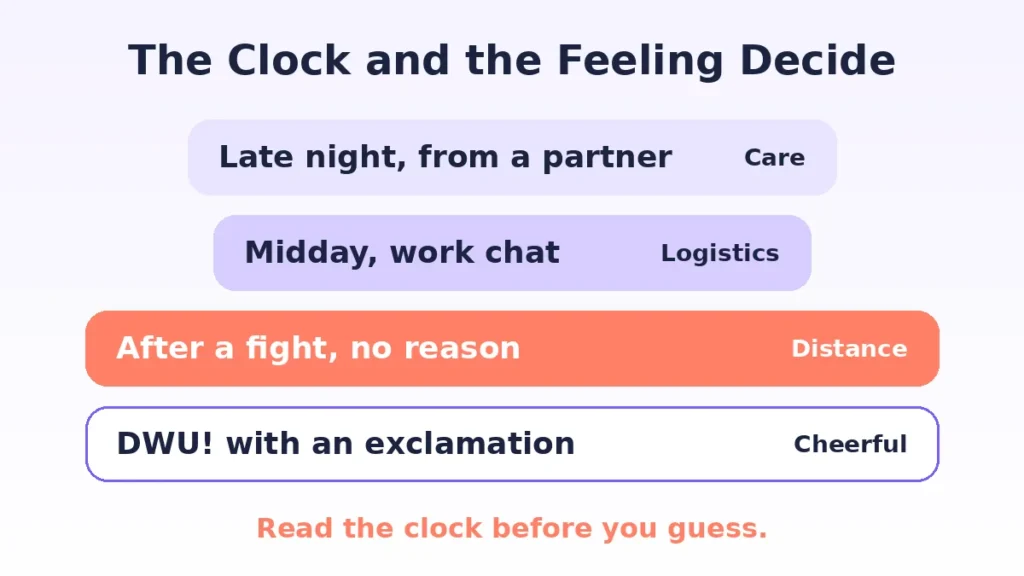
DWU is almost always kind — a courtesy that says “don’t put your evening on hold for me.” But the feeling changes with the clock and the relationship.
Late at night, from a partner, DWU is care. “Got a late meeting tonight, DWU 😊” says: I am thinking about your sleep. Add a heart emoji and it is warmer still.
After a fight, DWU is distance. “DWU” sent cold, with no reason and no emoji, can read as a door closing. The letters did not change. The relationship did. If a DWU feels cold, answer the coldness, not the letters.
Punctuation is the second clue. “DWU!” is cheerful — a party, a night out. “DWU.” is businesslike. “DWU…” is tired. If someone sends DWU and you answer by waiting up anyway, expect a head-shake — the territory of what SMH means in text — because you did the one thing they asked you not to do. And “to be honest, I’ll be late” is a very different message from a bare “DWU” after a fight.
DWU on TikTok, Snapchat, Instagram, and in Texting
In texting, SMS, and WhatsApp, DWU is at home — and the clues are richest there, because you know the sender.
On Snapchat, DWU is a sign-off. Snaps disappear and streaks demand daily contact, so “DWU, talk tomorrow” ends the day cleanly. A bare “dwu?” in a snap DM is the trap at its most common — short messages, vanishing context.
On Instagram, DWU shows up in DMs and Story replies, usually about being busy or out late: “Out tonight, DWU.” The photo is often the missing clue.
On TikTok, DWU lives in captions and comments: “DWU, I’m living my best life” is a sign-off, not a question. If a commenter really wants to know what you are doing, they will write WYD.
Who Sent It Changes How It Lands
From a parent, DWU usually runs the other way: they are telling you not to wait for them, or you are telling them not to wait for you. Either way it is care: “Got it, I’ll crash early then 😴.”
From a close friend — your best friend — DWU is easy: a night out, a late shift, a study session. Answer lightly: “Haha, no worries! Have fun 😄.”
From a crush or a partner, DWU is a small test of attention. “I’m heading out with friends, DWU” is a heads-up, not a brush-off — they want you to know, not to worry. Answer warmly and let it go: “Okay, text me when you’re free.” The same goes for a new dating-app match: an early “Got a late meeting tonight, DWU 😊” shows respect for your time — a good sign, not a red flag.
From a coworker or a boss, DWU is rare and best avoided. “Still finishing up the project, DWU” is understandable in a work chat, but it is still slang where clarity matters. Never send one upward yourself.
DWU vs WYD vs BRB vs TTYL
DWU gets mixed up with its neighbours because they all manage absence. They are not the same.
| DWU | WYD | BRB | TTYL | |
|---|---|---|---|---|
| Stands for | Don’t wait up | What are you doing? | Be right back | Talk to you later |
| Job | Don’t wait for me | Ask what you’re doing | Short pause | End the chat for now |
| Answers | “Okay, have fun” | What you’re doing | “Okay” | “Talk soon” |
DWU vs WYD is the classic mix-up. WYD asks a question; DWU gives an instruction. “WYD?” wants an answer about your evening; “DWU” wants you to go to bed.
The Other DWUs
DWU has a few other jobs outside texting. In education, it can stand for a university name — Delaware Wesleyan University. In computing, it appears as Data Work Unit or Data Warehousing Unit. None of them is what a texter means.
How to Reply When Someone Says DWU
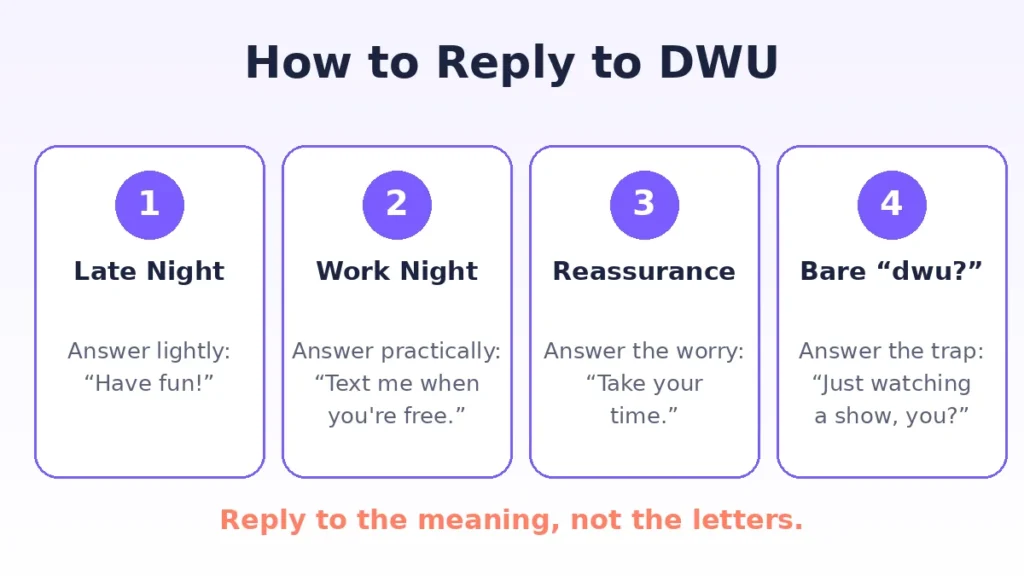
When DWU meant a late night out, answer lightly: “Haha, no worries! Have fun 😄” — or “Got it, I’ll crash early then 😴.”
When DWU meant a work night, answer practically: “Okay, text me when you’re free.” No drama, no waiting — that is the whole point.
When DWU meant reassurance, answer the worry, not the letters: “No problem, take your time.” The person is really saying “don’t worry about me” — tell them you are not worried, and mean it. A warm, for real “I’m fine, go enjoy your night” beats a formal one.
When DWU was a bare “dwu?” and you suspect the trap, answer with what you are doing: “Just watching a show, you?” If they meant “what are you doing,” you have answered it; if they meant “don’t wait up,” you have told them you are awake and fine.
When you don’t know what they meant, ask the right question: “Do you mean don’t wait up, or are you asking what I’m doing?” People would rather explain than be misread. But do not answer a worried DWU with a wall: “I don’t care” said kindly is still a wall.
When Not to Use DWU
Leave DWU alone in professional emails, job applications, and messages to clients — full sentences communicate better, and slang in a work inbox looks careless. Skip it in serious conversations: after bad news, “DWU” reads as distance when the other person needed closeness.
Do not use DWU as a brush-off. If someone is worried about you, “DWU” without a reason can feel like a door closing — add the reason and it becomes care: “DWU, I’m safe, just out late with friends.” And do not send DWU when nobody is waiting — it answers a question nobody asked. If clarity matters more than speed, spell it out: “Don’t wait up, I’ll be late” is never misunderstood.
Quick Answers About DWU
What does DWU mean in text?
DWU means “don’t wait up.” It is also casually used to mean “don’t worry about me.”
What does DWU mean on TikTok?
On TikTok, DWU means “don’t wait up” in captions and comments — someone announcing they are out, as in “DWU, I’m living my best life.” It is not a question.
What does DWU mean on Snapchat?
On Snapchat, DWU is a sign-off before going offline: “DWU, talk tomorrow.” A bare “dwu?” is often the trap — answer with what you are doing.
What does DWU mean on Instagram?
On Instagram, DWU means “don’t wait up” in DMs and Story replies, often about being busy or out late. The photo is often the missing clue.
Is DWU rude in text messages?
DWU is not rude on its own — it is usually polite. But a bare “DWU” after a fight can feel cold. Add the reason and it stays kind.
What is the difference between DWU and WYD?
WYD asks a question (“what are you doing?”); DWU gives an instruction (“don’t wait up”). One popular guide confuses the two, but the letters and the dictionary say DWU is “don’t wait up.”
What does DWU mean from a girl?
DWU means the same thing from a girl as from anyone else — gender does not change it. The situation decides.
When should I not use DWU?
Avoid DWU in professional emails, job applications, and serious conversations. Do not use it as a brush-off, and do not send it when nobody is waiting.
The Bottom Line on DWU
DWU means “don’t wait up” — three letters, one job, with a history that runs from the House of Lords in 1801 to your phone tonight. It tells someone not to stay awake for you, and in its softer face it tells them not to worry about you. The only real confusion comes from one popular guide that claims it means “what are you doing” — a claim its own page contradicts, its letters do not spell, and no dictionary supports. Run the Waiting Test: who is waiting, and does “don’t wait up” fit the sentence? If it fits, that is the meaning.
