
You are reading a text that says, “I can’t come bc I’m sick,” and you understand it instantly. Then another message says, “The temple was built in 2500 BC,” and the same two letters mean something completely different. That is the whole puzzle of bc meaning in text: in a chat it almost always means “because,” but the same letters have older jobs elsewhere, and telling them apart takes two seconds once you know how.
BC is the shortest way to give a reason. This guide shows you how to read any BC in a second, including the rare moments when it means something else.
What BC Means in Text
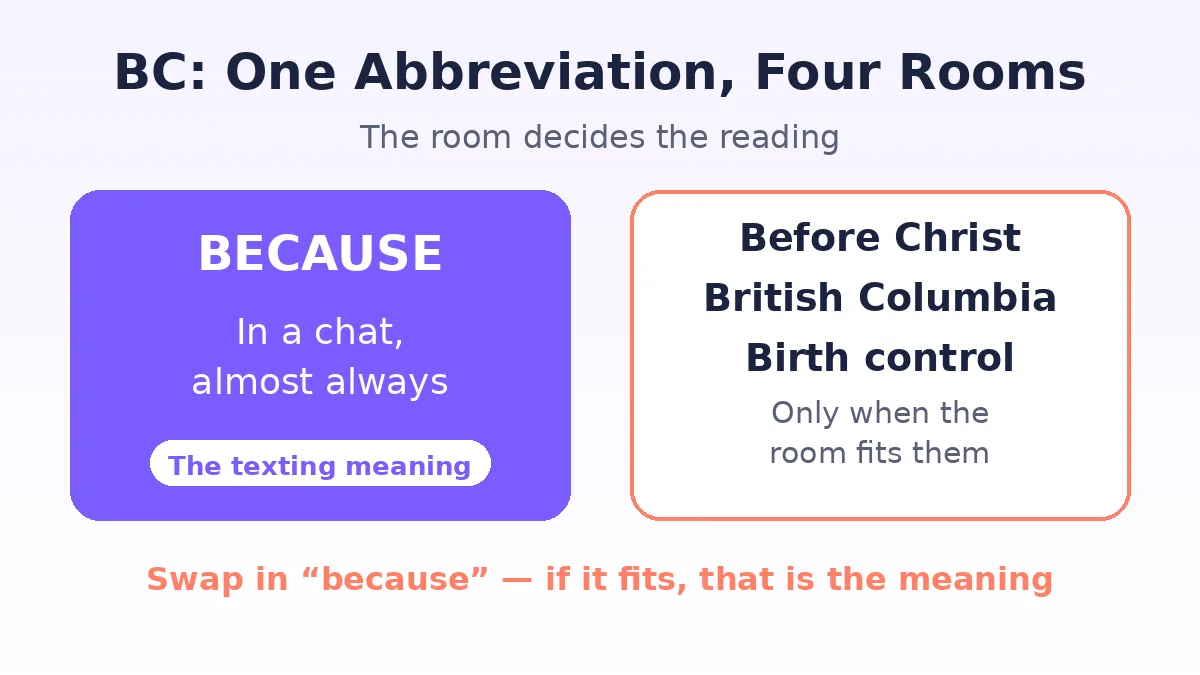
BC is short for “because” — an abbreviation, not an acronym — that chops the word down so you can type it faster. When someone writes “bc,” they are giving you a reason, exactly the way “because” does.
The letters are almost always lowercase: “bc.” At the start of a sentence it appears as “Bc,” like any word. The slash version, “b/c,” means exactly the same thing.
Here is the key fact: it is not a new word with a new meaning. It is an old, ordinary word wearing a shorter coat.
That is why BC pairs so naturally with other short words. A friend might write, “I can’t come bc I’m tired, for real” — BC gives the reason, FR underlines that the reason is genuine.
The BC Swap-and-Spot Test
Here is the named reader test for this article: the BC Swap-and-Spot Test. The first question alone settles almost every case.
Question 1: The Swap Test — put “because” back in. Swap BC for “because” and read the sentence again. If it still makes sense, that is your answer. “I’m late bc traffic is crazy” becomes “I’m late because traffic is crazy” — a perfect fit. “The pyramid was built around 2500 BC” becomes “The pyramid was built around 2500 because” — nonsense. The swap fails, so “because” is not the meaning there.
Question 2: The Spot Test — where does BC sit? “Because” is a conjunction, so it joins a reason to the rest of the sentence, and BC inherits that job. At the start of a clause (“Bc I was tired, I stayed home”) or in the middle of one (“I stayed home bc I was tired”), it means “because.” But directly after a number (“300 BC,” “44 BC”), it is a year marker — the historical “Before Christ.” A BC with a number glued to its left is never “because.”
Question 3: The Room Test — what is the conversation about? In a health or relationship conversation, “my doctor changed my bc” is about birth control. In a conversation about Canada, “Vancouver, BC” is British Columbia. In a history class, “BC” is Before Christ.
If the three answers still conflict, trust the Swap Test.
BC in Real Conversations
Giving a simple reason.
Maya: “Are you coming tonight?”
Jordan: “Can’t, bc I have work tomorrow.”
Maya: “No worries, next time.”
Explaining why something happened.
Chris: “Why is everyone laughing?”
Taylor: “Bc Sam just sent the funniest video.”
Answering a “why” question. “Why are you so happy?” — “Bc I got the job!” When the answer is an opinion rather than a reason, the sentence changes shape — that is the territory of what IMO means in text, which states a view instead of giving a cause.
How the Reason After BC Changes the Tone
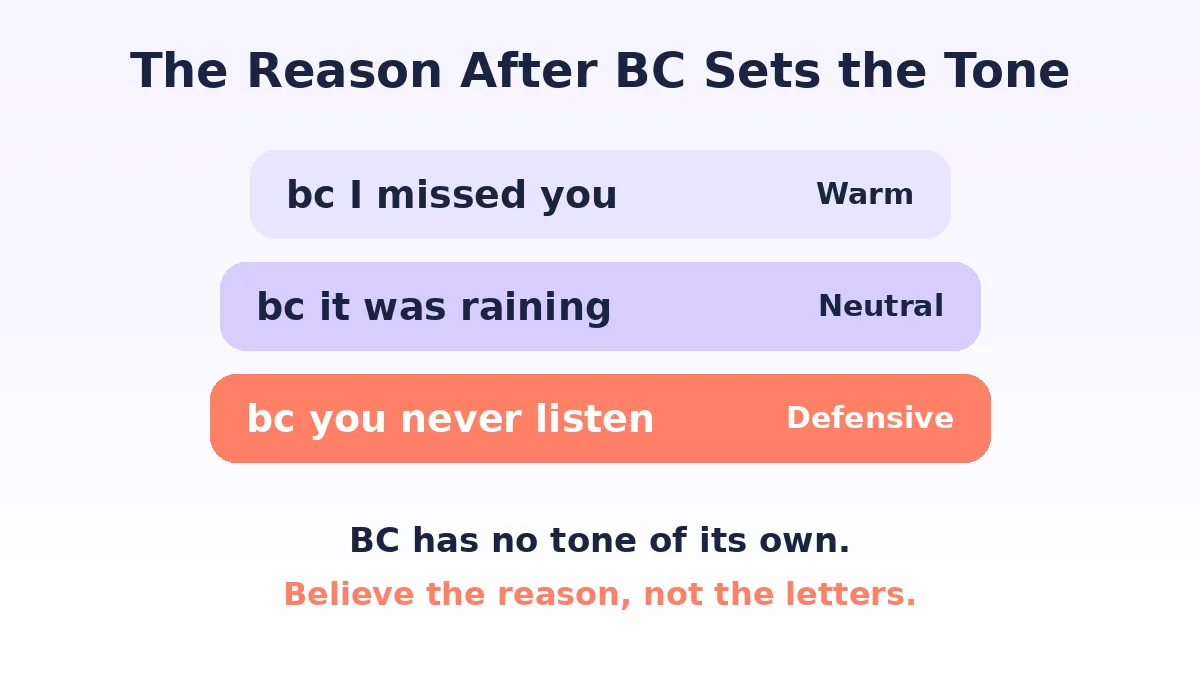
BC itself has almost no tone — all the feeling comes from the reason that follows it. “bc I missed you” sounds warm, because the reason is affectionate. “bc it was raining” sounds neutral, because the reason is just weather. “bc you never listen” sounds defensive, because the reason is a complaint.
Punctuation adds a second layer. A bare “bc.” with a full stop and nothing after it can feel blunt — “Why didn’t you come?” — “bc.” reads like a door closing. Add the reason and it opens again: “bc I wasn’t feeling well” is a complete, friendly answer. An emoji does the same work: “bc I’m so tired 😴” reads as honest and a little funny, while “bc whatever 🙄” reads as annoyed. When an emoji carries a strong feeling, believe the emoji over the letters.
The defensive BC is the one to watch for. “I didn’t reply bc you kept texting” is about frustration, not texting. If you receive a defensive BC, answer the feeling, not the letters: “Got it, I’ll give you space.”
BC on TikTok, Snapchat, Instagram, and in Texting
In texting, SMS, and WhatsApp, BC is at home: a quick reason in a private chat, usually about plans, moods, or something that just happened. It is one of the most common abbreviations in everyday messages because “because” is one of the most common words in everyday speech.
On Snapchat, BC lives in fast DMs and snap replies, often in lowercase — “bc I’m busy” after a snap you could not answer. Because snaps disappear, a bare “bc” with no reason can confuse the other person — the context may already be gone.
On Instagram, BC appears in DMs, comment threads, and replies to Stories. In comments it often explains a reaction: “This video went viral bc it’s so relatable.” In DMs it is usually a plain reason for being late or cancelling. On TikTok, BC is a caption and comment regular: “Skipping the gym today bc I’m exhausted.”
Who Sent It Changes How It Lands
From a close friend, BC is almost always easy: a quick reason, no hidden meaning, no decoding needed. From a crush, BC itself carries no romance. “I stayed up bc I wanted to talk to you” feels warm because of the reason — wanting to talk to you — not because of the letters.
From a parent, BC usually means a simple, practical reason: “Can’t come bc the car is in the shop.” From a boss or a teacher, BC can look careless, because it is so short. Do not send it upward yourself: “because the client meeting moved” says the same thing without the risk.
From a stranger or a new dating-app match, BC is genuinely casual, and that is useful information in itself. “I moved here bc of work” is a relaxed, low-effort way to share a fact. In a group chat, BC usually explains the message directly above it, not the whole conversation.
An honest opener often sits next to it: “bc I didn’t know, to be honest, I just guessed.” BC gives the reason; TBH flags that the reason is candid. A disbelief marker often rides along too — the tone notes in what NGL means in text work the same way, with the feeling carried by the words around the abbreviation.
The Other BCs: Before Christ, British Columbia, and Birth Control
Most of the time, BC means “because.” But the same two letters have three other established jobs, and knowing them keeps you out of a misunderstanding.
Before Christ is the oldest BC. It marks years before the traditional date of the birth of Christ: “The Battle of Actium took place in 31 BC.” It is almost always written in capitals, often with periods (“B.C.”), and it always sits directly after a number. You will see it in history books, museums, and school — essentially never in a casual chat.
British Columbia is the Canadian BC. It is the westernmost province of Canada, and it appears in addresses and geography: “Next year’s conference will be in Vancouver, BC, Canada.” In a chat, you will only meet this BC when the conversation is about Canada.
Birth control is the medical BC. In health or relationship conversations, “bc” can mean birth control: “My doctor changed my bc.” This reading only appears when the conversation is already about health or relationships.
BC in a Different Language and Culture
There is one more reading of BC. In some South Asian online conversations, the same two letters are also used as a masked shorthand for a strong Hindi/Urdu swear word (written in masked form as b***d). It appears on its own, usually during an argument, and it has nothing to do with “because.”
This is why the room test matters. “I’m late bc traffic” in an English conversation is “because” — nobody doubts it. But a lone “BC” fired off in the middle of a heated argument in a South Asian slang-heavy chat may not be “because” at all. When the context is unclear, asking what the person means is safer than assuming.
BC vs B/C vs Cuz vs Cos
BC is not the only way to shorten “because.” Each variant has its own flavor.
| BC | B/C | Cuz | Cos | |
|---|---|---|---|---|
| Full form | Because | Because | Because | Because |
| Feel | Neutral, standard | Slightly more formal | Very casual, spoken | Casual, British |
| Where you see it | Texting, social media | Notes, messages, emails | Chats, speech, captions | UK chats and speech |
BC is the most widely recognized of the four, and the shortest. B/C adds a slash and reads a touch more deliberate. Cuz spells out how “because” sounds when you say it fast. Cos is the British cousin, common in UK texting and speech.
The choice is style, not meaning — the Swap Test works on every one of them. The full question form of a related shortcut is what WDYM means in text — it asks what something means, while BC gives the reason behind it. Another classic shortcut worth knowing is what BRB means in text — it saves time the same way, by replacing a whole phrase with three letters.
How to Reply When Someone Says BC

You are never really replying to the letters — you are replying to the reason they introduce.
When BC gave a simple reason, acknowledge it and move on: “Makes sense.” “Got it.” “No worries.” If the reason was a plan changing, confirm the new plan: “Okay, tomorrow then.”
When BC gave a surprising reason, react to the surprise, not the abbreviation: “Wait, really?” “That explains it!” “Oh no, are you okay?” A quick check-in fits here too — what WBU means in text turns the question back: “What about you?”
When BC sounded defensive, do not argue with the reason. Answer the feeling behind it: “Got it, no pressure.” “Fair enough.” “Take your time.”
When you are unsure what they meant, ask which part was the reason: “Bc what — the traffic or the meeting?” Or use the shorthand in what LMK means in text.
When Not to Use BC
Leave BC alone in professional emails, job applications, and messages to clients. Skip it in academic writing and formal reports. Do not use it in serious or emotional conversations — “bc I was busy” after bad news can look dismissive even when you only meant to be quick.
Do not use BC with anyone who may not know texting slang, or when the reason itself is complicated. And do not send it bare: a lone “bc.” with no reason attached is not an explanation, it is a shrug.
If clarity matters more than speed, spell the word out.
Quick Answers About BC
What does BC mean in text?
BC means “because” — a short way of writing the word when you are giving a reason in a chat.
What does BC mean on TikTok?
On TikTok, BC means “because.” It appears in captions, comments, and replies, usually introducing the reason for something.
What does BC mean on Snapchat?
On Snapchat, BC means “because” in DMs and snap replies, usually in lowercase, sent as a quick reason after a missed message.
What does BC mean on Instagram?
On Instagram, BC means “because” in DMs, comments, and Story replies. In comments it often explains a reaction; in DMs it is usually a plain reason for plans changing.
Is BC rude in text messages?
BC is not rude on its own, but a bare “bc.” with no reason can sound dismissive, especially in a tense conversation or at work.
What is the difference between BC and B/C?
They mean the same thing: “because.” B/C adds a slash and reads slightly more formal; BC is shorter and more common.
What does “BC” mean in history?
In history, BC means “Before Christ,” marking years before the traditional date of the birth of Christ. It always sits directly after a number, as in “300 BC.”
When should I not use BC?
Avoid BC in professional emails, formal messages, job applications, and serious conversations. Write the full word “because” instead.
The Bottom Line on BC
BC is two letters doing one job: giving a reason. In a chat it means “because” almost every time, and the Swap Test proves it in a second. The other readings belong to other rooms — a number means a year, a Canadian address means a province, a doctor’s chat means birth control. Read the sentence, check the spot, mind the room, and BC will never confuse you again.
