

Someone disagrees with you in a group chat, and instead of saying “you’re wrong,” they write, “FWIW, I think the first design looked better.” The message is polite. It is also, somehow, a correction. Later, someone else writes, “FWIW, everyone else finished already,” and that one does not feel polite at all. That is the whole puzzle of fwiw meaning in text: four letters that always stand for the same phrase — “for what it’s worth” — yet sound helpful in one message and passive-aggressive in the next. The letters never change. The tone does.
What FWIW Means in Text

FWIW means “for what it’s worth.” It is a polite preface people put in front of an opinion, a suggestion, or an extra piece of information they are not sure you need. The message it sends is: this is just my take — you can use it or ignore it.
Think of it as the written version of a shrug. Instead of saying, “You have no idea what you’re talking about,” a friend writes, “FWIW, 4K TVs have four times the resolution of HD TVs.” The fact is identical. The sting is gone.
FWIW does not change what a sentence says. It changes how it lands. Delete it and the opinion survives — what disappears is the softening, the signal that says I’m offering this, not ordering it.
That is why it shows up everywhere: texts, group chats, Reddit, Discord, Instagram comments, and quick work messages. The phrase is old — “for what it’s worth” dates to the 1800s, when it was used in economics to talk about the literal value of goods — but the shortcut arrived with the early internet, on Usenet in the late 1980s.
FWIW has exactly one meaning. The question is never what it stands for, but what tone it carries.
The FWIW Delete-and-Swap Test
Here is the named reader test for this article: the FWIW Delete-and-Swap Test. It does not decode the letters — it decodes the tone — and it takes about three seconds.
Step 1 — Delete. Take FWIW out. If the sentence still says the same thing, FWIW was only a softener.
Step 2 — Swap. Replace FWIW with FYI. If the sentence still sounds natural, the tone is snarky — How-To Geek’s rule of thumb, because FYI is a fact word, not a softening one. If FYI sounds wrong or too blunt, the tone was genuine.
Step 3 — Move. Say the sentence to your boss in your head. If it still sounds fine, it was the polite FWIW. If it suddenly sounds rude, it was the passive-aggressive one — do not send it.
Try it: “FWIW, the first design looked better.” Delete it and the opinion survives. Swap in FYI and it sounds like a correction. Move it to a client email and it still reads polite.
The Four Tones of FWIW
FWIW sits on a dial with four stops. Learning to hear them is the whole skill.
Helpful. The most common tone. The sender genuinely wants to add something useful and is leaving the decision to you. “FWIW, the ice cream shop on 9th Street is really good.” “You did a great job, FWIW” is this tone too.
Neutral. Sometimes FWIW carries no feeling at all. “FWIW, the meeting starts at 9.” Nothing is being argued; it is just a polite way of adding a fact.
Snarky. This is where the FYI swap earns its keep. “FWIW, toothpaste kills bad breath germs” is a jab dressed as a fact, and swapping in FYI changes nothing — the “information” is something the other person obviously knows.
Passive-aggressive. The quietest and the least kind. “FWIW, everyone else finished already.” The words are mild; the message is not.
FWIW is almost never rude on its own — context turns the dial.
FWIW at the Start vs at the End
Where FWIW sits changes how it feels.
At the start, FWIW introduces an opinion. “FWIW, I liked the old version more.” The reader is warned before the opinion arrives: here comes a take, and it is only a take. This is the polite, standard move.
At the end, FWIW is a modest afterthought. “I probably wouldn’t choose that restaurant, fwiw.” The main point comes first; the softening arrives last. It can sound humble, but also like a parting shot — the last word lingers.
If you want to be clearly polite, put FWIW first. If you put it last, read the sentence again before sending — the afterthought position is where the snark hides.
FWIW in Real Conversations
The friendly recommendation.
Sam: “I can’t decide where to eat tonight.”
Alex: “FWIW, the place on 9th Street has the best coffee in town.”
Sam: “Sold. Let’s go there.”
The softened disagreement.
Priya: “I’m sure the second option is better.”
Jordan: “FWIW, the data shows something different.”
Priya: “Really? Show me.”
Jordan did not say “you’re wrong” — the abbreviation let him put a fact on the table without starting a fight.
The quiet jab.
Taylor: “I finally finished the report.”
Morgan: “FWIW, everyone else finished already.”
Same four letters. Completely different message. The test catches it: delete FWIW, the dig survives; swap in FYI, nothing changes.
FWIW on TikTok, Snapchat, Instagram, and in Texting
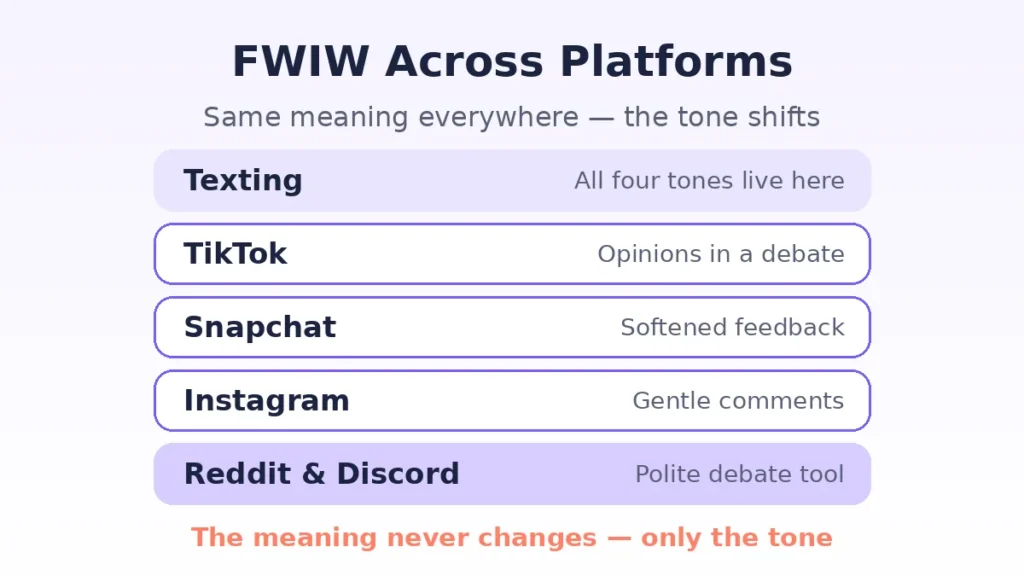
In texting, SMS, and WhatsApp, FWIW is at home — tone is hardest to read in a plain message.
On TikTok, FWIW lives in captions and comments, usually as an opinion in a debate. “FWIW, I think the first design looked better” under a creator’s video is a gentle disagreement. TikTok runs sarcastic, so a flat FWIW under a boast can also be snarky.
On Snapchat, FWIW shows up in chat replies and story reactions, often as softened feedback. “FWIW, that outfit looks great” is a compliment with the volume turned down.
On Instagram, FWIW appears in DMs, comments, and Story replies, usually as feedback on a post. “FWIW, this place has the best coffee” is a recommendation, not a review.
On Reddit, Discord, and gaming forums, FWIW is a standard tool for joining a debate without starting a fight. “FWIW, that weapon got nerfed last patch” shares useful experience.
The meaning never changes from platform to platform — only the likeliest tone shifts.
Who Sent It Changes How It Lands
From a close friend — your best friend — FWIW is almost always easy to read. You know their voice, so you know whether “FWIW, I liked your haircut” is a compliment or a joke.
From a crush or a partner, FWIW is usually thoughtful. “FWIW, I think honesty matters more than looks” is a small window into what they value.
From a coworker, FWIW is usually a polite suggestion. “FWIW, the client seemed happy with the first draft” is feedback, not a command. FWIW is unusual among texting abbreviations: it is genuinely at home in work chat — “FWIW, I tested the feature and it works on my side” is fine in a quick Slack message. But it does not belong in a formal document.
From someone who is annoyed with you, FWIW is the one to watch. “FWIW, you might want to check that file again” from a frustrated colleague is not a tip; it is a correction with plausible deniability.
A related abbreviation sits nearby: what TBH means in text is the honest-opinion marker, and it goes wrong the same way when the reader guesses at the tone.
FWIW vs FYI vs IMO vs TBH
FWIW gets mixed up with its neighbours because they all introduce extra information.
| FWIW | FYI | IMO | TBH | |
|---|---|---|---|---|
| Stands for | For what it’s worth | For your information | In my opinion | To be honest |
| Shares | An opinion or suggestion | A fact | A personal belief | A truth |
| Tone | Tentative, softening | Direct, factual | Owning the view | Blunt, confessional |
FWIW vs FYI is the classic mix-up — and the most useful one. FYI shares information: “FYI, the deadline is Friday.” FWIW shares an opinion: “FWIW, I prefer the first option.” If you can swap FWIW for FYI without changing the feel, the FWIW was probably snarky. What FR means in text is a similar trap — a short marker whose honesty can land harder than intended.
FWIW vs IMO is about confidence. IMO claims the viewpoint: “IMO, the first option is better” says this is my belief. FWIW is more detached. Own it with IMO; float it with FWIW.
FWIW vs TBH is about honesty versus softness. TBH introduces a truth: “TBH, I didn’t like it.” FWIW introduces an opinion offered lightly. TBH is confessional; FWIW is diplomatic. And when you genuinely do not know, the honest move is in what IDK means in text — “I don’t know” beats dressing a guess up as advice.
How to Reply When Someone Says FWIW
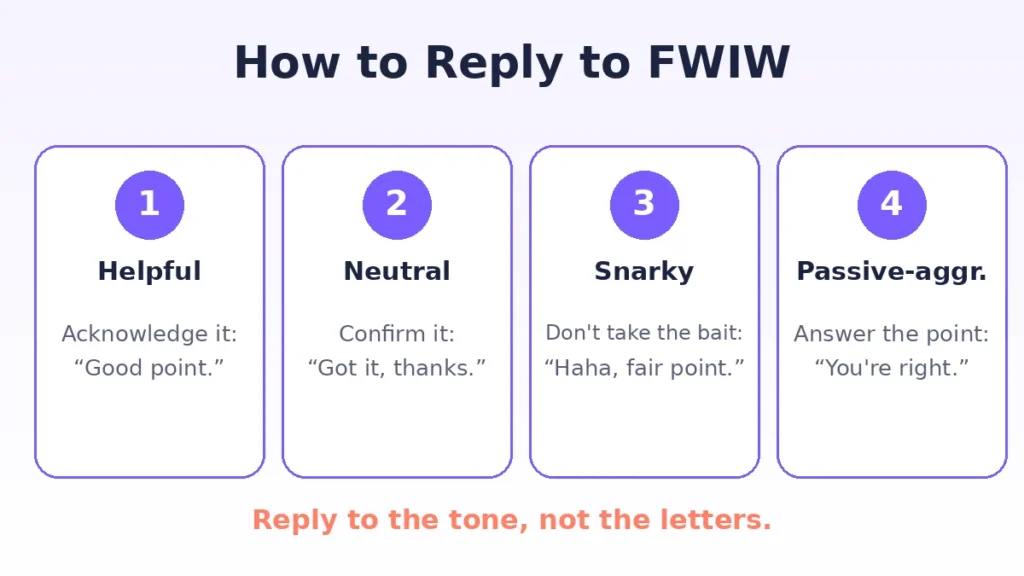
When FWIW was helpful, acknowledge it. “Good point.” “Yeah, that makes sense.” “I didn’t think about that.”
When FWIW was neutral, a simple confirmation is enough. “Thanks for the info.” “Got it.” “That helps.” No need to overthink a message that was just adding a fact.
When FWIW was snarky, do not take the bait. “Haha, fair point” ends it cleanly. If the snark was aimed at something you care about, the honest reply is the one in what IDC means in text — “I don’t care” said kindly is still a wall, and sometimes a wall is the right answer.
When FWIW was passive-aggressive, decide whether the point underneath is true. If it is, answer the point and ignore the packaging: “You’re right, I’ll check the file.”
When you are unsure what tone it was, ask: “Did you mean that as a suggestion or a heads-up?” People would rather explain than be misread.
When Not to Use FWIW
Do not use FWIW in formal writing — reports, proposals, official emails, academic papers. Write the full sentence instead.
Do not use it in sensitive conversations — a FWIW in front of a trivial silver lining, when someone is venting about a serious loss, can feel dismissive.
Do not use it when clarity matters more than politeness. “FWIW, the bridge is closed” is a bad way to warn someone about a bridge.
Do not use it as a reflex. If every opinion starts with FWIW, you sound unsure of your own thoughts. The plain sentence in what BC means in text — “I’m late because of traffic” — gives a reason without hiding.
Do not use it to deliver bad news sideways. “FWIW, everyone else finished already” is not feedback; it is a jab with an escape hatch.
Say it without FWIW. Sometimes the opinion is good and the abbreviation is in the way. Take the same opinion — the first design looked better — plain: “I think the first design looked better.” Firmer: “The first design was stronger.” Work-safe: “The first draft tested better with the client.” The opinion was always yours. When the reaction is disbelief, the territory belongs to what SMH means in text — the head-shake that says “I can’t believe this.” And if the opinion is about a relationship, the label in what FWB means in text goes wrong the same way when the reader guesses.
Quick Answers About FWIW
What does FWIW mean in text?
FWIW means “for what it’s worth.” It is a polite way to share an opinion or a suggestion without sounding forceful.
What does FWIW mean on TikTok?
On TikTok, FWIW usually introduces an opinion in a comment or caption — a gentle disagreement under a creator’s video.
What does FWIW mean on Snapchat?
On Snapchat, FWIW usually softens feedback in a chat reply or a Story reaction.
What does FWIW mean on Instagram?
On Instagram, FWIW usually softens feedback in a DM, comment, or Story reply — “FWIW, this place has the best coffee” is a recommendation.
Is FWIW rude in text messages?
FWIW is not rude on its own. But it can sound snarky or passive-aggressive depending on context.
What is the difference between FWIW and FYI?
FYI shares a fact directly: “FYI, the deadline is Friday.” FWIW shares an opinion tentatively: “FWIW, I prefer the first option.” If you can swap FWIW for FYI without changing the feel, the tone was probably snarky.
What does FWIW mean from a girl?
FWIW means the same thing from a girl as from anyone else — gender does not change it. The relationship and the topic decide the tone.
When should I not use FWIW?
Avoid FWIW in formal writing, in sensitive conversations, and when clarity matters more than politeness.
The Bottom Line on FWIW
FWIW is four letters doing one job with four different tones. It always means “for what it’s worth” — but whether it lands as helpful, neutral, snarky, or passive-aggressive depends on the sentence, the sender, and the moment. Delete it, swap in FYI, move it to your boss: three seconds, and you will know exactly what you just read.
