
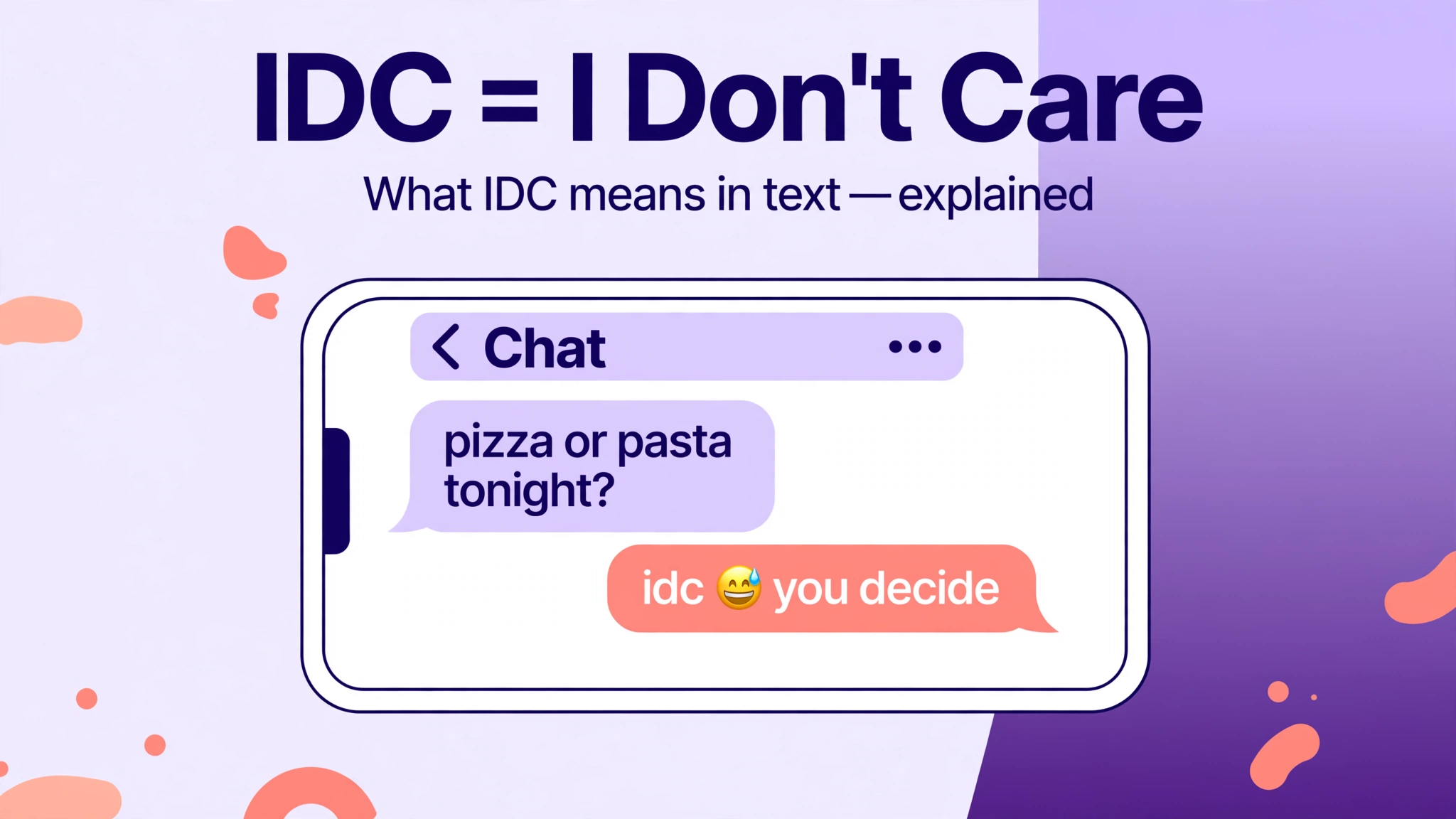
Three letters that can end a conversation in one word. You sent someone news, a question, a plan — and back comes a flat little “idc.” Now you’re staring at the screen with the real question this article exists to answer: did they just insult me?
IDC means “I don’t care” — but what it’s actually doing depends entirely on what you said before it. This guide covers where IDC came from, the simple test that tells you whether it’s chill or rude, how punctuation and emojis turn the rudeness dial, how IDC compares to IDM and IDK, and exactly how to reply when someone drops it on you.
IDC Meaning at a Glance
| Full form | I Don’t Care |
| Two readings | (1) No-preference — “whatever works”; (2) brush-off — mild dismissal |
| The deciding test | Dismissing a topic is fine; dismissing a person is rude |
| Tone dial | “idc.” (cold) · “idc 😅” (friendly) · “IDC!!” (annoyed) |
| Common in | Texts, group chats, DMs, comments, gaming chats |
| Softer swap | “I’m fine with anything” |
| Variant | IDRC — “I don’t really care,” essentially interchangeable |
| Natural reply | Take the decision yourself — or say “that felt dismissive” |
The Origin: Three Letters from the 1990s Chatroom Era
IDC is older than most of the people using it. It emerged in 1990s chatrooms and early internet forums — the same primordial soup that gave us TBH and BRB — where typing was slow and screen space was precious. The first Urban Dictionary definition landed in 2003, and IDC rode the SMS and instant-messenger boom of the early-mid 2000s into everyday texting, then into Twitter’s short-form culture. HowToGeek’s well-documented write-up of this timeline is the best-sourced origin account in this space.
That’s worth knowing for one reason: IDC was born as a typing shortcut, not as an insult. The rudeness problem arrived later, when the shortcut outlived the speed problem and the abbreviation itself started doing the emotional work.
The Rudeness Test: Are They Dismissing a Topic or a Person?
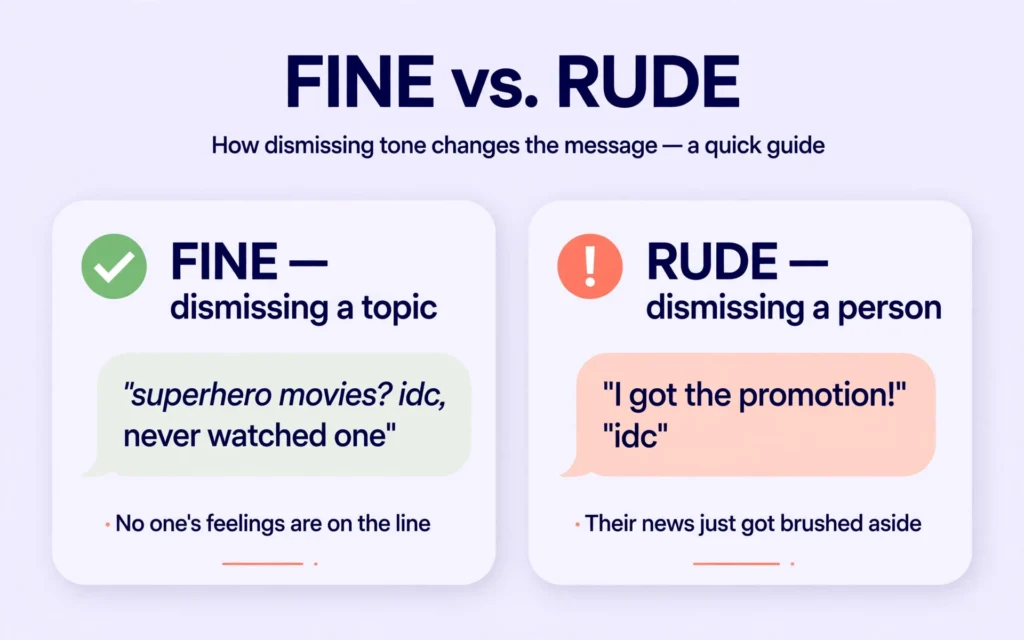
This is the section that settles it — the rudeness mechanic behind every “is IDC rude?” argument. The test comes from HowToGeek, and it has exactly two cases:
- Dismissing a topic is fine. “superhero movies? idc, never watched one” — nobody’s feelings are attached to superhero movies. The person is opting out of a subject, not rejecting you.
- Dismissing a person is rude. You share news — “I got the promotion!” — and get back a bare “idc.” That lands as rejection, because what you actually heard was indifference to you.
Why does it sting more than the full phrase? HowToGeek nails it: the rudeness is magnified because you used a short acronym — “you didn’t even care enough to type the entire phrase.” A three-letter brush-off reads colder than the words it stands for, because the abbreviation signals the effort the sender was willing to spend: almost none.
The test answers “did they just insult me?” in about three seconds.
The IDC Tone Decoder: Punctuation Is the Volume Knob
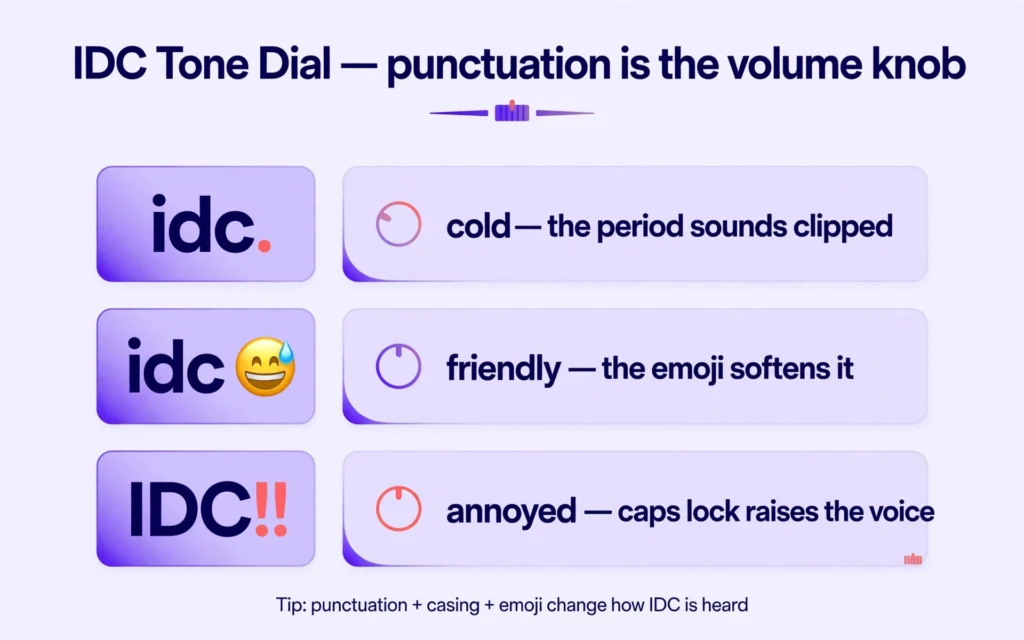
Same three letters, completely different messages. With IDC, the wrapping does all the emotional work — read it like a dial:
- “idc.” — the period is doing something. Clipped, final, cold. This is the version that starts arguments, because the full stop reads as “conversation over.”
- “idc, whatever you want” — neutral-to-chill. The add-on sentence softens the abbreviation; the decision is genuinely being handed over.
- “idc 😅 you decide” — friendly. The emoji and the follow-up convert a potential brush-off into an actual handoff. Nobody gets insulted by this one.
- “IDC, do whatever you want” — annoyed. Caps lock raises the voice; the sentence reads like surrender, not flexibility. This is the one sent after being asked the same question three times.
- “IDC!!” — frustrated, borderline hostile. Exclamation marks on top of caps mean the sender is done being asked.
You’ll also meet mood variants: the relaxed IDC (“idc tbh, both sound good”) is pure flexibility; the sarcastic IDC (“oh wow, idc 🙄”) is dismissal with a costume on. The reading that fits is usually the one that matches the conversation’s existing temperature.
The practical rule: if you mean it neutrally, never send the abbreviation alone. “idc” by itself is a coin flip that often lands on rude. One emoji or five extra words — “idc 😅 you pick!” — moves it firmly into chill territory, and saves you from arguments that start with “well you said you didn’t care” — a misunderstanding you could SMH at, if you weren’t the one who caused it.
IDC vs IDM vs IDK: Pick the Right One
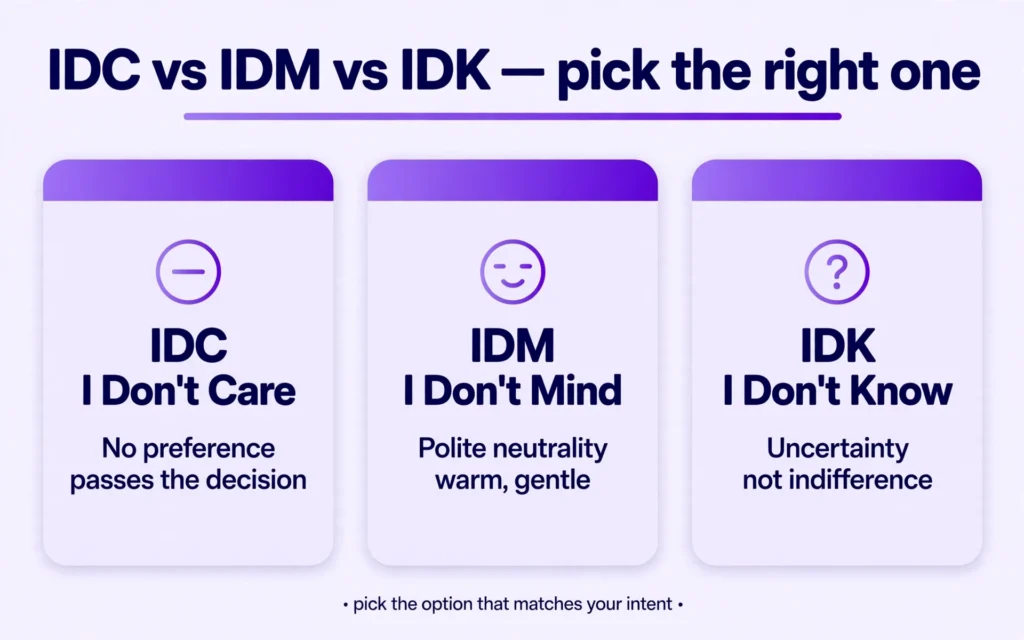
These three get mixed up constantly, but they do three different jobs. Use the wrong one and the whole message misfires:
| IDC | IDM | IDK | |
|---|---|---|---|
| Full form | I Don’t Care | I Don’t Mind | I Don’t Know |
| What it does | Expresses indifference — no preference | Expresses tolerance — it’s fine with me | Expresses uncertainty — no information |
| Temperature | Cool to cold | Warm and gentle | Neutral |
| Use when | You truly have no preference and want the other person to decide | You want to be agreeable and easygoing | You genuinely don’t have the answer |
| Risk | Reads as dismissive | Can read as passive | Can read as unhelpful |
Which to use when:
- Use IDC when you genuinely don’t care and the decision is low-stakes: “pizza or pasta?” → “idc, you decide.” Just soften it with an emoji or a few extra words.
- Use IDM when you want to sound easygoing rather than indifferent. “idm either way” and “idc either way” mean almost the same thing, but IDM feels like warmth and IDC feels like distance. With someone you don’t know well, IDM is always the safer send.
- Use IDK when the problem is knowledge, not preference. “idk what time it starts” asks for information; “idc what time it starts” tells the group their planning doesn’t matter to you. Different sentences, different fallout.
And when nobody can pick — when two IDCs just bounce off each other — WTD (what to do) is the abbreviation that actually asks for a way forward.
The IDRC Variant
IDRC means “I don’t really care” — IDC’s slightly longer sibling. The two are essentially interchangeable in texting; IDRC just spells out the hedging that IDC leaves implied. You’ll see it far less often, but treat it identically: same two readings, same rudeness test, same tone dial.
How to Reply When Someone Says IDC
The golden rule: an IDC hands you the decision — so take it. Don’t drag the sender back in with “but what do YOU think?” That defeats the point of the abbreviation.
- For the neutral reading (“idc, you decide”): just decide. “Cool, pizza it is 🍕” — done. No ceremony needed.
- For the dismissive reading (it stung): say so directly, once, without escalating. “That felt dismissive — this actually matters to me” is honest and hard to argue with. Don’t match the energy: replying “idc too” or firing back sarcasm turns a bruise into a fight.
- If it’s the annoyed version (“IDC, do whatever you want”): read the room. They’re probably tired, not cruel. “Okay, I’ll sort it — talk later?” gives them the exit they’re asking for. You’ll often see a GTG (got to go) right behind an annoyed IDC — same energy, same exit.
- When you’re the one who wants to pass the ball gently: consider whether you actually mean IDC at all. LMK (let me know) keeps the other person involved instead of shutting them out — “lmk which one you pick” invites a reply where “idc” ends the exchange.
What IDC Doesn’t Mean: A Quick Disambiguation
Outside of texting, IDC belongs to a few unrelated fields. If you land on this page from a work document or a medical report, one of these is probably what you’re looking for:
- International Data Corporation — a global tech market-research firm.
- Invasive Ductal Carcinoma — a medical term, a type of breast cancer.
- Interest During Construction — a finance term for interest capitalized while a project is built.
In a text message, though, assume “I don’t care” — the other readings essentially never show up in a chat.
Where You’ll See IDC
- One-to-one texts: the home turf — food choices, plans, movie picks, “idc, you decide.”
- Group chats: “where should we meet?” met with three IDCs in a row — the classic decision-stall.
- DMs and comments: short replies where the commenter has no stake in the outcome.
- Gaming and Discord chats: fast, low-ceremony environments where “idc, just queue” is pure efficiency, not attitude.
- Small talk: “wtw tonight?” (what’s the word) answered with “idc” usually means “I’m free, you plan it” — indifference as availability, not rejection.
The meaning doesn’t change across platforms — but the reading does. In a gaming lobby, a bare “idc” is wallpaper. In a relationship text after you shared something vulnerable, it’s a brick. Same letters, different rooms — which is exactly why the rudeness test matters more than any platform-specific rule. Reactions like OML can draw an IDC the same way good news can: “oml you got tickets?!” — “idc, can’t go” reads fine because the topic, not the person, is being declined. And where a friend shares a fact rather than a feeling, FYI is the give-information counterpart — it hands you a fact while IDC declines to engage with one.
FAQs
What does IDC stand for?
“I Don’t Care” — I for I, D for Don’t, C for Care. The full phrase in text is almost always shortened to the three letters.
Is IDC rude?
It can be — that’s the whole controversy. Dismissing a topic (“idc about superhero movies”) is neutral; dismissing a person (“idc” in reply to their news) reads as rude, especially because the abbreviation itself signals minimal effort. Run the topic-vs-person test before you decide.
What does “idc” mean in a text from a guy?
Almost always the no-preference reading — “you decide.” In a planning context (“where should we eat?”) it’s a handoff, not hostility. If it follows something personal you shared, the dismissive reading applies regardless of who’s sending.
What’s the difference between IDC and IDM?
IDC (“I don’t care”) expresses indifference; IDM (“I don’t mind”) expresses polite tolerance. Same decision, different temperature — IDM is warm and easygoing, IDC is cool and can read as dismissive. With people you don’t know well, send IDM.
What’s the difference between IDC and IDK?
IDC is about preference (“I have no opinion”); IDK (“I don’t know”) is about knowledge (“I have no information”). Mixing them up changes the message: “idk what time” asks for help, “idc what time” tells the group their plan doesn’t matter.
Is “idc.” with a period rude?
The period makes it colder — clipped and final. “idc.” alone is the version most likely to start an argument. Drop the period or add an emoji (“idc 😅”) when you mean it neutrally.
What does “idc about you” mean?
That’s the unambiguous hostile reading — indifference aimed directly at a person. It fails the rudeness test on purpose. Either disengage or address it plainly.
Should I use IDC at work?
Don’t. Even the neutral reading lands badly in professional chat, where “I don’t care” can sound like you don’t care about the work. Use “I’m fine with either option” — full words, zero ambiguity.
The Short Version
IDC is “I don’t care” — a 1990s chatroom shortcut that’s now a full conversational move with two readings: the chill handoff (“idc 😅 you decide”) and the cold brush-off (a bare “idc.”). Run the topic-vs-person test to tell them apart, read the punctuation like a volume knob, and if you mean it neutrally, never send the abbreviation alone. Pick IDM for warmth, IDK for uncertainty, and when someone IDCs you — just decide, or say it stung.
