
It is 11 p.m., your phone lights up, and the whole message is three letters: "IMY." No question, no plan, just a feeling in shorthand. If you have ever stared at those letters and wondered whether you were supposed to feel flattered, worried, or simply warm, you have felt the exact puzzle this article exists to solve. The imy meaning in text is easy to state and surprisingly easy to misjudge: the letters never change, but the weight behind them does.
IMY usually means "I miss you" — a short way of saying someone has noticed your absence and wants you to know it. That is the whole definition in nearly every text you will ever receive. The useful part is judging what kind of message it is: a light check-in, a real longing, or a bid for a reply — which is exactly what the Bid Test below does.
What Does IMY Mean in Text?
IMY is an initialism: I-Miss-You, read letter by letter, "eye-em-why." Wiktionary lists it as an internet-slang, text-messaging phrase: initialism of "I miss you." Unlike abbreviations that hide a second meaning, IMY has no rival reading in ordinary chats — every major guide agrees on the same three words. That unanimity is rare in slang, and it is why IMY rarely confuses people about what it says. It confuses them about what it wants.
That confusion is the point of this article. "I miss you" is a statement about a feeling, but in a chat it is also a move: it invites a reply, a plan, or at least a nod. A bare "IMY" after three weeks of silence is doing different work from an "IMY" inside a chat that never stopped. The letters are identical; the job is not.
One more thing the letters do: they soften the full sentence. Spelling out "I miss you" is heavier and more exposed; IMY keeps the same feeling at arm's length. That softness is why people reach for it — and why answering it well means matching the weight the sender chose, not the weight you assume.
The Bid Test
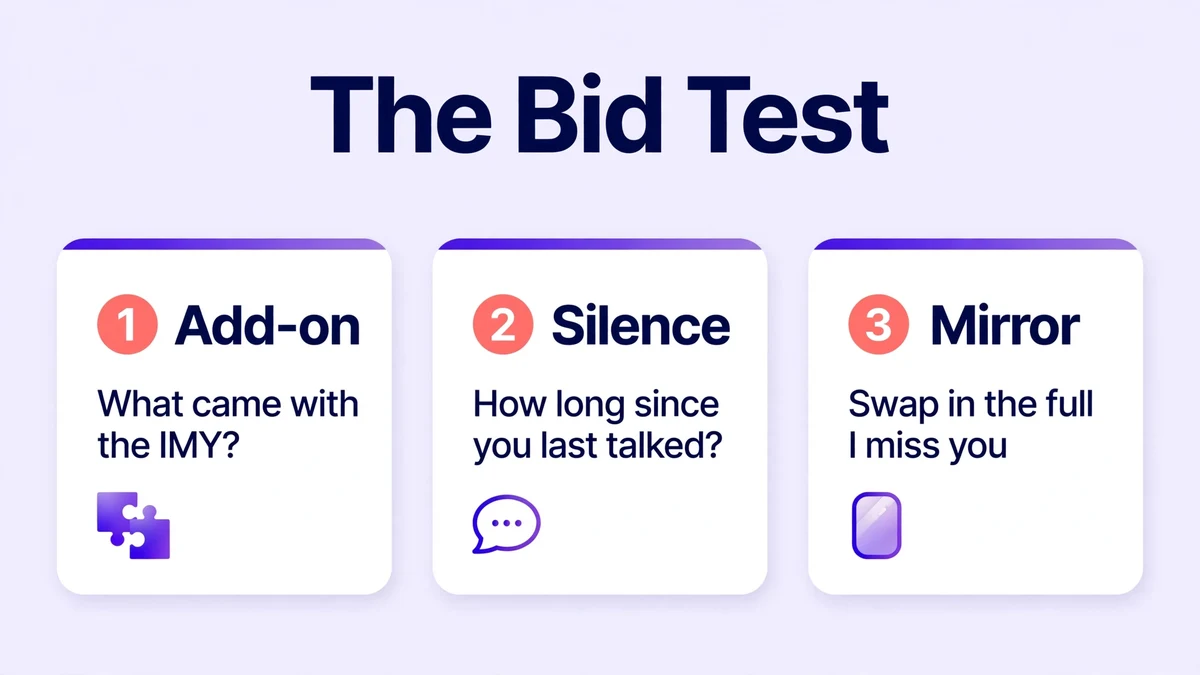
Here is this article's named method. Call it the Bid Test: three checks, run in order, on any IMY you receive. A "bid" is just a message that invites a reply — and every IMY is one, whether the sender knows it or not.
Check 1: The add-on check. What came with the IMY? A bare "IMY" is a pure check-in bid: it asks for nothing except to be noticed. "IMY, how have you been?" adds a question and wants conversation. "IMY, let's talk soon" adds a plan and wants time together. "IMY so much" adds an intensifier and wants matching warmth. Read the add-on first; it names the reply the sender is hoping for.
Check 2: The silence check. How long since you last talked? After a long gap, IMY is a reconnection bid — the sender is reopening a door that has been shut a while, and the brave part is the sending, not the letters. Inside a daily chat, IMY is maintenance: warmth, not urgency. The same three letters after a month mean far more than the same three letters after a morning.
Check 3: The mirror check. Swap IMY for the full "I miss you" and notice what changes. If the full sentence would feel too heavy for the relationship — a new friend, a colleague you like, a cousin you rarely text — then the sender chose IMY precisely to keep it light, and a light answer is the correct one. If the full sentence feels right, answer with matching weight: a real reply, not a shrug.
Run all three on a tricky example. "IMY" from a friend you have not heard from in a month, sent at midnight, with nothing after it: the add-on says check-in, the silence says reconnection, the mirror says the full sentence would feel big — so this is a brave, light-touch reopening, and the right reply is warm and open, not a paragraph. Now the opposite: "IMY so much, when are you back?" from your partner: the add-on says plan plus warmth, the silence says none, the mirror says the full sentence fits — answer with a plan and matching warmth.
The Variations: IMYT, IMYSM, IMYM, IMU, and MY
IMY has a small family, and every member means the same thing with a different dial setting.
| Form | Full form | What it actually does |
|---|---|---|
| IMY | I miss you | The base message — longing, absence felt |
| IMYT / IMY2 | I miss you too | The reply — answers an IMY, never opens cold |
| IMYSM | I miss you so much | Turned up — extra warmth, extra weight |
| IMYM | I miss you more | The playful contest — a game, not a measurement |
| IMU | I miss you | An older variant — same meaning, less common now |
| MY | Miss you | Almost never used alone — it is already an English word |
Two rules for the family. First, the reply forms only work as replies: "IMYT" answers an IMY; sending it cold, to someone who never said they missed you, reads as an answer to a question nobody asked. Second, the contest forms are a game, not a measurement — nobody is keeping score, and trading "no, I miss YOU more" for five rounds turns warmth into a rally. Play one round, then move on.
One case note, since it trips people up: IMY, imy, Imy — same meaning. Lowercase "imy" reads softer and more casual; uppercase IMY reads slightly more deliberate. The casing changes the temperature, not the definition.
IMY on TikTok, Snapchat, Instagram, and in Texting
IMY means the same thing on every platform: I miss you. What changes is the room, not the meaning — and no platform gives it a special definition.
Texting (SMS, WhatsApp, iMessage). This is IMY's home. One-to-one chats, late at night or after a gap: "IMY, it's been too long." The classic IMY is a text, not a post, and it is usually aimed at exactly one person.
Snapchat. DMs and story replies after a streak fades or someone has been away, and under memories and throwbacks ("IMY bestie!" on a shared photo). The snap version leans visual — the photo carries the memory, IMY carries the feeling.
Instagram. DMs, story replies, and comments under a friend's post ("IMY, come back to posting!"). A public comment IMY is a performance of closeness as much as a message — it tells the audience, too, that you two are close.
TikTok. DMs carry the private meaning; comments carry the public one. One TikTok-specific pattern is worth naming: creators and commenters play with the difference between the acronym and the spelled-out phrase — "IMY" in a comment versus "I miss you" said out loud — as a trend about effort, where the short form can read as low-effort next to the full sentence. That trend is about how the message lands, not a second meaning.
The pattern: private rooms miss a person; public rooms perform missing. And the meaning never changes by app — only the audience does.
Tone and Sender Context: Who Is Saying IMY
IMY's weight comes from the relationship, not the letters — and never from the sender's gender. Some guides run "what does IMY mean from a girl / from a guy" FAQs; that framing is refused here. A girl's IMY and a guy's IMY mean the same thing. The relationship decides, not the sender's sex.
From a close friend, IMY is the default room. After a gap it is reconnection; inside a daily chat it is maintenance. A TBH-style honest reply fits here: "TBH, I've missed our chats too."
From a crush or a partner, IMY is usually the heaviest — but not automatically romantic. A partner's IMY is affection; a crush's IMY is interest, not a confession. Do not upgrade it into something it never said.
From family, IMY is affection with a practical tail. Parents, siblings, grandparents: "IMY, call me when you're free." Answer the practical part too, not just the feeling.
From an ex or a near-stranger, handle with care. From an ex, IMY is often a test of whether the door is still open — the Bid Test's silence check matters most here. From someone you barely know, IMY assumes a closeness that may not exist yet; a polite, light reply keeps the boundary without rudeness.
In a group chat, IMY is usually aimed at one absent person ("IMY guys" for the group, or an IMY for someone not present). If you are not the intended target, you do not owe the reply.
How to Reply to IMY, and When to Spell It Out
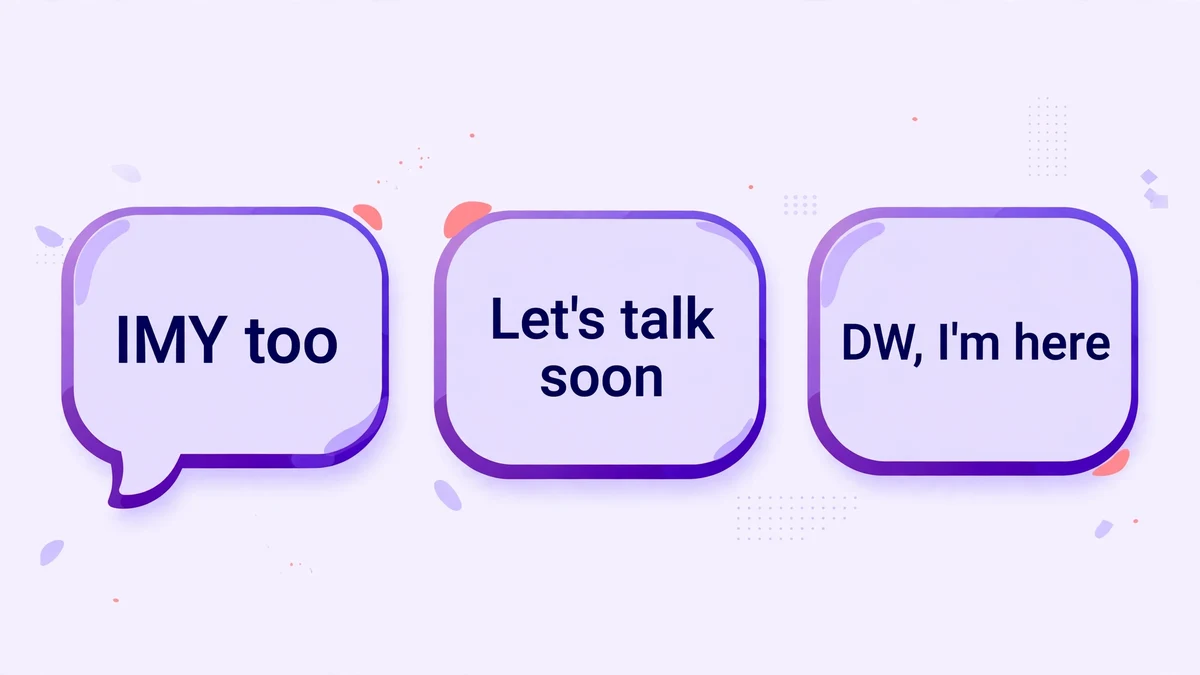
Match the bid, keep it short, and you are done. Three reply shapes cover nearly every IMY.
Mirror. For the pure check-in bid: "IMY too" or "Miss you too." Add one warm detail and it stops feeling like an echo: "IMY too, it's been too quiet without you."
Plan. For the IMY with a plan attached, or after a long silence: "Let's fix that — free Saturday?" A LMK close works well: "LMK when you're free and we'll sort it."
Reassurance. For the heavy IMY — someone lonely, far away, or going through it. A DW-style comfort pairs well: "DW, I'm here — tell me everything."
And the next-step reply: when missing means wanting to see them, say so directly. An FT request ("FT tonight?") turns longing into a plan. Or a callback: "IMY — HMB when you can" keeps the door open without demanding an instant reply.
When to spell it out. Use the full "I miss you" for professional contacts (never IMY at work), for anyone who may not know the slang, after a serious conversation where weight matters, and — per the TikTok effort trend — when you want the other person to feel the full weight rather than the shorthand. If you catch yourself sending IMY five times a day to the same person, stop: repetition drains it. Say it once, mean it, and let silence do the rest.
What not to send back. Do not answer an IMY with a test of your own ("prove you miss me"), and do not use IMY to fish — sending it to see whether someone cares enough to reply turns a warm message into a loyalty check. If you need reassurance, ask for it directly.
IMY vs ILY, MISS U, and the Other Exits
IMY sits in a family of feeling-and-leaving shorthand. The difference is what each one says about the relationship and the moment.
| Term | Full form | What it actually says |
|---|---|---|
| IMY | I miss you | Longing — your absence has been felt |
| ILY | I love you | Love — stronger, more intimate, and a different claim (named, not linked: the ILY page does not exist yet) |
| MISS U | Miss you | Same meaning, spelled-out casual variant |
| BRB | Be right back | A pause of minutes, not missing |
| GTG | Got to go | Leaving for any reason, not longing |
| TTYL | Talk to you later | Pauses a conversation without claiming anyone is missed |
The useful pairs: IMY says "I notice you're gone"; ILY says "I love you" — someone can say IMY without being in love, and ILY without currently missing anyone. And TTYL versus IMY: TTYL pauses a conversation; IMY names a feeling about an absence. If you are not sure which one you received, the Bid Test's add-on check usually settles it.
Debunked: What IMY Does NOT Mean
Short letters collect false meanings, and IMY has collected a few:
- "I'm mad at you" — a guess, not a meaning. A single anonymous forum comment suggests it. No guide supports it. IMY never means anger.
- "One of the most common abbreviations" — withdrawn. The old article opened with it, and listicles repeat it. No frequency study exists. Search-interest notes (a 2004 rise in searches, a pandemic-era bump) describe searches, not usage — and they are years old.
- Per-platform fixed meanings — a myth. TikTok does not own one meaning and Snapchat another. Rooms differ; the definition does not.
- Gendered readings — refused. "From a girl" versus "from a guy" changes nothing. The relationship decides.
- "Aura Impact +180 / Usage High / Cringe Medium" — fake precision. Gamified stats from one slang wiki, with no method behind them. Refused.
- Field acronyms — different-world names. A language code, a ringtone file extension, and a Swedish authority abbreviation are all real — and none of them is a texting meaning.
- IMY = ILY — no. Missing and loving are different claims, and swapping one for the other is the easiest serious misread in this article.
When Not to Use IMY
IMY is a joy in its habitat and a misfire outside it. Skip it when:
- The setting is formal. Emails, reports, client messages — IMY reads as careless there.
- You just met the person. It assumes a closeness that does not exist yet.
- You are testing someone. Sending IMY to see whether they care enough to reply turns warmth into a loyalty check.
- You have already been ignored. One unanswered IMY is a message; five in a row is pressure.
- You actually need to say more. If the real message is "I'm struggling" or "I need you," IMY undersells it — spell out the real sentence.
Quick Answers
What does IMY mean in text?
IMY means "I miss you" — a short way of saying someone has noticed your absence and wants you to know it. It is informal, warm, and used between friends, family, and partners.
Is IMY romantic?
Not automatically. From a partner it usually is affection; from a friend it is friendship; from family it is family love. The relationship decides, not the letters — and never the sender's gender.
What should I reply to IMY?
Match the bid. A bare IMY gets a mirror ("IMY too"); an IMY with a plan gets a plan ("free Saturday?"); a heavy IMY gets reassurance ("I'm here"). Run the Bid Test's three checks first.
What is the difference between IMY and ILY?
IMY says "I miss you" — longing for someone absent. ILY says "I love you" — a stronger, more intimate claim about love itself. Someone can say either one without meaning the other.
Can I use IMY at work?
No. It is too personal for most professional conversations, and it assumes a closeness work relationships may not have. Spell out a proper message instead.
Is IMY rude if I send it too often?
Not rude, but drained. Repetition bleeds the feeling out of it, and repeated IMYs after being ignored turn from a message into pressure. Say it once, mean it, and let silence do the rest.
Final Thoughts
IMY is three letters doing the work of an open door: "you've been gone, I've noticed, and I'd like you back in my day." Run the Bid Test before you read it and before you send it: check the add-on, check the silence, and check the mirror. Get that right, and IMY stays what it should be — a warm, honest check-in, not a test, not a guess, and not a performance.
