
If someone texts you “wanna FT later?” they are almost certainly not talking about feet, a job, or a newspaper. The ft meaning in text is usually “FaceTime” — a request for a video call.
FT means FaceTime. In a casual text, DM, or chat, “FT me later” means “video-call me later on FaceTime.” The rest of this guide covers the cases where the same two letters mean something else entirely — and the one test that tells them apart.
What Does FT Mean in Text?
FT is a shortening of FaceTime, Apple’s video and audio calling feature, which has shipped on iPhones, iPads, and Macs since 2010.
In a message, FT can be a verb, a noun, or a label. As a verb, it asks for or promises a call: “FT me when you get home.” As a noun, it names the call itself: “We were on FT for two hours.” As a label, it sits in front of a name, a number, or a job description — and there it stops being about calls at all.
One honest limit up front: no established general dictionary carries an entry for FT meaning FaceTime, and Wiktionary’s entries for FT cover older senses such as foot, Fort, and the Financial Times instead. That does not make the texting meaning doubtful — every slang explainer checked agrees on it — but this guide claims nothing about when the abbreviation was coined or how many people use it, since no frequency study exists.
The Call-or-Credit Test: How to Read Any FT
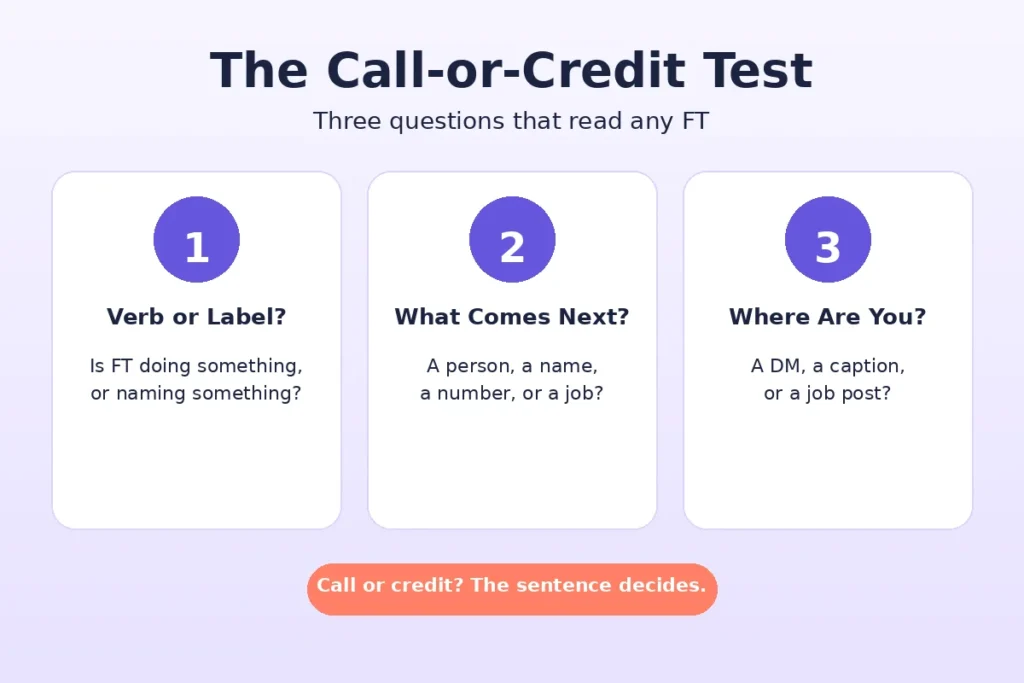
Here is this article’s named method. Before settling on a meaning, run three quick questions. Call it the Call-or-Credit Test: almost every FT is either asking for a call or giving someone credit.
Question 1: Is FT doing something, or labeling something? If FT is the action — “FT me,” “wanna FT?” — it is a call request. If FT sits in front of a name or a post — “new track ft. Maya” — it is giving credit, and it means featuring. Verbs ask; labels credit. That one distinction resolves most messages on its own.
Question 2: Who or what comes right after FT? A person being asked (“FT me”) points to a call. A person being named (“ft. Maya”) points to featuring. A number (“6 ft tall”) points to feet. A job or the letters PT nearby points to full-time. The word after FT is usually the answer key.
Question 3: Where are you reading it? A private message leans toward a call request. A public caption or track title leans toward featuring. A listing or spec sheet leans toward feet or full-time. If the first two questions disagree, the room breaks the tie. Still unsure? Ask: “FT as in FaceTime?” — it beats answering a call invitation with a comment about someone’s height.
FT as FaceTime: How the Verb Works
FaceTime is the default reading in casual chat because it fits the shape of a message. Call requests are short, they come from people you know, and they usually carry a time: “FT later?”, “FT me in 10.”
There is one wrinkle worth knowing, and it is the part most short explainers get wrong. FT does not always mean a literal FaceTime call. Because FaceTime became the best-known video call, FT has gone generic: on Snapchat or Instagram, “FT me” often just means “video-call me,” and the call itself may happen inside that app’s own video feature rather than in Apple’s FaceTime. On iMessage, where both people are on Apple devices, it usually does mean a real FaceTime call. If the exact app matters to you, say so: “Sure, but on WhatsApp?”
FT as Featuring: The Caption Reading
When FT follows a title, a caption, or a creator’s name, it means featuring: it credits a guest or collaborator. “New song ft. Maya” means Maya performs on the song too. “Vlog ft. my best friend” means your best friend appears in the video.
This reading is almost always lowercase, often with a full stop — “ft.” — and it comes with a name directly after it. That name is the giveaway: a call request never names a third person after FT, while a featuring credit always does.
FT as Feet and Full-Time: The Number and Job Readings
Two more readings are fully established, and both announce themselves clearly if you look at what sits next to FT.
Feet (or foot). Lowercase ft after a number is the standard abbreviation for feet, dictionary-attested in Cambridge, Collins, and Wiktionary alike: “6 ft tall,” “a 12 ft room.” One foot equals 12 inches. The number is the whole clue — FT meaning feet never appears without one nearby.
Full-time. In job posts, work chats, and schedules, uppercase FT means full-time, as opposed to PT (part-time): “FT position with benefits,” “She works FT at the hospital.” Cambridge’s business dictionary attests this sense too. The clue is the job context: hours, benefits, shifts, or a PT nearby.
In news writing, FT is also the Financial Times; in sports writing, it can mean free throw in basketball. Neither belongs in a DM.
FT on TikTok, Snapchat, Instagram, and in Texting
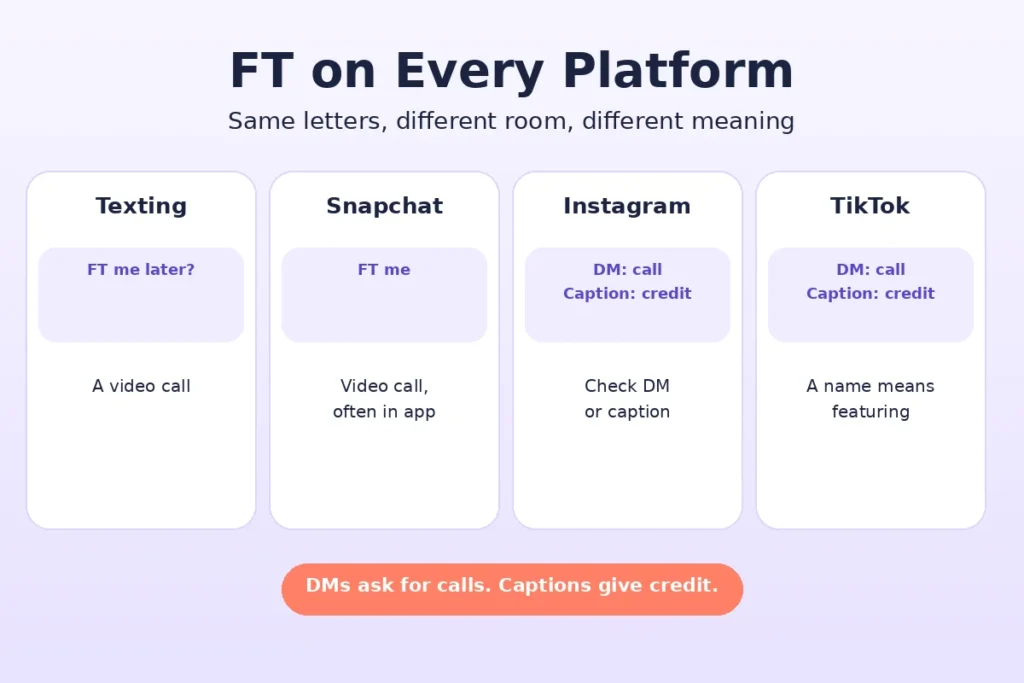
No platform gives FT a secret, different default meaning — several thin guides invent platform-specific definitions where none is supported. What changes by platform is which reading you are most likely to meet.
Texting and iMessage are FT’s home as a call request. Both people are usually on Apple devices, so “FT me” here most often means a literal FaceTime call. Snapchat leans the same way, with a twist: because Snapchat has its own video-call feature, “FT me” there often becomes a call inside Snapchat rather than in FaceTime. The invitation is real either way; only the app is negotiable.
Instagram splits along the DM-versus-caption line, the best demonstration of the Call-or-Credit Test. In DMs, “wanna FT later?” is a call request. In captions, “new reel ft. my sister” is a featuring credit. TikTok follows the same split. If a TikTok comment confuses you, check whether it names someone after FT; a name means featuring, a question mark means a call.
Tone and Sender Context: Who Sent It, and How It Was Typed
FT as a call request carries tone, and the tone lives in the words around it, not in the letters themselves. Warm and close: “FT me later? I miss you” is affection asking for face time. Casual and practical: “FT me in 10, I need to show you something” is logistics, not romance. Excited: “FT me RIGHT NOW” is urgency with the volume up. Low-key: a bare “FT?” is an open invitation; answering “Now or later?” is fine.
Sender context sharpens this. From a close friend, FT is usually a standing habit. From a partner, especially a long-distance one, a bedtime “FT?” is a ritual: “let’s end the day together.” From a crush, “wanna FT?” is a step up in closeness: texting is easy, video takes more nerve. From a stranger or a new dating-app match, “wanna FT?” is a reasonable safety step — a quick video call confirms someone is real before meeting — and it is equally reasonable to decline until you are comfortable.
How to Reply to FT, and How to Use It Well
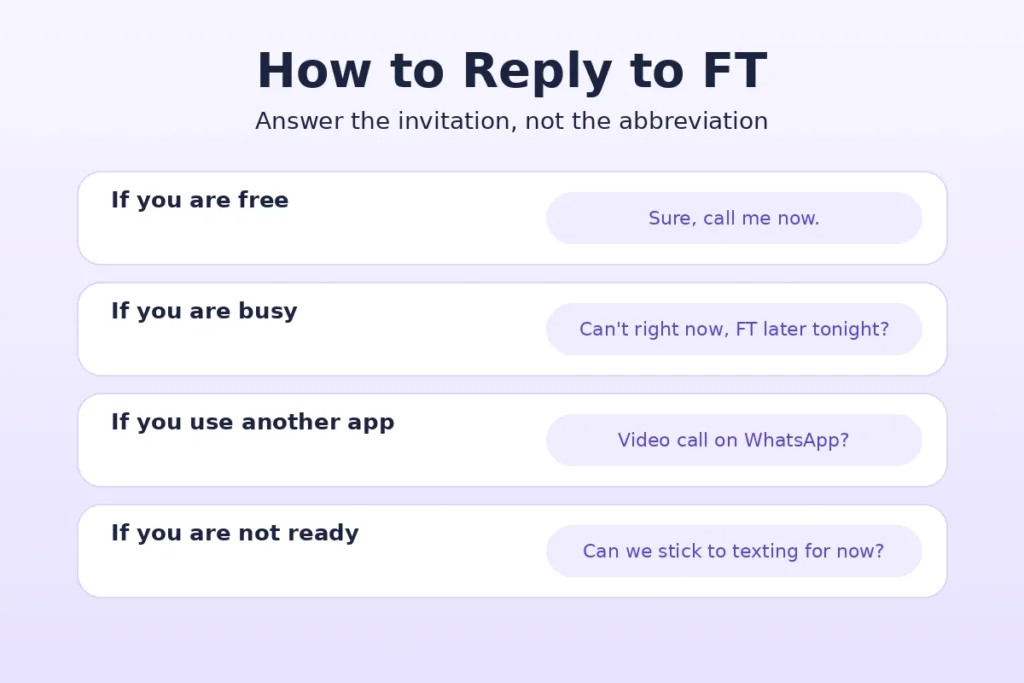
If someone sends you FT as a call request, answer the invitation, not the abbreviation. If you are free: “Sure, call me now.” If you are busy: “Can’t right now, FT later tonight?” If you do not use FaceTime, or you are on Android: “I don’t have FaceTime — video call on WhatsApp?” If you are not comfortable video-calling yet: “Can we stick to texting for now?” is a complete, polite answer.
When you send FT yourself, use it with people who video-call with you already, and add a time or a reason: “FT later? I want to show you the apartment” beats a bare “FT?” Do not use FT in a work email or to a client — spell out “video call” instead.
FT Mistakes to Avoid
Assuming it always means FaceTime. The most common mistake, because FaceTime is the default in chats. A caption, a measurement, and a job post will all punish that assumption — run the Call-or-Credit Test first.
Answering a credit as if it were a call. “New track ft. Maya” is not asking you anything.
Treating FT as a literal FaceTime guarantee. On Snapchat, Instagram, or a mixed-phone group, FT often means “video call me” in general.
Using FT formally. Job posts aside, FT belongs in casual conversation. In formal writing, spell out the full term.
Repeating weak readings as facts. Two readings found during research are graded weak and should not guide your interpretation. A “free time” reading appears in a single competitor’s table with no dictionary or usage backing, and a rude dismissal reading — masked here as “f*** that” — appears in a single low-quality explainer, while the standard form of that expression uses a different, longer abbreviation. Per this site’s policy, this masked mention is all that reading gets: it appears nowhere in this article’s title, summary, metadata, slug, or image text, and you should not use FT to mean it. Likewise, no gender-specific FT meaning is supported, and no claim is made here about FT’s popularity, origin date, or frequency — none of those has a citable source.
FT vs VC, FTT, and Similar Terms
FT vs VC. VC means video call in general, with no app attached. FT, in a private chat, usually means a FaceTime call specifically — or, on non-Apple apps, a video call by habit. If you want to be app-neutral, VC is clearer; if you both use iPhones, FT is natural. If you want to be exact, name the app.
FT vs FTT. FTT is a narrower variant meaning FaceTime tonight: “Wanna FTT?” packs the whole invitation into three letters. FT leaves the time open; FTT closes it.
Quick Answers
What does FT mean in text?
In most texts and chats, FT means FaceTime: a request for a video call, as in “wanna FT later?” In captions it means featuring, after a number it means feet, and in job posts it means full-time. The sentence around it decides.
What does FT mean on Snapchat?
Usually FaceTime, used as a general video-call request. Because Snapchat has its own video-call feature, the call often happens inside Snapchat instead — the invitation is the same either way.
What does FT mean on Instagram?
In DMs, FT usually means FaceTime, a call request. In captions, it usually means featuring, crediting someone in the post. A name after FT means featuring; a question about calling means FaceTime.
What does ft mean in a song title?
Lowercase ft, usually written “ft.”, means featuring: it credits a guest artist. “Song ft. Maya” means Maya performs on the song alongside the main artist.
What does FT mean in a job listing?
Full-time, as opposed to PT (part-time). It describes the hours of the role, not a video call: “FT position with benefits” is about employment, not about FaceTime.
Can Android users FT?
Not with a FaceTime app, since FaceTime is Apple-only. An Apple user can share a link an Android user opens in a browser to join a call, but Android users cannot start one. In practice, “FT” to or from an Android user usually means a video call on another app.
Does FT always mean FaceTime?
No. FaceTime is the most common meaning in casual chat, but FT also means featuring in captions, feet in measurements, full-time in job posts, and the Financial Times in news writing. Context decides.
Should I capitalize FT?
Either works in casual texts — lowercase “ft” is completely normal. As a soft guide, FaceTime and full-time lean uppercase, while feet and featuring lean lowercase, usually “ft.” Treat case as a hint, not a rule.
Final Thoughts
FT is two letters doing at least four jobs, and that is why it confuses people: the letters never change, so the reader has to. But the sentence almost always tells you which job FT is doing. If it is asking you something, it wants a call. If it is naming someone, it is giving credit. If it follows a number, it is measuring. Run the Call-or-Credit Test and the right meaning usually appears before you finish the sentence.
So the next time someone texts “wanna FT later?”, answer the invitation, name the app if it matters, and enjoy the call.
Related reading: If you liked this guide, you may also enjoy our guides to EYP, FS, FYA, TGIF, BMS, DM, DWBI, and TTYL.
