
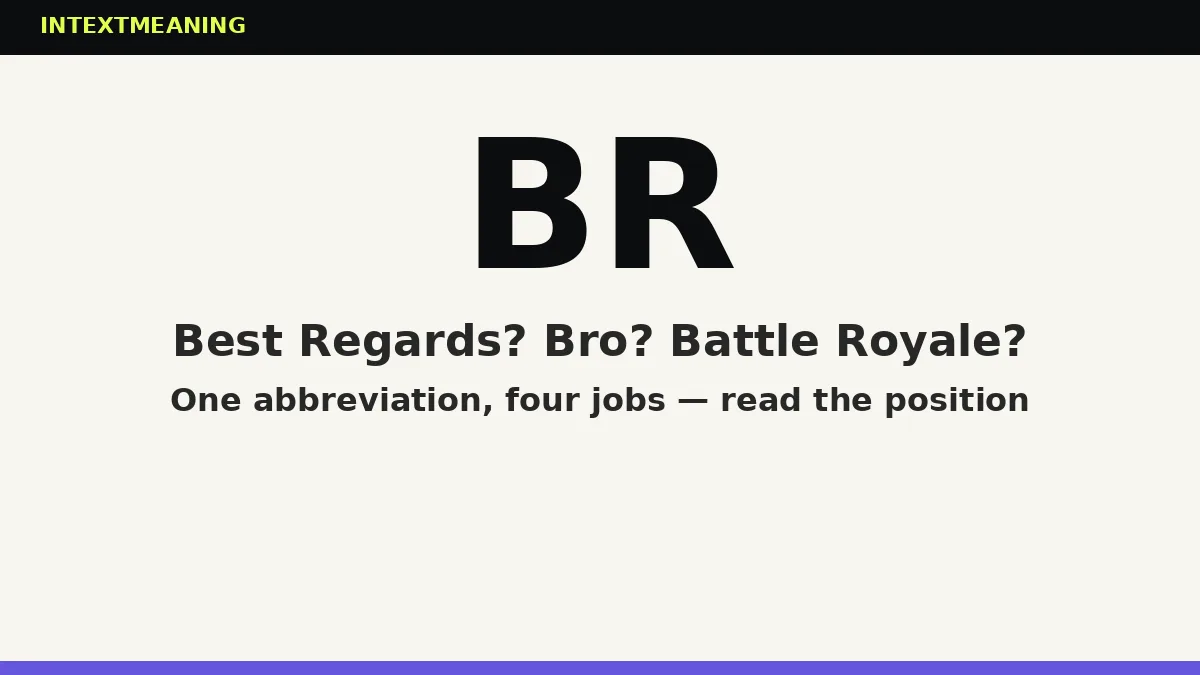
If you have ever stared at the two letters "br" at the bottom of a message and wondered what the sender actually meant, you are not alone. The question behind br meaning in text is trickier than it looks, because BR does not have one fixed job. It has four, belonging to the office, the friend group, the gaming lobby, and the quick "wait for me" reply. The good news is that you almost never have to guess: where BR sits in the message tells you what it is doing.
Most short forms have one obvious meaning. BR does not. It carries a polite email closing, a friendly nickname, a gaming genre, and a bathroom break in the same two letters, which is why explanations that pick one meaning — usually "Best Regards" — and ignore the rest feel unsatisfying. This article lays out every real reading, grades the evidence for each, and gives you a simple test for telling them apart in seconds.
BR Meaning in Text at a Glance
Here is the short version. BR most often means "Best Regards" at the end of an email or work message. Among friends, it usually means "bro", a short, warm way of addressing someone close to you. In gaming, it can mean "Battle Royale", the last-player-standing style of game, or "bathroom break", a quick announcement that someone is stepping away. A fifth reading, "be right", is weak: it is just a clipped piece of BRB, and most people type the full BRB instead.
Best Regards — End of emails and work messages. Strong — the classic sign-off.
Bro / brother — Friend chats, comments, gaming chat. Strong — the casual address.
Battle Royale — Gaming chats, video titles, comments. Real, but only in gaming.
Bathroom break — Gaming lobbies, close-friend chat. Real, but only in-group.
Be Right (back) — Rare, usually a fragment of BRB. Weak — use BRB instead.
If you remember one line, make it this one: do not ask what BR means in general. Ask what it is doing in this particular message. The message around it will point you to the right reading.
What Does BR Mean in Text?
Let us be honest about something first. There is no dictionary entry that settles BR the way a dictionary settles a normal word, and the guides that explain it disagree with each other about which meaning comes first. Some rank "Best Regards" first, because that is where the abbreviation has lived longest. Others rank "be right" first, because that is what they imagine people typing in chat. That disagreement is actually useful information: it tells you that BR has no single dominant texting meaning, and that anyone who tells you it always means one thing is oversimplifying.
What the evidence does support is a split by situation. In email and work writing, BR is a sign-off, full stop: the shortened form of "Best Regards", a polite closing used in business letters for decades, now squeezed to two letters. Abbreviation lists record it beside BRGDS, another shortening of the same phrase, which shows how established it is. In friend-to-friend chat, the picture flips. There, BR is far more likely to be "bro", the clipped form of "brother" used as a friendly address.
The gaming readings live in their own world: "Battle Royale" for game titles and lobby chat, and "bathroom break" for a quick step away. Then there is the odd one out, "be right". It appears in some guides, but in real messages it is almost always written as BRB, which is clearer and far more common. Bare BR for "be right" is best treated as a fragment, not a meaning to rely on.
The Sign-off-or-Sideline Test
Here is the new test this article gives you, and it takes about three seconds. Look at where BR stands in the message, and ask whether it is signing off or standing beside someone.
First, is BR at the very end of the message, on its own, after everything the sender actually wanted to say is finished? Then it is a sign-off, and it means "Best Regards". Think of it like a signature: it does not add information, it closes the conversation politely. A message like "I will send the report by Friday. BR" is not asking you anything and is not naming anyone. It is just ending well.
Second, is BR standing where a name would stand — at the start of a sentence aimed at someone, or tucked next to a reaction, like "thanks br" or "br, look at this"? Then it is a sideline address, and it means "bro". Nobody signs off a message in the middle of a sentence, and nobody addresses a friend with a formal closing. The position gives it away.
Third, is BR sitting in a gaming conversation, next to a game name, a lobby invite, or a "back in a minute" note? Then it is doing a gaming job: "Battle Royale" if it is naming the kind of game, "bathroom break" if it is announcing a short absence. If none of these three pictures fits, treat it as a probable typo for BRB and, if it matters, just ask.
BR as "Best Regards"
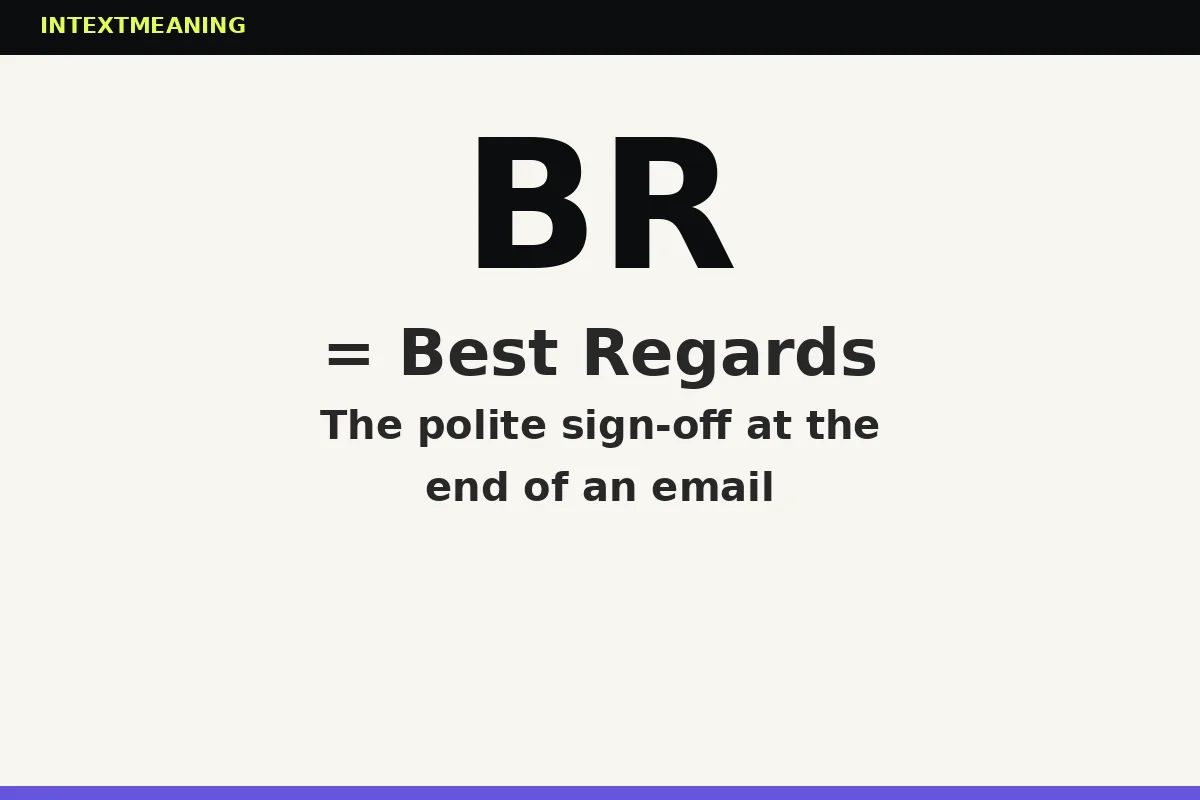
This is the oldest and most established reading, and it is the one you will meet most often if you work in an office or deal with emails. "Best Regards" is a standard polite closing, warmer than a bare "Regards" and less stiff than "Yours sincerely". Shortened to BR, it keeps the politeness while saving a few keystrokes, which is exactly why busy people reach for it in quick work messages, team chats, and follow-up emails.
You will usually see it on its own line at the end, sometimes with the sender's name after it, sometimes without. "Thanks for the update. BR" and "Looking forward to your reply. BR, Sarah" are both textbook examples. Notice what is not happening in those messages: the sender is not talking to a friend, not reacting to a joke, and not naming a game. The message is finished, and BR is the polite full stop at the end of it.
There is a limit, though. In a truly formal email — a job application, a legal letter, a message to someone senior whom you have never met — write "Best Regards" in full. BR is fine for people you already work with and for quick internal messages. With a stranger in a formal setting, the shortcut can read as rushed, which is the opposite of what a sign-off should do. When in doubt, spell it out.
BR as "Bro" or "Brother"
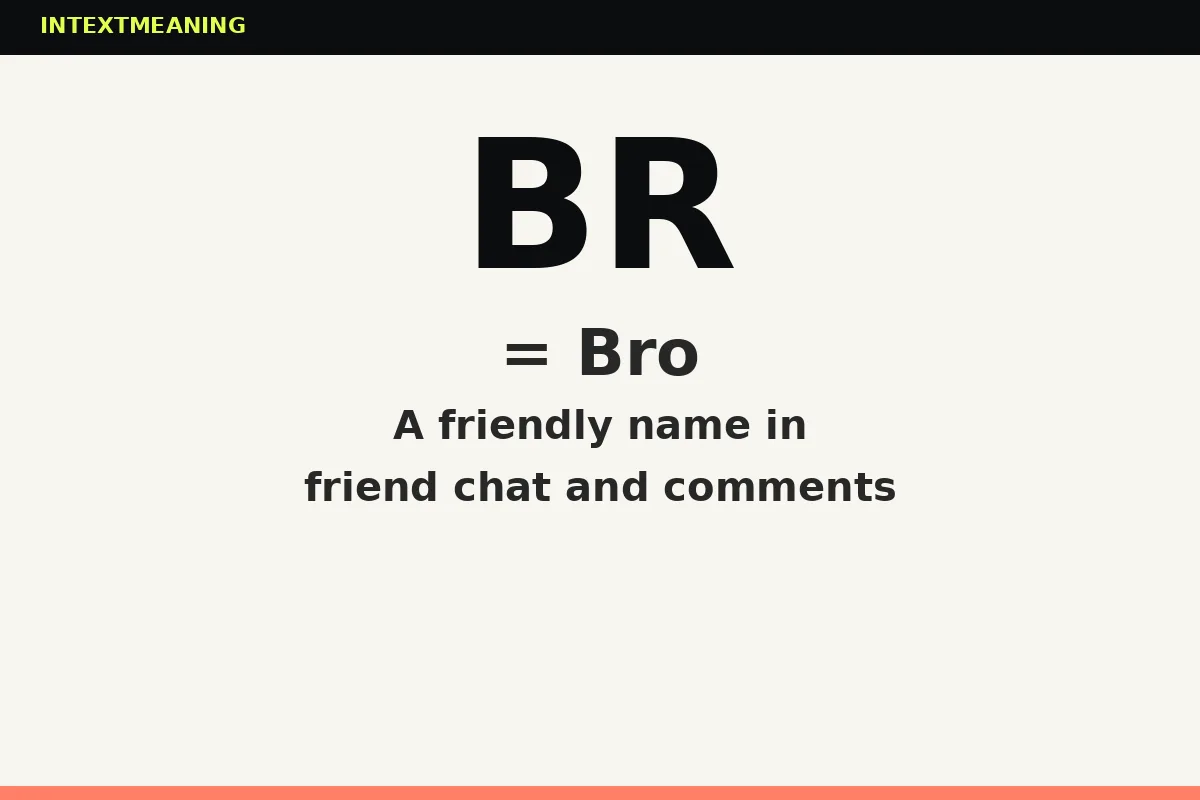
Now step out of the office and into a group chat, and BR changes completely. Here it is not a closing at all. It is a name, or something close to one: a short form of "bro", itself short for "brother", used to address a friend. "Thanks br, you saved me" does not end a business email. It thanks a friend, warmly and casually, in the language friends actually use with each other.
This reading is easy to spot once you know the position rule. A sign-off never appears at the start of a sentence or in the middle of a reaction. "Br, did you see that goal?" is addressing someone. "No way br 😭" is reacting to someone. In both cases BR stands beside a person, the way a name does, and that is the giveaway. It carries the same friendly tone as "bro" and "bruh", and it belongs to close, relaxed conversation.
One caution: this reading depends on the relationship. From a stranger in a work email, "br" at the end of a message is a sign-off, not a nickname. From a friend in a chat, it is a nickname, not a sign-off. You are not decoding letters. You are reading a relationship.
BR as "Be Right" — and Why BRB Usually Wins
Some guides list "be right" as a meaning of BR, usually with an example like "BR, back in a minute". There is a grain of truth here: BR can be a clipped fragment of BRB, the much better known "be right back". But that is exactly the problem. BRB is clearer, more common, and instantly understood, while bare BR for "be right" is rare and collides with every other reading on this page. A reader who sees "BR" alone has no reason to pick "be right" over "Best Regards" or "bro", and most will not.
So the honest advice is this: understand "be right" as a possible reading, but do not use bare BR for it yourself. If you are stepping away, write BRB, which nobody will confuse with a sign-off or a nickname. If someone sends you a bare "BR" that seems to mean "wait for me", check the context first: "back in a minute" next to it points to stepping away, while a finished message with nothing after it points to a sign-off. For the full form, see the guide to BRB meaning in text.
BR in Gaming: Battle Royale
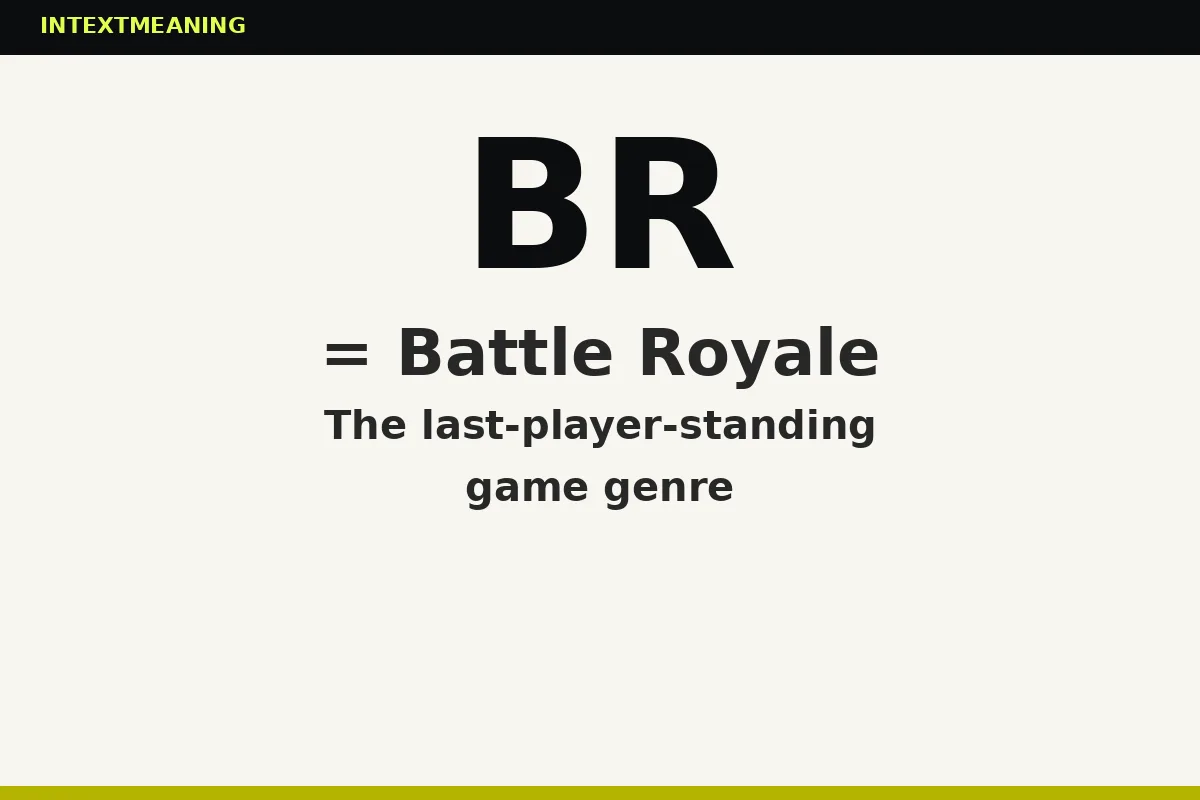
Gaming is the one place where BR picks up a meaning that has nothing to do with politeness or friendship. In gaming chat, video titles, and comments, BR stands for "Battle Royale": the genre of games in which a large group of players compete and only one player or team survives. When someone writes "BR tonight?" they are not signing off an email or calling you "bro". They are asking whether you want to play a battle royale game tonight.
This reading is almost impossible to confuse with the others once you see the setting. It appears next to game names, lobby invites, and clips — never at the end of a work email, and never as a way of addressing someone. The same lobby can also produce "bathroom break", so gaming BR needs one extra check: is it naming something to play, or announcing that someone is leaving? "BR lobby in five" names a game. "BR, back in a sec" announces an absence. The words around it settle the question every time.
BR on Different Platforms
Platform changes the odds, even when it does not change the meanings. On email and workplace chat, BR is overwhelmingly the sign-off — its home turf, and your first guess in a work inbox by a wide margin. On WhatsApp and ordinary texts, the picture is mixed: a colleague probably ends with the sign-off, while a close friend probably uses the "bro" address.
On Instagram and TikTok, the casual readings take over. Comments and replies lean heavily toward "bro", often as a reaction — the equivalent of saying "bro, really?" under a surprising video. Gaming clips on those same platforms add the "Battle Royale" reading, so a comment under a gameplay video needs the gaming check first. Snapchat behaves like ordinary friend chat: no platform-specific BR sense has been verified there, so read it as friend chat and nothing fancier.
Discord deserves a special note because it mixes everything. One server can hold a work channel, a friend channel, and a gaming lobby side by side, so BR can mean three different things in three adjacent channels. On Discord, the channel matters more than the platform. Read the room first, then read the letters.
BR by Sender: Who Is Talking to You?
If position is the fastest test, the sender is the second fastest. A manager or a client who ends a message with BR is signing off. They are not suddenly calling you "bro", and reading it that way would be a mistake. A close friend who opens with "br" is addressing you, warmly and casually, and reading it as a formal sign-off would be equally wrong. A teammate in a gaming lobby who types BR before a match is talking about a game or a break, not about office manners.
The relationship also sets the stakes. Misreading a sign-off as a nickname at work can feel unprofessional; misreading a nickname as a sign-off among friends just feels odd. The safest habit is a two-second pause: who sent this, and where does BR sit in their message? Those two answers agree almost every time, and when they disagree — a friend signing off a serious message, for example — position usually wins, because people borrow the sign-off style for serious moments even with friends.
It is also worth saying what does not decide the meaning. Some low-quality guides claim BR means one thing when a man sends it and another when a woman sends it. There is no evidence for that split. Meaning follows position, platform, and relationship — not the sender's gender, and not capitalisation. A lowercase "br" from a friend and an uppercase "BR" from a colleague differ because the senders and settings differ, not because of the shift key.
When to Use BR — and When to Spell It Out
Use BR as a sign-off for quick messages to people you already work with, where the tone is friendly but professional — short follow-ups and internal team chats where a full closing would feel heavy. Use it as "bro" only with friends you are genuinely close to, in casual chat where that tone is already normal. Use it for gaming only where the game or the break is obvious from the surrounding words.
Spell it out in every other case. In formal emails, write "Best Regards" in full. When stepping away, write BRB instead of bare BR. When addressing a friend and there is any chance of confusion, write "bro". When talking about a game, write "battle royale" the first time, then BR after that. Abbreviations save seconds; misunderstandings cost minutes, and sometimes a relationship.
One last case: the mixed audience. A group chat holding colleagues and friends is the worst place for BR, because half the room will read the sign-off and half the nickname. In a mixed group, spell out whichever meaning you intend.
Common Mistakes and Misreadings
The most common mistake is treating BR as if it had one meaning and applying it everywhere. Someone who has only ever seen the email sign-off will read a friend's "thanks br" as strangely formal. Someone who has only ever seen the gaming usage will read a client's "BR" as a game reference. Both are reading the letters instead of the message, and both are avoidable with the position test.
The second mistake is using bare BR for "be right": the weakest reading here, colliding with all the stronger ones, when BRB exists precisely to avoid that collision. The third is using the sign-off where formality matters: a job application signed "BR" reads as rushed, and an official document should never carry an abbreviated closing. The fourth is the reverse — the casual "bro" reading with someone you do not know well, where it can feel over-familiar. And the fifth is the collision trap: reading BR as Brazil, as the HTML line-break tag, or as a technical abbreviation outside chat. Those are codes and markup, not chat meanings, and they only appear in country lists, code, and technical writing.
BR vs Similar Terms
BR is easy to confuse with its neighbours. BRB is the full "be right back" and is always about stepping away; BR is only sometimes about that, and only weakly. RGDS is another shortening of "Regards", a close cousin of the BR sign-off but slightly cooler in tone. BRO is the unclipped casual address, clearer than BR and better whenever there is doubt. And the sign-off family as a whole — "Best Regards", "Kind Regards", "Regards" — differs from BR in one simple way: the full phrases are safe everywhere, while BR is safe only where its meaning is already obvious.
For comparison, the guide to ONB meaning in text shows a phrase whose meaning also turns on who is speaking and why, while the guide to NGL meaning in text shows a term that, unlike BR, keeps one stable meaning across platforms. Some abbreviations are stable. BR is not one of them.
Related Posts
Quick Answers
What does BR mean in text?
BR has no single texting meaning. At the end of an email or work message it means "Best Regards". Among friends it usually means "bro". In gaming it can mean "Battle Royale" or "bathroom break". Position in the message and your relationship to the sender decide which reading applies.
Is BR short for "Best Regards"?
Yes, in email and work messages. BR is a shortened form of "Best Regards", related to BRGDS and RGDS. It is a polite sign-off at the end of a message, usually on its own line, best kept for people you already work with rather than formal first-contact emails.
Does BR mean "bro" in chat?
Yes, in casual friend chat and comments. There, BR is a clipped form of "bro", used to address someone warmly, as in "thanks br". Tell it from the sign-off by position: the "bro" reading stands where a name would stand, at the start of a sentence or beside a reaction, never alone at the end of a finished message.
What does BR mean in gaming?
In gaming, BR usually means "Battle Royale", the last-player-standing genre, when it names a game or a lobby. It can also mean "bathroom break" when someone announces they are stepping away. The surrounding words decide: a game name points to Battle Royale, "back in a minute" to a break.
Is BR the same as BRB?
No. BRB means "be right back" and is always about stepping away briefly. Bare BR only weakly carries a "be right" reading, and it collides with "Best Regards", "bro", and the gaming meanings. If you are stepping away, write BRB: clearer, more common, and never mistaken for a sign-off.
Should I use BR in a formal email?
Not as an abbreviation. In a formal email, write "Best Regards" in full. BR works with colleagues you already know and in quick internal messages, but in a job application, an official letter, or a first message to someone senior, the full phrase reads as careful and professional, while BR can read as rushed.
