
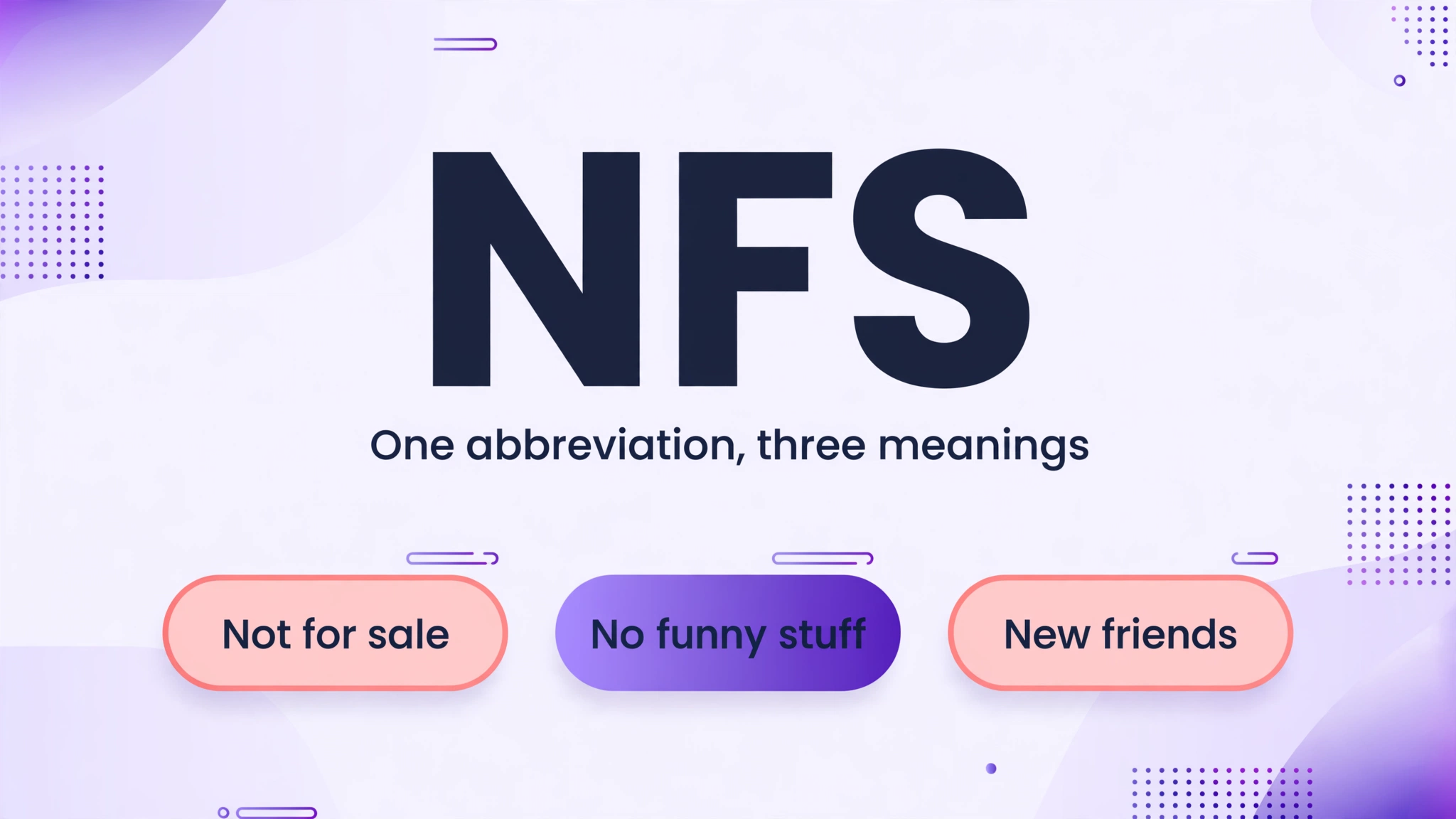
Three messages, same three letters, three different meanings. A sneaker photo captioned “grail pair, NFS” is not an invitation to make an offer. A text that reads “come over, but NFS” is not about shopping. And a bio that says “just moved here, NFS” is asking for people, not warning them off. The nfs meaning in text is never one fixed definition — it is decided by what sits next to it: an item, a boundary, or an invitation.
In short: NFS most often means “not for sale” under a photo or listing, “no funny stuff” in a chat where someone is getting serious, or “new friends” in a bio or add request. Smaller readings exist too, but the first three do almost all the work. The Three-Question Sort below tells you which one you are reading, in order, without guessing.
What NFS Means in Text
NFS is an initialism, spoken letter by letter — “en-ef-ess” — when it is spoken at all.
The oldest job is “not for sale.” Wiktionary lists NFS as an initialism of “not for sale,” with a printed example from 1980: a Stephen King story puts an “NFS card” on a picture frame to show the picture is not being sold.
The chat jobs came later, and no dictionary records them. “No funny stuff” is the serious-tone marker: a sender drawing a line or asking to be taken seriously. “New friends” is the social one: someone open to meeting people, usually in a bio, a story, or an add request. Both appear across every competitor guide. Neither has a traceable coiner or first year, so this article claims no origin date for them. Two honest limits: no reputable source documents which sense belongs to which app, and no frequency ranking is printed here, since the only numbers found are search signals, not usage studies.
The NFS Three-Question Sort
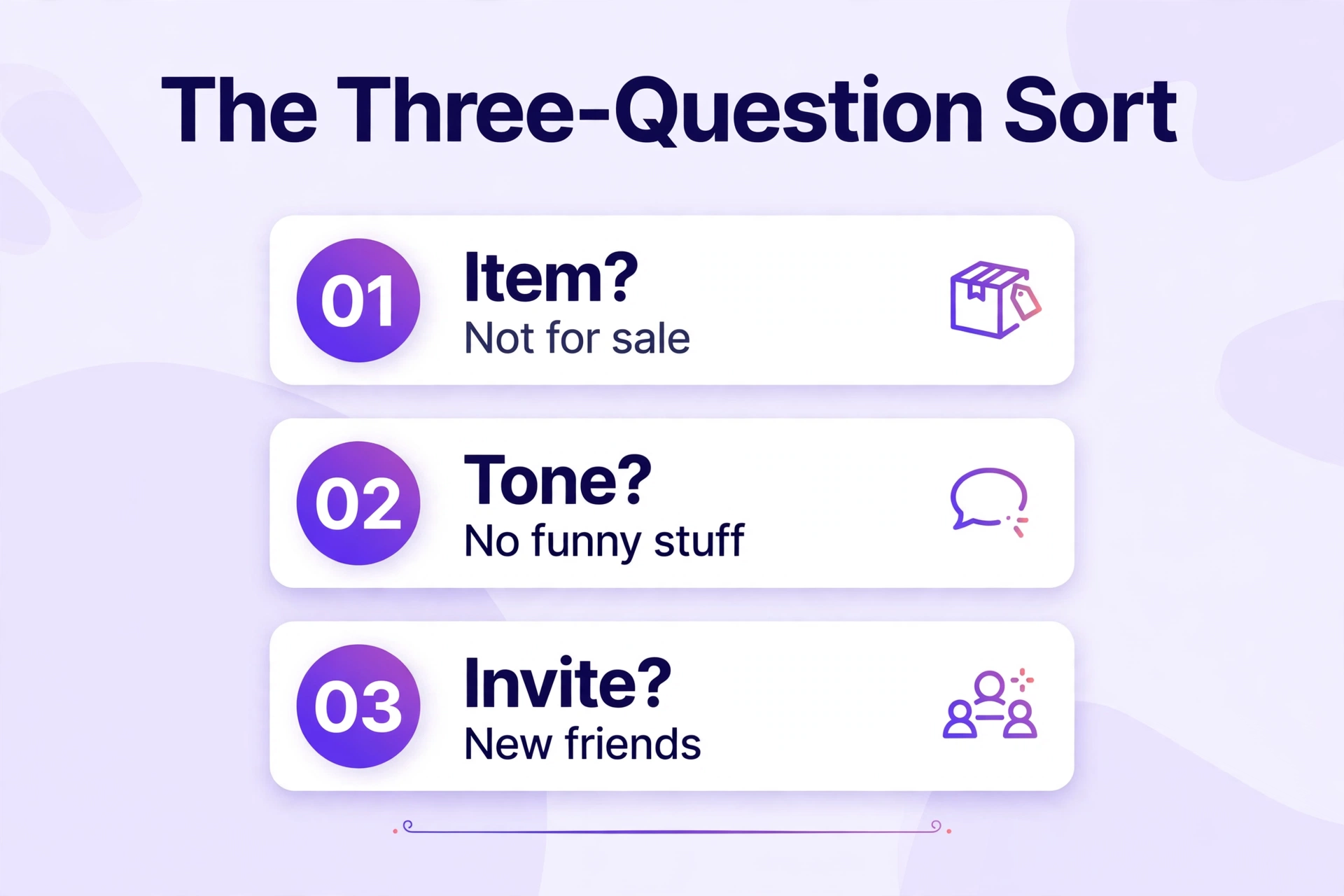
Here is this article’s named method, the NFS Three-Question Sort. Ask in order; stop at the first yes.
Question one: is there an item someone might want to buy? If the message sits under a photo of sneakers, a car, art, a watch, or a collection — or inside a listing — NFS means “not for sale.”
Question two: is the sender setting the tone for what happens next? If NFS appears inside a conversation — at the start of a serious request, after a joke that went too far, or attached to plans — it means “no funny stuff.”
Question three: is the sender inviting contact? If NFS sits in a bio, a story, or an add request from someone new in town or new to an app, it means “new friends.” The giveaway is the social frame. The three opening examples sort cleanly: the sneaker photo stops at question one, the “come over” text at question two, the bio at question three.
NFS Means Not for Sale
“Not for sale” is the safest reading whenever an item is in the picture. A collector posts rare sneakers with “NFS” and the message is simple: admire them, do not offer for them. An artist posts a painting marked NFS and means the piece itself is staying put.
This reading is the one with dictionary backing, and the one where misreading costs the most social capital: asking “how much?” under a post the owner marked NFS is the exact question the tag was trying to prevent. Note also that NFS is the opposite of FS (“for sale”), not the same as NFT (“not for trade”).
NFS Means No Funny Stuff
In a conversation, NFS changes its job completely. Here it means “no funny stuff”: I am serious, do not joke about this, do not play games. “NFS, I need you on time tomorrow” is a boundary around plans. “NFS, tell me what happened” is a request for a straight answer.
The clean expansion is “no funny stuff,” and that is the form to use in your own messages. A ruder version of the same phrase exists — the same three words with a profanity in place of “stuff.” This article mentions it once, in this paragraph, in masked form only: the vulgar variant is “no funny sh*t.” It means exactly the same thing as the clean version, it is never spelled out in full anywhere in this article’s headings, metadata, or images, and it is not a separate meaning — just a coarser way of writing the same boundary. Use the clean version.
Tone decides how firm this NFS sounds. Between friends who joke constantly, “NFS” can be half-playful: a signal that this one message is serious, not that the friendship is. In a tense or new conversation, the same letters read firmer, closer to a warning.
NFS Means New Friends
The third everyday reading lives in bios, stories, and add requests: NFS as “new friends.” Someone who just moved, just joined an app, or is rebuilding a social circle posts “NFS” to say they are open to meeting people. “Just moved to Austin, NFS, add me” is an invitation, not a warning and not a sales label.
This reading is the easiest to misread if you only know the other two. A stranger’s bio saying NFS does not mean they are selling nothing or setting rules; it means they want company. The clues are social, not commercial: a new account, a new city, a friend-finding app, a story asking people to reach out. It pairs naturally with the kind of message in our FR guide — where FR vouches truth, NFS vouches the invitation. One caution: an invitation from a stranger is still an invitation from a stranger, so keep early chats on the app and do not share personal details.
NFS on TikTok, Snapchat, Instagram, and in Texting
In plain texting, the chat readings dominate: “no funny stuff” when someone gets serious, and “not for sure” when someone is uncertain.
On Snapchat, placement splits the meaning. In a chat, NFS leans toward “no funny stuff.” On a story or a snap of an item, it leans toward “not for sale”: a photo of sneakers or art with NFS is a display, not a listing.
On Instagram, the item reading leads. Captions under photos of sneakers, cars, art, and collections use NFS to stop price questions before they start. In DMs it behaves like texting, private and pointed. Instagram also hosts the photo-filter reading: a selfie captioned #nfs on a Sunday may mean “no filter Sunday,” which only fits when the post is a selfie with no item for sale.
On TikTok, NFS lives mostly in comments, captions, and skits. The serious-tone reading shows up in comments — “NFS, I actually cried” vouches for a real reaction — and the item reading shows up in collection and product videos.
Tone and Sender Context: Who Is Saying NFS, and Why It Lands Differently
NFS carries a job, not a tone — and the tone comes from the sentence, the punctuation, and the person sending it. “NFS.” with a full stop reads firm and final. “nfs lol” reads softer, almost apologetic, the way a boundary sounds when the sender is nervous about setting it. A bare “nfs” after a joke reads tired rather than angry. Unlike SMH, which names a feeling, NFS only sets the terms — so never read NFS as a reaction on its own.
From a close friend, “no funny stuff” NFS is usually a gear change, not a fight: the friend who jokes all day is telling you this one message is real.
How to Reply to NFS, and When to Spell It Out
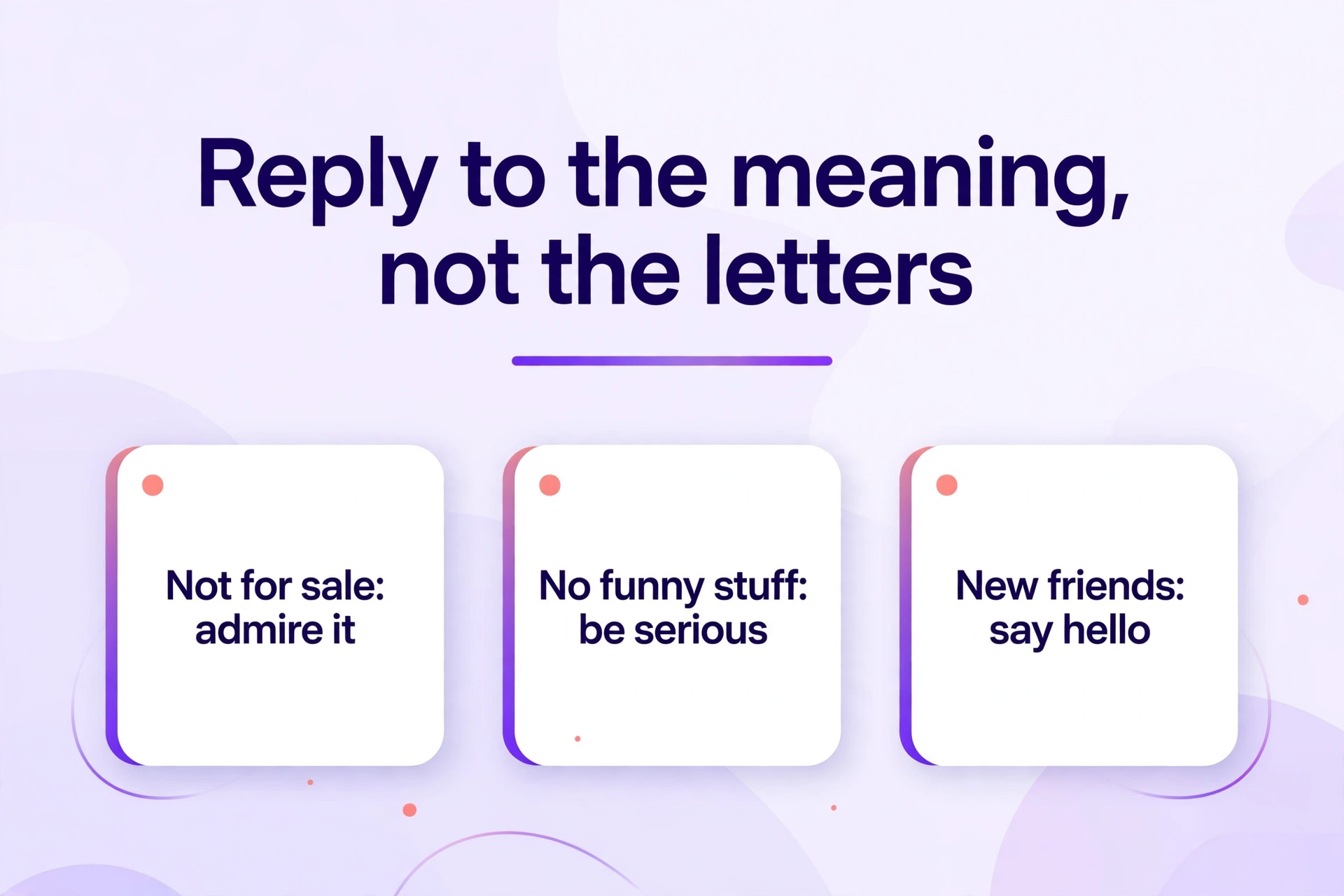
Reply to the reading, not the letters. If NFS meant “not for sale,” do not make an offer — admire the item instead: “That pair is beautiful, congrats on finding it.” If it meant “no funny stuff,” acknowledge the boundary: “Got it, seriously — what happened?” If it meant “new friends,” answer the invitation or leave it alone. And if it meant “not for sure,” treat it as a maybe, not a no: “No rush, just lmk when you know.”
If the meaning is unclear, asking beats guessing. “Quick check — do you mean not for sale or something else?” prevents the two classic mistakes: offering money for a keepsake, or joking through someone’s serious moment. If you add a side note while replying, remember the BTW guide on this site: put the real reply first and the aside second.
If you are sending NFS, spell it out when the reader may not know the slang, when the setting is professional, when money is involved, or when the boundary matters enough that ambiguity would hurt. “Not for sale” costs two words and zero confusion in a listing.
NFS vs Related Terms
NFS sits near several short forms that look similar but do different jobs, and mixing them up is how replies go wrong.
| Term | Full form | How it differs from NFS |
|---|---|---|
| NFS | Not for sale / No funny stuff / New friends | Meaning decided by context: item, tone, or invite. |
| FS | For sale | The opposite of the sales reading: the item IS available. |
| NSFW | Not safe for work | A warning about explicit content. Looks similar, means nothing similar. |
| TBH | To be honest | Certifies a sentence as the speaker’s real view. TBH frames honesty; NFS sets a boundary or labels an item. |
| IDC | I don’t care | A brush-off. NFS is never a brush-off. |
| IDK | I don’t know | A full admission of not knowing. “Not for sure” NFS is softer — a maybe, not a blank. |
Debunked: What NFS Does NOT Mean
Short letters collect false meanings, and NFS has collected many. First: NFS does not have one fixed meaning per platform. Guides that declare “Snapchat NFS means X” and “TikTok NFS means Y” are tidying up a mess that is genuinely untidy — the same app hosts multiple readings, and the Sort’s questions, not the app icon, decide.
Third, the smaller readings need honest grading. “Not for sure” is real but thin: it appears in several guides with the same two example patterns (“NFS yet,” “I’m NFS on the headcount”), and it only fits when the message is about uncertainty over plans or facts. “No filter Sunday” is real but narrow: it fits only a selfie or story post, ideally on a Sunday, with no item for sale.
Fourth, the non-texting readings are real in their own rooms and irrelevant in a chat thread. Need for Speed is the racing game series — correct in a gaming conversation, a wrong guess anywhere else. Network File System is a file-sharing protocol — correct among IT staff talking about servers, a wrong guess anywhere else.
When Not to Use NFS
Skip it when money or clarity is on the line. In a listing, a client message, or any professional context, write “not for sale” in full — the abbreviation saves two words and risks a lost sale or an unwanted offer.
Skip it, too, when the reader may not know it. NFS is searched constantly, which is itself evidence that plenty of readers do not know it yet. If your reader is a parent, a client, a teacher, or anyone outside the group chat, spell it out. And skip the vulgar variant entirely in any context where the clean version works — which is all of them.
Quick Answers
What does NFS mean in text?
It depends on context. In a text usually “no funny stuff” or “not for sure.” Under a photo usually “not for sale”; in a bio usually “new friends.”
What does NFS mean on Snapchat?
In a chat usually “no funny stuff”; on a story or photo of an item usually “not for sale”; in a bio or add request usually “new friends.”
What does NFS mean on Instagram?
Usually “not for sale” under photos of sneakers, cars, art, or collections. In DMs it behaves like texting, and a Sunday selfie tagged #nfs may mean “no filter Sunday.”
What does NFS mean on TikTok?
In comments it usually means “no funny stuff” — a serious or genuine reaction. In product and collection videos it usually means “not for sale.” Read the video before the hashtag.
Does NFS mean something rude?
Not by itself. The clean readings are polite. The boundary reading has a ruder variant with a profanity in place of “stuff,” but the clean “no funny stuff” is the form to use.
Is NFS the same as NSFW?
No. NSFW means “not safe for work,” a warning about explicit content. NFS carries no such warning — the letters just look alike.
What does NFS mean from a girl?
The same as from anyone else. There is no gendered meaning: check whether the message is about an item, a boundary, an invitation, or uncertainty.
Can I use NFS at work?
Better not. At work, write it out: “not for sale,” “I’m being serious here,” or “let me know when you’re sure.” NFS reads as too casual and too ambiguous for work.
Final Thoughts
NFS is three letters doing three jobs. Look for the item first, then the tone, then the invite. And when none of those fit, ask — a five-second question beats a wrong guess every time.
