
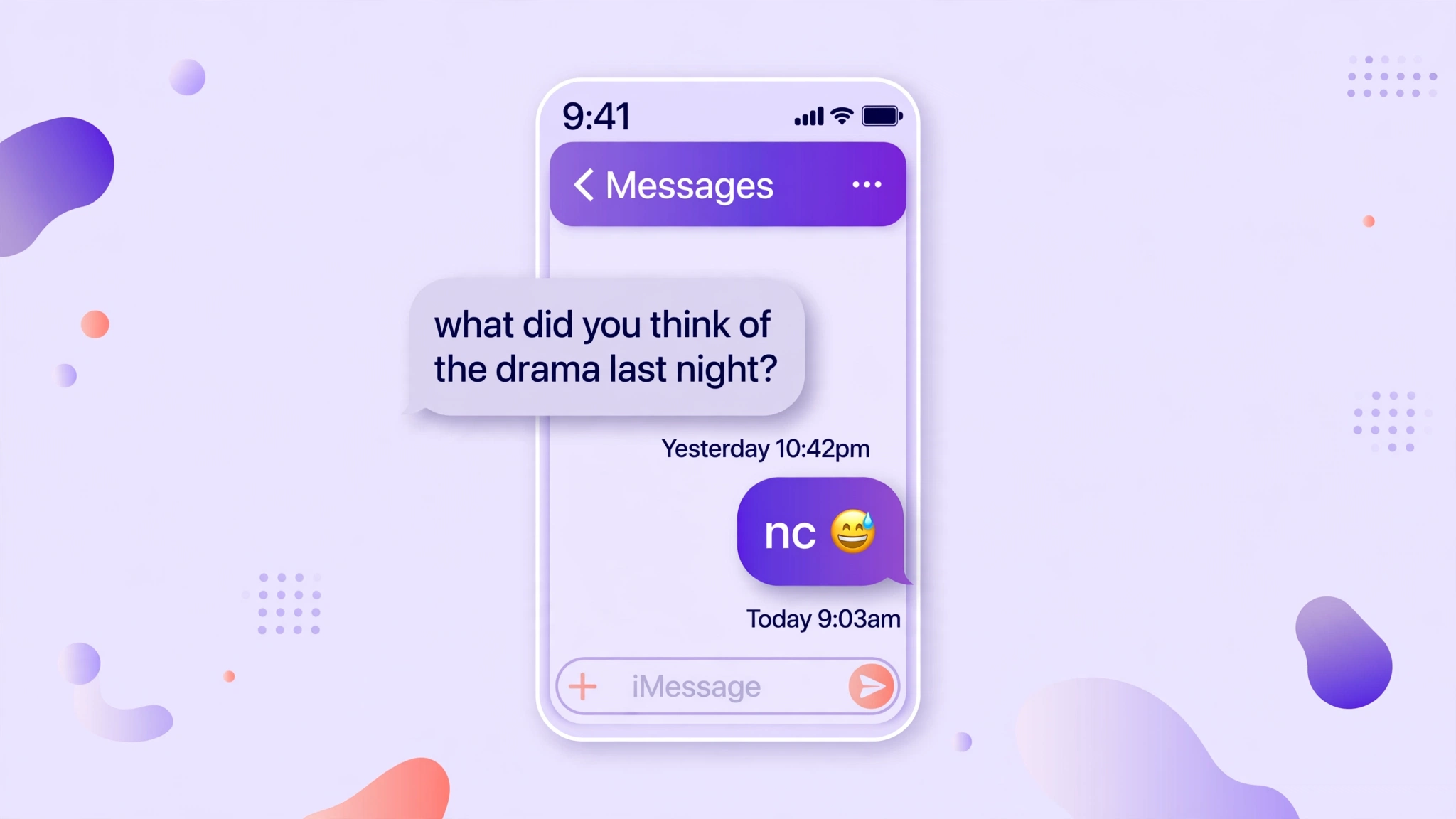
NC isn’t really a definition — it’s a social tool. Two letters that end a topic, dodge drama, or decline without offending anyone. When someone replies “nc” to a loaded question, they’re not telling you what the letters stand for. They’re telling you the conversation is over, politely.
If you’re looking up the nc meaning in text, the short answer is “no comment.” But the interesting part isn’t the expansion — it’s the job. NC is how you say “I’m not touching that” without starting a fight. This guide covers what NC really means, how it differs from its cousins IDK and IDC, why punctuation changes everything, and when to upgrade to real words instead.
The Short Answer
| Question | Answer |
|---|---|
| What it means | “No comment” — a polite refusal to engage with a topic |
| What it does | Ends a topic, dodges drama, declines without offending |
| Tone | Neutral to cool; softeners (emoji, “haha”) warm it up, a period chills it |
| Where it sits | Usually a standalone reply to a direct question |
| Register | Casual — texts, group chats, DMs, comments |
| Formal alternative | “I’d rather not get into it” or “no comment” spelled out |
What NC Actually Means (Honestly Graded)
Not every meaning you’ll find online deserves equal trust. Here’s the honest breakdown:
“No comment” — strong. This is the established reading, supported across independent sources: McAfee’s teen-slang list, multiple slang dictionaries, and the direct competitors ranking for this term all agree. In texts and chats, NC is “no comment” the overwhelming majority of the time — a digital shrug borrowed from journalism and corporate-speak.
“North Carolina” — strong but context-locked. The US state abbreviation. It only applies when location is the topic (“driving through NC tomorrow”). If nobody’s talking about geography, this isn’t it.
“No charge” — moderate. Commercial and customer-service contexts: “replacement part provided NC.” Real, but you’ll never see it in a personal text.
“Nice chat” / “no contest” — low to moderate. Single-source attestations. Possible, but don’t lead with these.
“No cap” to “nc” — myth, busted. One content-farm source claims “nc” means “no cap.” In real usage, “no cap” is essentially never shortened to “nc” — the abbreviation doesn’t work that way, and no one in actual conversations uses it. If a competitor tells you otherwise, they’re parroting a weak source. Consider this article your correction.
“No clue” / “nice call” — no support found. Some lists include these, but there’s no real-world evidence behind them. They read like someone guessed. This guide won’t present guesses as facts.
So: in a texting conversation, NC is “no comment.” Everything else is context-locked trivia or myth.
NC vs. IDK vs. IDC vs. NVM: Know the Difference
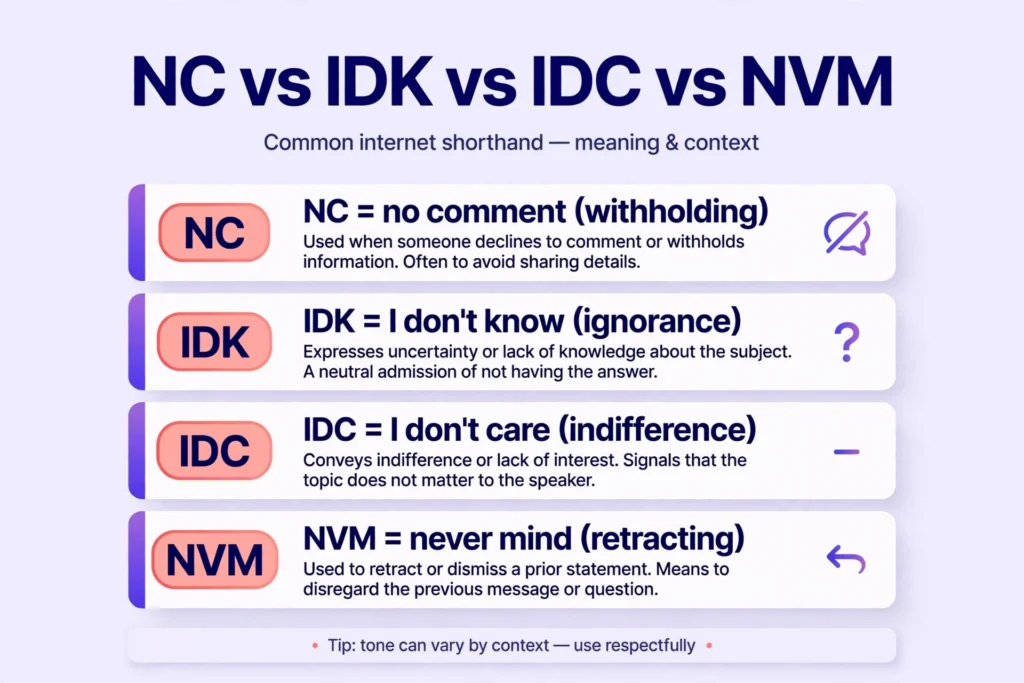
This is the comparison that actually matters, because these four get confused constantly. They look similar — two or three letters, all conversation-enders — but they do completely different jobs:
| What it says | The real meaning | When to use it | |
|---|---|---|---|
| NC | “No comment” | I have thoughts but I’m not sharing them | Dodging drama, declining to engage |
| IDK | “I don’t know” | I lack the information | Genuine ignorance, no opinion yet |
| IDC | “I don’t care” | I have no stake in this | Indifference — use carefully, it stings |
| NVM | “Never mind” | Drop it, forget I asked | Retracting your own question |
The difference is why the conversation stops. IDK stops it because there’s nothing to say. IDC stops it because nothing matters. NVM stops it because the asker takes it back. NC stops it because the answer exists but isn’t being shared — and that deliberate withholding is what gives NC its power (and its risk).
“Did you hear what happened with Jake and Mia?” → “nc” means I know but I’m staying out of it. → “idk” means I genuinely haven’t heard. → “idc” means I don’t care about their drama. Three letters, three completely different social moves. Choose like it matters, because it does.
Where It Came From
The “no comment” reading has a plausible lineage: journalism and corporate communications, where “no comment” is the official non-answer — the thing spokespeople say when they can’t say anything. One slang source traces NC’s migration from that world into texting, and the shape fits: the same deliberate refusal, compressed for speed.
Treat this as “where it probably came from” rather than gospel — it’s single-sourced. But it explains why NC feels more formal than its cousins. IDK and IDC are native texting slang; NC is a borrowed suit. That’s why it works as the “polite” option: it carries a whiff of press-conference dignity even in a group chat.
Tone Forensics: Punctuation Does the Work
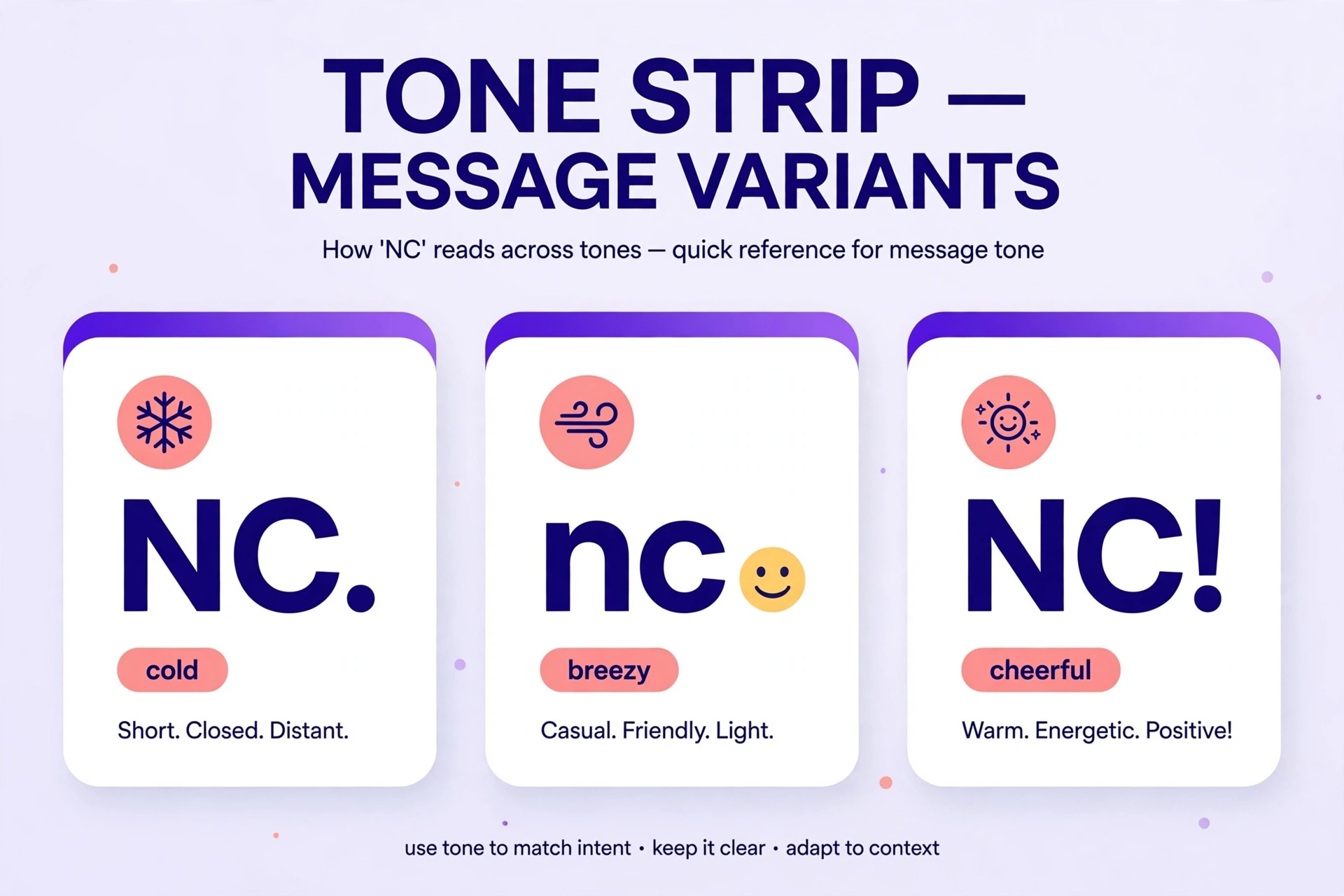
NC is toneless on its own, so the wrapping decides everything. The same two letters send opposite signals:
- “NC.” — the period is a door closing. Cold, clipped, possibly annoyed. In a tense conversation this reads as stonewalling.
- “nc” with sweat-smile emoji — breezy and warm. The sweat-smile emoji says I’m dodging this playfully, no hard feelings. The safest default.
- “nc haha” — the laugh softens it further. This topic is funny to avoid, not serious.
- “NC!” — reads as approval or enthusiasm, almost a different word. No comment — and I’m cheerful about it!
- “nc” with zipper-mouth emoji — the zipper-mouth makes the refusal explicit and playful: my lips are sealed.
The rule: bare “NC” to a direct question can feel rude. It’s a refusal wearing no padding. Add a softener — an emoji, a “haha,” an exclamation — and the same refusal becomes social grace. Two letters, five moods. Choose deliberately.
The Sarcastic NC
There’s a second NC hiding inside the first: the playful guilt-admission. “Did YOU eat the last slice?” → “nc” with smirk emoji. The smirk emoji flips the meaning — this isn’t a refusal to comment, it’s a confession wearing a refusal’s clothes. Yes, it was me, and I’m delighted about it.
This usage only works because everyone knows the straight version. The joke is in the gap: the form says “no comment” while the emoji says “absolutely guilty.” It’s the same mechanics as pleading the Fifth with a wink — and the same energy as a wtw (“what’s the word”) asked with a grin. Readers recognize it instantly — which is why it’s worth knowing, not just as trivia but as a move you can use.
When NC Backfires (and the Upgrade)
NC is a precision tool, and precision tools cut the user when misapplied:
In serious conversations, it reads as stonewalling. “We need to talk about what happened last night” → “nc” doesn’t dodge drama — it creates it. When someone needs a real answer, a two-letter refusal feels like contempt. The upgrade: “I’d rather not get into it tonight, can we talk tomorrow?” — a refusal with a reason and a timeline. (If you genuinely need to leave the conversation, “brb” is honest; “nc” is a dodge.)
One-on-one, it can feel like a door closing. In a group chat, NC is a drama-dodge everyone understands. Directed at one person asking a sincere question, the same letters feel personal. You’re the topic being declined.
Repeated NCs become a wall. One “nc” is graceful. Three in a row is a pattern, and the pattern says I don’t want to talk to you at all. If you’re dodging that often, the honest move is addressing why — or stepping back from the conversation entirely.
At work, spell it out. “NC” to a colleague’s question reads as dismissive. “I don’t have visibility into that — lmk if you need me to find out” does the same job without the chill.
NC in Real Conversations
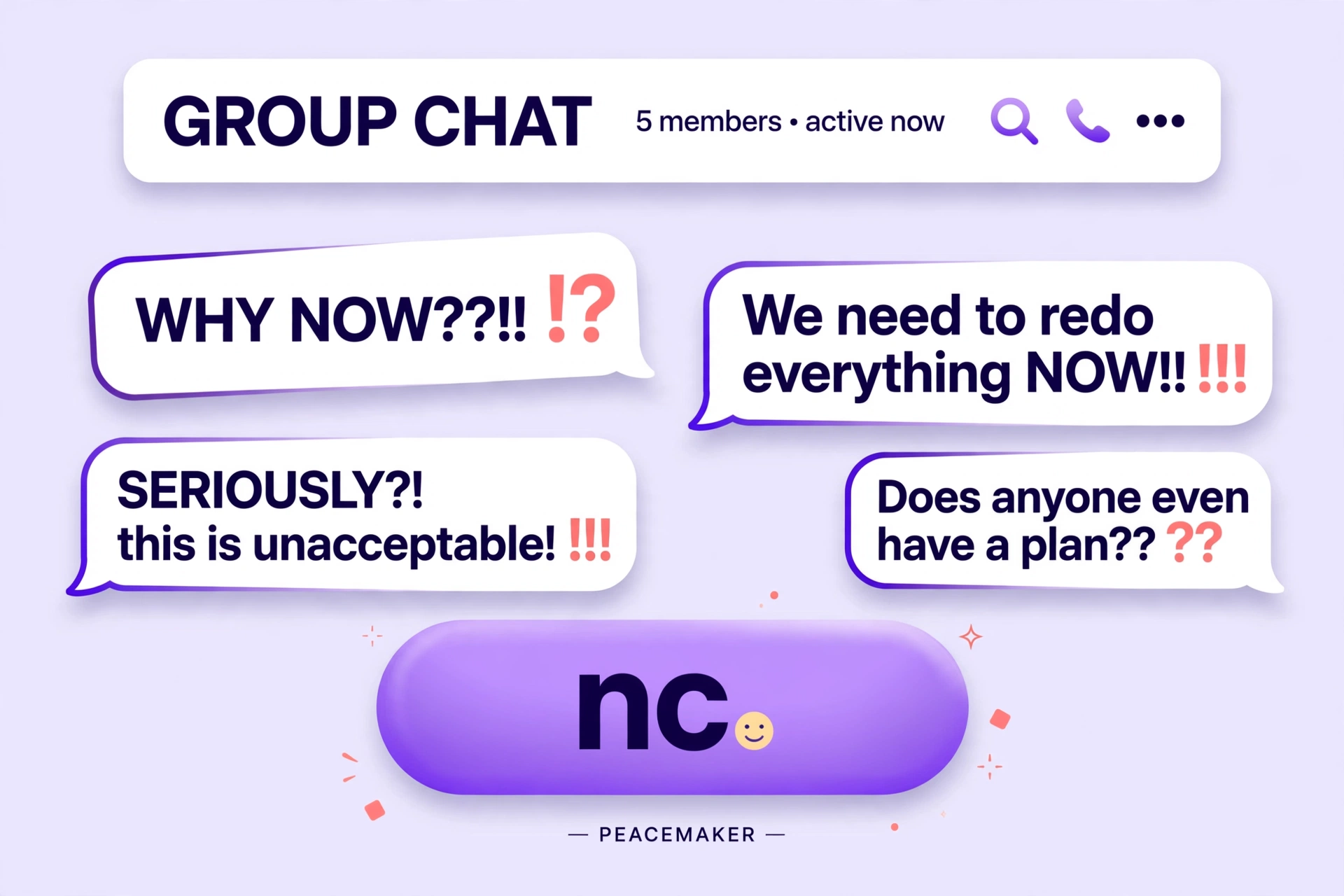
The exchanges below are illustrative examples, not real messages.
The group-chat drama dodge
- Sam: “ok but what did everyone think of what happened at dinner last night??”
- Jordan: “nc”
- Sam: “lol fair”
Jordan knows, has opinions, and is choosing peace. The emoji keeps it friendly; Sam reads it correctly and moves on. This is NC at its best.
The loaded question
- Alex: “so are you two actually dating or what”
- Riley: “nc”
Riley’s not answering, and the zipper-mouth makes it playful rather than hostile. Alex gets the message: not your business, asked nicely. (If Riley had actually spilled the secret by accident, the only fix would be an instant “mb, forget I said that.”)
The sarcastic confession
- Casey: “who ate my leftovers??”
- Morgan: “nc”
Everyone knows it was Morgan. The “nc” is the joke — a fake refusal performing a real confession.
The FYI vs NC split
- Taylor: “fyi, the meeting moved to Thursday”
- Jamie: “nc”
Jamie’s NC here is odd — there’s nothing to dodge. This is NC misfiring: applied to neutral information, it reads as cold for no reason. “Thanks!” or “got it” was the right reply. NC needs a loaded topic to make sense.
Quick Answers
What does NC mean in text?
“No comment” — a polite refusal to engage with a topic. “What did you think of the drama?” → “nc” means I’m staying out of it.
Is NC rude?
It can be. Bare “NC” to a direct question reads cold; “nc” with a softener reads breezy. The letters are neutral — the punctuation and emoji decide.
What’s the difference between NC and IDK?
Knowledge vs. refusal. IDK means you genuinely don’t know. NC means you might know but aren’t saying. “Do you know what happened?” → IDK is honest ignorance; NC is deliberate silence.
What’s the difference between NC and IDC?
IDC (“I don’t care”) declares indifference — it stings. NC (“no comment”) declines without declaring anything. NC is the diplomatic one.
Does NC mean “no cap”?
No — that’s a myth from a weak source. “No cap” is never shortened to “nc” in real usage. Don’t use it, don’t expect it.
What does “nc” with smirk emoji mean?
Usually the sarcastic confession — yes, it was me — delivered as a fake refusal. The smirk emoji is doing all the work.
Can I use NC at work?
Better to spell it out. “I’d rather not get into it” or “I don’t have visibility into that” does the same job without reading as dismissive.
When should I NOT use NC?
In serious one-on-one conversations where someone needs a real answer, when the topic isn’t loaded (it just reads cold), and when you’ve already used it twice — a third NC is a wall, not a dodge.
The Short Version
NC is “no comment” — two letters that politely end a topic. It’s a social tool, not just a definition: the digital equivalent of a press secretary’s smile. Don’t confuse it with IDK (genuine ignorance) or IDC (declared indifference) — NC is deliberate silence, and that’s its power. Soften it with an emoji (“nc”), never aim it at someone who needs a real answer, and upgrade to actual words when the conversation matters. The polite full stop only stays polite if you punctuate it like one.
