
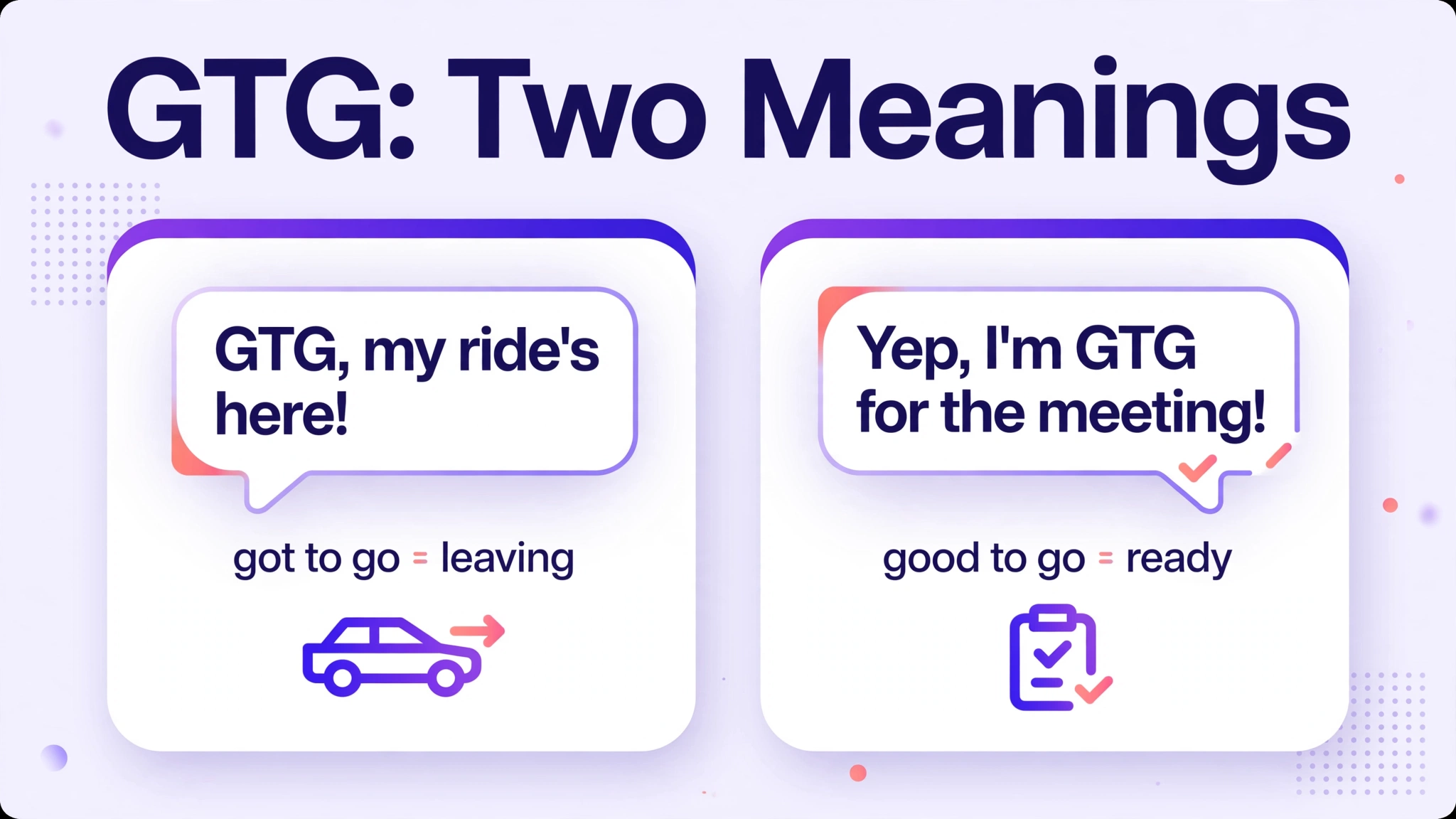
Three letters with a split personality. Type “gtg” at the end of a chat and everyone reads a goodbye. Type “gtg?” after a question and everyone reads a readiness check. Same letters, opposite jobs — one is leaving, the other is confirming. And confusing the two is one of the most quietly embarrassing mistakes in texting.
If you’re looking up the gtg meaning in text, you probably already know one meaning. This guide covers both: the classic “got to go” sign-off (one of the oldest acronyms still in daily use, born in 1990s IRC chat), and the widely-used “good to go” reading that most guides skip entirely. Plus the exit-vocabulary ladder, the gaming use, tone forensics, and a reply playbook for each meaning.
The Short Answer
| Question | Answer |
|---|---|
| What it means | “Got to go” (leaving) — or “good to go” (ready/confirmed) |
| What it does | Ends a conversation, or confirms readiness |
| How to tell | End of chat, abrupt = “got to go”. Question form (“you gtg?”) or after a readiness question = “good to go” |
| Tone | Neutral-to-warm; lowercase “gtg” is relaxed, “GTG!” is urgent |
| Where it sits | Standalone sign-off, or as a reply to “ready?” |
| Register | Casual everywhere — texts, group chats, gaming, work chat |
| Formal alternative | “I have to run” or “I’m ready” spelled out |
“Got to Go”: The Classic Reading
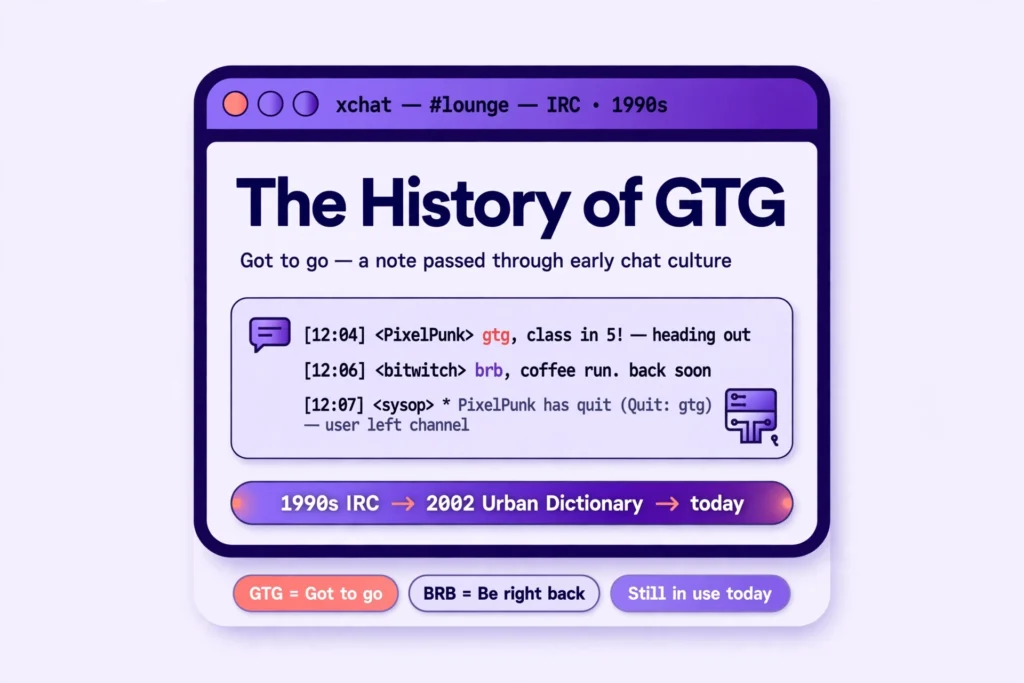
This is the GTG everyone knows: “got to go” — the polite exit. “gtg, my ride’s here.” “Sorry gtg, dinner’s ready.” It’s a conversation-ender that carries no drama: I’m leaving, it’s not about you, talk later.
GTG belongs to a specific generation of internet shorthand. In the 1990s, IRC chat rooms had no “online status” indicator — nobody could see whether you were still there. So people announced their departures explicitly, and a family of exit initialisms was born: BRB (be right back), AFK (away from keyboard), and GTG (got to go). The earliest Urban Dictionary entry for GTG dates to July 2002, defining it simply as “Got to go.” It rode SMS and instant messaging into the mainstream in the 2000s, and it’s still alive in WhatsApp and iMessage today — making it one of the oldest acronyms still in daily use.
That history explains GTG’s specific job. Unlike BRB, which promises “I’ll be back soon,” GTG makes no promise. “GTG” means I’m leaving and the conversation is over for now — it might resume later, or it might not. That open-endedness is the point: it’s the graceful way to vanish.
“Good to Go”: The Second Meaning Nobody Teaches
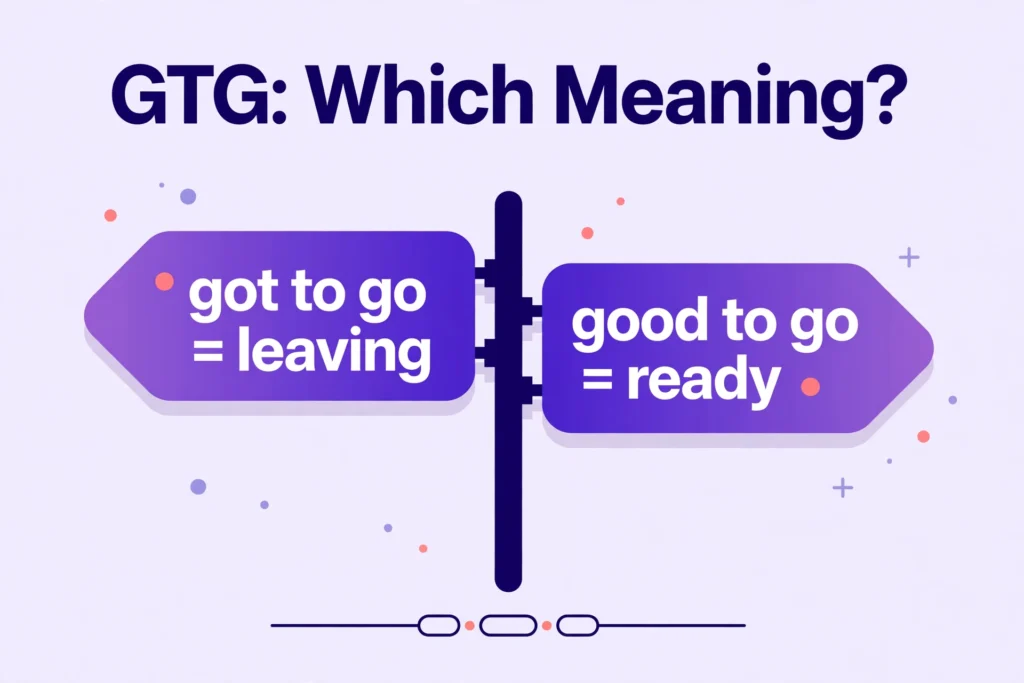
Here’s what most guides miss: GTG also means “good to go” — ready, confirmed, all set. “You gtg for the meeting?” “Yep, I’m GTG.” “Car’s packed, we’re gtg.”
This reading is strong and widely used, verified across multiple sources (HowToGeek, addictivetips, qoli.ai). It lives in a different context from the goodbye: it appears in reply to readiness questions, in logistics (“tickets booked, hotel confirmed — gtg”), in sports and gaming (“squad gtg?”), and in work chat (“deck’s ready, I’m gtg for the review”).
The disambiguation is almost always automatic because the two meanings live in opposite sentence positions:
- End of a message, standalone, often abrupt → “got to go.” “gtg, talk later!” Nobody reads this as “good to go.”
- Question form, or directly answering “ready?/set?/all good?” → “good to go.” “You gtg?” is never asking whether you’re leaving.
The failure case is real though: someone asks “you gtg for tomorrow?” (readiness check) and the other person replies “bye!” — having read it as a goodbye. The recovery is one line: “haha no — gtg as in good to go, I’m ready!” If you ever feel the ambiguity, spell it out. As HowToGeek’s guide notes, where ambiguity matters, “good to go” should be typed in full.
The Exit Vocabulary Ladder
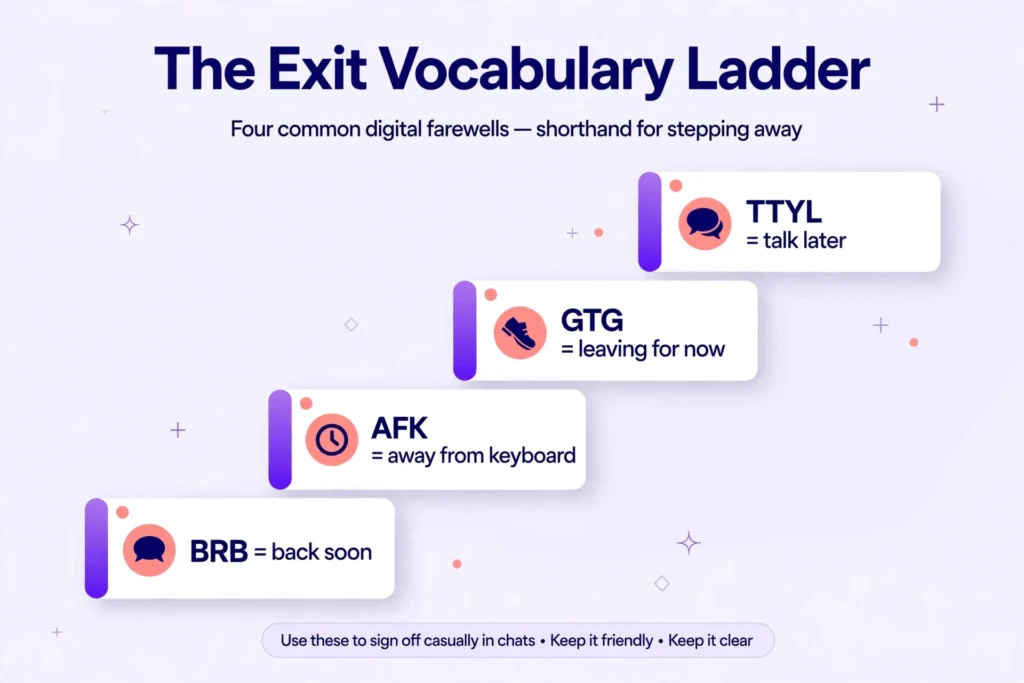
GTG doesn’t work alone — it’s part of a family of exits, and each one promises something different about returning. Learning the ladder makes you fluent in the whole system:
BRB — “be right back.” The shortest exit. Promises a quick return: minutes, not hours. “brb, doorbell.”
AFK — “away from keyboard.” Physically gone from the device. Common in gaming and work chat. No promise about when — just not here right now.
GTG — “got to go.” Leaving, conversation over for now. Softer than “bye” in some ways (it’s circumstantial — I have to go, not I want to stop talking), and it pairs naturally with a follow-up: “gtg, ttyl!”
TTYL — “talk to you later.” The warm wrap-up. Less abrupt than GTG — it explicitly schedules the next conversation.
CYA — “see ya.” Casual, breezy, final-ish. More of a wave than an explanation.
The practical difference: BRB pauses the conversation; GTG ends it (for now); TTYL ends it warmly with a promise. Using “gtg” when you mean “brb” accidentally kills a conversation that was only taking a break — match the exit to the actual plan. (And when the exit needs information rather than just a goodbye — “gtg, fyi the meeting moved” — the FYI does the informing while GTG does the leaving.)
GTG in Gaming
Gaming is where GTG does double duty most visibly. In squad and raid coordination, both meanings show up in the same lobby:
“gtg” as the exit: a player leaving mid-session. “gtg guys, dinner.” Same as texting — the conversation (here, the game) continues without them.
“gtg” as the readiness check: the raid leader asking “everyone gtg?” before pulling the boss. Here it’s unambiguously “good to go” — nobody’s leaving, everyone’s confirming.
Context does all the work, and gamers rarely confuse the two, because the readiness check almost always comes as a question before the action, while the exit comes as a statement during a lull. If you’re new to a squad and unsure, the safe reply to “gtg?” is “ready” — spelled out, zero ambiguity.
Tone Forensics: What the Wrapping Says
GTG is toneless on its own, so the delivery decides the mood:
- “gtg” — relaxed, default. The lowercase workhorse of casual exits.
- “GTG!” — urgent or cheerful. The exclamation mark adds energy: either I really have to run or I’m excited to be leaving for something fun.
- “gtg, sorry!” — the apology softener. Signals the exit is abrupt but not rude.
- “GTG. TTYL.” — clipped and formal-ish. Periods make it feel scheduled rather than spontaneous.
- “gtg??” — the readiness check, question form. This is the “good to go” reading wearing its question mark like a uniform.
- Bare “gtg” mid-conversation — a soft conversation-ender. Dropped without explanation, it signals I’m done here more than I have somewhere to be. If the chat was lively, add the reason: “gtg, my ride’s here” lands warmer than a naked “gtg.”
GTG in Real Conversations
The exchanges below are illustrative examples, not real messages.
The classic exit
- Sam: “this was fun, we should do it again”
- Jordan: “definitely! gtg now though, my ride’s here 👋”
Clean, warm, complete. The reason (“my ride’s here”) removes any sting.
The readiness check
- Alex: “tickets are booked, hotel’s confirmed — you gtg for Friday?”
- Riley: “yep, all gtg on my end!”
Both uses of the “good to go” reading, back to back. No goodbye anywhere in sight.
The confusion (and recovery)
- Casey: “you gtg for the meeting tomorrow?”
- Morgan: “bye!!”
- Casey: “haha no — gtg as in good to go, are you ready?”
- Morgan: “OH. yes, I’m ready 😅”
It happens. The recovery is instant and nobody’s feelings are hurt — which is why the ambiguity is a funny story, not a real problem.
The gaming lobby
- Raid leader: “everyone gtg?”
- Player 1: “ready”
- Player 2: “gtg”
- Player 3: “one sec, grabbing buffs”
Readiness check, confirmations, one holdout. The system works.
The soft ending
- Taylor: “anyway, gtg — lmk how the interview goes!”
- Jamie: “will do, good luck!”
“gtg” ends Taylor’s part, and the lmk books the follow-up. Textbook graceful exit.
How to Reply to GTG
To “got to go”:
- The standard: “ok, ttyl!” or “bye!”
- If they gave a reason: acknowledge it. “Have fun at dinner!”
- Don’t guilt-trip the exit. “Ugh, fine 🙄” turns a normal goodbye into a thing.
To “good to go” (the question):
- Confirm: “yep, gtg!” or spell it out: “ready!”
- If not ready: say what’s missing. “Almost — just need 5 more minutes.”
- If you misread it as a goodbye: laugh it off and answer the actual question. (The classic misread-recovery phrase is mb — “my bad” — as in “mb, thought you were leaving 😅”.)
When someone GTGs mid-conversation with no reason:
- Don’t chase. “ok!” is enough. If it becomes a pattern of abrupt exits, that’s a conversation about the relationship, not the acronym. (And if you’re the one always leaving first, a quick wya check before you go — “wya, want to meet up later?” — softens the exit considerably.)
Quick Answers
What does GTG mean in text?
Usually “got to go” — a casual way to end a conversation. It can also mean “good to go” (ready/confirmed) when answering a readiness question.
What’s the difference between “got to go” and “good to go”?
Position and context. Standalone at the end of a chat (“gtg, bye!”) = leaving. In question form (“you gtg?”) or answering “ready?” = confirming readiness.
Is GTG the same as BRB?
No. BRB (“be right back”) promises a quick return; GTG ends the conversation for now with no promised return time.
Where did GTG come from?
1990s IRC chat rooms, alongside BRB and AFK. Early chat had no online-status indicators, so people announced departures explicitly. The first Urban Dictionary entry is from July 2002.
What does “you gtg?” mean?
“Are you good to go?” — a readiness check, not a goodbye. Reply with confirmation (“yep!”) not a farewell.
Can I use GTG at work?
The “got to go” exit is fine in casual team chat (“gtg, catching my train”). The “good to go” confirmation is very work-natural (“deck’s ready, I’m gtg”). In formal emails, spell both out.
What’s G2G?
An alternate spelling of “got to go” (Dictionary.com lists “GTG or G2G”). Same meaning, same usage.
How do I reply if I misread “gtg?” as a goodbye?
Laugh it off: “haha — gtg as in good to go? Yes, I’m ready!” The ambiguity is common enough that nobody minds.
The Short Version
GTG is “got to go” — one of the internet’s oldest goodbyes, born in 1990s IRC chat when you had to announce you were leaving. But it also means “good to go” — ready and confirmed — and that second meaning is everywhere once you look for it. End-of-chat plus abrupt equals leaving; question form plus readiness context equals confirming. Learn the exit ladder (BRB pauses, GTG ends, TTYL promises), spell it out where ambiguity matters, and never reply “bye!” to a readiness check.
