
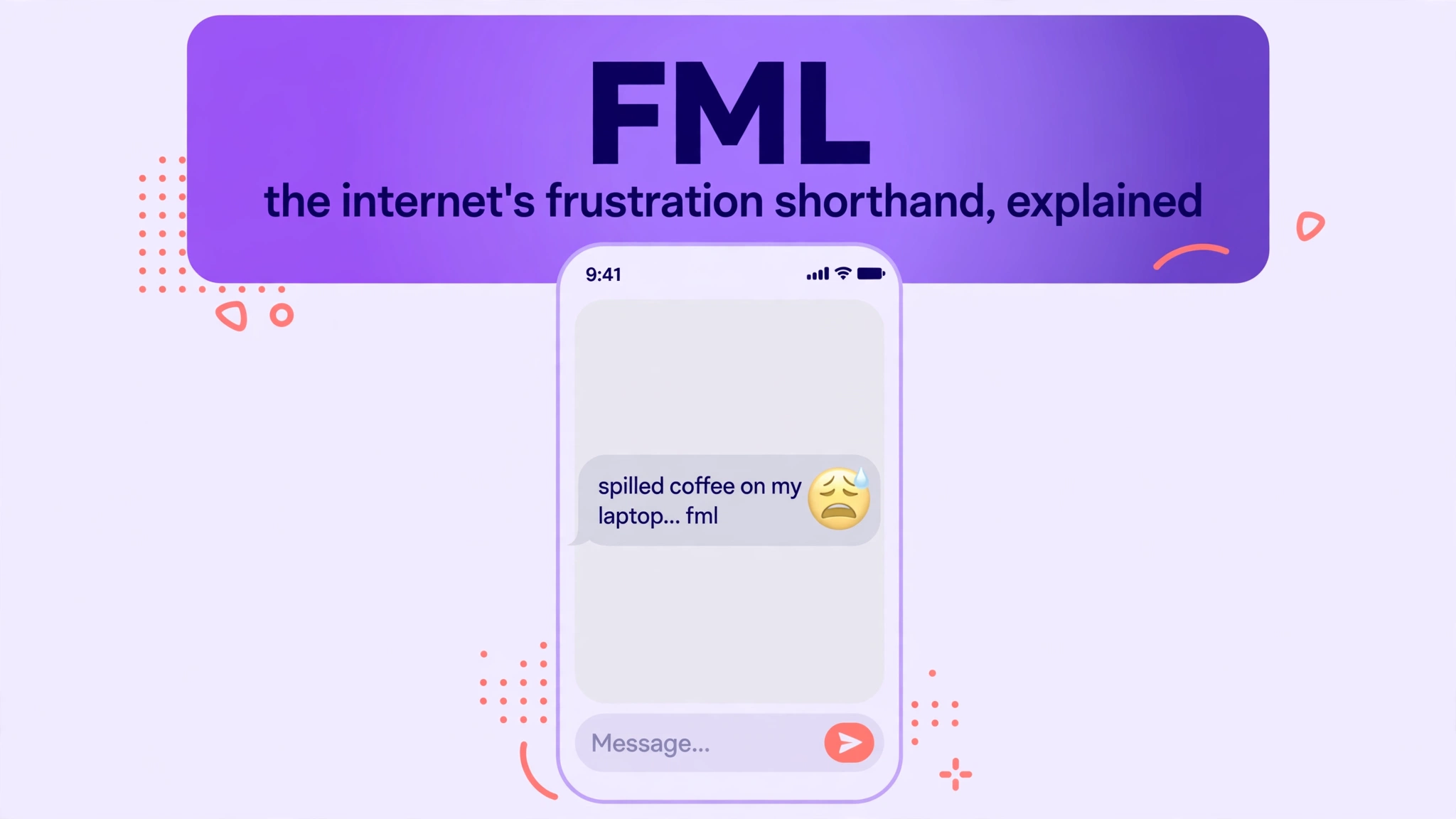
FML meaning in text stands for “F*** My Life,” and it is a widely used slang expression in online chats, messaging apps, and social media platfoThree letters. One verdict on the day. You’ve seen “FML” at the end of a text about a missed train, under a TikTok about a Monday disaster, or standing alone in the group chat like a tiny tombstone. It’s the internet’s most durable way of saying: things are not going my way right now.
Most slang dictionaries will tell you FML is “F*** My Life” and leave it there — a shrug in definition form. But FML is more interesting than that. Unlike nearly every abbreviation it grew up with, it survived. It has a birthplace, a ritual, and two decades of bad days behind it. This guide covers where FML actually came from, how to tell whether someone means it playfully or seriously, why it outlived its entire generation of slang, and when you probably shouldn’t type it.
FML Meaning at a Glance
| Full form | F*** My Life |
| Main job | Venting — stamping a moment of bad luck, frustration, or comic misfortune |
| Tone | Casual, hyperbolic; swings from playful to genuinely upset |
| Common in | Texts, group chats, DMs, Twitter/X, TikTok, Reddit, comments |
| Example | “locked my keys in the car… fml” |
| Capitalization | fml and FML mean the same thing; lowercase reads lighter |
| Natural reply | Empathy, not advice — “nooo 😭” lands better than a solution |
| Avoid | Work messages, formal settings, strangers, genuine tragedy |
Born in 2008: The Website That Made FML Famous
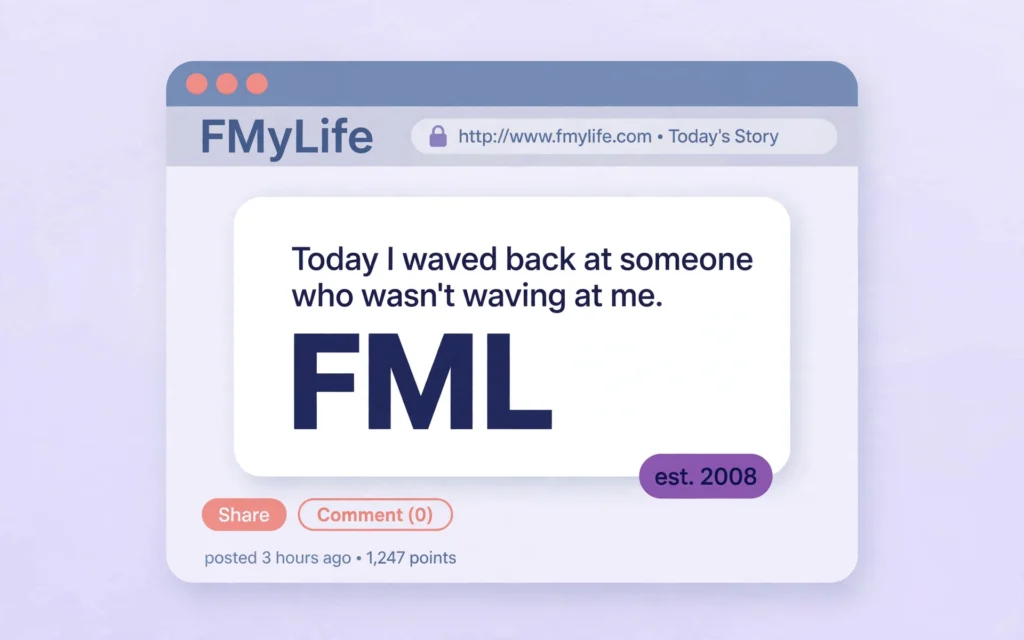
Before FML was a texting staple, it was a website ritual. FMyLife.com launched in 2008 as a home for anonymous, short anecdotes about everyday disasters — a few lines describing some small catastrophe, every single one ending with the same punchline: “FML.”
The format was a joke with a built-in drum hit: setup, disaster, FML. Readers voted on the best entries, the site went viral, and the ritual escaped the website to become everyday online slang. The classic entry went something like this: today I waved back at someone who wasn’t waving at me — followed by the letters that turned private embarrassment into public comedy.
That website matters because it gave the abbreviation something most slang never gets: a home and a grammar. On FMyLife, FML wasn’t just venting — it was punctuation, the laugh track at the end of someone else’s disaster story. Strangers voted on whose day was worse, which meant your worst moment had an audience that got it. That’s the engine that carried FML into mainstream texting.
The letters themselves predate the site — FML circulated in early-2000s forums and chatrooms as venting shorthand — but FMyLife is why it stuck. Plenty of abbreviations were born in those same chatrooms. Almost none got their own website, ritual, and fan club. FML did, and that’s the head start that carried it through the next twenty years.
The Tone Decoder: Playful “fml” vs. Serious “FML.”
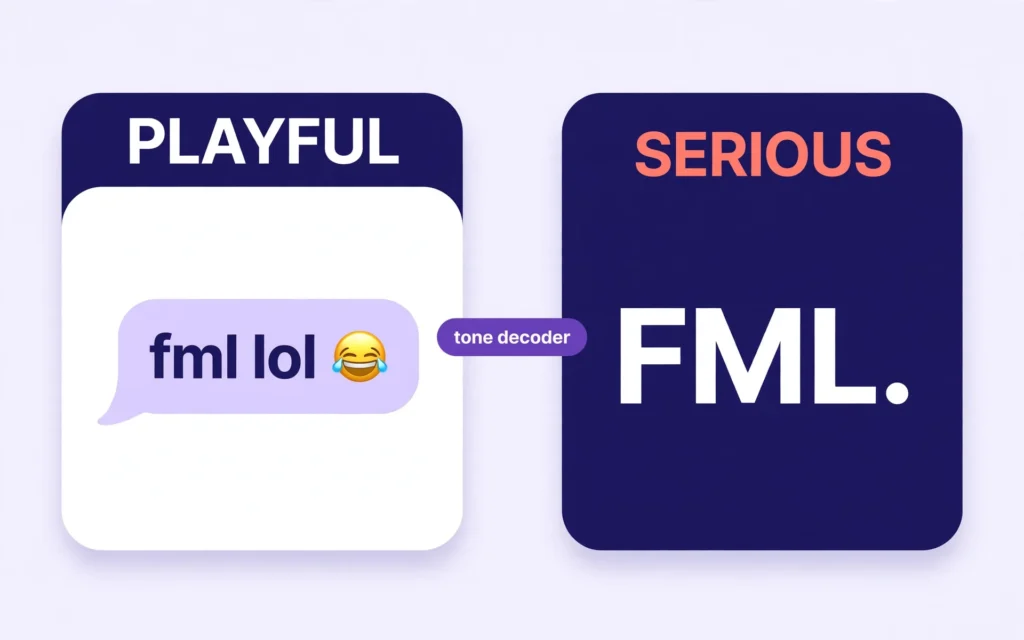
FML lives in two registers, and misreading the register is the only real way to misuse it. The letters are identical — everything around them is a signal.
Playful is where most FMLs live: lowercase “fml,” a laughing emoji, “lol,” a ridiculous detail. “fml lol I just put salt in my coffee instead of sugar 😂” The message is funny-bad — small disaster, low stakes, laugh along with me.
Serious is unmistakable once you know the tells: capital “FML,” sometimes with a full stop, standing alone after genuinely bad news. “Got laid off today. FML.” No emoji, no laugh track, no detail. The message is don’t laugh at this one — real frustration, real stakes, venting rather than performing.
Reading the cues: lowercase leans playful, ALLCAPS leans serious; a period adds weight; 😂 means play, 😭 means pain, and silence means read the room. A funny, specific detail (“salt in my coffee”) is performance; a bare announcement (“car died”) is a real complaint.
The golden rule: never laugh at a serious FML. A laughing emoji on “fml lol my charger broke” is solidarity; the same emoji on “Got laid off today. FML” is a wound. When in doubt, match the sender’s energy exactly — banter back to banter, empathy back to pain.
Why FML Outlived Its Entire Generation of Slang
FML grew up alongside a wave of early-2000s texting abbreviations, and the graveyard of that era is crowded — shorthand that once felt essential and now reads like a time capsule. FML didn’t just survive the extinction; it crossed from forums to flip phones to smartphones to TikTok without losing a step. Slang researchers have flagged it as a genuine survivor: consistent usage across two decades, still instantly understood by people who weren’t online when it was born.
Three reasons, all about the design of the thing. First, the raw material is infinite. FML runs on bad luck, and bad luck never goes out of style — Monday mornings, spilled coffee, dead phones, public embarrassments. A forever supply of subject matter.
Second, it’s a complete emotional arc in three letters. Most venting takes a paragraph. FML compresses frustration, self-pity, and a request for sympathy into a keystroke cluster — and the FMyLife era trained a generation to hear it as the end of a joke, so even a standalone “fml” carries the rhythm of a story. Setup, disaster, laugh track: three characters.
Third, it’s flexible. Caption, reply, standalone message, hashtag, punchline — texts, tweets, TikTok captions, Reddit titles, spoken conversation. Slang that fits everywhere just follows the audience.
Compare it with SMH, another rare survivor and instructive company. SMH owns disbelief; FML owns misfortune. Both lasted because they named a permanent human feeling in a package small enough to text. The abbreviations that died named a platform, a moment, or a trend. Feelings don’t expire.
#FML: From Text Message to Content Genre
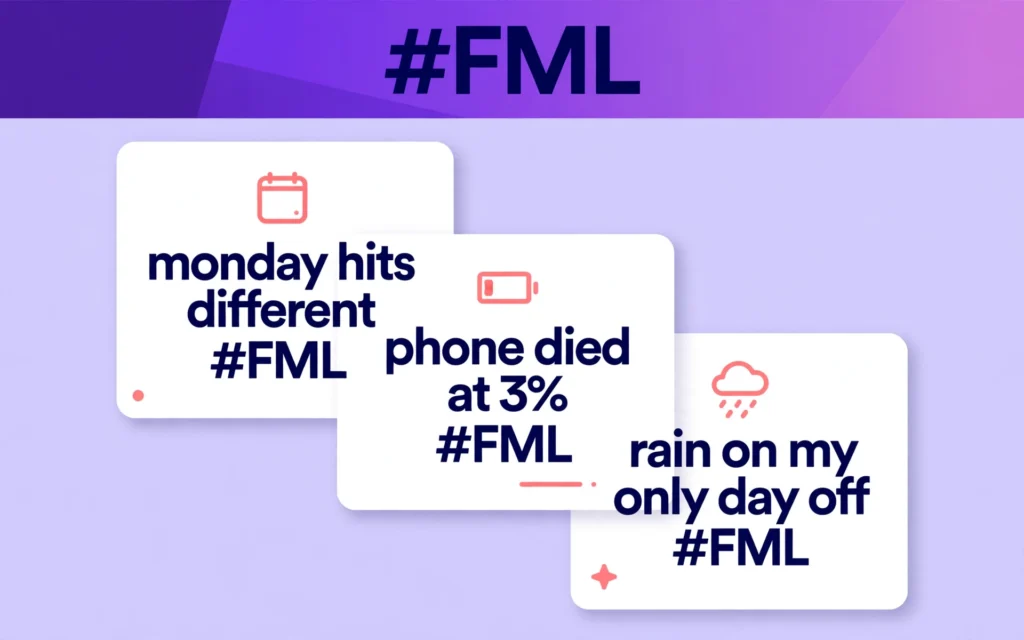
Somewhere along the way, FML stopped being just a reaction and became a format — and the hashtag did it. #FML on Twitter/X, TikTok, and Reddit is now a content genre in its own right: the everyday-struggle post. A cracked phone screen. A date gone wrong. A bank balance after rent. The caption classifies the content: this is a disaster, laugh with me.
The genre works because it’s participatory. An #FML post isn’t really about the disaster; it’s an invitation — your turn, top this. Comment sections become trading floors for bad days, and the currency is commiseration. There’s a specific pleasure in reading someone else’s worse day: it converts your own bad luck from isolating to communal.
The meme ecosystem also explains FML’s durability with younger users who never visited the original site. Reaction slang like OML rides the same currents — short, emotional, caption-ready — and FML slots into TikTok storytimes and comment-section pile-ons as naturally as it once slotted into forum posts. The platforms changed completely; the job didn’t. As long as people need a three-letter container for “you will not believe what just happened to me,” #FML has a home.
Reading and Replying to FML in Real Conversations
The exchanges below are illustrative examples, not real messages.
The playful FML — match the comedy
- Mia: “just dropped my bagel cream-cheese-side down in the parking lot”
- Noah: “fml lol the universe really chose violence today 😂”
Small disaster, laughing energy, banter back. With a playful FML, your job is to be the laugh track.
The serious FML — empathy, not solutions
- Ava: “My car just failed inspection. FML.”
- Ethan: “nooo that’s the worst 😭 want company while you deal with it?”
No laugh, no minimizing, no unsolicited mechanic advice. Serious FML is a vent looking for a witness, not a problem looking for a solver. “Ugh, brutal” beats a fix-it list every time.
The stranded FML — act, don’t just react
- Grace: “phone died at 3% and I’m stuck at the station… fml”
- Owen: “otw 🚗 wya?”
When an FML describes a solvable problem, skip the commentary and help. A quick “wya” (where you at) does more than a paragraph of sympathy. Save the jokes for after the rescue.
The collapsed-plans FML — hand the ball back
- Ella: “concert’s sold out. fml, I waited too long 😭”
- Lucas: “nooo 😭 lmk if you still wanna try the Saturday show?”
When plans fall apart, the natural follow-up to an FML is a gentle relaunch. A soft “lmk” (let me know) passes the next move back without pressure — sympathy first, logistics second.
An Honest Note on the Profanity
No lecture — but one honest paragraph, because the letters earn their weight from somewhere. FML contains a profanity in its full form (“F*** My Life”), and that’s exactly why it hits harder than a clean abbreviation would. The edge is the point: frustration strong enough to reach for the strong stuff, compressed into three letters you can fire off mid-disaster.
That edge is also why FML is casual-only: not at work, clients, emails, or with strangers — anywhere the full phrase would make you flinch said out loud. It sits in the same family as JFC: widely understood, genuinely common in private chats, absolutely not for professional settings. The letters are fine among friends who talk like you do; everywhere else, pick the clean vent and save FML for the group chat.
When Not to Use FML
- At work or with clients. Even the letters carry the full phrase with them. Keep FML out of Slacks, emails, and anything a manager might read.
- In response to genuine tragedy. FML is built for bad luck, not grief — on real loss it reads as trivializing.
- Aimed at a person. “FML” about your own day is venting; dropped into an argument it reads as swearing at someone. Point it at situations, never at people.
- When you need help, not sympathy. FML announces a feeling; it doesn’t ask for anything. If plans genuinely collapsed, vent first — then ask WTD (what to do) next and problem-solve.
- To strangers or in first messages. Abbreviations assume a shared register. With someone new, write the feeling out instead.
FAQs
What does FML stand for?
“F*** My Life” — the internet’s three-letter container for frustration, bad luck, and comic misfortune.
Is FML a swear word?
The full form contains a profanity, so it’s profanity-adjacent even as letters. Most adults recognize it instantly. Keep it in casual company and out of professional or formal settings.
What’s the difference between “fml” and “FML”?
Same letters, different energy. Lowercase “fml” usually reads light and playful, often with a laughing emoji; ALLCAPS “FML” — especially alone or with a period — usually signals real frustration. Read the case, the punctuation, and the company it keeps.
What’s the difference between FML and FYI?
Opposite jobs: FYI informs, FML emotes. “FYI, the café is closed” is logistics; “…fml” is the emotional sequel. (See: FYI.)
Where did FML come from?
The letters circulated in early-2000s forums and chatrooms, but FMyLife.com — launched in 2008 — made them famous. Anonymous users posted short disaster anecdotes, each ending with “FML,” readers voted on the best, and the ritual carried the abbreviation into mainstream texting.
Is FML still used?
Yes — one of the rare early-2000s abbreviations still in active circulation. It moved from forums to texts to social media to TikTok captions without losing its meaning, which is why slang researchers treat it as a genuine survivor rather than a fad.
What should I reply to “FML”?
Match the register. Playful FML (“fml lol 😂”) gets banter and laughing emojis; serious FML (“Got laid off. FML.”) gets empathy and zero jokes. When in doubt, mirror the sender’s energy exactly.
The Short Version
FML is “F*** My Life” — the internet’s oldest running joke about bad luck. Born in forum chatrooms, raised by a 2008 website (FMyLife.com) where strangers competed over whose day was worse, perfected into two tones: playful “fml lol” for comic disasters, serious “FML.” for days that actually hurt. It survived because bad luck is forever and three letters is the perfect container for it. Type it among friends when the day goes sideways; read the register before you reply; retire it around work, strangers, and real grief. Twenty years of bad days, three letters — that’s staying power.
