
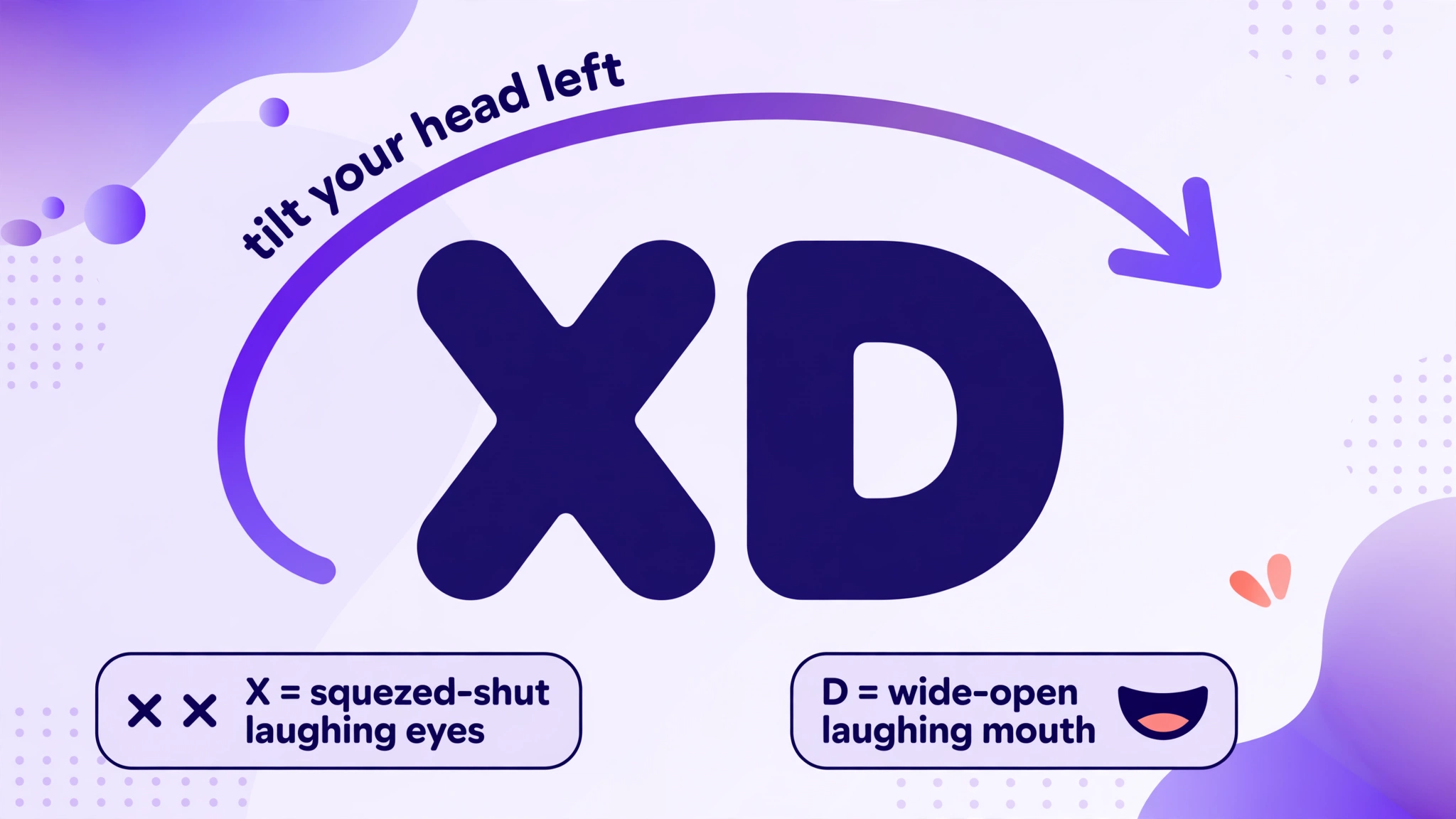
Two letters. Zero ambiguity — once you see the face.
Tilt your head to the left. Now look at XD again. There it is: the X is a pair of eyes squeezed shut from laughing, and the D is a mouth hanging wide open mid-laugh. That is all XD has ever been — a face drawn with two keyboard characters.
If you grew up on AIM or MSN Messenger, you never learned this — you absorbed it. XD was simply how laughter looked online before the emoji keyboard existed. Here’s the full story: the anatomy, the history, why it outlived emoji, the generational tell, and where XD still thrives.
XD Meaning at a Glance
| What it is | A laughing-face emoticon, not an acronym — X = squeezed-shut eyes, D = wide-open mouth |
| Reading trick | Tilt your head left and the two letters become a face |
| Era | Late 1990s–early 2000s: AIM, MSN Messenger, Yahoo! Chat, IRC, forums |
| Tone | Playful, nostalgic, lighthearted — never formal |
| Stronghold today | Gaming chats and Discord |
| Example | “you actually slipped on the ice XD” |
| Case guide | XD = the classic; xd = casual; XD!!! = maximum laughter |
| Formal alternative | None — keep XD out of work email |
Read the Face: XD’s Anatomy Lesson
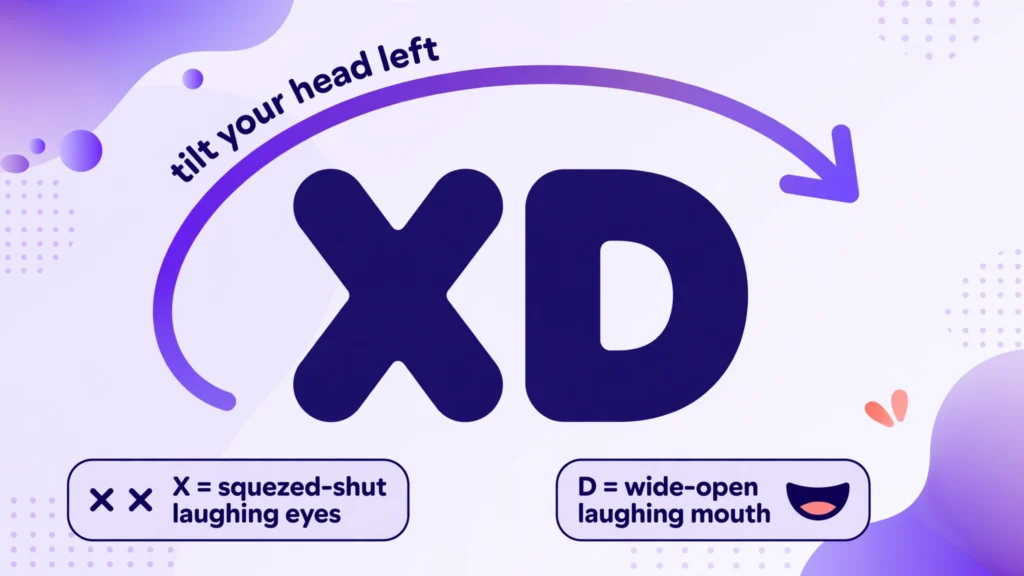
This is the single most satisfying thing the article can teach you, so let’s do it properly.
The X is a pair of eyes squeezed shut. Your eyes narrow to slits when you laugh hard — cartoonists draw it as ><, and XD’s X is the same idea in one character. The D is the mouth: a big, round, open shape, the universal cartoon signal for laughing out loud. Put them together, tilt your head 90 degrees left, and a face stares back at you.
Three things made this two-character face brilliant. It was instant: no emoji picker, no sticker drawer — two keystrokes, working on every device ever made, because every device has an X and a D. It was unambiguous: a lot of old emoticons were Rorschach tests (:-/ — annoyed or confused?), but squeezed eyes plus open mouth equals exactly one thing. It feels handmade: an emoji is a polished picture drawn by a designer; XD looks like you drew it, right now. That handmade quality is a large part of why people stayed loyal — it carries the sender’s hand in a way a rendered glyph never will.
Once you see the face, you can’t unsee it — and a generation of early-2000s teenagers never stopped typing it.
A Short History of the Laughing Face
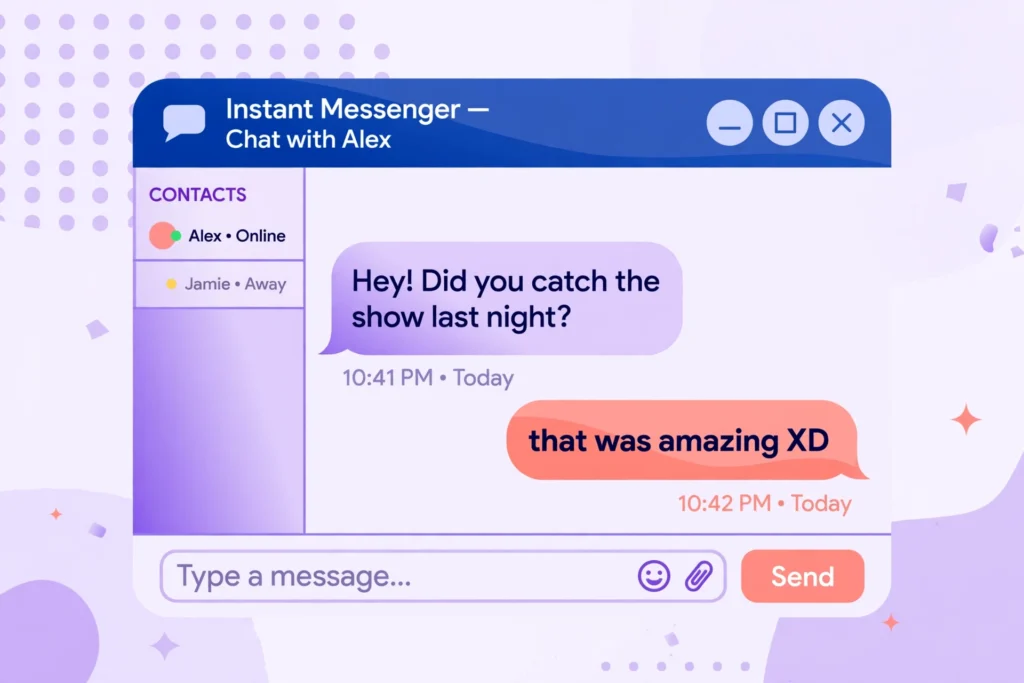
The exchange below is an illustrative example, not a real message.
Before emoji, feelings on the internet were built from keyboard characters — :), ;), :P — assembled by hand in the only medium available. XD was born into that world. Here’s the timeline:
The 1990s: forums and IRC. Text emoticons were a necessity, not a decoration — without tone of voice, faces had to be typed. XD emerged here as the hardest-laughing face in the keyboard’s vocabulary.
Late 1990s–early 2000s: AIM, MSN Messenger, Yahoo! Chat. XD’s golden age. Millions of teenagers signed in after school and laughed in XD — in chats, away messages, and screen names. If you remember the dial-up handshake sound, you remember XD; the two are from the same internet:
- PixelKid92: brb mom needs the phone
- xX_Sarah_Xx: XD ok hurry back
Mid-2000s: MySpace and Facebook. The face went mainstream, migrating from private chats to public walls and comments without losing a step.
The 2010s: the emoji extinction event. Smartphones put a laughing-crying emoji one tap away, and most keyboard emoticons died within a few years. XD was supposed to go with them — and didn’t.
Today: the gaming stronghold. Gaming communities were among XD’s earliest adopters, and they never let go. More on that below.
XD isn’t the only fossil still walking around — FML dates to 2008 and still gets typed daily. But FML survived as a punchline; XD survived as a face — not a joke about your life, but a drawing of your laugh.
Why XD Survived the Emoji Extinction
Most text emoticons died when emoji arrived: emoji did the job better — clearer, prettier, one tap. By that logic XD should be a museum piece. It isn’t, and the reasons are worth naming, because they explain what people actually want from a laugh online.
Nostalgia is a feature. Typing XD is a small act of time travel — every XD carries a trace of MSN Messenger and after-school chats. As one reference puts it, “XD survived because many users enjoy its nostalgic and playful feel.” Nobody feels nostalgic tapping an emoji, but two letters can carry twenty years.
It’s playful in a way emoji can’t be. Emoji are finished products; XD is a sketch, and sketches invite participation. Stretching it — XDDDDD — is something you do, mid-laugh, with your own fingers. You can’t stretch an emoji.
Gamer culture kept it on life support, then made it cool again. Gamers never stopped typing XD because they never had a reason to stop (see below) — and gamer culture drives internet culture, so XD kept getting reintroduced to new audiences.
Meme revivals gave it second and third lives. XD pops up in nostalgic meme cycles, each recruiting fresh typists who weren’t alive for AIM.
FYI: the extinction was real — most keyboard faces from 2004 are museum pieces now. XD’s survival tells you what the laughing-crying emoji doesn’t provide: a sense of the person behind the laugh. An emoji says “laughter happened.” XD says “I’m laughing, right now, with these hands.”
The Generational Tell: XD vs 😂 vs 💀
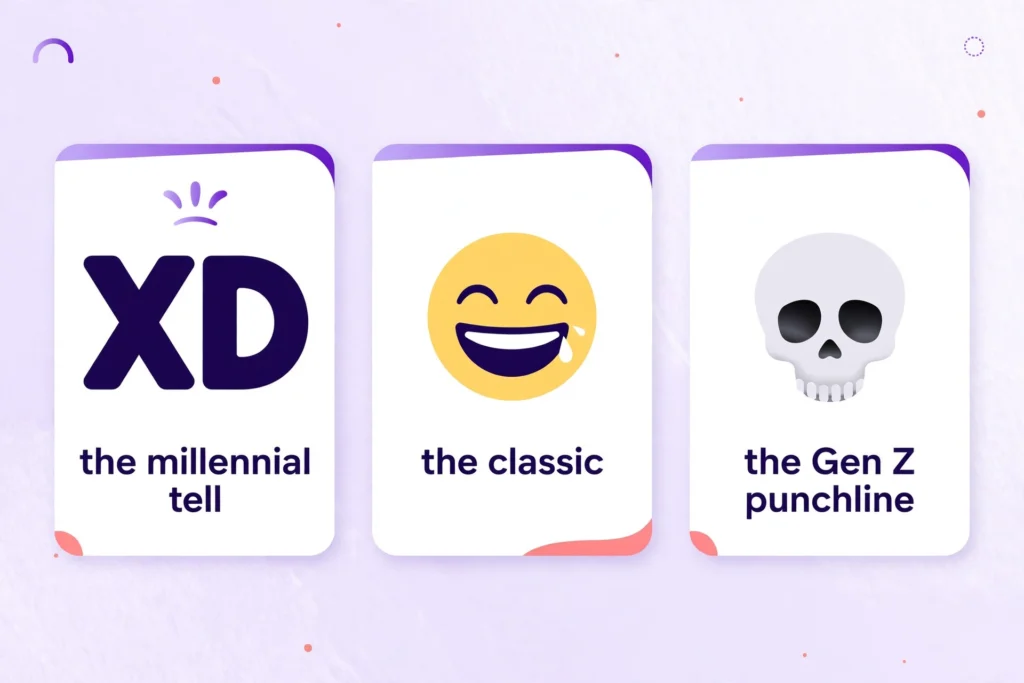
Here’s the article’s most quotable section — with one framing note: this is a tendency, not a law. Plenty of people break the pattern. But it’s real enough that you can roughly age-date a chat by its laugh.
XD — the millennial tell. Unironic XD usually means the typer learned to laugh online before the emoji keyboard existed — the AIM generation’s signature. Like still saying “dial” a phone number: a fossilized habit marking when you arrived.
😂 — the classic. The laughing-crying emoji is the universal default. Every generation uses it, which is exactly why it tells you nothing about anyone — the laugh equivalent of a firm handshake: correct everywhere, distinctive nowhere.
💀 — the Gen Z punchline. “I’m dead.” The skull replaced the laughing face for a generation raised on irony: where XD says “I’m laughing,” 💀 says “this killed me,” and the exaggeration is the point.
The fun is in the mismatches: Gen Z typing XD is usually doing it ironically — wearing the millennial tell like a vintage jacket — while a millennial typing 💀 is code-switching into the younger generation’s laugh.
One more distinction: laughing with something and shaking your head at it are different jobs. If the laugh curdles into disbelief, that’s SMH territory — different face, different feeling.
The Gaming Stronghold
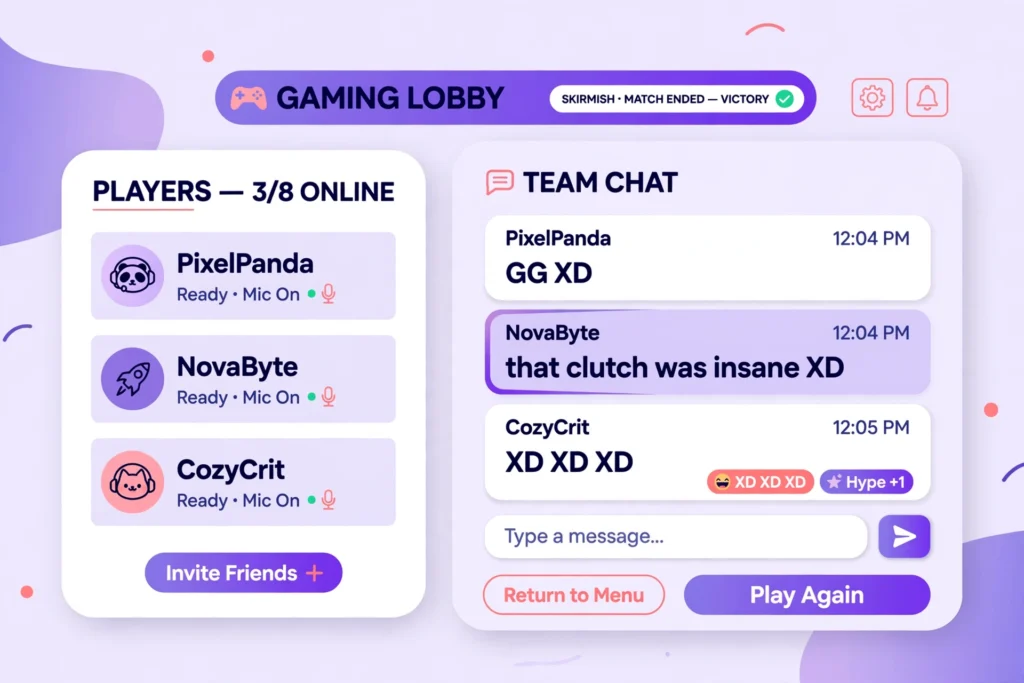
The exchange below is an illustrative example, not a real message.
If XD has a capital city in 2026, it’s a Discord text channel at 11 PM. Gaming communities were among the first to popularize XD, and they’re why it’s still thriving:
Speed is everything. Mid-game, your hands are on the keyboard and your eyes are on the screen. Opening an emoji picker means stopping. Typing XD means two keystrokes without looking — X and D are one row apart, both reachable without moving your left hand. In a medium where half a second matters, XD wins on pure ergonomics.
It’s text-native. Discord, in-game chat, Twitch chat are text-first environments where keyboard culture never died — the native language of a chat box is still characters, and XD speaks it fluently.
It’s the right volume. A lone 😂 in a fast-scrolling game chat can feel oddly formal. XD matches the register: quick, casual, disposable — and when something is really funny, you hold the D key: XDDDDD. Try that with an emoji.
A typical post-match scroll:
- NovaByte: that clutch was insane XD
- PixelPanda: GG XD
- CozyCrit: XD XD XD
Nobody there is being nostalgic — just laughing in the fastest way available, which happens to be a twenty-five-year-old emoticon. Survival by fitness, not sentimentality.
(Coordinating the next match is WTW territory.)
XD vs xd vs XD!!!: A Tiny Tone Guide
The meaning never changes — always the laughing face — but case and punctuation set the volume:
- XD — the classic. Neutral-positive, friendly, the default. Works everywhere casual.
- xd — lowercase, softer, more casual: “lol xd” reads like a chuckle, “lol XD” like a real laugh. Also the stealth option — less visually loud in a serious chat.
- XD!!! — maximum. The exclamation marks do the shouting; reserve for genuine laugh-out-loud moments, since overuse deflates it fast.
- XDDDDD — the stretch. Holding the D is the keyboard equivalent of laughing so hard you can’t stop — common in gaming chats, where the laugh has to match the chaos.
Two classic pairings: “oml XD” is the double-tap — OML for the shock, XD for the laugh. And “gtg XD” is the upbeat sign-off — GTG softened with a grin so the exit doesn’t read as abrupt.
Where You’ll See XD
Gaming chats and Discord — the stronghold. If you play anything with a text channel, you’ve seen XD this week. Group chats with millennials — the AIM generation types XD automatically; spot one and you’ve usually spotted the oldest person in the chat (affectionate). Memes and retro-internet aesthetics — XD cycles through nostalgic meme revivals, each recruiting typists who never used MSN. Spanish-speaking internet culture — one line of color: XD has a notably loyal following there, where meme pages and forums kept it in heavy rotation long after English-language chats moved on. Some fossils migrate; this one found a second home.
Not at work. XD is pure casual — no professional register, no formal variant. Keep it out of emails, Slack channels with your manager, and job applications. The face is laughing; your boss won’t be.
FAQs
What does XD mean in text?
A laughing-face emoticon. Tilt your head left: the X is eyes squeezed shut from laughing, the D is a wide-open mouth. The sender is laughing — hard.
Is XD an acronym?
No — it doesn’t stand for anything, despite sitting next to real acronyms like LOL. XD is a drawing, not an abbreviation.
Is XD still used in 2026?
Yes — most visibly in gaming communities and Discord, where it never died, plus nostalgic meme cycles that keep reintroducing it. Reports of its death have been greatly exaggerated for about fifteen years.
What’s the difference between XD and 😂?
Same job, different flavor. 😂 is the polished universal default; XD is the handmade, nostalgic version — and it carries a generational signal, marking the typer as someone who learned to laugh online in the keyboard era.
What does lowercase “xd” mean vs uppercase “XD”?
Same meaning, different energy: lowercase is a chuckle, uppercase a belly laugh. Some people type it lowercase just to skip the shift key — very much in the XD spirit.
Is XD rude or unprofessional?
Not rude, but unprofessional — no formal context exists where XD belongs. With friends it’s warm; in a work email it’s a category error. Match the face to the room.
One Last Laugh
XD is a fossil from before emoji existed — and fossils tell you what the internet used to feel like. It felt handmade: feelings assembled from keyboard characters, laughter typed at full speed, faces you had to tilt your head to see. Most of those faces are gone. XD survived because it was never just a shortcut — it was a drawing of a laugh, and people don’t throw away drawings that still make them smile.
So next time an XD lands in your chat, tilt your head left: twenty-five years of internet history in two keystrokes. Spot one in the wild this week? LMK — some of us are keeping count.
