
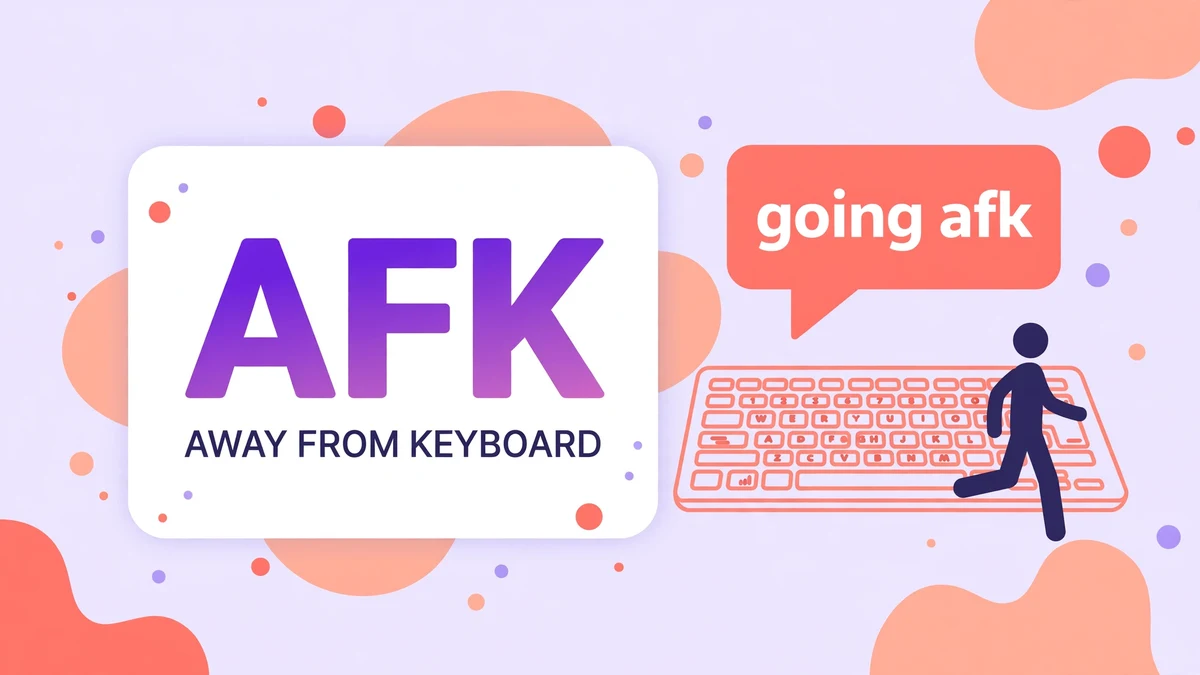
If you’re looking up the afk meaning in text, here’s the two-line version: AFK means “away from keyboard.” But that expansion barely tells you anything, because AFK was never really about a keyboard. It’s a doorway state — a person half in the room, half out, who has promised to come back. Run the Doorway Test in this article and you’ll know in seconds whether someone is AFK, rage-quitting, or just asleep at the desk.
AFK is one of the oldest surviving pieces of internet slang — born in 1990s chat rooms, raised in dungeon raids, and now sitting in your Slack status. Along the way it picked up a split personality: in casual chats it’s one of the politest things you can type, and in competitive games it’s a reportable offense. Both are true. The room decides.
AFK Meaning at a Glance
| Full form | Away From Keyboard |
| Main job | Announcing you’re idle but coming back |
| Where you see it | Game chat, Discord, Slack/Teams, group texts |
| Example | “going afk, doorbell — don’t start without me” |
| The catch | Unannounced in ranked play, it’s not AFK — it’s abandoning the match |
The Doorway Test: Is the Person Standing in the Doorway?
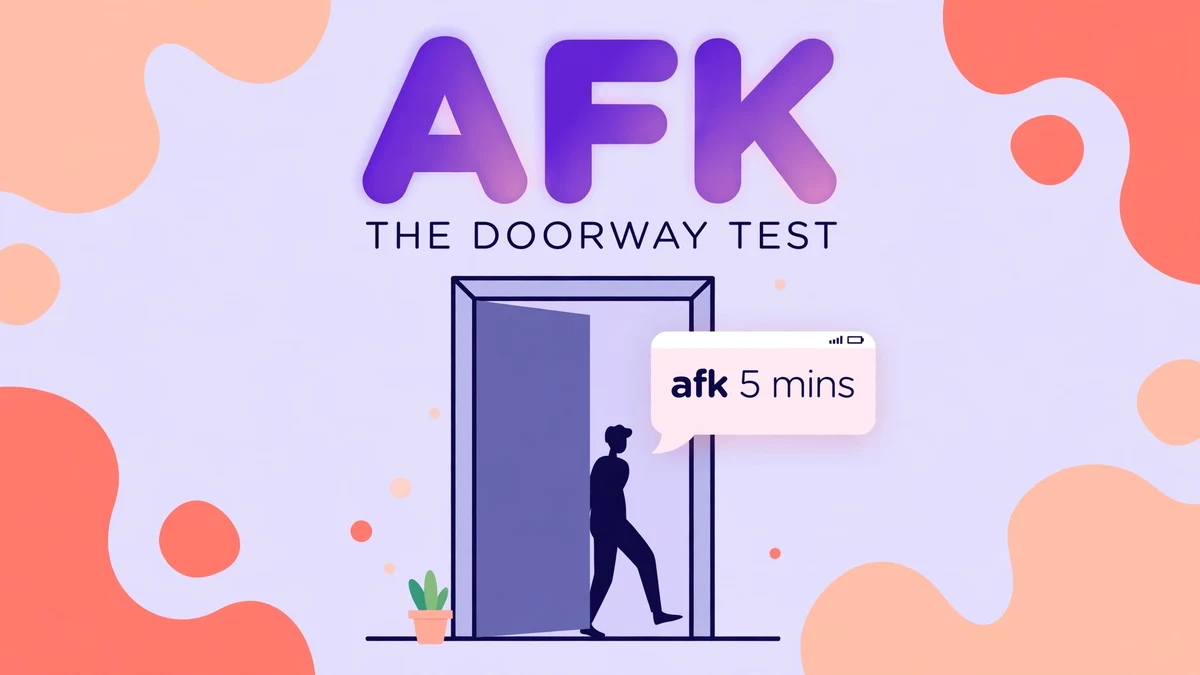
AFK is not a message. It’s a state — the state of standing in a doorway. One foot in the room (still connected, still in the chat), one foot out (not reading, not responding). The Doorway Test is the fastest way to classify any silence you see online:
1. Announced + brief + returning = AFK. “afk 5 mins” is the doorway held open — the person told you, gave you a time, and will walk back in. This is the only true AFK.
2. Vanished without a word in ranked play = rage-quit. No announcement, no timer, character frozen at spawn while the team pings them. That’s not AFK; that’s someone who slammed the door. The distinction matters because games punish it — more on that below.
3. Asleep at the desk = something else. Snoring in a Discord voice channel for two hours isn’t AFK either — that’s idle, unconscious, or just gone. AFK promises a return. Sleeping makes no promises.
Run it before you react: when a teammate goes silent, ask “is this person standing in the doorway, or did they leave the building?” Announced, brief, returning — doorway. Anything else, and the letters don’t apply. (Fair warning, fyi: the game client runs its own version of this test — most games kick an idle player after about 15 minutes, doorway or not.)
Where AFK Was Born: From IRC Rooms to Dungeon Doors
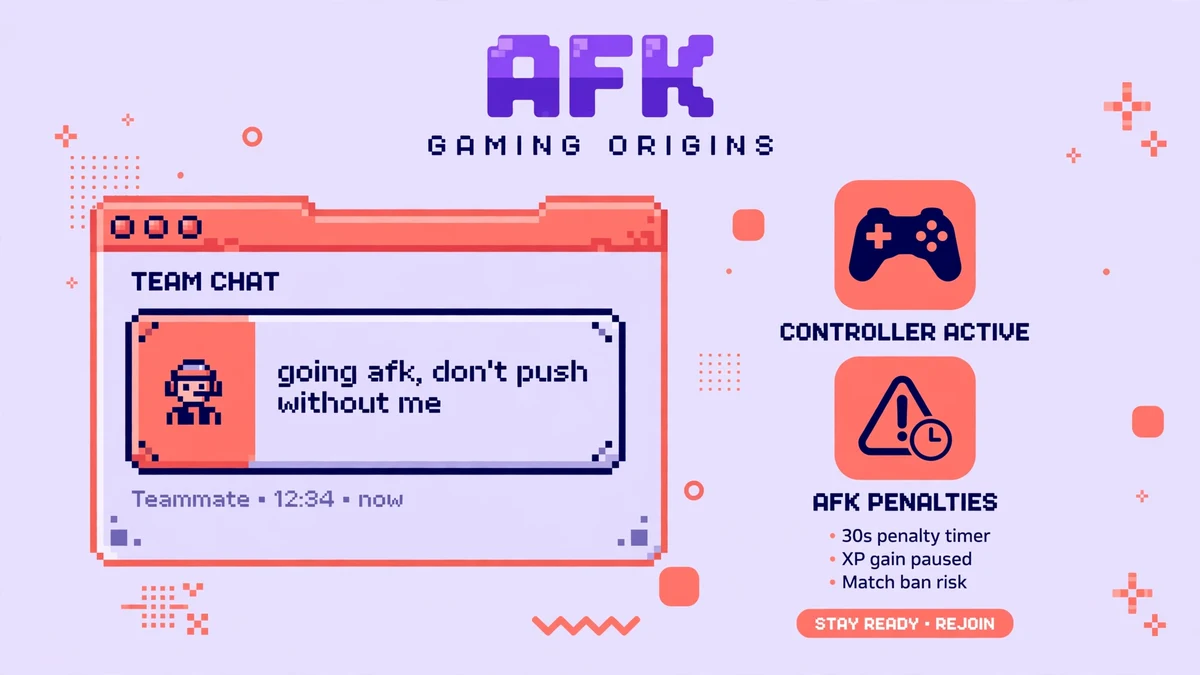
AFK is older than most people who type it. The abbreviation surfaced in the early–mid 1990s on IRC (Internet Relay Chat), where real-time text conversations needed a quick way to say “I’m stepping away” before the thread moved on without you. It was netiquette before it was slang: type “afk,” vanish for two minutes, come back, nobody’s confused.
Then the MMO era adopted it and never gave it back. In games like EverQuest and later World of Warcraft, where five people might be deep in a dungeon together for hours, knowing whether someone was at their keyboard was tactical information — the group literally could not fight without the healer. Community glossaries from that era define AFK flatly as a verb: the player is not actively controlling their character. “I’m gonna go AFK in a few mins” — the dictionary’s own example sentence — shows the verb form that gaming cemented.
Two things about the origin explain the modern usage. First, AFK survived ~30 years almost unchanged — one of the rarest feats in internet slang — because it names a permanent condition of online life: the body and the screen are in different places. Second, console players adopted it too, keyboard or not, which is why “away from keyboard” is now a fossil phrase — nobody believes the keyboard is the point. The point is the doorway.
The AFK Timeline: One Match, Two Silences
Same silence, two rooms. Read this annotated ranked-match log and watch the Doorway Test do its work:
21:04 — Rin: “going afk, doorbell, don’t push without me”
21:04 — Marcus: “got it, we turtle mid”
21:05–21:08 — Rin’s character stands at the fountain, untouched. Teammates hold position.
21:09 — Rin: “bk, sorry, pizza guy”
21:09 — Marcus: “all good, no fight missed”
Silence one was AFK: announced, brief, returning. The team adjusted, nothing broke, no one reported anyone. The announcement converted an absence into teamwork.
21:14 — Owen’s character stops moving mid-lane. No message.
21:14 — Tess: “owen?”
21:15 — Tess: “OWEN ping”
21:17 — Owen’s character auto-walks into the enemy tower and dies.
21:19 — Marcus: “that’s a report, he’s just standing there”
Silence two was not AFK — no announcement, no timer, no return. In the game’s eyes, that’s abandoning the match, and this is where the politeness story ends: in competitive play, the second silence gets you punished. League of Legends’ LeaverBuster system escalates from short queue delays to lockouts lasting a day or more for repeat offenses, with ranked restrictions and even permanent bans for chronic offenders; Valorant strips 6–24 ranked points and escalates to temporary and then permanent bans. Tbh, roughly 9% of players engage in consistent AFK behavior by one developer’s own figures — which is exactly why the systems exist.
The timeline is the whole article in miniature: the announcement is the politeness. Same absence, with and without the words, and the outcomes are opposites.
The Office: Where AFK Got a Calendar Invite
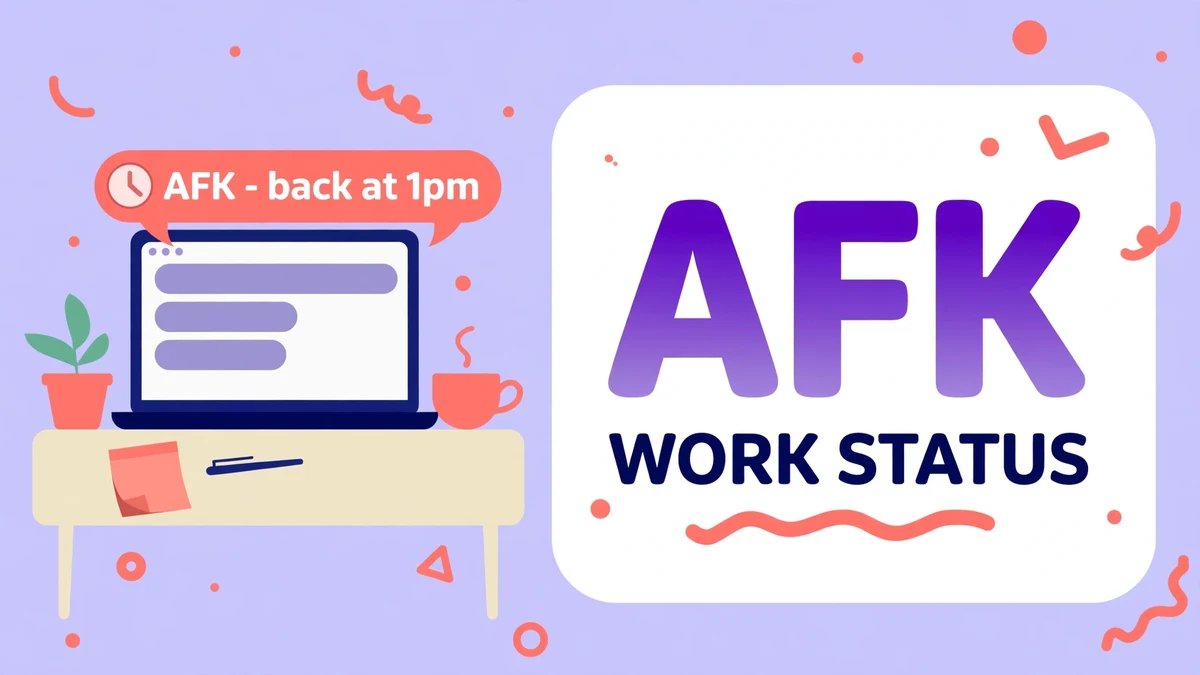
Gaming’s netiquette term grew up and got a job. Slack’s own remote-work guide lists AFK (away from keyboard) as a suggested status message, right alongside OOO and TMB. Discord servers go further: many have a dedicated AFK voice channel, and admins set timers that auto-move anyone idle too long into it — the server itself enforces the doorway.
In work chat, AFK does something it never did in games: it becomes calendar-adjacent. “AFK for lunch, back at 1” isn’t asking permission; it’s broadcasting a return time so nobody’s blocked. The formality line is simple — AFK belongs in the quick chat channel, not the email to the client, and not the report. One colleague’s “AFK” Slack status is transparent; the same letters in a board deck would be bizarre.
The office also shows AFK’s range. A two-minute “afk, grabbing coffee” is the original IRC meaning, intact after thirty years. An “AFK till tomorrow” is a different animal — less doorway, more closed door — and if the absence is long enough, the honest abbreviation changes to gtg or OOO. AFK scales, but it has a ceiling: past it, you’re not away from the keyboard, you’re gone.
The Couch: “afk 5 mins” and the Duration Mechanics
In casual texting, AFK is the low-stakes cousin of its gaming self — “afk 5 mins, mom’s calling,” “sorry was afk, making dinner.” Nobody’s getting reported; the Doorway Test still works, but the stakes are a delayed reply, not a lost match. The older version of this page claimed AFK always means a short break — it doesn’t, and “AFK this weekend, unplugging” is perfectly normal. Short is the default, not the rule.
Watch what the duration qualifier does, because it does the politeness work:
- Bare “afk” — pure state. “I’m in the doorway.” No promise attached.
- “afk 5 mins” / “afk a sec” — state plus contract. This is the most common form in real chats: the number answers the only question the other person has (“when are you back?”).
- “afk for lunch” / “afk this weekend” — the stretched form. The letters scale from seconds to days.
- “going AFK” / “he went afk mid-match” — the verb form, gaming’s grammatical gift to the acronym. “I’m afking for a bit” sounds natural in a lobby and absurd in an email, which is exactly the formality map.
The rule of the couch: the less you qualify, the more trust you’re spending. “afk” to a friend is fine. “afk” with no return time to a team waiting on you is the doorway creaking shut.
The Politeness Mechanics: When AFK Is Courteous and When It’s an Offense
The old version of this page called AFK “a polite way to step away.” That’s half true, and the wrong half is the interesting one. AFK’s politeness is mechanical, not inherent — it works like this:
In casual chats and Discord, AFK is courtesy. Announcing absence costs you three letters and saves everyone else from wondering if they’re being ignored. The announcement is the politeness; the letters are just the envelope. “Sorry, was afk” after a delayed reply is the apology form — it says the silence wasn’t personal.
In work chat, AFK is transparency. A status is a promise to the team; keeping it updated is professional hygiene. Letting “AFK — back at 1” sit there until 4 is worse than no status at all, because the doorway was a lie.
In competitive games, unannounced AFK is one of the rudest things you can do. This is the correction the old page owed its readers: the room where AFK was born is the room where its misuse gets punished. An announced “afk 2 mins” between rounds is fine — teams accommodate it. A silent disappearance mid-match is griefing-adjacent, reported by teammates, and penalized by systems built specifically for it. The politeness lives entirely in the announcement. Typing the letters doesn’t make you polite; the doorway only counts if you hold it open.
AFK vs the Near-Misses
AFK has lookalikes. The Doorway Test separates them:
| Term | Meaning | How it differs from AFK |
|---|---|---|
| brb | Be right back | MMO convention: brb < ~5 min, AFK > ~5 min. Brb is a countdown; AFK is a state. |
| GTG | Got to go | GTG closes the door. AFK holds it open. |
| Offline | Not connected | AFK means still connected but idle — which is why games auto-logout idle players after ~15 minutes. |
| Lurking | Reading without typing | A lurker is at the keyboard, just quiet. AFK means the keyboard is empty. |
| Idle | Auto-flagged inactivity | Idle is what the system says about you; AFK is what you say about yourself. |
| Rage-quit | Leaving in anger, silently | No announcement, no return promised. Fails the Doorway Test at step one. |
The old page’s comparison table had the right instinct but the wrong edges — AFK’s uniqueness isn’t that it’s “temporary” (brb is temporary too); it’s that it’s announced idleness with an implied return.
AFK in Real Conversations
The exchanges below are illustrative examples, not real messages.
The lobby — gaming’s doorway
- Rin: “going afk, don’t push without me”
- Marcus: “turtling mid, take your time”
- Rin: “bk”
Announced, brief, returning. Textbook.
The office — the status version
- Tess (Slack status): “AFK — back at 1”
- Jay (DM, 1:40): “you back?”
- Tess: “yeah sorry, lunch ran long — what’s up”
The stale status is the only sin here; the announcement itself was correct form.
The couch — the apology form
- Noa: “did you see the thing i sent”
- Owen: “sorry was afk, making dinner — just watched it lol”
- Noa: “and??”
- Owen: “we’re going. obviously.”
Delayed, explained, resumed. Nobody needed more than that.
Reading It Right: A Small Reply Guide
Match the room, not the letters.
- Someone announces AFK with a time (“afk 5”): acknowledge and hold — “got it 👍” is the whole reply. The doorway is held; don’t crowd it.
- Someone goes silent mid-game with no word: run the Doorway Test before the report button. One ping, one minute — a doorbell is not a rage-quit. But repeated, patterned silence is what the penalty systems are for.
- “Sorry, was afk” after a delay: accept it at face value. The apology form is doing its job; interrogating it (“afk doing WHAT”) turns courtesy into an argument.
- A stale work status (“AFK — back at 1”, it’s 4): a gentle nudge beats a meeting about it. “Back yet?” — or the classic wyo — is fine.
- Genuinely unsure: one question beats a wrong guess. “afk or out for the night?” — and a “lmk when you’re back” keeps the doorway open without hovering in it.
Ways AFK Goes Wrong
- Going silent in ranked play and calling it AFK later. The announcement has to come before the absence. Retroactive AFK is just quitting with better branding.
- The eternal “afk.” An AFK with no return time in a context that needs one — a raid, a meeting, a waiting friend. The number after the letters is the politeness; don’t skip it where it matters.
- Using AFK where a real sentence belongs. Client emails, formal docs, cover letters — the letters read as slang because they are slang. Write the sentence.
- Assuming “afk” means two minutes. It defaults to short, but “afk this weekend” exists. If the duration matters to you, ask — “back when?” takes three seconds.
- Treating every silence as a crisis. Someone’s “afk 5” is not an emergency. Put the fomo down — the doorway will still be there in five minutes.
Quick Answers
What does AFK mean in text?
AFK means “away from keyboard” — an announced, temporary absence with an implied return. In a text it’s usually casual: “afk 5 mins” means stepping away briefly. The announcement is what makes it AFK rather than just disappearing.
Is AFK only used in gaming?
No, though gaming is its home. It started in 1990s IRC chat rooms, spread through MMO games like EverQuest, and now lives in Discord servers, Slack/Teams statuses, and casual texting. The dictionary definition tags it as video-games and internet slang.
Can you get banned for going AFK?
For announced AFK, no. For vanishing mid-match in competitive games, yes — League of Legends escalates from queue delays to multi-day lockouts and possible permanent bans; Valorant strips ranked points and can ban repeat offenders. The punishment is for the silence, not the letters.
Is AFK polite or rude?
The letters are neutral; the announcement is the politeness. “Going afk, back in 5” in a casual chat or a Discord server is courteous. Disappearing without a word during a ranked match is one of the rudest moves in gaming — and a punishable one.
What does “afk 5” mean?
“AFK for 5 (minutes)” — the duration qualifier is the most common real-world form. The number answers “when are you back?”, which is the only question the other person actually has.
Is AFK formal or informal?
Informal. Fine in chats, game lobbies, Discord, and casual work chat (Slack statuses, even). Wrong in emails, reports, and anything a client reads.
The Short Version
AFK means “away from keyboard,” but the keyboard is a fossil — what AFK really names is the doorway state: announced, brief, returning. Run the Doorway Test on any silence: announced + brief + returning is AFK; a silent vanishing in ranked play is a rage-quit; sleeping at the desk is something else entirely. The announcement is the politeness, the number after the letters is the contract, and in the room where AFK was born, misusing it gets you punished. Hold the doorway open — or don’t call it AFK.
